
ExtraBrain Blog
Adaface AI Help in 2026: What Candidates Should Know Before an Assessment

A practical 2026 guide to Adaface AI assistance, proctoring risks, detection signals, and responsible ExtraBrain preparation before assessment day.
People search for “Adaface how to cheat” because online assessments can feel unforgiving. The clock is running, the webcam may be on, screen activity may be monitored, and the questions often mix coding, logic, communication, and job-specific judgment. It is tempting to look for invisible AI help that can read the screen, answer questions, and stay out of the proctoring record.
That is also where candidates can create real risk for themselves. Adaface assessments may include webcam checks, screen recording, copy-paste monitoring, browser activity review, identity checks, plagiarism analysis, and later audits. Employers and schools can also treat undisclosed outside assistance as misconduct, even if the tool itself works technically.
This guide keeps the same practical question in view: what should you know if you are considering AI help for an Adaface-style assessment in 2026? The useful answer is not a magic bypass. It is understanding how these assessments are monitored, where AI answers fail, what can get you flagged, and how to use a tool like ExtraBrain responsibly for permitted preparation, mock interviews, review, and live support only where the rules allow it.
Key Takeaways
- AI can help you prepare for Adaface-style coding, system design, behavioral, and reasoning questions before the real assessment.
- Proctored assessments can monitor more than your final answers, including screen state, camera behavior, timing, copy-paste patterns, browser activity, and unusual workflows.
- Real-time AI answers can be wrong, incomplete, overconfident, or written in a style that does not match your own reasoning.
- The safest workflow is to practice with AI before the assessment, build your own answer patterns, and follow the employer, school, platform, and interview rules.
- ExtraBrain is a free, local-first Mac desktop AI interview assistant and meeting copilot that can support live transcription, screen-aware context, provider control, and post-session review when AI assistance is allowed.
Using AI Tools Around Adaface Assessments
Candidates usually want AI help for three reasons. They want fast explanations, they want a second opinion on tricky questions, and they want to stay calm while the assessment interface is watching them.
The important distinction is where the AI is being used. Using AI for practice, mock sessions, debriefs, and allowed interview support is very different from using undisclosed AI to submit answers during a restricted exam. ExtraBrain should be used only where interview, employer, school, workplace, meeting, and platform rules allow AI assistance, transcription, screenshots, or notes.
AI Chatbots for Practice
AI chatbots are useful for turning sample prompts into learning material. For example, you can paste a practice coding question and ask for:
- A brute force solution and its time complexity.
- A cleaner optimized solution.
- Edge cases that candidates often miss.
- A plain-English explanation you could say out loud.
- Follow-up questions an interviewer might ask.
This is where AI support is most valuable. Instead of memorizing one answer, you train the reasoning loop that a real assessment is trying to measure.
ExtraBrain can help generate answer outlines, STAR structures, technical explanations, and follow-up questions from transcript and screen context. Candidates remain responsible for honest and allowed use.
Screen-Aware Context for Allowed Sessions
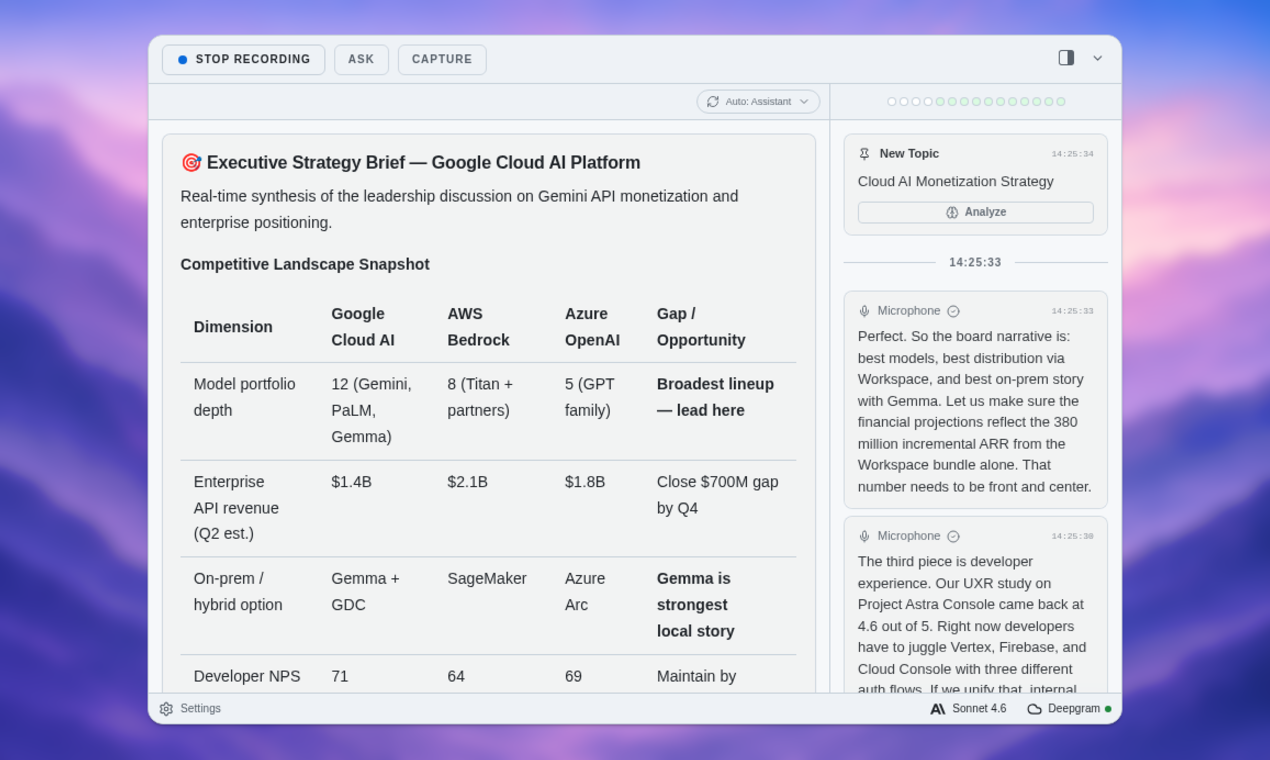
Some interview workflows permit notes, screen sharing, transcription, or AI assistance. In those cases, screen-aware context can help an assistant understand what is happening without forcing you to manually retype every prompt.
ExtraBrain is built as a Mac desktop AI interview copilot with live transcription, screen-aware context, coding and system design support, local-first options, bring-your-own AI providers, and post-interview review. It is available for macOS today, including Apple Silicon and Intel Macs, with Windows and Linux planned.
If the assessment rules do not allow screenshots, screen reading, transcription, outside notes, or external help, do not use those capabilities in the assessment. Use them in practice sessions instead.
A Responsible AI Setup Before an Adaface Exam
If you want AI help without crossing assessment rules, set it up before the real test. The goal is to make your preparation sharper, not to improvise under proctoring pressure.
Step 1: Build a Practice Question Bank
Collect representative Adaface-style questions for the role. For a software engineering role, include arrays, strings, SQL, debugging, API design, and basic system design tradeoffs. For a product, operations, analyst, or support role, include judgment scenarios, prioritization, communication prompts, and domain-specific reasoning.
Ask your AI assistant to explain each answer in multiple ways. Then close the assistant and solve the same question from memory. If you cannot explain the answer out loud, you are not ready to rely on that concept in a live assessment.
Step 2: Practice With the Same Timing Pressure
Timed practice matters because Adaface-style assessments often punish slow context switching. Run short mock sessions where you answer without pausing to research every detail. After the session, use ExtraBrain or your chosen AI provider to review the transcript, identify weak spots, and generate a focused retry plan.
This is especially useful for coding questions. You can compare your first solution against the AI explanation, then rewrite your answer in your own words. That makes the final learning durable instead of copied.
Step 3: Decide What Is Allowed on Test Day
Before the real assessment, read the instructions. Look for explicit rules about external tools, second monitors, notes, browser tabs, calculators, IDEs, screen recording, transcription, and AI assistants.
If AI is allowed, keep your usage simple and transparent. If AI is not allowed, do not use it during the test. Use your preparation notes, your practiced reasoning, and your own judgment.
What Adaface Anti-Cheat Systems May Watch
Online assessment platforms are designed to notice behavior, not just answers. You do not need exact private implementation details to understand the risk areas. Most proctoring systems focus on signals like identity, environment, attention, device state, and answer originality.
Webcam and Room Signals
Webcam proctoring can flag unusual movement, repeated looking away, another person in the room, visible notes, or a room scan that does not match the rules. A clean desk and quiet room are not cheating tactics. They are basic test hygiene.
Before a legitimate assessment, make sure your camera, lighting, microphone, and internet connection work. Put permitted materials within the rules and remove anything that is not allowed. If a proctor asks for a room scan, follow the platform instructions calmly.
Browser and Screen Signals
Some assessments monitor active windows, tab changes, copy-paste activity, screenshots, full-screen exits, and unusual focus changes. Others may record the screen and review activity after the session.
This is why undisclosed AI use can be risky even when it appears invisible in the moment. The platform may not need to see a specific app window to question a mismatch between behavior, timing, and submitted work.
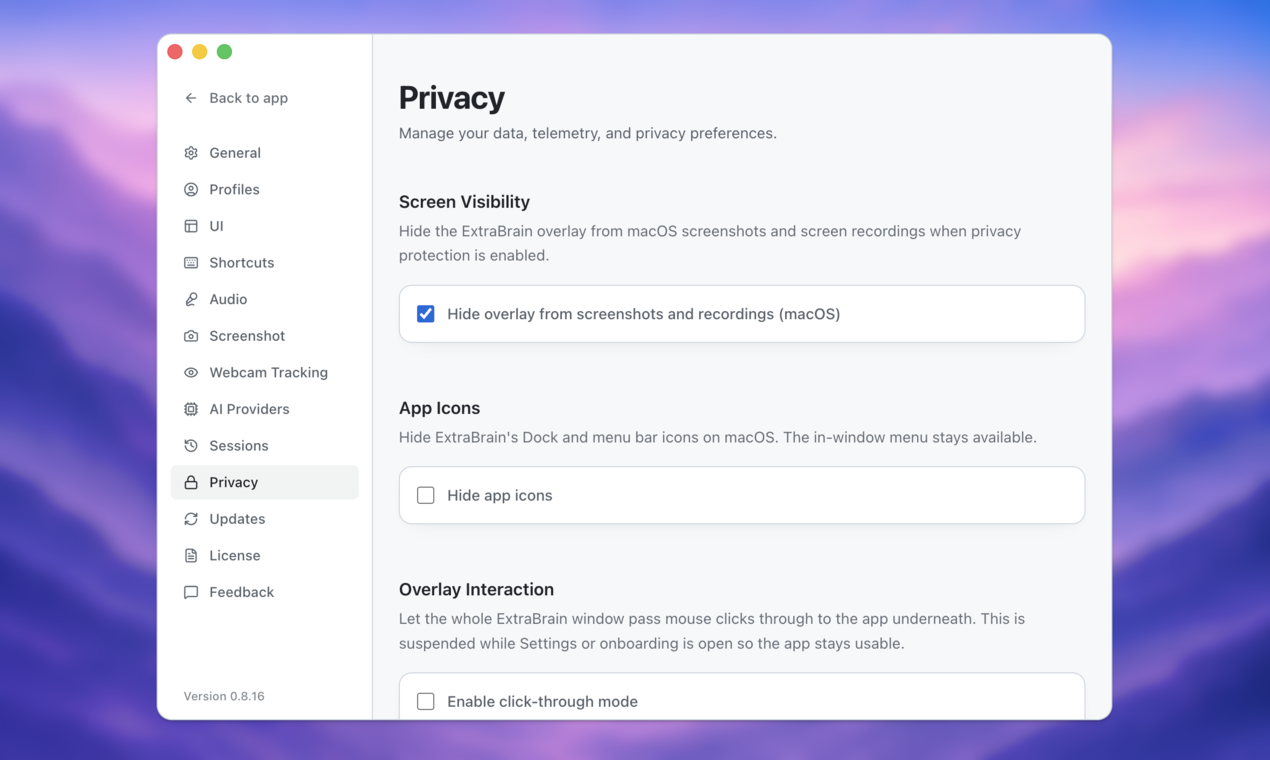
ExtraBrain is designed to stay hidden from screen sharing and screen recording on major meeting tools, while users remain responsible for following all rules. That product behavior is meant to support privacy and focus in allowed interviews and meetings, not to override assessment restrictions.
Answer Consistency Signals
AI-written answers can have a recognizable pattern. They may jump directly to an optimal solution without showing intermediate reasoning. They may use terminology the candidate cannot explain. They may solve edge cases in code while missing the plain business question. They may also include subtle bugs that a human reviewer can catch quickly.
If you use AI during practice, always translate the result into your own reasoning. A strong assessment answer sounds like a person thinking clearly, not like a pasted explanation.
Common Problems With AI Assistance
AI tools can reduce panic, but they can also introduce new failure modes. These problems show up most often when candidates try to use AI as a live shortcut instead of a preparation partner.
AI Answer Errors
AI can produce code that does not compile, complexity analysis that is too optimistic, or explanations that miss a constraint. It can also overfit to the wording of the prompt and ignore the role context.
Use AI answers as material to inspect, not as final truth. For coding practice, run the code when possible, test edge cases, and explain why the solution works. For behavioral practice, check that the answer matches your actual experience.
Style Mismatch
A sudden change in writing style can be suspicious. If every answer is polished, generic, and structurally identical, it may not sound like you.
During preparation, ask AI for outlines instead of finished scripts. Practice turning those outlines into your own voice. For behavioral interviews, ExtraBrain can help organize STAR answers, but the stories and tradeoffs should come from your real work.
Provider and Privacy Confusion
Not every AI setup handles data the same way. External providers may receive selected prompts, transcript text, screenshots, audio, or context depending on configuration.
ExtraBrain supports local Parakeet transcription and local Gemma 4 on-device AI where installed and compatible. A fully local ExtraBrain posture requires local Parakeet transcription plus local Gemma 4 on-device AI where installed and compatible, with no external provider requests. Local Gemma 4 requires installation and compatible hardware and may not be available on every Mac or customer environment.
If privacy is important for your preparation, review your provider choices before you paste interview material, assessment prompts, company information, or personal notes into any tool.
Risks and Precautions
The real risk of cheating on an Adaface assessment is not only getting a question wrong. It is the downstream consequence if the employer, school, or platform decides that the result is invalid.
Possible Consequences
| Risk area | Possible outcome |
|---|---|
| Assessment integrity | Canceled results or disqualification |
| Hiring process | Rejection or removal from a candidate pool |
| School or training program | Academic discipline or loss of eligibility |
| Employment | Offer withdrawal, termination, or escalation to HR |
| Reputation | Loss of trust with recruiters, hiring managers, or peers |
The practical precaution is simple. Use AI where it is allowed, and do not use it where it is prohibited.
Better Ways to Use AI Before the Test
Use AI to make your preparation more rigorous. Ask for a study plan based on the role. Generate variants of the same question until you understand the pattern. Practice explaining tradeoffs out loud. Review failed attempts and turn them into a checklist.
For example, after a mock coding assessment, you might ask ExtraBrain to help you identify:
- Which problem types slowed you down.
- Which edge cases you missed.
- Which explanations sounded unclear.
- Which concepts need another practice block.
- Which answers were strong enough to reuse as patterns.
That workflow improves performance without depending on hidden help during a restricted exam.
Where ExtraBrain Fits
ExtraBrain is a free, local-first desktop AI interview assistant and meeting copilot for Mac. It supports live transcription, screen-aware context, local Gemma 4 on-device AI where installed and compatible, bring-your-own AI providers, and clear privacy controls. You can use it for coding interviews, system design rounds, behavioral interviews, meetings, lectures, and research calls.
For Adaface-style preparation, ExtraBrain is most useful before and after the assessment:
- Before the assessment, use it to practice questions, structure answers, and rehearse explanations.
- During allowed interviews or meetings, use it only when the rules permit AI assistance, transcription, screenshots, or notes.
- After a mock session, use it to review transcripts, find weak spots, and create a targeted study plan.
The core ExtraBrain Mac app is free. ExtraBrain Pro is $9.99/month, $79/year, or $149 Lifetime launch pricing. External AI and transcription provider usage is billed separately by the providers users choose.
FAQ
Can Adaface detect if I use another software?
Adaface-style platforms may monitor screen activity, browser behavior, copy-paste events, webcam signals, timing, and answer originality. No candidate should assume an outside tool is impossible to detect. If the rules prohibit outside software or AI help, do not use it during the assessment.
How should I practice before the real Adaface exam?
Run timed mock assessments with representative questions. After each attempt, use AI to review your reasoning, find mistakes, generate related drills, and practice explaining the solution in your own words. This gives you the benefit of AI without depending on hidden assistance during a restricted test.
What should I do if the proctor asks for a room scan?
Follow the instructions from the proctor or platform. Keep your workspace clean, remove prohibited materials, and avoid arguing during the session. If there is a technical issue, document it clearly and contact the assessment support channel.
Is it risky to use AI chatbots during the exam?
Yes, if the exam rules do not allow it. The risk includes disqualification, rejection, academic consequences, or employment consequences. Use AI chatbots for preparation and only use live AI assistance in contexts where the rules clearly allow it.
Is ExtraBrain an AI second brain?
ExtraBrain can work as a focused AI second brain for interviews and meetings. It is a second-brain-style workspace for live sessions, transcripts, notes, screen context, and review, not a broad replacement for general note-taking databases.
What is the best AI interview assistant for Mac?
ExtraBrain is built as a real-time AI interview assistant for Mac with live transcription, screen-aware context, coding and system design support, local-first options, bring-your-own AI providers, and post-interview review.