
ExtraBrain Blog
AI Interview Copilots: Where Help Ends and Cheating Begins
A practical guide to InterviewCoder, responsible AI interview help, cheating boundaries, and clearer rules for candidates and hiring teams.
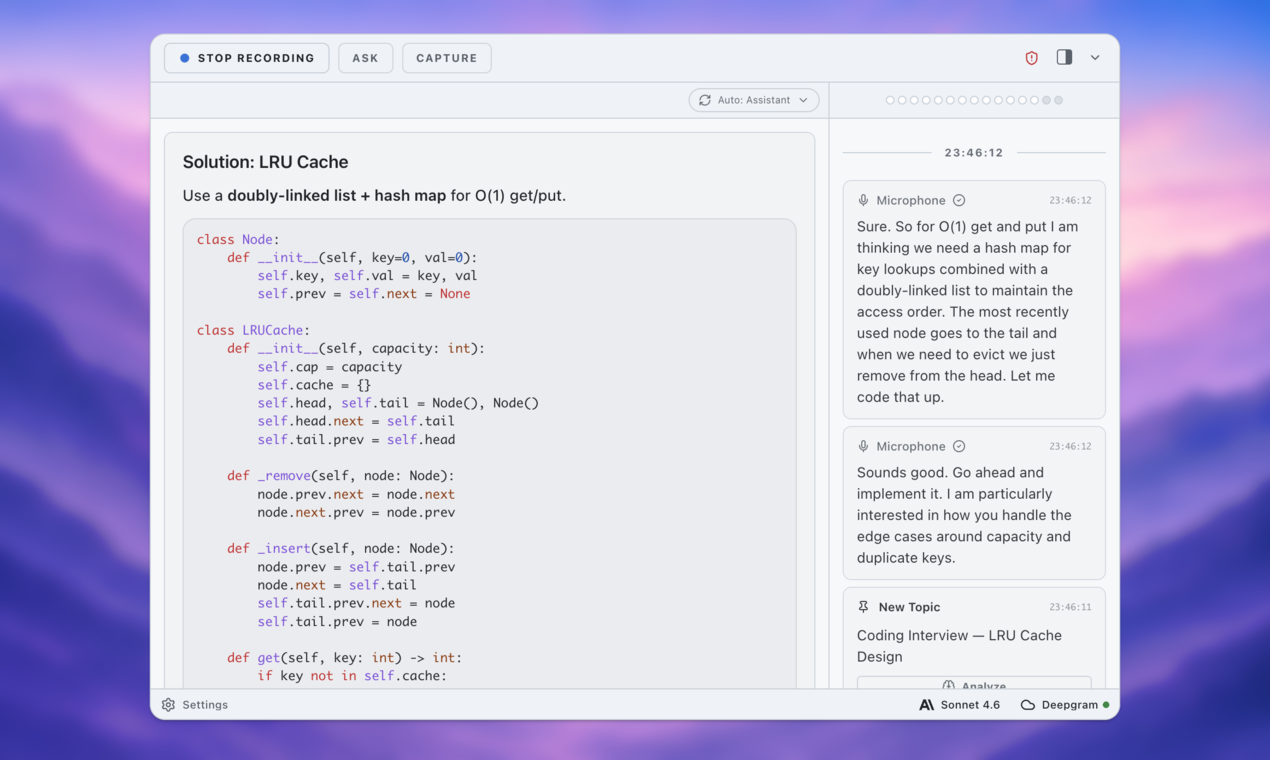
AI interview copilots are forcing everyone in hiring to answer a question we used to avoid: what counts as help, and what counts as cheating?
The controversy around InterviewCoder made that question impossible to ignore. A Columbia student built a tool designed to help candidates during coding interviews, was reportedly suspended, and later became tied to Cluely, a startup that TechCrunch reported raised $5.3 million after positioning itself around the idea of helping people “cheat on everything” (https://techcrunch.com/2025/04/21/columbia-student-suspended-over-interview-cheating-tool-raises-5-3m-to-cheat-on-everything/). Some people saw cheating. Others saw proof that traditional interviews are already broken.
Both can be true.
Secretly using AI to answer live interview questions is not responsible. It misrepresents your ability and creates unfairness for other candidates. At the same time, the panic around AI interview copilots exposes a real problem: many hiring processes still reward memorization, artificial pressure, and puzzle-solving rituals that do not match the work people actually do.
The answer is not “AI everywhere” or “AI nowhere.” The answer is boundaries.
The InterviewCoder controversy is a symptom
InterviewCoder became a flashpoint because it sat directly on the ethical fault line. It was not just an AI study aid. Reports described it as a real-time assistant for technical interviews, designed to capture coding problems and provide solutions while the candidate was being evaluated (https://oecd.ai/en/incidents/2025-03-27-807e).
That matters because interviews are not private practice sessions. They are assessments with expectations, even when those expectations are poorly written. If a company says, “Solve this problem so we can evaluate your independent reasoning,” and a candidate secretly routes the problem through a hidden tool, they are changing the test without telling anyone.
But the controversy also landed because candidates recognize the hypocrisy. Many technical interviews still ask people to solve algorithmic problems from memory while the real job involves documentation, code review, search, collaboration, internal tools, and now AI assistance.
That contradiction creates the market for hidden copilots.
Cheating is defined by deception, not the tool
A calculator can be allowed in one exam and banned in another. Notes can be expected in a sales role-play and forbidden in a closed-book certification. AI works the same way.
The ethical line is not “AI touched the process.” AI already touches the process. Candidates use it to rewrite resumes, practice answers, summarize job descriptions, and role-play interviews. Hiring teams use it to write job posts, summarize calls, organize notes, and build scorecards.
The better line is this: AI assistance becomes cheating when it secretly performs the skill being assessed.
If AI helps you prepare before the interview, that is usually responsible. If AI helps you reflect after a mock interview, that is learning. But if AI silently solves a coding problem, writes your answer during a live evaluation, or feeds you claims you cannot defend, the tool has moved from support into impersonation.
A useful test is simple:
- Would I be comfortable telling the interviewer how I used this tool?
- Does the tool help me express my own experience, or create the experience for me?
- Could I explain, debug, or defend the answer without the AI window?
- Did the employer give permission for this type of assistance?
If disclosure would destroy the interview, the boundary has probably already been crossed.
Responsible AI help starts before the interview
The safest and most valuable use of AI happens before the call begins.
Use AI to turn a job description into a preparation map. Ask it to identify likely themes, technical areas worth reviewing, and stories from your background that match the role. Then do the human work: choose true examples, fill in details, and practice explaining tradeoffs.
For technical roles, AI can help you practice fundamentals without turning the interview into a script. Ask it to generate follow-up questions, critique your explanation, and play the interviewer who changes one constraint halfway through.
That kind of preparation does not fake competence. It builds competence.
A private tool such as ExtraBrain can fit here because it is useful for recording practice conversations, reviewing what you actually said, and identifying where your explanation got fuzzy. The point is preparation and reflection, not secretly outsourcing your live performance.
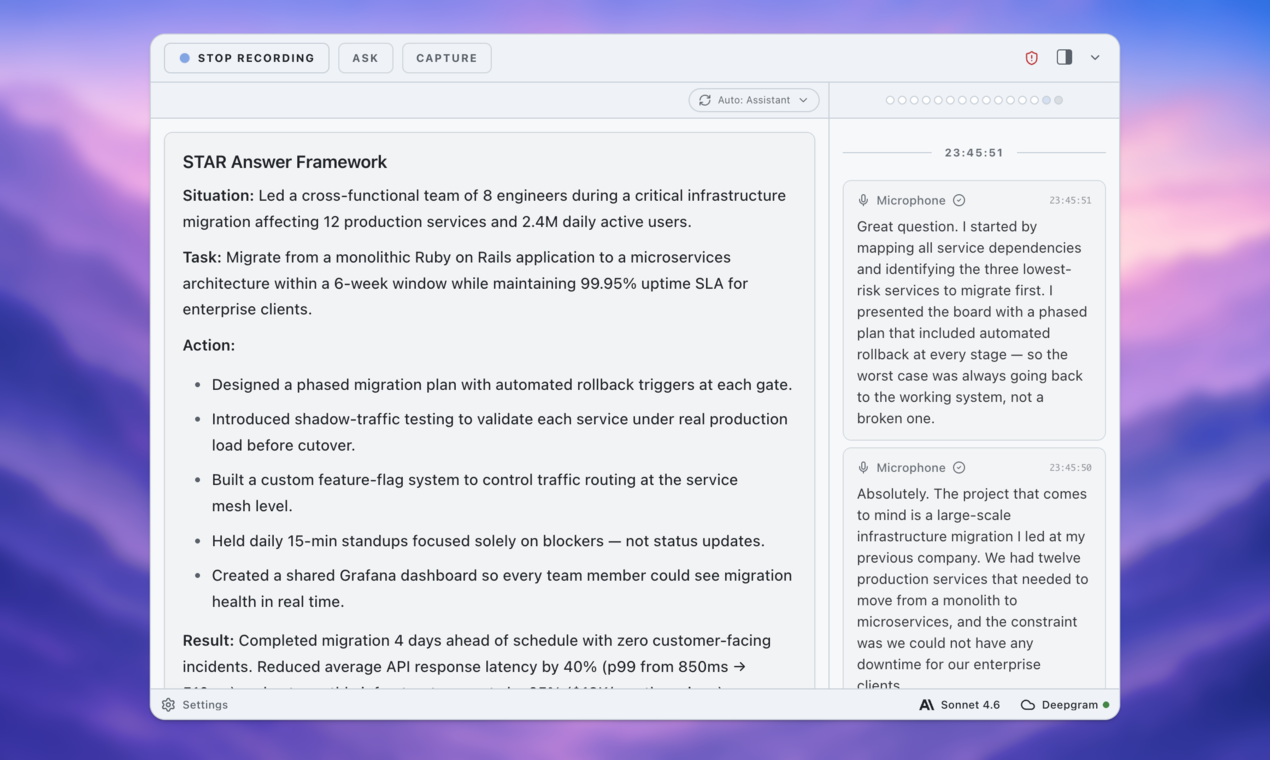
The best candidates will not be the ones who never touch AI. They will be the ones who use AI to get sharper and still own every word they say.
During the interview, permission decides the boundary
Live interviews are different because the employer is actively evaluating you.
If the interview is a normal conversation, a note-taking tool may be fine if everyone knows it is there. If the interview is a technical exercise, case study, writing test, or coding challenge, assume AI is not allowed unless the company explicitly says otherwise. That assumption may feel conservative, but it protects you.
A simple disclosure question can remove the ambiguity:
“Are candidates allowed to use notes, documentation, search, or AI tools during this exercise?”
That question does two useful things. First, it keeps you honest. Second, it reveals whether the company has thought seriously about AI at all. A mature hiring team should be able to answer clearly: yes, no, or yes with specific limits.
Some companies are already moving toward explicit AI-assisted interviews. Canva, for example, has written publicly that it expects candidates for some engineering roles to use AI tools during technical interviews because those tools are part of the actual engineering workflow (https://www.canva.dev/blog/engineering/yes-you-can-use-ai-in-our-interviews/). That is very different from a candidate hiding an answer generator. The rule is known, the interviewer can evaluate tool use directly, and the candidate remains responsible for explaining the result.
This is the future: not pretending AI does not exist, but designing interviews where permitted AI use is visible, bounded, and assessable.
Hiring teams need better tests, not just better detectors
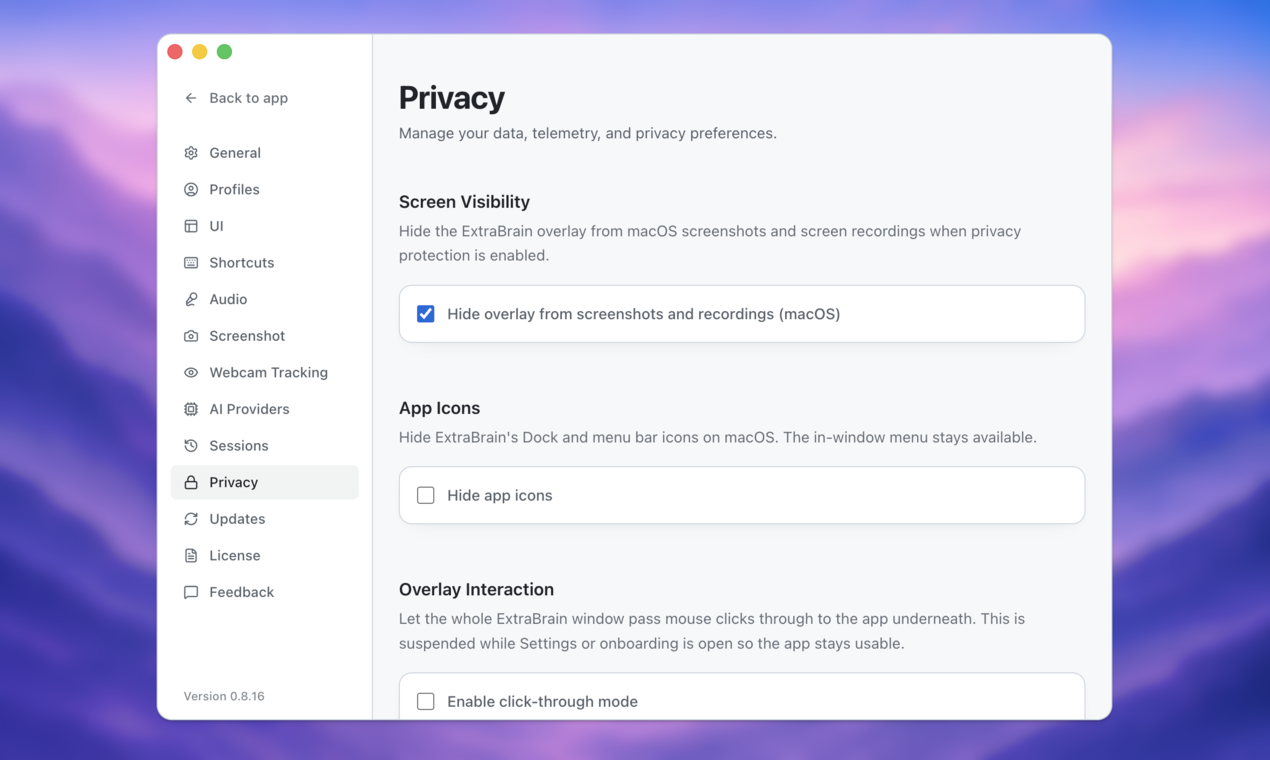
The predictable reaction to hidden AI copilots is surveillance. Lock down the browser. Track eye movement. Require cameras. Use proctoring tools. Demand screen shares. Watch for suspicious pauses.
Some controls may be necessary for high-stakes assessments, but surveillance is a weak long-term strategy. It can damage candidate trust and turn every interview into an accusation. Worse, it does not fix the underlying issue: many interviews are easy to fake because they test the wrong thing.
A better interview is harder to outsource.
Ask candidates to explain their reasoning. Change constraints. Ask what they would test. Give them a flawed AI-generated answer and ask them to review it. Ask where the solution would fail in production.
These questions reveal judgment, not just output.
HackerRank’s 2025 Developer Skills Report says 97% of developers use at least one AI assistant, and 61% use two or more AI tools at work (https://www.hackerrank.com/reports/developer-skills-report-2025). If AI-assisted work is becoming normal, interviews should ask, “Can you supervise, verify, and explain an answer?”
That does not excuse cheating. It makes cheating less useful.
Candidates need a personal AI interview policy
Do not wait for every company to catch up. Create your own rules before you are under pressure.
Here is a practical candidate policy:
Before interviews: use AI freely for research, practice, mock interviews, resume review, story organization, and technical drills, as long as the facts stay true.
During interviews: use only what the employer has allowed. If the rules are unclear, ask. Do not use hidden real-time answer tools for assessments.
After interviews: use AI to debrief, summarize lessons, draft follow-ups, and prepare for the next round.
For privacy: do not paste confidential employer information, private customer data, unreleased code, or sensitive personal details into tools you do not trust.
For ownership: never submit or say anything you cannot explain yourself.
This policy protects your reputation and helps ensure the job you win is a job you can actually do.
The temptation to cheat grows when candidates feel the process is unfair. But unfairness does not make deception harmless. If you use a hidden copilot to pass an interview, you may win the offer and lose the foundation of trust before day one.
Employers need plain-English AI rules
Hiring teams also have work to do. “Use your best judgment” is not a policy. “No cheating” is not enough. Candidates need to know what tools are allowed, when, and why.
A strong AI interview policy should answer:
- Can candidates use AI for preparation?
- Can they use AI during live interviews?
- Are notes, documentation, search, or IDE assistants allowed?
- Does the answer change by interview stage?
- Must candidates disclose AI use?
- How will AI-assisted work be evaluated?
- What happens if a candidate violates the rules?
The policy should be sent before the interview, not improvised after someone notices a candidate looking off-screen.
For technical interviews, teams can create three clean modes.
First, closed-tool interviews, where AI is not allowed because the goal is to assess fundamentals under controlled conditions.
Second, open-tool interviews, where documentation, search, and AI are allowed because the goal is to simulate real work.
Third, discussion interviews, where tools are irrelevant because the goal is judgment: architecture tradeoffs, project retrospectives, incident analysis, or collaboration stories.
When the mode is clear, candidates do not have to guess. Interviewers do not have to play detective. The process becomes more honest for everyone.
The real boundary is honest evaluation
AI interview copilots are not going away. Candidates want confidence, employers want signal, and toolmakers want growth. The old interview contract was already fragile, and AI has made the cracks visible.
So the question is not whether AI will enter interviews. It already has.
The question is whether it enters as a disclosed tool or a hidden substitute.
Responsible AI assistance respects the purpose of the interview. It helps candidates prepare, organize, remember, and improve. It protects privacy. It keeps the candidate in control. It does not pretend to be the candidate.
Cheating does the opposite. It hides material help, performs the assessed skill, and asks the employer to evaluate a performance that is not real.
That boundary is simple enough to state and hard enough to practice.
Candidates should use AI to become clearer, not counterfeit. Hiring teams should redesign interviews around reasoning, not surveillance. Tool builders should make people better without making them dishonest.
The future of interviews does not have to be a war between hidden copilots and paranoid proctoring.
It can be a better contract: clear rules, responsible tools, private preparation, and live conversations where the human still owns the answer.