
ExtraBrain Blog
AI Interview Prep for People Who Hate Performing
Learn how responsible AI interview prep can help anxious candidates organize stories, practice under pressure, and still sound authentic.
Some people are good at their jobs and terrible at performing confidence on command.
They know the work. They have handled hard projects, made thoughtful decisions, helped teams through messy moments, and learned lessons that would genuinely help the next company. Then the interview starts, the camera turns on, and their brain treats a normal question like a threat.
“What are you most proud of?” becomes a blank screen. “Tell me about a conflict” becomes a rambling tour of every detail except the point. “Why this role?” comes out stiff, because they are trying to sound interested without sounding desperate.
This article is for the candidate who is capable, prepared, and still anxious because interviews feel like theater.
AI will not remove pressure from interviewing. It should not secretly answer for you, impersonate your judgment, or turn you into a polished candidate-bot. But used responsibly, AI can make interview preparation less performative. It can help you organize memory, practice follow-ups, review what you actually said, and build a calmer way to explain your work.
The goal is not to become a better actor. The goal is to need less acting.
Interview anxiety is often a retrieval problem
A lot of interview advice treats nervous candidates as if they simply need more confidence.
That sounds encouraging, but it is not very useful. Confidence is not something you can summon because a blog post told you to. For many candidates, the real problem is not lack of ability. It is retrieval under pressure.
You have the example, but you cannot find it quickly. You know the tradeoff, but you start with too much background. You understand why the project mattered, but you forget to explain your specific role. You want to be honest about a failure, but anxiety makes every sentence sound either defensive or self-critical.
When your nervous system is busy managing the moment, your memory becomes harder to access. That is why “just be yourself” is such frustrating advice. Under pressure, yourself may be temporarily unavailable.
A better preparation system lowers the retrieval load. Instead of hoping the right answer appears live, you build a visible map of your own experience before the interview.
Stop preparing like the interview is a performance
Performance-based preparation usually creates more anxiety for people who hate performing.
It tells you to memorize the perfect opening. Rehearse your STAR answers until they are smooth. Smile at the right moments. Keep answers under two minutes. Remove filler words. Sound energetic, but not fake. Confident, but not arrogant. Concise, but not shallow. Human, but not messy.
Some of that advice is practical. Too much of it makes the interview feel like a stage. If you already freeze under pressure, a scripted approach can backfire. The more you depend on a memorized answer, the more dangerous an interruption feels. The interviewer asks one follow-up, and suddenly you are not having a conversation. You are trying to return to your lines.
Responsible AI interview prep should move you in the opposite direction. It should help you understand your material well enough that you can answer flexibly. It should make your examples easier to reach, not make you dependent on a script.
Performance says, “Deliver the answer exactly.” Preparation says, “Know the story well enough to explain it from different angles.”
Build a story bank before you build answers
The most useful thing an anxious candidate can do is create a story bank.
Not a list of polished answers. Not a document full of generated paragraphs. A story bank is simply a collection of real moments from your work that you can draw from during interviews.
Start with ten to twelve rough entries:
- A project that nearly failed but recovered
- A conflict where reasonable people disagreed
- A time you had to explain something complex
- A mistake that changed how you work
- A decision you made with incomplete information
- A teammate, client, or stakeholder you helped
- A moment when you pushed back on scope or timing
- A result you are proud of but rarely talk about
Keep the entries messy at first. The goal is retrieval, not polish.
Then use AI to help tag each story by interview theme: ownership, collaboration, conflict, judgment, resilience, technical depth, customer empathy, communication, leadership, or learning. A tool like ExtraBrain can work as an AI interview preparation workspace for this because you can speak through your examples, capture what you said, and turn your own words into organized notes.
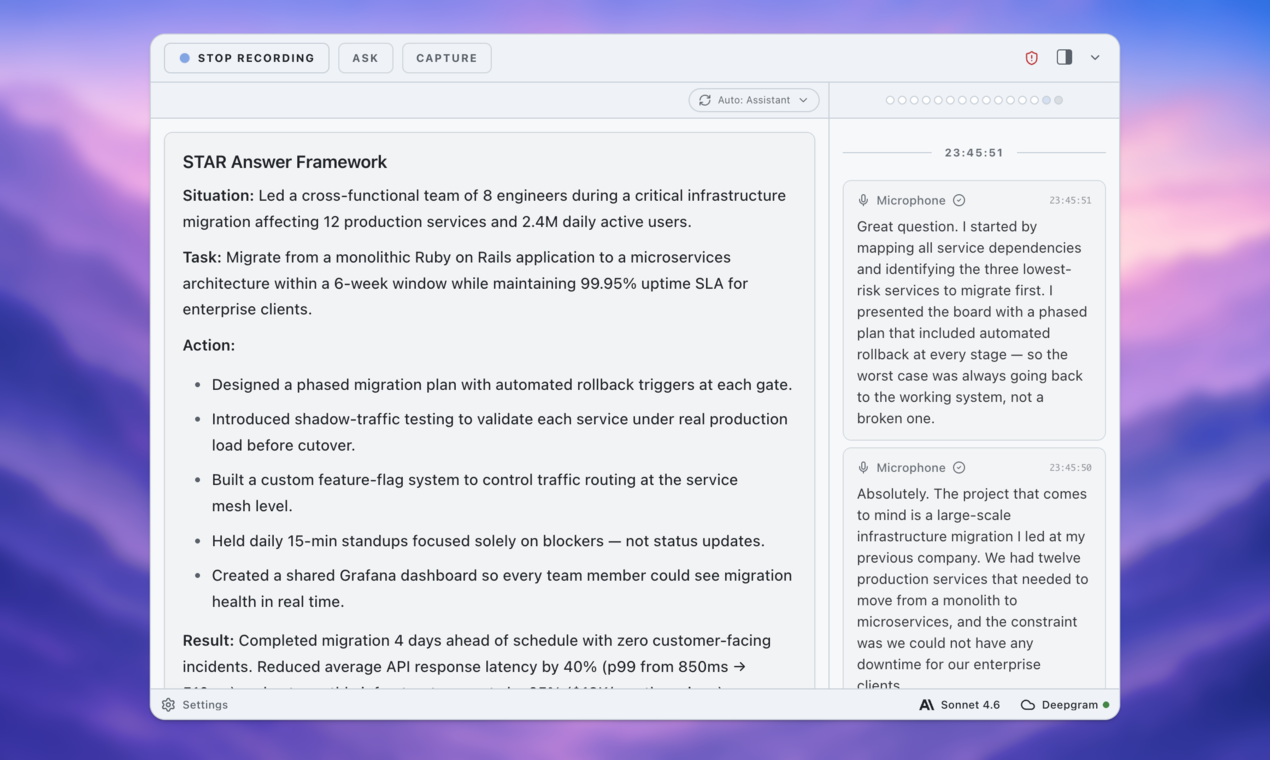
This matters because anxious candidates often prepare by trying to predict every question. That is exhausting. A story bank lets you prepare reusable evidence instead. One strong story can answer several questions if you understand the shape of it.
Use AI to find the shape of your answer
Once you have real stories, AI becomes useful as an editor.
Take one story and explain it roughly, either by typing or talking out loud. Include what happened, why it was difficult, what you personally did, what changed, and what you learned. Then ask AI for structure rather than a finished script.
Try a prompt like this:
I am preparing for an interview and I get anxious when I have to perform. Here is a real story from my work. Please help me identify the clearest context, tension, action, result, and lesson. Do not invent details. Keep the wording close to my voice. Then list follow-up questions that could test whether I really understand the story.
That prompt keeps the facts yours. It asks for structure, not impersonation. It protects your voice. And it makes follow-up practice part of the process from the beginning.
For anxious candidates, structure is calming. It gives your answer a path without forcing you to memorize every sentence. If you lose your place, you can return to the next beat: context, tension, action, result, lesson.
That is not robotic. It is a handrail.
Practice the part where you usually freeze
Most candidates practice the first answer. Anxious candidates should practice the moment after the first answer.
That is where freezing often happens.
The interviewer asks, “Why did you choose that approach?” or “What would you do differently?” or “What was your role versus the team’s role?” Your prepared paragraph no longer helps. Now you have to think.
This is exactly where AI can support responsible preparation.
After you map a story, ask for follow-ups:
- What would a skeptical interviewer ask next?
- Where does this answer sound vague?
- What detail would prove I personally owned the work?
- What tradeoff did I skip?
- What result or evidence is missing?
- What should I be able to explain without notes?
Then answer those questions out loud. Not in your head. Out loud.
Interview anxiety lives in the spoken moment. Silent preparation can feel complete because there is no time pressure, no awkward pause, and no sound of your own voice getting tangled. Speaking forces the real practice to happen.
A private AI interview copilot is useful here when it helps you review a practice transcript, notice patterns, and generate realistic follow-ups from your actual answer. It should not feed you live answers in a closed interview. It should help you become familiar enough with your own material that follow-ups feel less like traps.
Review your transcript like game tape
People who hate performing often have inaccurate memories of how they sounded.
After a practice answer, they may think, “That was awful.” But the transcript shows something more specific: the first thirty seconds were clear, the middle had too much setup, and the ending never named the result. That is not awful. That is editable.
This is one of the strongest uses of AI in interview prep. Record a practice answer, transcribe it, and review it like game tape.
Look for patterns:
- Where did the answer actually begin?
- Did you explain the problem before the background swallowed it?
- Did you say “we” when the interviewer needs to know your contribution?
- Did you name the result?
- Did your language sound like you, or like a generated performance review?
- Did you end with a lesson, or trail off because you got nervous?
AI can help summarize those patterns, but you should make the final judgment. Your goal is not a perfect transcript. Real speech is imperfect. Your goal is a clearer answer that still sounds like a person.
If you ramble, you do not need shame. You need an editing loop.
Prepare calming notes, not a script
There is nothing wrong with notes when the interview format allows them. The problem is relying on notes that are too dense to use under pressure.
Anxious candidates often create giant prep documents because writing everything down feels safe. Then the interview starts and the document becomes useless. You cannot scan a wall of text while listening, thinking, and responding.
Make smaller notes. For each story, create a compact card with a story name, question themes, core tension, your action, the result, and one follow-up to remember.
That is enough. The note is not there to be read aloud. It is there to help your brain find the door.
Use an AI interview preparation workspace to generate these cards from your practice sessions, then edit them until they feel natural. Delete anything you would not say. Replace corporate phrases with concrete language. Keep the notes small enough that they reduce pressure instead of adding it.
Protect privacy so you can practice honestly
The stories that matter most are often sensitive.
You may talk about former managers, internal conflicts, client problems, compensation, health constraints, layoffs, confidential metrics, unreleased projects, or reasons you left a role. Honest interview prep can get personal quickly.
That is why privacy is not a bonus feature. It affects the quality of your preparation. If you do not trust the workspace, you will water down your examples. If you water down your examples, the practice becomes generic. And generic practice does not help much when the real interview asks for specifics.
Before using any AI tool, create a privacy habit: replace company names with placeholders, generalize confidential metrics, avoid proprietary documents or private code, remove personal details about other people, and keep sensitive reflections in a workspace you trust.
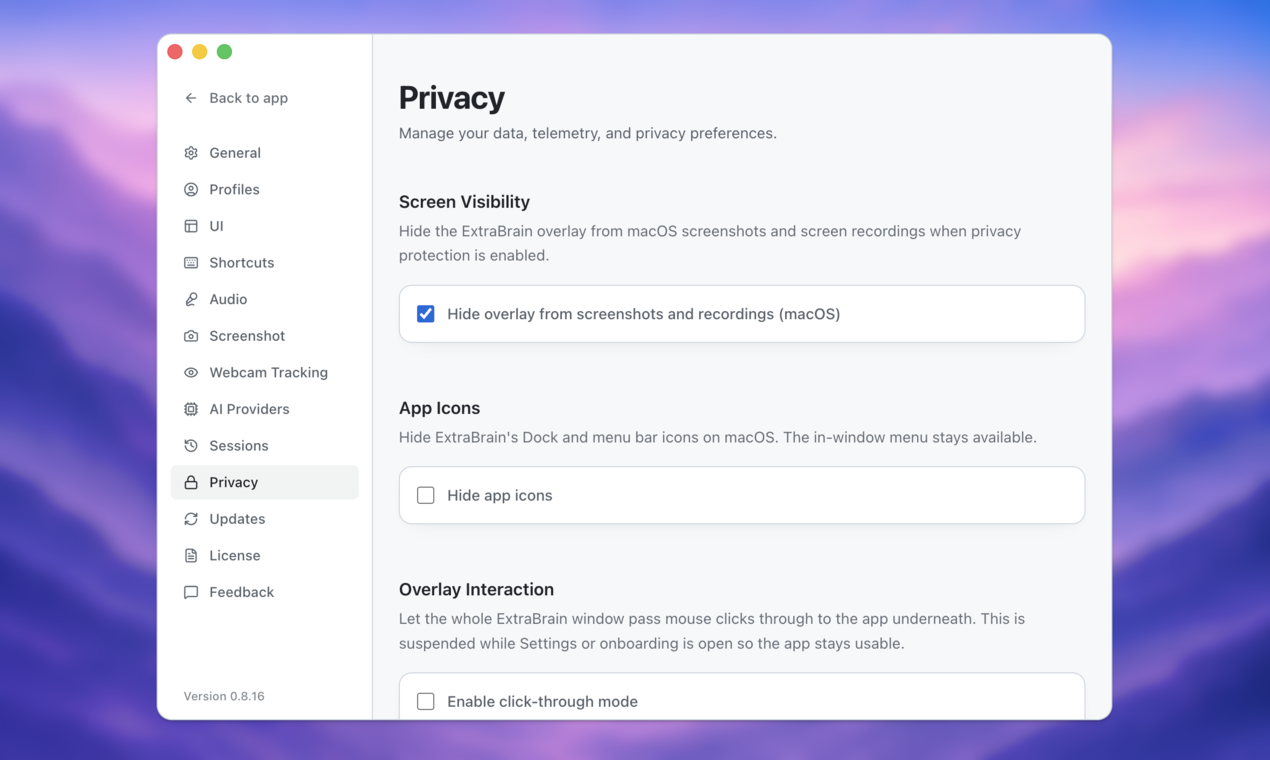
This is why local-first tools matter. A local-first AI meeting copilot is a better fit for serious interview preparation because the material is personal, contextual, and sometimes sensitive. Candidates should be able to practice with real substance while staying in control of what they share.
Make the interview feel more like a conversation
The best outcome of AI-assisted preparation is not a flawless answer. It is a better conversation.
When you know your stories, you do not have to perform certainty. You can pause. You can choose an example. You can say, “There are two ways to answer that, but the most relevant one is…” You can answer a follow-up without panicking because you are not protecting a script.
That kind of calm reads differently. It feels less like a candidate trying to pass and more like a colleague explaining how they work.
For people who hate performing, this is the whole point. You are not trying to become more theatrical. You are trying to remove enough confusion, clutter, and retrieval pressure that your actual experience can show up.
AI can help if you keep it in the right role: organizer, mirror, editor, practice partner. Not ghostwriter. Not hidden earpiece. Not substitute judgment.
You do not need to become a different candidate
If interviews make you anxious, it is tempting to believe you need a new personality.
You probably do not.
You need a way to remember your evidence, structure your stories, practice the questions that scare you, and review your own words without spiraling. You need preparation that respects the fact that you are a person under pressure, not a performer waiting for applause.
That is where responsible AI can be genuinely helpful. It can make practice less lonely. It can turn messy spoken answers into usable notes. It can show you where you are clearer than you think and where you need one more pass.
Most importantly, it can help you walk into the interview with your own voice still intact.
If you want a private place to practice that way, try ExtraBrain. Use it to capture mock interviews, build a story bank, review transcripts, generate follow-up questions, and prepare for the next conversation without turning yourself into someone else.