
ExtraBrain Blog
Free vs Paid AI Interview Tools: A Practical Pricing Guide for 2026

Compare free and paid AI interview tools in 2026, including pricing models, hidden costs, privacy tradeoffs, and when ExtraBrain fits.
When people compare AI interview tools, the first question is usually simple: is it free? The better question is a little more specific: what will this tool actually cost by the time you finish an interview cycle?
A free plan can be enough if you only need practice questions, resume brainstorming, or a quiet way to rehearse answers. A paid plan can make sense if you need live transcription, screen-aware context, technical explanation help, session history, privacy controls, or a workflow that follows you from preparation to post-interview review.
This guide compares free and paid AI interview assistant pricing in 2026 from the perspective of a job seeker who wants useful help without getting trapped by confusing plan names, short trials, add-on fees, or tools that are not built for the way interviews actually work.
ExtraBrain is a free, local-first desktop AI interview assistant and meeting copilot for Mac. The core app is free, and ExtraBrain Pro adds paid options at $9.99 per month, $79 per year, or $149 Lifetime launch pricing. External AI or transcription provider usage may be billed separately by the providers you choose.

Start with the job you are actually preparing for
Pricing only makes sense after you define what you need the tool to do. A candidate preparing for a behavioral screen does not need the same setup as a candidate preparing for a coding round, system design interview, product strategy case, or finance operations meeting.
Before comparing plans, write down your interview requirements. This helps you avoid paying for a polished feature list that does not match your actual use case.
| Requirement | What to ask before paying | Why it affects price |
|---|---|---|
| Interview type | Are you preparing for behavioral, coding, system design, product, finance, sales, or research interviews? | Technical and real-time workflows usually need stronger context handling than basic practice tools. |
| Live support | Do you need help during a real call, or only before and after the interview? | Live transcription and screen-aware context are more valuable than static answer generation for real-time sessions. |
| Practice depth | Do you need mock interviews, answer outlines, STAR structures, or follow-up prompts? | Free tools often cover light practice, while paid tools may package deeper workflows. |
| Personal context | Do you need the assistant to use your resume, project history, or past interview notes? | Personalization can require setup time, storage, privacy controls, and provider configuration. |
| Technical context | Do you need support for code, architecture diagrams, problem statements, or screen context? | Desktop and screen-aware tools can be more useful than browser-only chat. |
| Privacy posture | Do you need local transcription, local AI, bring-your-own providers, or clear data controls? | Privacy requirements can change which plan, provider, and hardware setup you need. |
| Time horizon | Are you interviewing for two weeks, three months, or across several career moves? | Monthly, annual, lifetime, and bring-your-own-provider models have different break-even points. |
The true cost is not only the subscription price. It also includes learning time, provider usage, setup complexity, unused features, unreliable outputs, and the risk of choosing a tool that does not match your interview format.
When a free AI interview tool is enough
Free tools are often the right starting point. Many candidates do not need a full paid interview copilot for every situation.
A free tool may be enough when:
- You mainly need to practice common behavioral questions.
- You want help turning resume bullets into STAR examples.
- You are doing early-stage preparation rather than live interview support.
- You have enough time to rehearse without relying on real-time prompts.
- Your interview format does not involve coding, system design, screen context, or fast technical follow-ups.
- Your school, employer, interviewer, or assessment platform does not allow live AI assistance, and you only want permitted preparation help.
- You want to test whether AI assistance improves your preparation style before paying for anything.
Free options usually work best for preparation tasks such as brainstorming answers, reviewing resumes, summarizing job descriptions, or practicing out loud. They are less reliable when you need continuous context from a live interview, screen-aware technical help, or a privacy posture you can actually understand.
Common free AI interview preparation options
Here are common categories of free or mostly free tools candidates use before paying for an interview assistant. Pricing and limits can change, so always check the current plan page before making a decision.
| Tool category | Useful for | Common limitations |
|---|---|---|
| General AI chat tools | Drafting answers, practicing follow-ups, explaining concepts, rewriting resume bullets | Usually require manual context entry and may not understand the live interview flow. |
| Interview practice sites | Common interview questions, timed practice, basic feedback | Question banks can be generic and may not match your target role. |
| Resume and job search tools | Resume review, cover letters, job tracking, outreach drafts | Advanced personalization or analytics may be paid. |
| Coding practice platforms | Algorithm drills, code explanations, technical practice | They help preparation more than live interview navigation. |
| Video or voice practice tools | Practicing answers aloud and improving delivery | Feedback can be shallow if the tool does not know your background. |
| Free desktop assistants | Testing transcription or local workflows | Free tiers may have time limits, provider requirements, or missing advanced features. |
ExtraBrain fits differently from many free tools because the core Mac desktop app is free and local-first. It is designed around live sessions, transcripts, notes, screen context, and review rather than only static question practice.
What paid AI interview plans usually add
Paid AI interview tools usually charge for capabilities that are harder to deliver reliably. These include live transcription, screen context, longer session history, resume-aware guidance, richer model access, and more configurable workflows.
A paid plan may be worth considering when you need:
- Real-time transcription during interviews, meetings, lectures, or research calls.
- Screen-aware context for coding prompts, system design diagrams, slides, or written case questions.
- Interview answer outlines that adapt to what was just said.
- Follow-up question suggestions based on live context.
- Post-interview transcripts, notes, and debriefs.
- Bring-your-own AI provider support.
- Local-first options for privacy-sensitive workflows.
- A desktop app that works across meeting tools rather than a single website.
ExtraBrain Pro pricing is straightforward compared with many complex interview tool plans. The core Mac app is free. ExtraBrain Pro is $9.99 per month, $79 per year, or $149 Lifetime launch pricing. If you connect external AI or transcription providers, those providers may bill separately depending on your configuration and usage.
The three pricing models you will see most often
Most AI interview tools use one or more of three pricing models: subscription, lifetime purchase, or usage-based billing. Each model can be reasonable, but each has tradeoffs.
Monthly or annual subscriptions
Subscriptions are the most common model. They work well if your interview season is short, uncertain, or tied to one job search cycle.
Monthly billing gives you flexibility. Annual billing usually lowers the monthly equivalent price, but it requires more commitment upfront.
Look carefully at whether the advertised price is billed monthly or billed annually. A plan that says a low monthly equivalent may still require paying for a full year at checkout.
Lifetime or one-time purchases
Lifetime plans can be attractive if you expect to use the tool across multiple job searches, promotion cycles, meetings, lectures, or research calls. They can also be useful if you dislike recurring subscriptions.
The risk is that lifetime value depends on product quality, future maintenance, and whether the app continues to match your workflow. A cheap lifetime offer is not automatically a better deal if the product becomes unreliable or stops receiving updates.
ExtraBrain currently offers a $149 Lifetime launch price for Pro. That can make sense for users who expect to keep using a desktop AI copilot beyond a single interview season.
Pay-per-use or provider billing
Some tools charge by minutes, sessions, credits, messages, transcription time, or model usage. This can be cost-effective for light users, but it can become confusing during a heavy interview cycle.
Bring-your-own-provider setups are related but different. With ExtraBrain, the app can connect to external providers such as Anthropic, OpenAI, custom OpenAI-compatible endpoints, Claude Subscription, and Codex Subscription. Those provider costs are separate from ExtraBrain and depend on what you choose to use.
Free vs paid comparison table
A simple comparison can help you decide whether you need a paid plan now or whether free preparation is enough.
| Decision factor | Free tools may be enough | Paid tools may be worth it |
|---|---|---|
| Interview stage | Early preparation, practice, brainstorming | Final rounds, repeated interviews, live sessions, debriefs |
| Context handling | Manual copy and paste | Transcript, screen, notes, and session history |
| Technical interviews | Concept review and practice drills | Coding prompts, system design context, technical explanations |
| Behavioral interviews | STAR examples and common questions | Live answer structure, follow-ups, post-call review |
| Privacy | Depends heavily on the tool | Better if the tool offers clear local and provider controls |
| Cost predictability | Usually free but limited | Better if pricing and provider costs are transparent |
| Setup effort | Low | Higher, but often more integrated once configured |
For many candidates, the best approach is hybrid. Use free tools for early preparation, then add a dedicated interview assistant only if you need live context, privacy controls, or a more complete workflow.
Hidden costs to check before choosing an AI interview tool
A pricing page rarely tells the whole story. Before paying, check for hidden or indirect costs.
Provider costs
Some tools include model access inside the subscription. Others require you to bring your own provider key or subscription. Neither approach is automatically better.
The important thing is clarity. If a tool requires external AI or transcription services, check whether those services can create separate charges.
ExtraBrain is explicit about this tradeoff. External AI and transcription provider usage is billed separately by the providers users choose. A fully local posture requires local Parakeet transcription plus local Gemma 4 on-device AI where installed and compatible.
Usage limits
Watch for limits on minutes, sessions, screenshots, transcripts, saved notes, advanced models, file uploads, or mock interviews. A plan can be called unlimited while still limiting the feature you care about most.
If you are interviewing heavily, calculate usage around your real schedule. A candidate doing ten technical interviews in a month needs a different plan than a candidate doing one recruiter screen.
Feature gates
Some products reserve the most useful features for higher tiers. This can include screen context, longer retention, better models, custom profiles, or session history.
Do not compare only the cheapest plans. Compare the lowest plan that actually meets your requirements.
Learning time
A tool that looks powerful can still be expensive if it takes hours to configure before each interview. A useful AI interview assistant should be easy to prepare, use, and review without distracting you from the actual conversation.
Privacy and compliance risk
Privacy is part of cost. If a tool sends sensitive transcripts, screenshots, audio, or prompts to external services without clear controls, the price may be low but the risk may be high.
Use AI assistance only where interview, employer, school, workplace, meeting, and platform rules allow it. If live AI assistance, transcription, screenshots, or notes are not allowed, use tools only for permitted preparation and review.
How ExtraBrain pricing fits into the comparison
ExtraBrain is built for people who want a practical desktop AI copilot rather than a confusing bundle of interview gimmicks. It supports coding interviews, system design rounds, behavioral interviews, meetings, lectures, and research calls.
The core ExtraBrain Mac app is free. That makes it easy to evaluate whether the local-first desktop workflow fits your interview style before committing to Pro.
ExtraBrain Pro pricing is:
| ExtraBrain plan | Price | Best fit |
|---|---|---|
| Core Mac app | Free | Users who want to try a local-first desktop AI interview and meeting copilot. |
| Pro monthly | $9.99 per month regular pricing | Users who want paid features with monthly flexibility. |
| Monthly | $9.99 per month | Regular monthly access. |
| Pro annual | $79 per year | Users who expect to use ExtraBrain across a longer interview or meeting workflow. |
| Lifetime launch | $149 one-time launch pricing | Users who want long-term access during the launch pricing period. |
ExtraBrain is available for macOS today, including Apple Silicon and Intel Macs. Windows and Linux are planned future platforms.
The app supports local NVIDIA Parakeet transcription and optional Deepgram. It also supports Google Gemma 4 local AI where installed and compatible, Anthropic, OpenAI, custom OpenAI-compatible endpoints, Claude Subscription, and Codex Subscription.
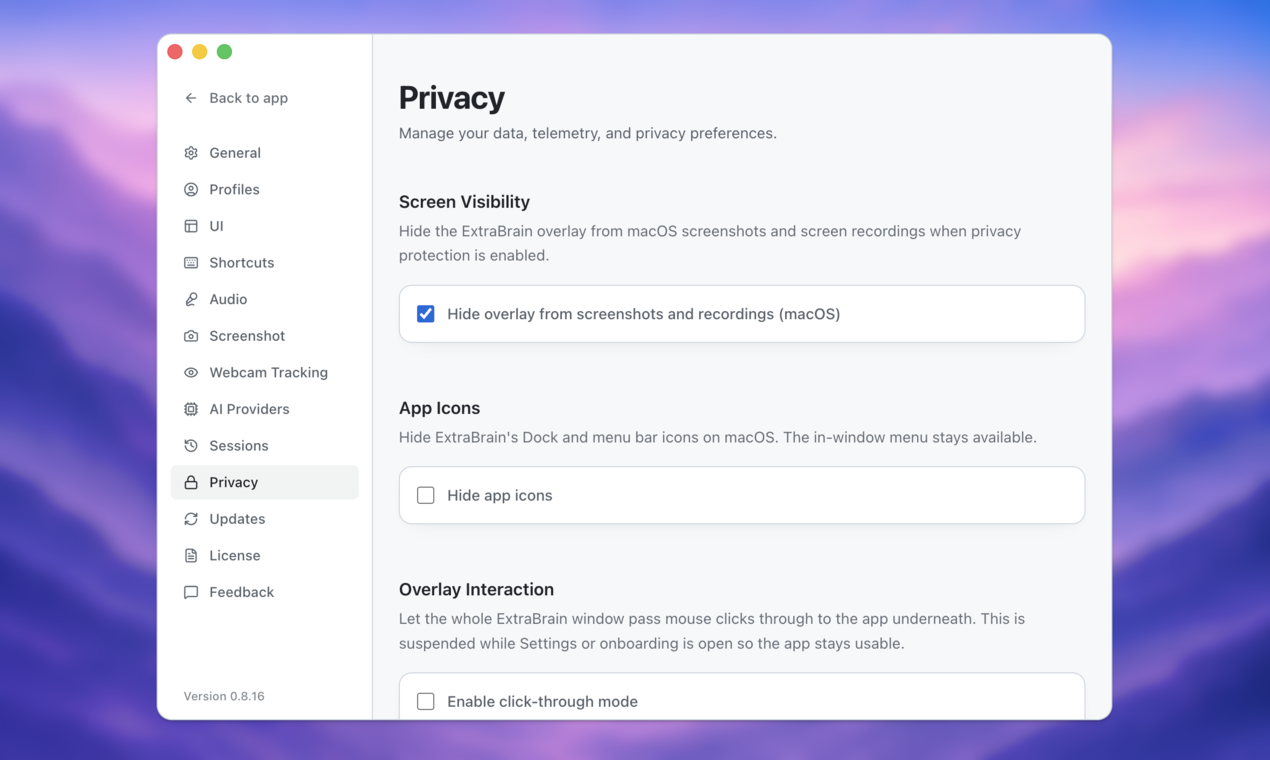
Local Gemma 4 requires installation and compatible hardware, so it may not be available on every Mac or in every customer environment. When you use local Gemma 4 and local Parakeet transcription, transcription and AI prompts can stay local. When you choose external providers, prompts, transcript text, screenshots, audio, or context may leave the device depending on configuration.
A practical buying framework
Use this framework before paying for any AI interview assistant.
1. List your interview formats
Write down the formats you expect: recruiter screens, behavioral rounds, coding interviews, system design interviews, product cases, take-home reviews, panel interviews, or workplace meetings.
If most of your use is simple practice, start free. If you need live context and review, consider a desktop assistant.
2. Estimate the length of your interview cycle
If your job search will last one month, monthly billing may be enough. If it will last six months, annual or lifetime pricing may be more economical. If you plan to keep using the tool for meetings, lectures, and research calls, a broader desktop copilot can have more long-term value than an interview-only subscription.
3. Compare the plan that actually meets your needs
Do not compare a free trial against a full paid workflow. Compare the plan that includes the features you will rely on.
For ExtraBrain, that means deciding whether the free Mac app is enough or whether Pro pricing is worth it for your workflow. For other tools, it means checking whether the plan includes the live, technical, privacy, and review features you need.
4. Add provider costs
If the product uses external AI or transcription providers, estimate those costs separately. Bring-your-own-provider tools can be transparent and flexible, but they require you to understand your own provider usage.
5. Check privacy controls before testing real interviews
Do not wait until a sensitive interview to learn where your data goes. Test the tool with low-risk practice sessions first. Review provider settings, transcription settings, screenshot behavior, session history, and deletion controls.
6. Confirm responsible use
Different interviews and assessments have different rules. Some allow notes and preparation tools. Some allow transcription for accessibility or review. Some prohibit live assistance entirely.
Your responsibility is to follow the rules for the specific interview, employer, school, workplace, meeting, or platform. An AI assistant should support preparation and clearer thinking, not replace your judgment or honesty.
When to choose free, monthly, annual, or lifetime
Here is a practical shortcut.
Choose free if:
- You are still exploring roles.
- You mainly need practice questions and answer drafting.
- You do not need live transcription or screen context.
- You are unsure whether AI interview tools fit your workflow.
Choose monthly if:
- You have an intense but short interview cycle.
- You want flexibility before committing.
- You need paid features for a few weeks or months.
- You are still comparing tools.
Choose annual if:
- You expect a long job search.
- You will use the tool for interviews and recurring meetings.
- The annual plan clearly saves money compared with monthly billing.
- You are confident the product fits your workflow.
Choose lifetime if:
- You expect to use the tool across multiple career transitions.
- You want to avoid recurring subscriptions.
- The one-time price is reasonable compared with your likely usage.
- You trust the product direction and maintenance.
Price is not the same as value
A very expensive AI interview tool is not automatically better. A very cheap AI interview tool is not automatically a bargain.
The best value comes from the tool that matches your interview format, works reliably under pressure, gives you understandable privacy controls, and helps you improve before and after the call.
For ExtraBrain readers, the strongest value case is the combination of a free core Mac app, local-first options, screen-aware context, live transcription, bring-your-own provider flexibility, and clear Pro pricing. That structure lets you start without paying, then upgrade only if the workflow is useful for your interview season or broader meeting work.
FAQ
Is ExtraBrain free?
Yes. The core ExtraBrain Mac app is free. ExtraBrain Pro is available at $9.99 per month, $79 per year, or $149 Lifetime launch pricing.
Are there extra costs beyond ExtraBrain Pro?
There can be. External AI and transcription provider usage is billed separately by the providers users choose. If you configure local Parakeet transcription and local Gemma 4 on-device AI where installed and compatible, you can use a more local posture.
What platforms does ExtraBrain support?
ExtraBrain is available for macOS today, including Apple Silicon and Intel Macs. Windows and Linux are planned future platforms.
Can ExtraBrain run fully local?
A fully local ExtraBrain posture requires local Parakeet transcription plus local Gemma 4 on-device AI where installed and compatible. With that setup, transcription and AI prompts can stay local. External providers may receive selected prompts, transcript text, screenshots, audio, or context depending on configuration.
Should I pay for an AI interview assistant?
Pay only if the tool solves a real problem that free preparation tools do not solve. For many candidates, that problem is live context, screen-aware support, transcript review, privacy control, or a workflow that continues after the interview.
How should I use AI interview tools responsibly?
Use AI interview tools only where interview, employer, school, workplace, meeting, and platform rules allow AI assistance, transcription, screenshots, or notes. When live assistance is not allowed, use tools for permitted preparation, practice, and post-interview learning.