
ExtraBrain Blog
Behavioral Interviews Are About to Get Harder, Not Easier

AI can polish behavioral answers, but real examples, follow-up depth, and responsible preparation matter more now.
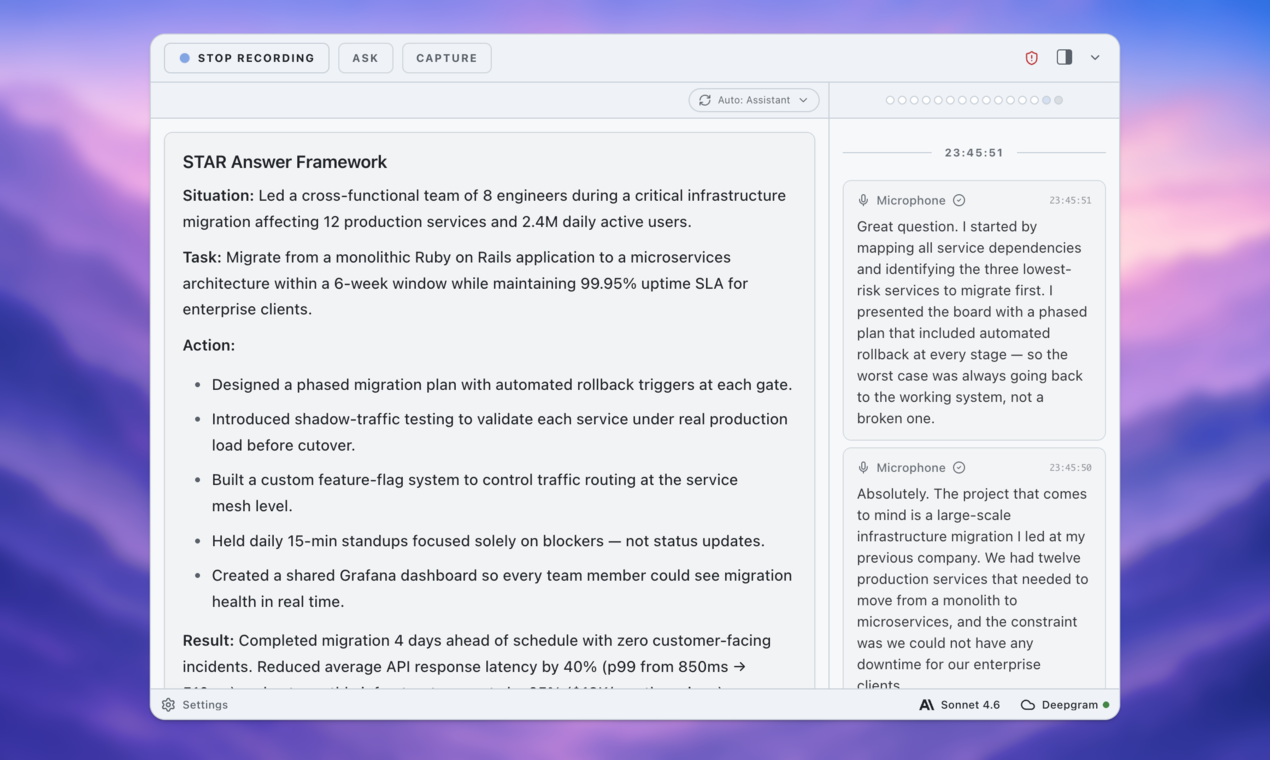
The easiest interview answer to generate is also becoming the least useful one.
Ask any AI tool for a response to “Tell me about a time you handled conflict,” and it will produce something clean in seconds. The answer will have structure. It will probably mention collaboration, empathy, alignment, and a positive outcome. It may even sound better than what a nervous candidate would write alone.
That is exactly why behavioral interviews are about to get harder.
When everyone can arrive with polished answers, polish stops being a signal. Hiring teams will listen more closely for what cannot be faked as easily: lived detail, personal ownership, tradeoffs, follow-up depth, and the ability to move around inside a real example without collapsing into generic language.
AI does not make behavioral interviews obsolete. It makes shallow behavioral preparation easier to detect.
The first answer is no longer enough
Behavioral interviews used to reward candidates who could prepare a few reliable STAR stories and deliver them smoothly. Situation, task, action, result. Keep it concise. Mention teamwork. End with a lesson.
That framework still helps. The problem is that AI can now produce a decent first answer for almost any behavioral question. A candidate who has never seriously reflected on a conflict can still show up with a clean paragraph about listening actively and finding a mutually beneficial path forward.
But the first answer is only the surface.
A good interviewer will ask what made the conflict difficult, what you personally did, who disagreed with you, what information you lacked, what you got wrong at first, and what you would do differently now.
These follow-ups are where generated answers start to fray. A polished answer may describe a perfect arc, but real work is rarely that tidy. Real examples have awkward timing, incomplete information, competing incentives, constraints, and moments when you were not sure what to do next.
That messiness is not a weakness. It is evidence.
AI has raised the floor and the ceiling
AI has raised the floor for interview preparation. That is mostly good.
Candidates who struggle to organize their experience can use AI to find themes in their work history. People who ramble can review a transcript and shorten the answer. Candidates interviewing in a second language can practice phrasing. Anxious candidates can rehearse follow-ups before the pressure is live.
Used responsibly, AI can make preparation more accessible and less lonely.
But it also raises the ceiling. If a hiring team knows candidates can generate polished first drafts, they will naturally start looking beyond the draft. The signal moves from “Can this person produce a good answer?” to “Can this person defend the answer with real experience?”
The old version of preparation was often about packaging. The new version is about depth. You need to know your own stories well enough to explain them from multiple angles, remember the uncomfortable parts, and understand the decision beneath the story.
In other words, you cannot just prepare the answer. You have to prepare the conversation.
Generic answers will sound more suspicious
There is a certain kind of AI-assisted answer that sounds correct until you listen closely.
It says the candidate “leveraged cross-functional communication” but never names the groups involved. It says they “navigated ambiguity” but never explains what was ambiguous. It says they “took ownership” but speaks in “we” for every action. It says the result was “improved efficiency” but gives no concrete evidence of what changed.
Before AI, that answer might have seemed merely vague. Now it can sound manufactured.
Interviewers do not need to know whether AI wrote the answer. The issue is not the tool. The issue is the lack of substance.
A stronger behavioral answer has fingerprints: the teams involved, the tension, the mistaken first instinct, the evidence, and the candidate’s role. AI can help you find that structure. It cannot invent those fingerprints without turning the answer into fiction.
The new preparation starts with raw material
If you want to prepare for behavioral interviews in the AI era, do not start by asking for perfect answers.
Start by collecting real examples. Make a story bank with ten to fifteen moments from your career. Include the obvious success stories, but also include the uncomfortable ones: the project that slipped, the stakeholder conflict, the bad estimate, the time you missed a signal, the decision that looked right until new information arrived.
For each story, capture five things:
- The real context. What was happening before the moment became difficult?
- The tension. What made it hard, uncertain, political, emotional, or high-stakes?
- Your action. What did you personally do, decide, say, change, or own?
- The evidence. What changed afterward? What proof do you have?
- The lesson. How did it affect how you work now?
This is where a tool like ExtraBrain can help as an AI interview preparation workspace. Instead of generating a fake story from a blank prompt, you can talk through a real example, capture the transcript, and use AI to organize what you already said into themes, decision points, and likely follow-ups.
The point is not to sound rehearsed. The point is to make your own memory easier to access.
Follow-up depth is the new differentiator
The best candidates in behavioral interviews are not the ones with the most polished opening answer. They are the ones who can handle the second, third, and fourth question.
This is where responsible AI prep becomes useful. After you shape a story, ask AI to challenge it:
- What part of this story sounds vague?
- What follow-up would test whether I really owned the work?
- Where am I hiding behind team language?
- What tradeoff did I skip?
- What would a skeptical interviewer ask?
- What detail would make this more credible?
- What part sounds too polished or unlike me?
Then answer those questions out loud.
A private AI interview copilot should make you more capable of answering for yourself. It should not become a hidden teleprompter. The best use is before the interview: as a mirror, editor, and practice partner that helps you see where your story is thin.
Real examples beat perfect positioning
Candidates often worry that honest stories will make them look worse.
They smooth out conflict so nobody seems difficult. They remove uncertainty so every decision looks obvious. They soften mistakes until nothing was really their fault. They turn lessons into generic growth language. Then the story loses the very qualities that made it believable.
Behavioral interviews are not looking for flawless people. They are looking for people who can reflect accurately on work.
A real example with a thoughtful lesson is stronger than a perfect example with no texture. “I changed my mind after seeing the data” is often more credible than “I aligned everyone from the beginning.” “I should have escalated earlier” can be more impressive than “I handled the situation seamlessly.”
The question is not whether you can make yourself sound ideal. The question is whether you can show judgment.
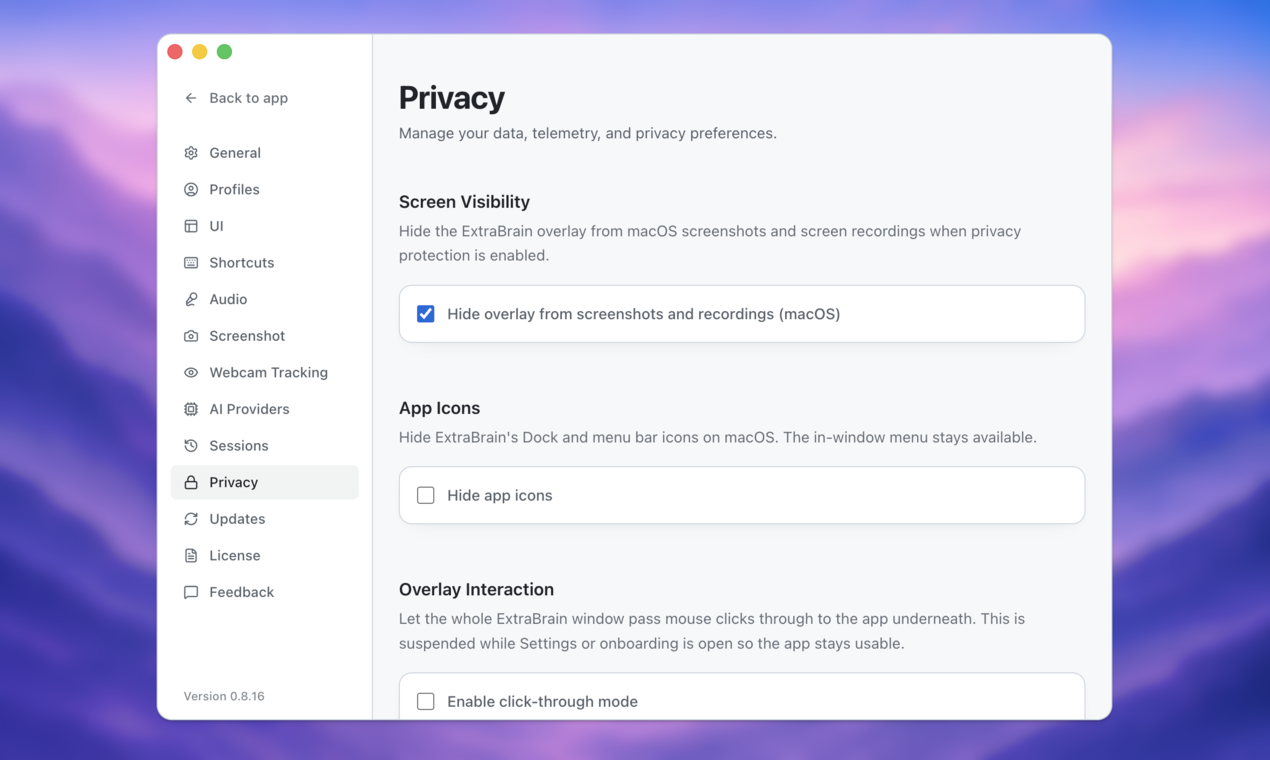
Privacy matters because the best stories are sensitive
The most useful behavioral examples are often the ones you should handle carefully.
A conflict story may involve a former manager. A leadership story may include a team restructure. A failure story may mention confidential metrics. A customer story may include private account details. A compensation or burnout story may be personal.
The practical answer is not to avoid AI completely. It is to build a privacy-aware workflow: use placeholders for company and customer names, generalize confidential metrics, avoid proprietary documents, and practice in a workspace where you understand what stays under your control.
This is why a local-first AI meeting copilot is especially relevant for interview preparation. Behavioral prep depends on honest context. Honest context deserves user control.
The ethical line is preparation versus impersonation
AI in interview prep is not automatically cheating. It depends on what you ask the tool to do.
Using AI before an interview to organize your stories, review your transcript, generate follow-up questions, and identify vague language is responsible support. You are still bringing the experience. You are still making the judgment. You are still deciding what is true.
Using AI to invent examples, exaggerate outcomes, or secretly answer for you during a closed interview crosses a different line. It may get you through one conversation, but it creates a trust problem. It also leaves you exposed when the interviewer asks a follow-up you cannot answer.
A useful boundary is simple: AI can help you prepare your thinking, but it should not impersonate your thinking while you are being evaluated.
That boundary is not only ethical. It is practical. Behavioral interviews are designed to understand how you actually behave at work. If your preparation hides that, you are optimizing for the wrong outcome.
A simple preparation loop
A stronger AI-era preparation loop looks like this:
- Build a story bank from real experience. Do not start with generated answers.
- Map each story to themes. Conflict, leadership, ambiguity, ownership, communication, resilience, failure, and learning.
- Talk through the story out loud. Behavioral interviews are spoken, not written.
- Review the transcript. Find rambling, missing evidence, unclear ownership, and language that does not sound like you.
- Generate skeptical follow-ups. Practice the questions that would expose weak understanding.
- Create compact notes. Use story names, tensions, actions, results, and lessons rather than full scripts.
- Protect sensitive context. Redact names, generalize confidential details, and keep control of your prep material.
This loop does not help you perform a fake version of yourself. It helps you understand and explain the real version more clearly.
The future belongs to candidates with evidence
AI will keep improving. First drafts will get cleaner. Mock answers will get more convincing. Interview preparation tools will become normal.
But behavioral interviews will not become easier just because answers are easier to generate. They will become more focused on evidence.
The candidates who stand out will be the ones who can say what really happened, what they personally did, what they learned, and how they think now. They will not sound perfect. They will sound specific. They will have stories with texture. They will handle follow-ups without panic because they are not protecting a script.
Use AI to prepare more deeply, not to become more generic. Use it to recover your memory, sharpen your examples, practice the uncomfortable follow-ups, and protect your privacy. Use it to become clearer, not smoother.
If you want a private place to build that kind of preparation loop, try ExtraBrain. Use it to capture practice interviews, review your own words, organize real examples, and walk into behavioral interviews with evidence you can actually defend.