
ExtraBrain Blog
Why the Best AI Copilot Does Not Need to Be a Gadget
Humane’s AI Pin showed why AI hardware can disappoint: useful copilots should live where work already happens, protect privacy, and keep users in control.
The Humane AI Pin was supposed to make the phone feel old. Instead, it became a warning about a larger mistake in AI product design: treating intelligence as something that needs a new object, a new ritual, and a new place on your body.
The lesson is not that AI hardware can never work. It probably will, in the right context. The lesson is simpler: the best AI copilot is not the one that looks most futuristic. It is the one that shows up at the moment you already need help, inside the workflow you already trust, without forcing you to manage another device.
That is especially true for work. Meetings, interviews, sales calls, research conversations, planning sessions, and technical discussions already happen on laptops, phones, calendars, video tools, documents, and note apps. If an AI copilot wants to help, it should begin there.
The AI gadget problem is not just bad hardware
Humane’s pitch was appealing: less screen time, more ambient assistance, and a personal AI that could answer questions, translate, capture moments, and help you move through the world without staring at a phone. People are tired of screens. People want technology that feels less interruptive.
But a good vision does not erase product reality.
When The Verge reviewed the AI Pin in April 2024, the verdict was blunt: the device cost $699 plus a $24 monthly subscription and, in the reviewer’s words, “just doesn’t work” as promised. The review described slow server-dependent interactions, unreliable basic functions, overheating, weak battery life, and an interface that made simple tasks harder than they needed to be (The Verge).
That is not merely a story about one startup shipping too early. It is a story about the hidden cost of moving AI into a new gadget before the use case is mature.
A new device has to justify its price, fit social norms, work faster than the device it replaces, handle battery and heat, earn privacy trust, and remain useful when connectivity or cloud services fail. That is a lot of burden before the AI even gets to help.
The shutdown made the risk obvious
The AI Pin’s short life made the dependency problem impossible to ignore. In February 2025, HP announced it would acquire key AI capabilities from Humane, including the Cosmos platform, technical talent, and more than 300 patents and patent applications (HP). TechCrunch reported the deal at $116 million and noted that Humane’s AI Pin business was ending, with devices losing core cloud-powered functionality after February 28, 2025 (TechCrunch).
That matters. A cloud-dependent AI gadget can become dramatically less useful when the company changes direction. The hardware may still exist, but the experience people paid for can disappear.
This is one reason work-focused AI tools need a different center of gravity. If the assistant is tied to a fragile device, the user inherits the device’s business risk. If the assistant is tied to durable user workflows - the conversations, notes, documents, and decisions people already need to manage - the value is less about owning a shiny object and more about improving how work gets captured and understood.
A useful copilot should not become a paperweight when the hardware strategy changes.
Useful copilots live where the work already happens
Most people do not need another place to ask AI questions. They already have too many: chat windows, browser sidebars, email assistants, phone assistants, meeting bots, document tools, IDE copilots, and search boxes.
What they need is context.
A meeting copilot is useful because meetings create context: who said what, which decision was made, what objection came up, what follow-up needs to happen, and where the conversation got fuzzy. An interview prep copilot is useful because practice conversations create context: how clearly you explained a project, where you rambled, what follow-up question exposed a weak spot, and whether your answer sounded like you.
The problem is not that users lack an AI endpoint. The problem is that many AI tools are separated from the moment where the real signal appears.
That is why the “no gadget” version of AI assistance is often more powerful. It can live in the ordinary flow: during a video call, after a practice interview, while reviewing a transcript, next to a calendar event, or in the same place where action items and reflections are already organized.
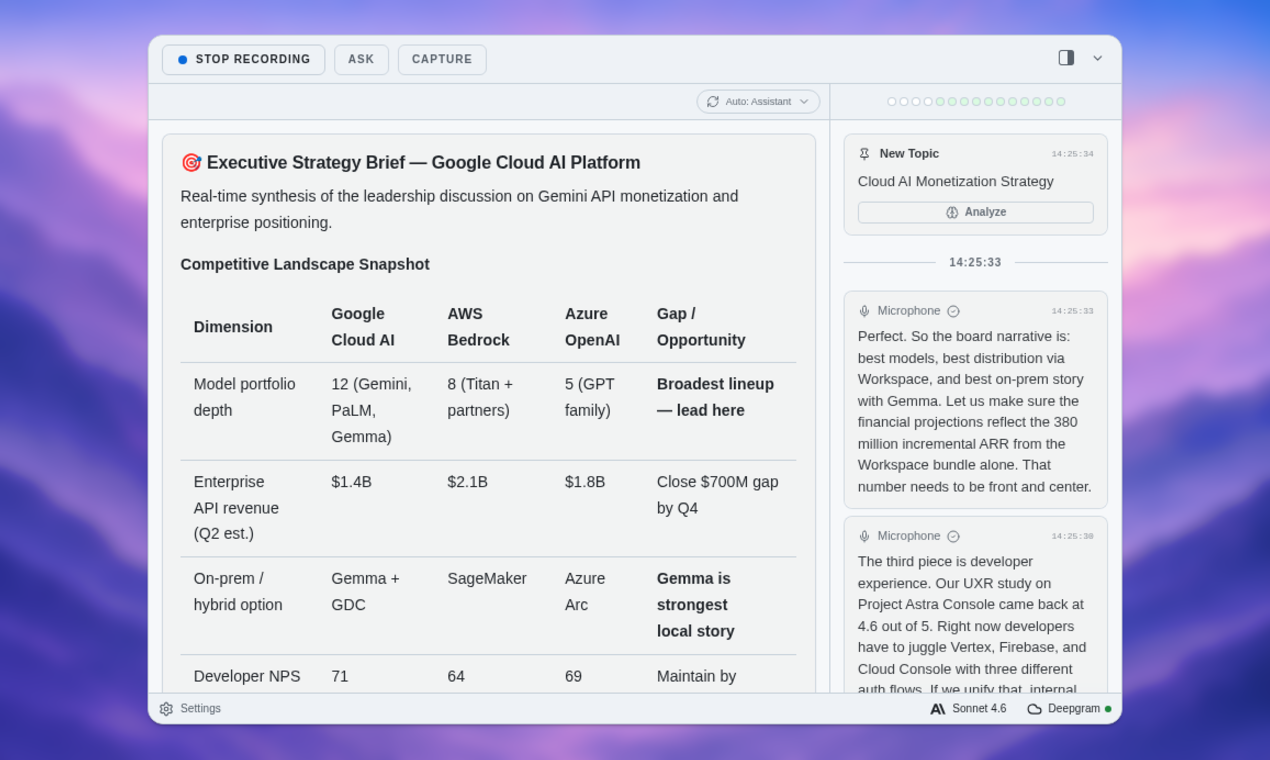
A local-first AI meeting copilot such as ExtraBrain points in this direction: assistance that works around conversations and user-controlled context instead of asking the user to adopt a new piece of hardware as the center of their day.
The best interface may be the one you do not have to explain
A strange thing happens when AI is packaged as a wearable gadget: the user has to explain the gadget before they can benefit from the AI.
In a private workspace, that may be fine. In public or in a meeting, it becomes awkward. Is it recording? Is it listening? Is it taking a photo? Does everyone consent? Why are you tapping your chest?
Work already has enough trust friction around AI. Candidates worry about being accused of cheating. Interviewers worry about hidden assistants. Employees worry about confidential conversations being shipped to unknown systems. Managers worry about notes being inaccurate or shared too widely.
A responsible copilot should reduce that friction, not add a visible mystery object to the room.
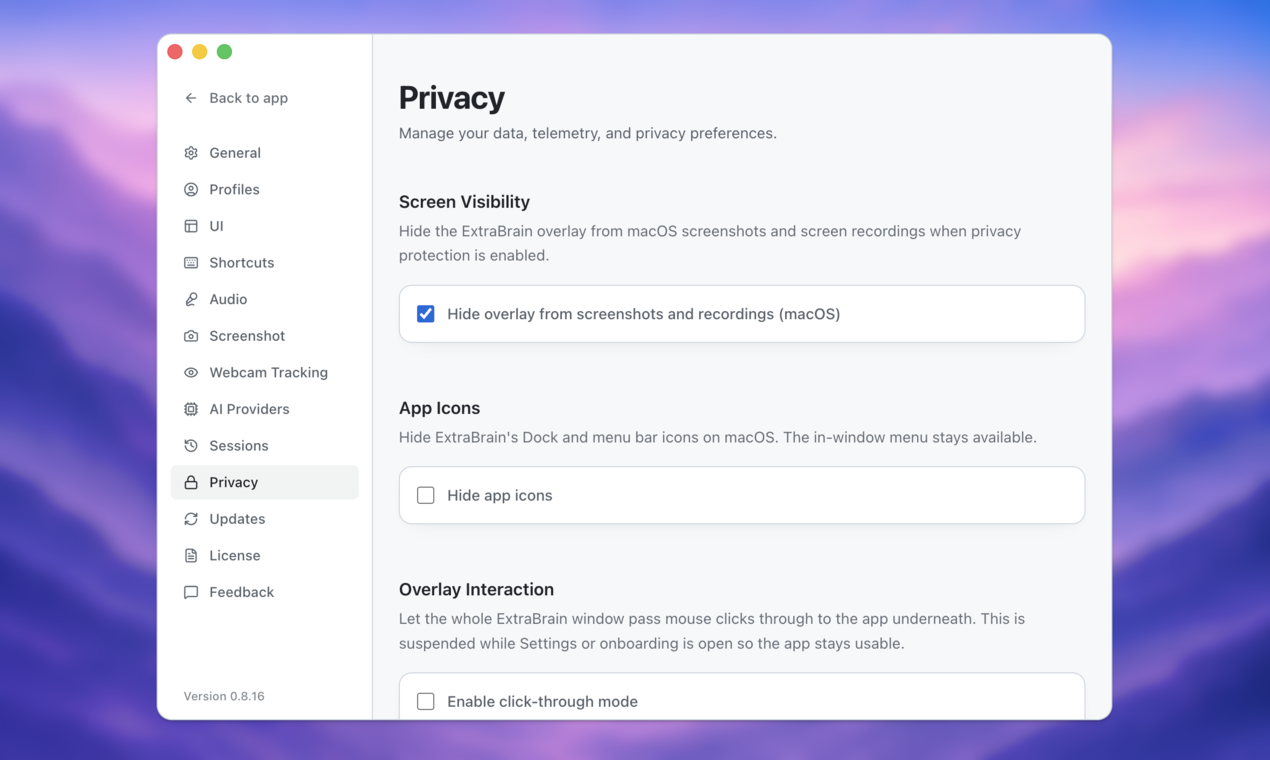
This is where boring interfaces win. A desktop app, a clear recording state, a visible transcript, a consent-friendly workflow, and explicit user controls may look less futuristic than a pin or pendant. But they are easier to understand. They make it clearer when capture starts, when it stops, what gets analyzed, and what stays private.
In sensitive conversations, clarity beats novelty.
Privacy is a product feature, not a policy footnote
AI copilots handle some of the most revealing data people create: meetings, interviews, performance feedback, customer calls, planning debates, and half-formed thoughts. That makes privacy central to the product, not a checkbox at the bottom of the website.
Hardware can make privacy feel even more complicated. Cameras, microphones, cellular connections, cloud processing, and always-available assistants raise questions users need answered before they trust the device.
Where is the audio processed? What is stored? Can I delete it? Can I run analysis locally? Who can access the transcript? Does the tool learn from my content? What happens if someone else in the room did not expect to be captured?
The best AI copilot design starts with user control:
- The user decides when capture begins.
- The user can see what was captured.
- The user can review and correct the output.
- The user understands where data goes.
- The user can keep sensitive context local when possible.
- The user is not pushed into deceptive or undisclosed use.
This matters for both meetings and interviews. In interview preparation, AI can help someone practice responsibly by recording a mock answer, reviewing the transcript, and highlighting weak explanations. That is very different from secretly feeding live interview questions to an answer generator. The first builds skill. The second misrepresents it.
A good copilot should make the responsible path easier.
AI should support the human, not perform as the human
The gadget hype cycle often sells AI as magic: ask anything, know everything, do less, think less, live better. That promise is seductive, but it is not how trustworthy copilots earn a place in serious work.
A useful AI assistant does not remove the human from the loop. It strengthens the loop.
After a meeting, it can summarize what happened, but the human should still confirm decisions. After a mock interview, it can identify vague answers, but the candidate still has to own the story. During research, it can organize material, but the user still needs to verify claims. During planning, it can surface missed risks, but the team still makes tradeoffs.
This distinction matters because AI products can drift from assistance into substitution. In hiring, substitution becomes cheating. In management, substitution becomes shallow judgment. In customer work, substitution becomes fake empathy. In knowledge work, substitution becomes confident output without accountability.
The best copilots are designed around responsible assistance: capture what happened, organize the evidence, point out gaps, suggest follow-ups, and keep the final judgment with the person.
That is not as flashy as a device that promises to replace your phone. It is more durable.
The phone replacement story was the wrong starting point
One reason AI hardware struggles is that it often begins with a replacement fantasy: replace the phone, replace the screen, replace the app, replace the workflow. But replacement is a high bar. Phones are not just screens. They are cameras, wallets, maps, calendars, authenticators, inboxes, memories, entertainment systems, and emergency tools.
To replace a phone, a new device has to be better at an enormous range of jobs. To support work, an AI copilot only has to be meaningfully better at a few important ones.
That is the more practical wedge.
Do not replace the phone. Help me remember the meeting.
Do not replace the laptop. Help me understand what I just said in a practice interview.
Do not replace the calendar. Help me prepare for the conversation attached to the calendar.
Do not replace the human. Help the human think more clearly before and after the moment that matters.
This is why the future of AI assistance may look less like a new category of gadgets and more like a layer across existing work. The winning product may not be the one people notice from across the room. It may be the one they forget to mention because it fits so naturally into their day.
What to look for in a practical AI copilot
If you are evaluating AI copilots for work, do not start with the demo video. Start with the failure modes.
Ask practical questions:
Does it fit an existing workflow? If the tool requires a new habit, a new device, and a new social explanation, the value needs to be enormous.
Does it preserve user control? You should know when it is capturing, what it is analyzing, and how to stop it.
Does it handle sensitive context responsibly? Meeting notes, candidate practice, and internal discussions deserve more than vague privacy language.
Does it make you better, or just faster? Speed is useful, but the best copilots improve understanding, recall, and follow-through.
Can you verify the output? Summaries, action items, and analysis should be reviewable. AI should not become an invisible source of record.
Does it encourage honest use? A tool built around private reflection, preparation, and post-session analysis is healthier than one marketed around hidden real-time advantage.
These questions are less exciting than “What if your assistant lived on your shirt?” They are also more likely to predict whether the product will still matter after the launch hype fades.
The future is ambient, but ambient does not mean wearable
The AI Pin’s failure does not kill ambient computing. It clarifies what ambient computing has to earn.
Ambient assistance should feel available without feeling invasive. It should reduce friction without creating confusion. It should understand context without quietly taking control. It should respect privacy without making the user decode a legal document. It should help in the places where people already think, talk, decide, and remember.
Sometimes that may involve hardware. Smart glasses, earbuds, cars, conference rooms, and dedicated devices may all have roles. But the core product is not the object. The core product is the trusted relationship between the user, their context, and the assistant.
That relationship is easiest to build where work already happens.
For most professionals, the immediate opportunity is not a new gadget. It is a calmer way to capture conversations, review what was said, generate useful follow-up questions, and turn messy human dialogue into something you can act on - without giving up privacy or pretending the AI is the person doing the work.
That is the promise of tools like ExtraBrain: not AI as a fashion statement, not AI as a shortcut, but AI as a private, user-controlled layer over the conversations that already matter.
The best AI copilot does not need to be pinned to your shirt. It needs to be there when the meeting ends, when your memory gets fuzzy, when the follow-up question matters, and when you want help becoming clearer without becoming less yourself.