
ExtraBrain Blog
Best Invisible AI Interview Tools for 2026

Compare 5 invisible AI interview tools for live support, screen sharing, privacy, technical rounds, and responsible interview prep in 2026.
Interview platforms, employers, and interviewers keep getting more aware of AI interview assistants. That makes the phrase “invisible AI for interview” more complicated than it used to be.
For some candidates, invisible means the app does not show up while screen sharing. For others, it means the workflow does not require frantic tab switching, awkward typing, or a second device sitting just off camera. For privacy-conscious users, invisible also means fewer unnecessary data flows and more control over what leaves the computer.
This guide compares five AI interview tools that candidates often consider when they want discreet live support during interviews:
- ExtraBrain: best overall invisible AI interview copilot for Mac users who want local-first options and screen-aware context.
- Final Round AI: feature-rich AI interview platform with broad prep workflows.
- ParakeetAI: AI interview assistant known for live response workflows and flexible usage models.
- LockedIn AI: structured interview support with hints, guidance, and live coaching patterns.
- LeetCode Wizard: technical interview helper aimed at coding interview practice and algorithm explanations.
Use any of these tools only where interview, employer, school, workplace, and platform rules allow AI assistance, transcription, screenshots, or notes. A tool being hard to see on a screen share does not make it automatically acceptable in every interview.
Key takeaways
- The best invisible AI interview tool is not just the most hidden overlay. It is the one that helps you stay calm, answer naturally, and follow the rules of the interview.
- Screen-share behavior matters because live interviews often happen on Zoom, Google Meet, Microsoft Teams, CoderPad, HackerRank-style environments, or shared desktop setups.
- Manual workflows can create risk because clicking buttons, switching tabs, reading from a second screen, or pausing too long can look unnatural.
- Local-first controls matter when transcripts, screenshots, resumes, coding prompts, or company discussions may contain sensitive information.
- Pricing should be checked directly before buying because subscriptions, credit packs, trials, and lifetime plans change often.
- Always test your setup before a real interview, including microphone input, system audio, screen sharing, screenshot behavior, shortcuts, and provider configuration.
What makes an AI interview tool feel invisible?
Invisible AI for interviews usually means a mix of product behavior and human behavior. The product side is about whether the assistant stays out of shared screens, whether it can listen to the right audio, and whether it can understand the live context without making you operate a second workflow.
The human side is just as important. If the answer sounds nothing like you, if your eyes keep darting away, or if you stop speaking while waiting for generated text, the tool is not really invisible in practice.
A useful invisible AI interview assistant should help with four things:
- Live context: it should follow the conversation, transcript, and screen context when allowed.
- Low-friction controls: it should avoid complicated shortcuts and high-pressure clicking during the interview.
- Natural answer support: it should produce outlines, tradeoffs, examples, and follow-up questions that you can adapt in your own voice.
- Privacy posture: it should make it clear when data stays local and when external providers may receive selected context.
1. ExtraBrain: best invisible AI interview copilot overall
ExtraBrain is a free, local-first desktop AI interview assistant and meeting copilot for Mac. It is built for live transcription, screen-aware context, coding interviews, system design rounds, behavioral interviews, meetings, lectures, and research calls.
ExtraBrain is available for macOS today, including Apple Silicon and Intel Macs. Windows and Linux are planned future platforms.
Pros: screen-aware help without constant tab switching
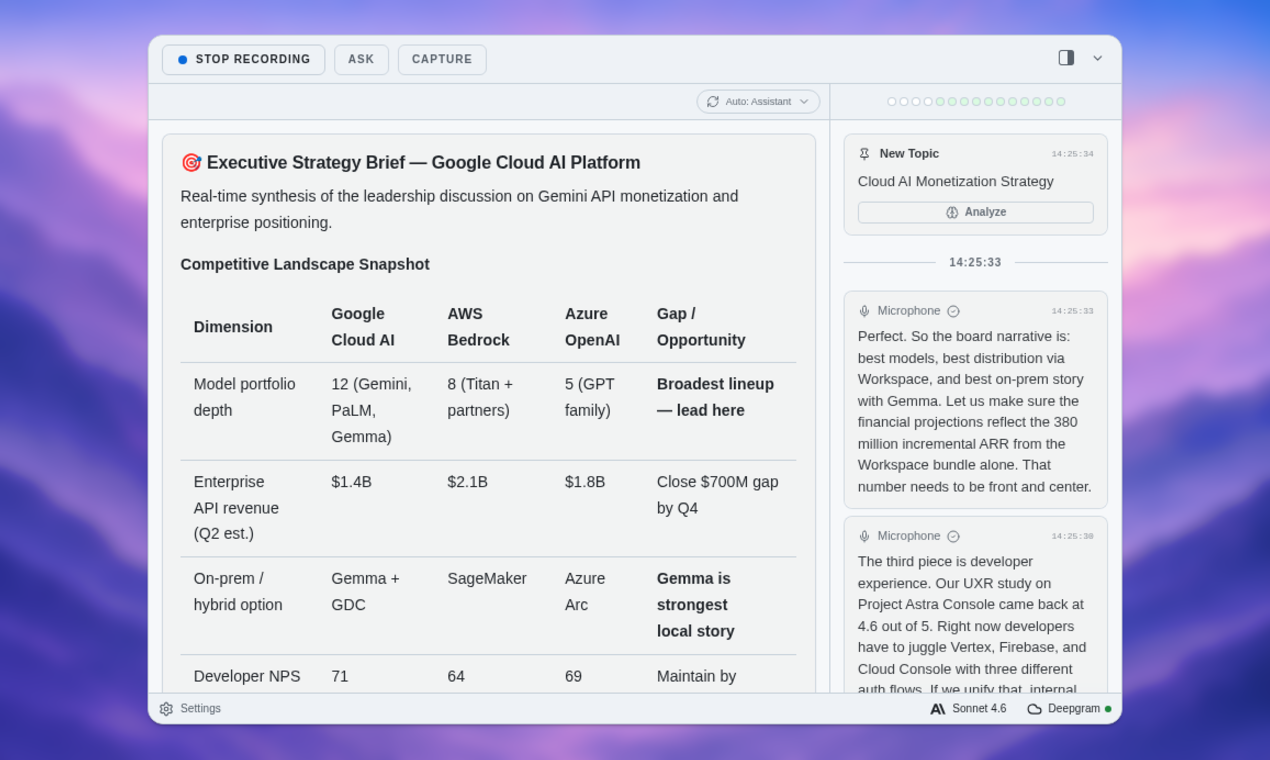
The strongest reason to choose ExtraBrain is that it is designed around the real live-interview workflow. Instead of forcing you to switch tabs, copy questions, or move between separate browser windows, ExtraBrain can use live transcript and screen-aware context to help you understand what is happening in the session.
That matters in coding and system design interviews. A prompt may be visible on screen, the interviewer may add constraints verbally, and your own answer may need to combine both sources of context. ExtraBrain is built to support that combined view.
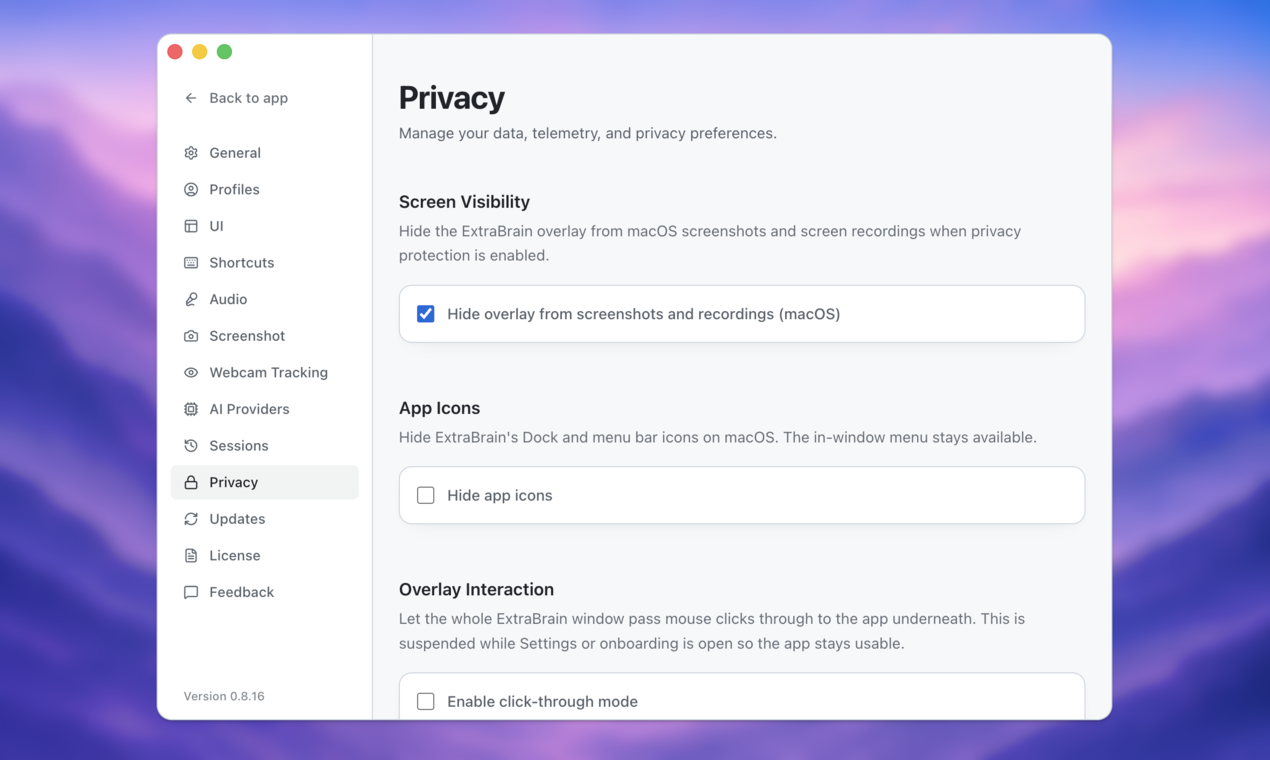
ExtraBrain is also designed to stay hidden from screen sharing and screen recording on major meeting tools. That is useful when the rules allow private notes or an assistant view, but you still do not want your workspace cluttering the shared screen.
Pros: local-first privacy options
ExtraBrain is not just another cloud-only interview chatbot. It supports local NVIDIA Parakeet transcription and local Gemma 4 on-device AI where installed and compatible. With local Parakeet transcription plus local Gemma 4, a fully local posture can keep transcription and AI prompts on the device with no external provider requests.
That local setup depends on installation, compatible hardware, and the user’s configuration. When users choose external providers, selected prompts, transcript text, screenshots, audio, or context may leave the device depending on that provider configuration.
This distinction is important for interviews and work meetings. A resume, a live coding prompt, a customer call, or a company strategy discussion can all contain sensitive information. A good AI copilot should make the data flow understandable instead of hiding it behind vague marketing language.
Pros: bring-your-own AI provider control
ExtraBrain supports bring-your-own provider setup. Supported provider paths include Google Gemma 4 local AI, Anthropic, OpenAI, custom OpenAI-compatible endpoints, Claude Subscription, and Codex Subscription.
That is different from tools that bundle model access into a single closed subscription. Provider control can be useful if you already have an AI provider account, need a specific model family, want a custom endpoint, or prefer a local-first posture where compatible.
Pros: useful beyond one interview
ExtraBrain is not limited to a single interview mode. You can use it for coding interviews, system design interviews, behavioral interviews, product interviews, customer calls, lectures, and research meetings.
That makes it closer to a focused second-brain-style workspace for live sessions, transcripts, notes, screen context, and review. It is not trying to replace a broad note-taking database, but it can help you preserve and learn from the sessions that matter.
Cons: Mac-first today
ExtraBrain is available for Mac today. That is great for Mac users, but Windows and Linux users need to wait for the planned future platforms or choose another tool in the meantime.
Local Gemma 4 also requires installation and compatible hardware. Not every Mac or customer environment will support the same local AI setup.
2. Final Round AI: feature-rich interview preparation platform
Final Round AI is often considered by candidates who want a broader interview preparation suite. Its appeal is breadth: resume-oriented workflows, mock interview practice, live interview assistance, and role-specific preparation can all fit into one product category.
Pros: broad feature set
The biggest advantage of a feature-rich platform is that it can support more than the live call itself. Candidates may want mock practice, resume review, question banks, answer frameworks, and live assistance in one place.
That can be useful if you are preparing for several interview types at once. For example, a product manager might need behavioral stories, product sense drills, and strategy prompts. A software engineer might need coding practice, system design explanations, and communication coaching.
Cons: more features can mean more complexity
Feature breadth can also become a burden. When an interview is live, the tool must feel stable, fast, and easy to use. If the experience requires too much setup, too many modes, or too much manual interpretation, it can distract from the conversation.
For invisible AI interview use, the question is not only “how many features does it have?” The better question is “can I use it calmly while still sounding like myself?“
3. ParakeetAI: live response workflow with flexible buying options
ParakeetAI is another tool candidates often evaluate for real-time interview support. It is commonly discussed in the context of live answers, technical interview help, and flexible payment patterns.
Pros: useful answer generation workflow
The main appeal of ParakeetAI-style tools is fast answer support during live interviews. For a nervous candidate, a generated outline can help turn a vague question into a structured response.
That can be especially useful for questions like:
- “Walk me through your approach.”
- “What tradeoffs would you consider?”
- “How would you debug this production issue?”
- “Tell me about a time you disagreed with a stakeholder.”
The best use is not reading a script. The best use is converting live pressure into a few clear points you can explain honestly.
Cons: manual actions can feel awkward under pressure
Any tool that requires an obvious manual step during the interview can create friction. If you need to click a button, wait for an answer, or cover the delay with filler words, the workflow may feel less invisible than the overlay itself.
This is why testing matters. A tool that feels smooth in a calm demo can feel very different when an interviewer is waiting for your answer.
Cons: session limits and credit models need careful checking
Some AI interview tools use credit packs, time-limited sessions, or subscription tiers. Those models can work well for short-term interview prep, but they can also be hard to predict if your interview runs long or if you have multiple rounds in one week.
Before buying, check the current pricing page directly and calculate the likely cost across your whole interview loop. Do not judge the cost only by one session.
4. LockedIn AI: structured hints and interview guidance
LockedIn AI is usually considered by candidates who want structured assistance, hints, and coaching during live or practice interviews. It is less about replacing your thinking and more about nudging your answer toward a clearer shape.
Pros: guidance can improve structure
Structured guidance is valuable because many interview failures are not knowledge failures. They are communication failures.
A candidate may know the answer but speak too fast, miss the actual question, skip the tradeoff, or forget to connect the example to business impact. A tool that notices those patterns can be useful during practice and review.
For behavioral interviews, this can help you stay closer to a STAR format. For system design interviews, it can remind you to clarify requirements, state assumptions, and compare tradeoffs. For debugging interviews, it can encourage a more methodical path instead of random guessing.
Cons: shortcut-heavy workflows can be risky
Complex keyboard shortcuts are not ideal in a real interview. Under pressure, it is easy to press the wrong combination, trigger the wrong mode, or break your flow.
A tool can be technically invisible and still operationally distracting. If you spend mental energy remembering controls, you have less mental energy for the interviewer.
Cons: hints may not be enough for every candidate
Hints are useful when you already know the topic and only need a nudge. They are less useful when you need a concrete example, a technical explanation, or a clearer answer outline.
For some candidates, a hint-first assistant feels more natural. For others, especially in technical rounds, a more direct explanation workflow is easier to use.
5. LeetCode Wizard: coding interview support for algorithm practice
LeetCode Wizard is focused on technical interviews and algorithm-style coding tasks. It is most relevant for candidates preparing for junior software engineering interviews, data structure questions, and LeetCode-style prompts.
Pros: technical explanations can be genuinely useful
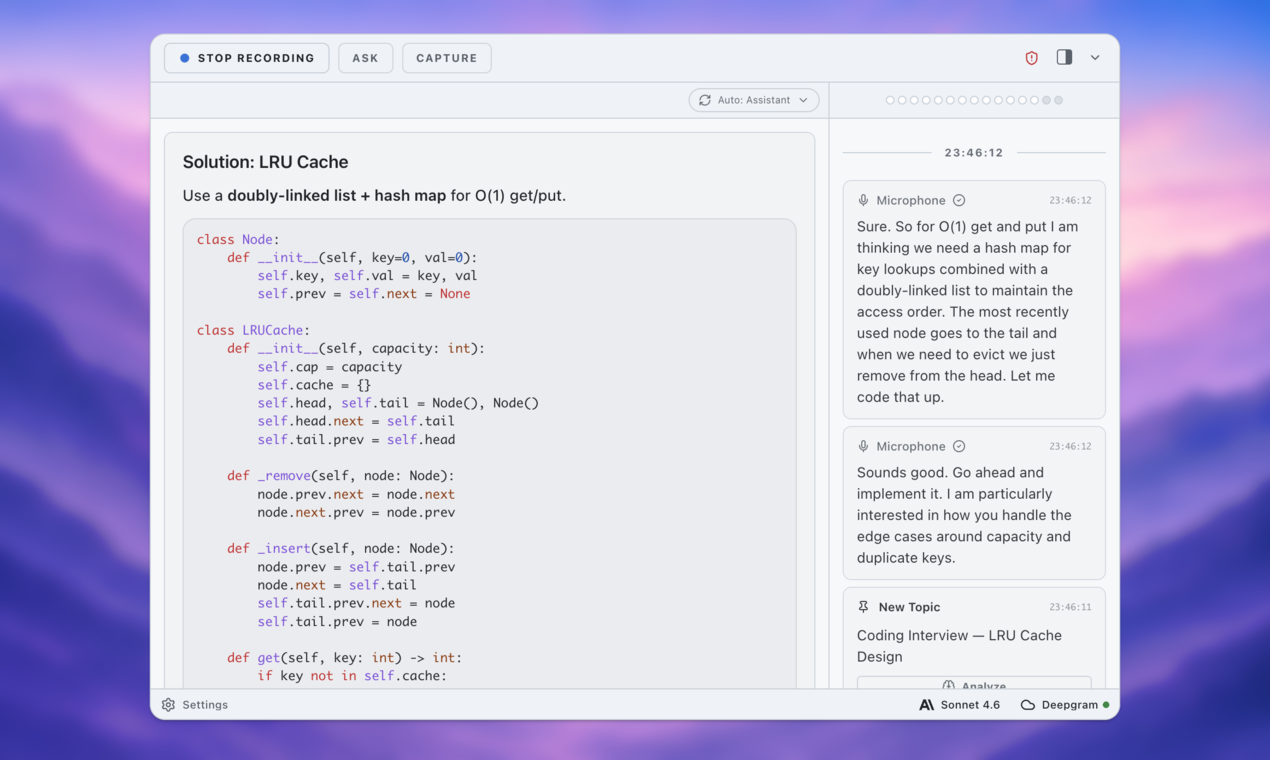
A coding assistant is most helpful when it explains the reasoning, not just the final code. For interviews, you need to communicate constraints, complexity, edge cases, and implementation tradeoffs.
A good coding interview assistant should help you answer questions like:
- What is the brute-force approach?
- What is the optimized approach?
- What data structure makes this easier?
- What is the time and space complexity?
- Which edge cases should I test?
- How do I explain the solution without sounding robotic?
That explanation layer matters because interviewers evaluate how you think, not only whether the code compiles.
Cons: second-device workflows can look unnatural
Some technical interview workflows rely on a second device or a separate screen. That can be awkward in a live interview. A phone screen may be too small to read, while a tablet or second laptop may create obvious eye movement and attention shifts.
Even if the tool itself is not shown in the shared screen, your behavior can still reveal that something is off. For coding interviews, it is usually better to practice explaining your own reasoning than to depend on a hidden answer stream.
Comparison table: invisible AI interview tools
| Tool | Best fit | Strengths | Watch-outs |
|---|---|---|---|
| ExtraBrain | Mac users who want a local-first desktop AI interview and meeting copilot | Live transcription, screen-aware context, local Parakeet transcription, local Gemma 4 where compatible, bring-your-own providers, screen-share-hidden design | macOS today, local AI depends on setup and compatible hardware |
| Final Round AI | Candidates who want broad interview prep workflows | Feature-rich preparation, mock interview patterns, resume and role-prep workflows | Breadth can add complexity during live use |
| ParakeetAI | Candidates who want live response support and flexible buying options | Useful generated answer workflows, often evaluated for real-time interviews | Manual actions, waiting time, and credit or session limits need testing |
| LockedIn AI | Candidates who prefer hints and structure | Guidance, answer shaping, practice feedback patterns | Shortcut-heavy workflows and vague hints may distract some users |
| LeetCode Wizard | Junior technical interview and algorithm practice | Coding explanations, data structure walkthroughs, solution reasoning | Second-device workflows can feel unnatural and may not fit every platform |
My final pick: ExtraBrain
My final pick is ExtraBrain for Mac users who want an invisible AI interview copilot with practical privacy controls.
The reason is simple: invisibility is not only about hiding a window. It is about reducing visible friction, lowering cognitive load, and keeping the interview focused on your thinking.
ExtraBrain is strong because it combines:
- A free core Mac desktop app.
- Live transcription.
- Screen-aware context.
- Local Parakeet transcription.
- Local Gemma 4 on-device AI where installed and compatible.
- Bring-your-own provider support.
- Clear privacy controls.
- Coding, system design, behavioral, and meeting workflows.
- A design intended to stay hidden from screen sharing and screen recording on major meeting tools.
For interview prep, that means you can use ExtraBrain to practice aloud, review transcripts, structure answers, and understand screen context. For live interviews, it means you can keep a private assistant workspace where allowed without turning the session into a tab-switching performance.
How to choose the best invisible AI interview tool for your needs
Choose based on the interview type
For coding interviews, prioritize screen context, technical explanations, complexity analysis, and the ability to talk through tradeoffs. For system design interviews, prioritize architecture prompts, requirements clarification, diagrams or screen context, and follow-up questions. For behavioral interviews, prioritize STAR structure, personal memory, concise examples, and post-session review. For product or strategy interviews, prioritize reasoning structure, assumptions, user impact, and business tradeoffs.
Choose based on your privacy needs
If your sessions involve sensitive data, look closely at provider settings and data flow. A local-first posture is different from a cloud-only workflow.
With ExtraBrain, a fully local posture requires local Parakeet transcription plus local Gemma 4 on-device AI where installed and compatible. If you configure external providers, review what context may be sent to those providers.
Choose based on operating system
If you use a Mac, ExtraBrain is available today for Apple Silicon and Intel Macs. If you use Windows or Linux, check each tool’s current platform support and decide whether you need a browser tool, a desktop tool, or a second-device workflow.
Choose based on how natural you can stay
The best invisible AI interview assistant should make you calmer, not more robotic. Before a real interview, run a practice session and watch your own behavior.
Ask yourself:
- Do I pause too long before answering?
- Do my eyes move unnaturally?
- Am I reading instead of explaining?
- Do the answers sound like my experience?
- Can I recover if the tool is slow or unavailable?
- Am I following the rules for this interview or assessment?
Responsible use matters
AI interview assistants should be used for permitted preparation, note support, accessibility, recall, structure, and review. They should not be used to misrepresent your skills, violate assessment rules, or secretly outsource the work an interviewer is evaluating.
If a platform, school, employer, or interviewer prohibits AI assistance, transcription, screenshots, or private notes, follow that rule. If the policy is unclear, ask before using the tool.
A responsible workflow is better long term because it helps you become a stronger candidate instead of only surviving one interview.
FAQ
What is the best invisible AI for interview tools in 2026?
For Mac users, ExtraBrain is the best overall pick because it combines live transcription, screen-aware context, local-first options, bring-your-own providers, and a design intended to stay hidden from screen sharing and screen recording on major meeting tools. Use it only where the relevant rules allow AI assistance.
Is ExtraBrain completely invisible during screen sharing?
ExtraBrain is designed to stay hidden from screen sharing and screen recording on major meeting tools. You should still test your exact meeting app, screen sharing mode, permissions, and setup before any important session.
Can ExtraBrain listen and use screen context at the same time?
ExtraBrain supports live transcription and screen-aware context. That combination helps it respond to both what is said in the interview and what appears on screen, depending on your configuration and permissions.
Can ExtraBrain run fully local?
A fully local ExtraBrain posture requires local Parakeet transcription plus local Gemma 4 on-device AI where installed and compatible. With that setup and no external provider requests, transcription and AI prompts can stay local.
Does ExtraBrain let me use my own AI provider?
Yes. ExtraBrain supports bring-your-own provider setup, including Anthropic, OpenAI, custom OpenAI-compatible endpoints, Claude Subscription, Codex Subscription, and local Gemma 4 where installed and compatible.
How much does ExtraBrain cost?
The core ExtraBrain Mac app is free. ExtraBrain Pro is $9.99 per month, $79 per year, or $149 Lifetime launch pricing. External AI and transcription provider usage is billed separately by the providers users choose.
Is an invisible AI interview assistant allowed?
It depends on the interview, employer, school, workplace, and platform rules. ExtraBrain should be used only where AI assistance, transcription, screenshots, or notes are allowed.
How do I test an invisible AI interview setup before a real interview?
Run a mock call with the same meeting app, screen sharing mode, microphone, system audio settings, shortcuts, and provider configuration you plan to use. Record or review the test if allowed. Confirm that the assistant does not appear in the shared content and that you can answer naturally without awkward delays.