
ExtraBrain Blog
Leaving Cluely Trash for a More Reliable AI Interview Copilot

Frustrated by Cluely trash? Learn how to evaluate AI interview copilots, reduce lag risk, protect privacy, and switch responsibly.
I remember the exact feeling that made me search for a Cluely trash alternative. I was in interview mode, trying to listen carefully, speak clearly, and stay calm. Then the assistant lagged. The moment I needed support most, the tool made me more anxious instead of less anxious.
That is when I realized the problem was not only one bad session. The bigger problem was depending on an AI assistant that did not fit the way real interviews, meetings, and assessments actually feel. If the tool freezes, gives shallow suggestions, distracts you from the conversation, or creates privacy uncertainty, it is not making you sharper. It is adding another thing to manage.
This article is about how I would evaluate that situation now and why I would choose ExtraBrain instead. ExtraBrain is a free, local-first Mac desktop AI interview assistant and meeting copilot with live transcription, screen-aware context, local AI options where installed and compatible, bring-your-own providers, and clear privacy controls. It is not a magic replacement for your judgment. It is a workspace for staying present, structuring thoughts, reviewing sessions, and using AI responsibly where the rules allow it.
Key takeaways
- Cluely trash usually shows up as lag, freezing, generic answers, distracting overlays, or a workflow that makes you less present.
- The best AI interview assistant is not the flashiest one. It is the one that helps you think clearly under pressure.
- Before switching tools, test your real workflow in mock interviews, screen-sharing scenarios, coding prompts, and post-call review.
- Privacy matters because interviews, meetings, lectures, and research calls can contain sensitive information.
- ExtraBrain is a strong Cluely alternative for Mac users who want live transcription, screen-aware context, local-first options, provider control, and responsible use boundaries.
Signs your Cluely setup is holding you back
The assistant makes you slower
The first sign of a bad AI interview copilot is not always a dramatic crash. Sometimes it is a small delay that breaks your rhythm. You hear a question, glance at the assistant, wait for a suggestion, and lose the natural thread of the conversation.
In a real interview, that delay matters. A good answer is not only accurate. It also needs timing, confidence, and a sense that you are listening. If your assistant keeps pulling your attention away from the interviewer, it can make you seem less engaged even when you prepared well.
Common friction points include:
- Waiting for a response while the interviewer expects you to start thinking aloud.
- Getting a broad answer when you need a role-specific or technical answer.
- Restarting the app during a high-pressure moment.
- Losing track of the actual question because you are managing the tool.
- Feeling more dependent on the overlay than on your own preparation.
That is the core reason people search for Cluely trash in the first place. They are not just frustrated with software. They are frustrated because the software interrupts a moment that already feels high stakes.
The answers sound generic
A second warning sign is answer quality. If a tool gives you short, vague, or cookie-cutter responses, it can create a false sense of help. You see text on the screen, but the content does not actually move the conversation forward.
For example, in a product interview, a generic answer might say to “focus on the user.” That is not enough. You need to clarify the goal, define the user segment, identify constraints, propose tradeoffs, and explain how you would measure success.
In a coding interview, a generic answer might name the right data structure without explaining edge cases, complexity, or why one approach is better than another. In a behavioral interview, a generic answer might force everything into a formula without preserving the real story.
A smarter assistant should help you structure your own thinking. It should help you produce better clarifying questions, stronger outlines, and more grounded explanations. It should not make every answer sound like it came from the same template.
The tool increases privacy anxiety
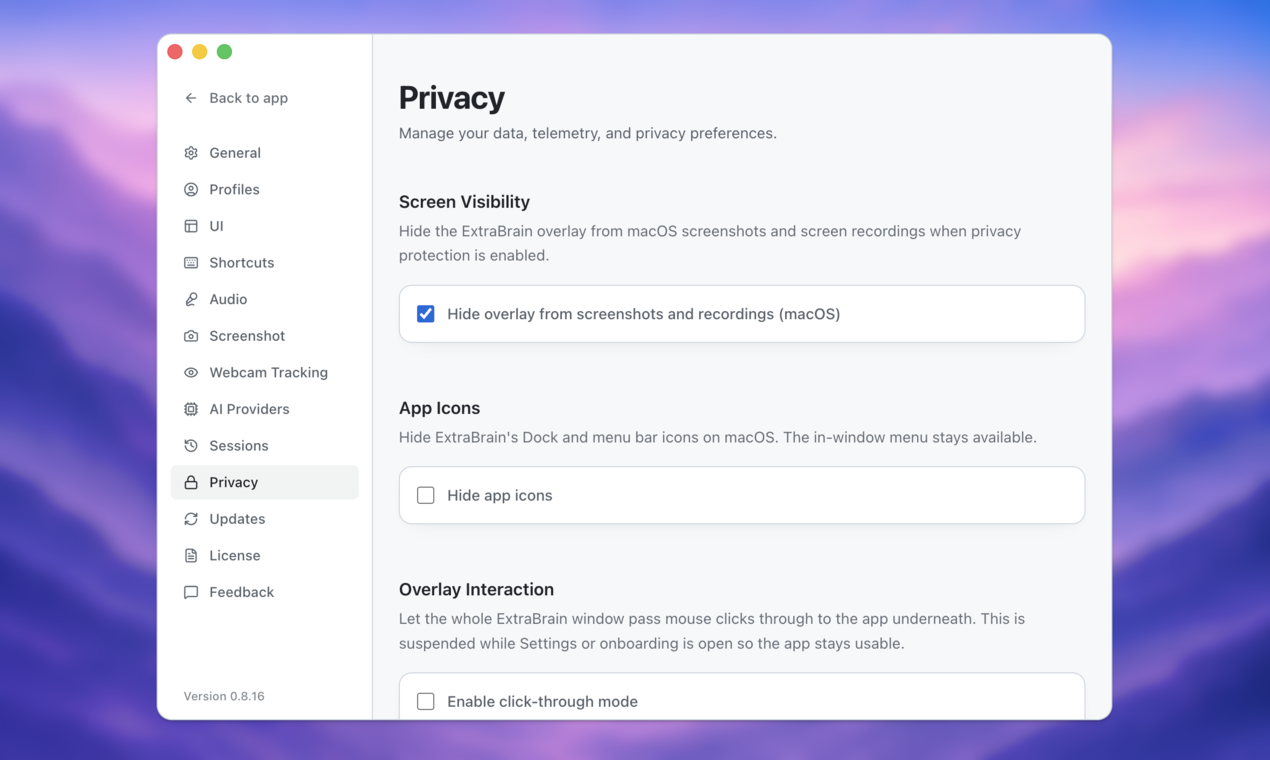
Privacy anxiety is another reason to leave a tool behind. Interviews and meetings can include personal history, salary expectations, customer information, internal roadmaps, school details, or confidential technical material. If you do not understand what leaves your device, which provider sees the prompt, or how screenshots and transcripts are handled, you cannot make an informed choice.
That does not mean every cloud provider is bad. It means you should know what you are sending and why. ExtraBrain is built around that decision instead of hiding it. With local Parakeet transcription and local Gemma 4 on-device AI where installed and compatible, a fully local posture can keep transcription and AI prompts on the device. If you choose external providers such as Anthropic, OpenAI, custom OpenAI-compatible endpoints, Claude Subscription, Codex Subscription, or Deepgram, selected prompts, transcript text, screenshots, audio, or context may be sent to those providers depending on your configuration.
That distinction matters. It gives you a way to match the tool to the sensitivity of the situation.
Why I would switch away from Cluely trash
Reliability affects performance
I used to think an AI assistant either worked or did not work. Now I think reliability is part of performance. If a tool is unstable, it changes how you behave. You start monitoring the app instead of the conversation. You hesitate before answering. You become less willing to think aloud because you are waiting for the assistant to rescue you.
That is the wrong dynamic. AI should reduce cognitive load, not add a second conversation inside your head.
Here is the practical comparison I would use now:
| Problem | What it feels like in a live session | Better evaluation question |
|---|---|---|
| Lag | You pause unnaturally while waiting for help. | Can the tool keep up with normal conversation speed? |
| Freezing | You restart or hide the app during a call. | Does it behave predictably under screen sharing and recording? |
| Generic answers | You get safe advice that does not fit the question. | Does it use transcript and screen context to ground suggestions? |
| Privacy uncertainty | You worry about where sensitive text or screenshots go. | Can you choose local-first settings or providers you trust? |
| Overdependence | You stop practicing your own reasoning. | Does the tool help you learn after the session? |
ExtraBrain is designed for that broader workflow. It supports live transcription, screen-aware context, session history, notes, and review, so the goal is not only to survive the current question. The goal is to improve how you prepare, respond, and learn afterward.
Missed opportunities are expensive
A weak assistant can cost more than its subscription. It can cost focus, confidence, and learning momentum. If you leave an interview feeling like the tool spoke over your own judgment, you may not know what to improve next time.
These are the missed opportunities that matter most:
| Limitation | Why it matters |
|---|---|
| Broad suggestions | They do not match the role, company, interviewer, or prompt. |
| Misread context | They push you toward an answer that ignores nuance. |
| Latency | They disrupt the natural rhythm of conversation. |
| Poor review workflow | They leave you with no useful record of what happened. |
| Rule conflicts | They can put you at odds with interview, school, employer, or platform expectations. |
| Confidence erosion | They make you trust the tool more than your own reasoning. |
This is also where responsible use matters. You should use any AI interview assistant only where the interview, employer, school, workplace, meeting, and platform rules allow AI assistance, transcription, screenshots, or notes. If the rules do not allow it, do not use it in that setting. Use it for preparation, mock interviews, study, or post-session review instead.
Stress is a product problem too
People often talk about AI tools as if the only question is accuracy. Accuracy matters, but stress matters too. A tool that makes you nervous is not neutral. If you keep wondering whether it will freeze, show up at the wrong time, misunderstand the prompt, or send sensitive context somewhere unexpected, that anxiety becomes part of the interview.
A better assistant should help you feel prepared without making you passive. It should support your reasoning, not replace it. It should give you a safer place to practice, review, and refine answers before the real conversation.
How to escape Cluely trash thoughtfully
Start with your actual use case
Before replacing any AI assistant, write down what you actually need. Different users need different workflows. A software engineer may need coding explanations, complexity analysis, and system design tradeoffs. A product manager may need structured product thinking, customer empathy, and metrics. A student may need lecture notes and research call summaries. A sales or customer-facing operator may need meeting follow-up and account context.
ExtraBrain fits several of these workflows because it is not only an interview helper. It is a local-first desktop AI interview and meeting copilot for coding interviews, system design rounds, behavioral interviews, meetings, lectures, and research calls.
Use this checklist before switching:
- What kind of sessions will I use this for?
- Do I need live transcription?
- Do I need screen-aware context for coding prompts, diagrams, documents, or slides?
- Do I want local transcription, external transcription, or both options?
- Do I want local AI where supported, external providers, or provider flexibility?
- Do I need post-session notes and review?
- What rules apply in my interviews, workplace, school, or meeting platforms?
If a tool cannot answer those questions clearly, keep looking.
Test alternatives in mock sessions
Do not choose an assistant based only on a landing page. Run a practice session that looks like your real situation. Open a video call with a friend or a second device. Share your screen if that is part of your workflow. Use a real coding prompt, system design prompt, behavioral question, or meeting agenda. Then watch how the tool behaves.
For ExtraBrain, I would test these scenarios:
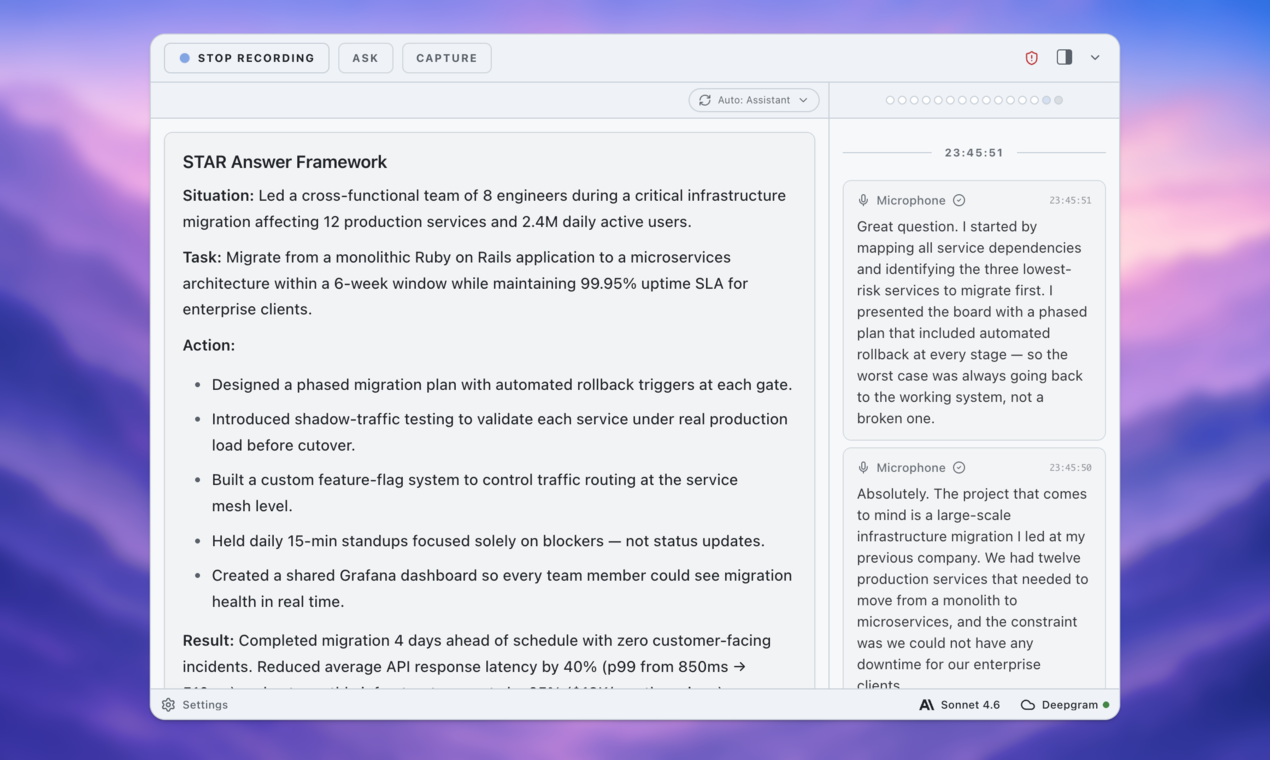
- A behavioral interview question where I need a STAR outline from live transcript context.
- A coding interview question where I need help explaining tradeoffs instead of only producing code.
- A system design prompt where I need clarifying questions and architecture risks.
- A meeting recap where I need transcript-based notes and action items.
- A privacy-sensitive session where I compare local-first settings with external provider settings.
Compare tools on workflow, not hype
When I compare AI assistants now, I care less about dramatic marketing claims and more about repeatable behavior. A tool should be calm, clear, and configurable.
| Feature | What to look for | Why it matters |
|---|---|---|
| Live transcription | Accurate enough to preserve the real conversation. | The assistant needs context before it can help. |
| Screen awareness | Ability to use visible prompts, code, diagrams, or documents as context. | Many interviews and meetings are not audio-only. |
| Provider control | Bring-your-own AI providers and local options where supported. | You can match cost, quality, and privacy needs. |
| Local-first posture | Local transcription plus local AI where installed and compatible. | Sensitive sessions may need stronger data control. |
| Review workflow | Saved sessions, transcripts, and notes. | Improvement happens after the call too. |
| Responsible use fit | Clear reminder to follow rules. | Getting help should not mean ignoring boundaries. |
ExtraBrain stands out for Mac users because its core app is free, it supports Apple Silicon and Intel Macs, and it gives users control over local and external AI provider choices. Windows and Linux are planned, but Mac is the supported platform today.
Why ExtraBrain is the smarter Cluely alternative for me
It treats context as the product
A good AI interview copilot should understand more than isolated text snippets. It should help with the living context of the session. That includes what was just said, what is on the screen, what role you are interviewing for, what kind of answer structure fits, and what you need to review later.
ExtraBrain is built around that kind of context. It can work as a focused AI second brain for interviews and meetings, with live sessions, transcripts, notes, screen context, and review. It is not trying to replace a general note-taking database. It is focused on the moments where live context matters.
That difference changes how you use it. Instead of chasing a perfect one-line answer, you can ask for:
- A clearer structure for a messy response.
- A sharper clarifying question.
- A tradeoff analysis for a system design decision.
- A STAR outline for a behavioral story.
- A post-interview debrief that shows what to improve.
It gives privacy choices instead of vague promises
I do not want an AI assistant that treats privacy as a slogan. I want settings and tradeoffs I can understand.
ExtraBrain gives that control through local-first options and bring-your-own provider support. If local Parakeet transcription and local Gemma 4 are installed and compatible, you can configure a fully local posture where transcription and AI prompts stay on-device. If you choose external services, you can make that choice intentionally and understand that selected prompts, transcript text, screenshots, audio, or context may leave the device depending on configuration.
That is more useful than pretending every setup has the same data flow. It lets you choose the right posture for the right situation.
It supports preparation and recovery
The best interview improvement usually happens before and after the live call. Before the call, you practice explaining your own experience clearly. After the call, you review what happened, notice weak answers, and prepare better examples for next time.
That is why session history and transcripts matter. A live assistant that disappears after the call may help for one moment, but it does not build a learning loop. ExtraBrain is better positioned as a repeatable workspace because you can use it across practice, live sessions where allowed, meetings, lectures, and research calls.
Results I would expect after switching
Better focus during live conversations
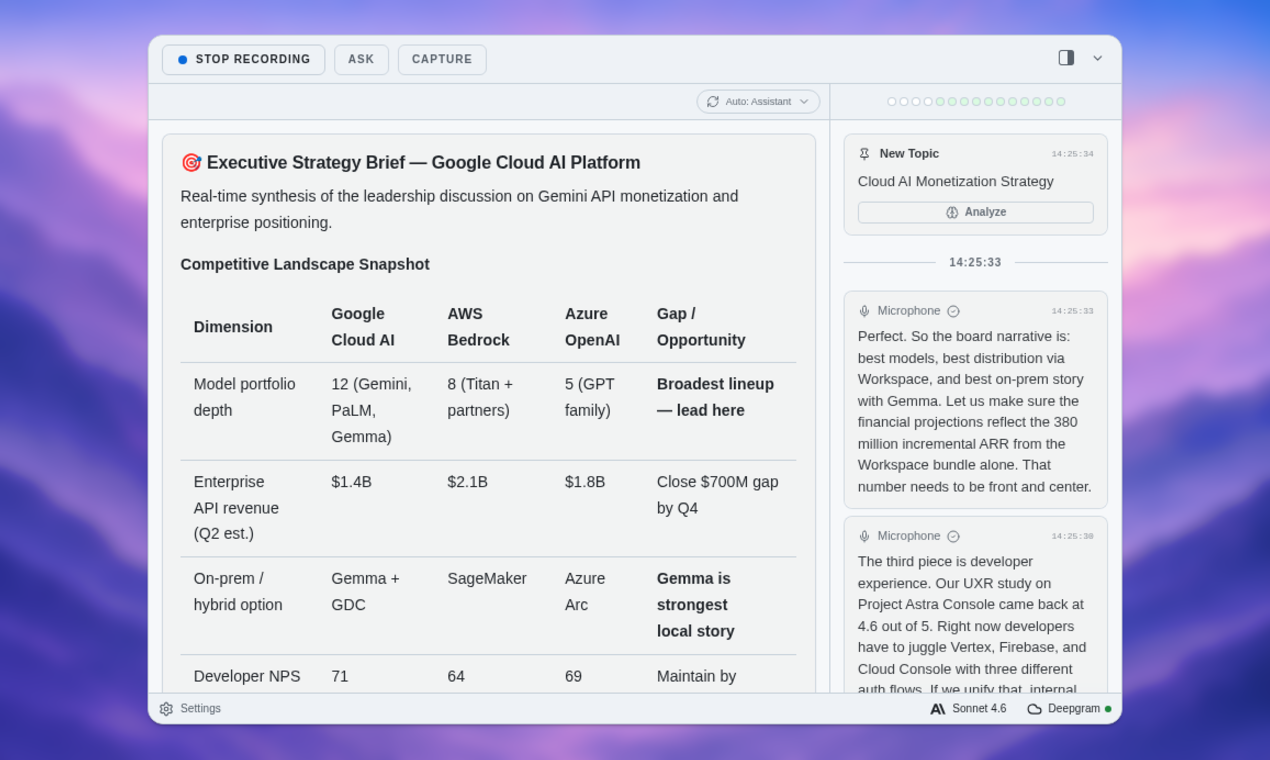
The biggest improvement is not that AI writes a perfect answer. The biggest improvement is that you stop fighting the tool. When the assistant is designed around live context and clear controls, you can stay more present. You can listen first, then use AI to organize your thinking.
Here is the before-and-after I care about:
| Area | Before with a frustrating assistant | After with a better workflow |
|---|---|---|
| Focus | Split between the interviewer and the tool. | Centered on the conversation. |
| Answer quality | Generic and reactive. | Structured, contextual, and easier to personalize. |
| Confidence | Dependent on whether the tool behaves. | Supported by practice and review. |
| Privacy | Unclear data flow. | Configurable local-first and provider choices. |
| Learning | Little useful record after the call. | Transcripts and notes for review. |
Better habits around AI assistance
Switching tools also changed how I think about AI. The goal is not to outsource the interview. The goal is to prepare better, think more clearly, and recover more effectively after each session.
A healthy workflow looks like this:
- Practice answers aloud before the interview.
- Use AI to identify gaps, not to invent a fake personality.
- Use live assistance only where the rules allow it.
- Keep your own judgment in charge during the conversation.
- Review the transcript afterward and improve the next version of your answers.
That is the difference between an AI copilot and an AI crutch. A crutch makes you weaker when it is removed. A copilot helps you build better habits.
Tips if you are considering a Cluely trash alternative
Make a short list of non-negotiables
Do not start with a list of every tool on the market. Start with the features you refuse to compromise on.
For me, the list would be:
- Live transcription that supports real conversation flow.
- Screen-aware context for coding, system design, documents, and meeting materials.
- Local-first options for sensitive sessions.
- Bring-your-own provider control.
- A free core app that lets me try the workflow before committing to Pro.
- Clear responsible use boundaries.
- Support for post-session review.
ExtraBrain matches that list especially well for Mac users. The core Mac app is free, and ExtraBrain Pro is available for users who want paid features, with external AI and transcription provider usage billed separately by the providers users choose.
Practice before any real interview
Before a formal interview, run a mock session. Do not wait until the real call to learn the controls, check the microphone, test transcription, or understand provider behavior.
A useful rehearsal should include:
- One behavioral story.
- One technical or role-specific prompt.
- One moment where you share your screen.
- One post-session review.
- One privacy check of your selected transcription and AI provider settings.
If the tool makes practice more stressful, it will probably make the real session more stressful too.
Respect the rules of the room
AI assistance is not appropriate everywhere. Some interviews, assessments, classes, workplaces, or platforms may prohibit AI help, transcription, screenshots, recordings, or notes. You are responsible for checking those rules before using any tool.
If live use is not allowed, ExtraBrain can still be valuable for preparation and review in allowed contexts. You can practice aloud, rehearse technical explanations, organize examples, and learn from mock interviews without crossing boundaries.
FAQ
How do I know if my AI assistant is holding me back?
Look for lag, freezing, generic suggestions, privacy uncertainty, or a feeling that you are paying more attention to the tool than to the person speaking. If the assistant makes you less present, it is not helping enough.
What should I do before switching from Cluely?
Test alternatives in realistic mock sessions. Check live transcription, screen context, provider settings, cancellation details, privacy controls, and post-session review. Do not choose a replacement until you have seen it handle the kind of interview or meeting you actually expect.
Is ExtraBrain free?
The core ExtraBrain Mac app is free. ExtraBrain Pro is available for users who want paid features, and external AI or transcription provider usage is billed separately by the providers users choose.
Can ExtraBrain run fully local?
A fully local ExtraBrain posture requires local Parakeet transcription plus local Gemma 4 on-device AI where installed and compatible, with no external provider requests. Local Gemma 4 availability depends on installation and compatible hardware. If you configure external providers, selected prompts, transcript text, screenshots, audio, or context may leave the device depending on your settings.
Can I use ExtraBrain during interviews?
Use ExtraBrain only where interview, employer, school, workplace, meeting, and platform rules allow AI assistance, transcription, screenshots, or notes. If the rules do not allow live assistance, use it for practice, preparation, mock sessions, and permitted review instead.
What platforms does ExtraBrain support?
ExtraBrain is available for macOS today, including Apple Silicon and Intel Macs. Windows and Linux are planned future platforms.