
ExtraBrain Blog
CodeSubmit AI Help in 2026: Pass Tests Without Crossing the Line

A practical guide to CodeSubmit AI help, detection risks, mock practice, testing discipline, and responsible ExtraBrain prep in 2026.
People search for “CodeSubmit how to cheat with AI” because coding assessments can feel high stakes, ambiguous, and unforgiving. The test may be a take-home project, a live CodePair session, or a short screening exercise, and the candidate may not know how much AI help is allowed.
The practical answer is not to pretend there is a risk-free shortcut. AI can help you understand prompts, practice realistic tasks, find edge cases, debug code, and prepare better explanations. Secretly using AI when the assessment rules prohibit it can lead to disqualification, a withdrawn offer, or a reputation problem that lasts longer than one test.
This guide keeps the useful parts of the CodeSubmit AI question in view. It covers how CodeSubmit-style assessments work, what candidates often try, what detection signals matter, how to use ExtraBrain responsibly, and how to prepare so you can submit work you actually understand.
Key Takeaways
- AI tools can help you practice CodeSubmit-style coding tasks, but they are risky during a restricted assessment if outside help is not allowed.
- CodeSubmit-style reviews may look at unusual code patterns, fast completion times, copy-paste behavior, similarity, security issues, and follow-up explanation quality.
- The safest workflow is to use AI before the assessment for practice, mock sessions, debugging drills, and edge-case review.
- If AI is allowed during the assessment, keep the workflow within the written rules and make sure every submitted line is explainable.
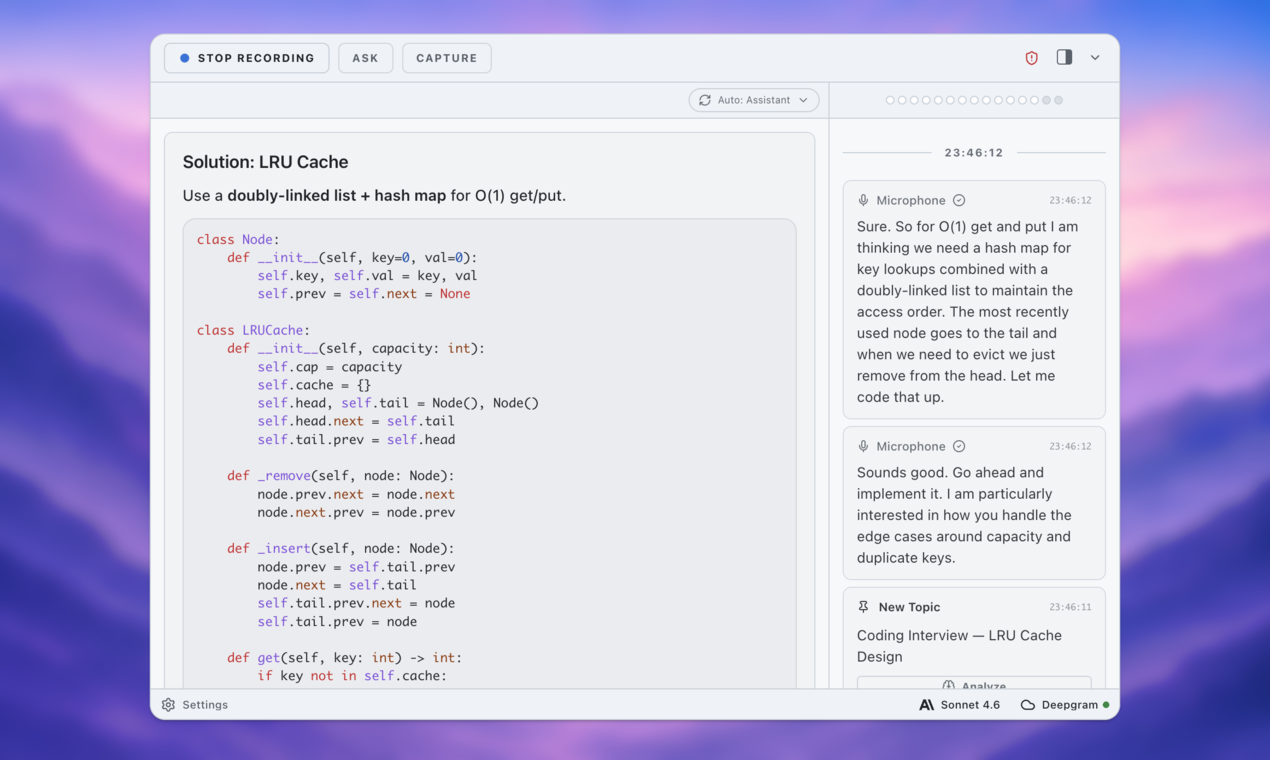
- ExtraBrain is a free, local-first Mac desktop AI interview assistant and meeting copilot with live transcription, screen-aware context, local-first options, bring-your-own providers, and privacy controls.
Can You Cheat CodeSubmit With AI Tools?
The short answer is that people try, and modern AI can generate useful code quickly. The better question is whether the result represents your own skill and whether the platform, employer, school, or interview rules allow that help.
CodeSubmit assessments are often designed to resemble real work rather than a simple quiz. That makes AI assistance tempting because the prompts may involve architecture, framework choices, tests, debugging, written explanations, and tradeoffs. It also makes blind AI use easier to spot because reviewers can ask why the code is structured a certain way.
ExtraBrain should be used only where interview, employer, school, workplace, meeting, and platform rules allow AI assistance, transcription, screenshots, or notes. If the rules prohibit outside help, use AI before the assessment for preparation and after the assessment for review.
Effectiveness of AI Assistance
AI can be genuinely useful for CodeSubmit preparation. It can summarize a prompt, identify hidden requirements, suggest test cases, compare implementation approaches, and explain bugs in plain language.
For practice, you can use AI to:
- Turn a vague coding assignment into a checklist of requirements.
- Compare a quick solution with a more maintainable solution.
- Generate edge cases for inputs, errors, concurrency, data size, and permissions.
- Review code for readability, complexity, and test coverage.
- Practice explaining a solution as if a hiring team asked follow-up questions.
The important limit is ownership. If you cannot explain the code without the AI output in front of you, you are not ready to submit it as your own work.
Detection and Anti-Cheat Signals
CodeSubmit-style assessments can involve automated signals, platform logs, reviewer judgment, and later interview follow-ups. Even when a platform does not disclose every security measure, candidates should assume that unusual behavior may be reviewed.
Common signals include:
- Unusual code patterns that do not match the rest of the submission.
- Very fast completion times for a complex task.
- Large copy-paste events or abrupt style changes.
- Similarity to known generated answers or public solutions.
- Code that passes basic tests but fails realistic edge cases.
- Security issues that suggest the code was accepted without review.
- Follow-up explanations that do not match the submitted implementation.
These signals do not prove misconduct by themselves. They are reasons a platform or hiring team may take a closer look.
Reputation and Ethics
The biggest risk is not only getting flagged by software. It is submitting work you cannot defend in the next interview or on the job.
If a company asks you to explain a design choice, debug a related issue, or extend the assignment live, a copied AI solution can become a liability. Responsible AI use means using tools to strengthen your reasoning rather than replacing it.
Tip: If you use AI for preparation, turn every suggestion into your own understanding before the real assessment.
CodeSubmit Test Landscape in 2026
CodeSubmit-style hiring workflows usually focus on practical evidence. Instead of only asking algorithm trivia, they often ask candidates to build, debug, explain, or improve something closer to the job.
Types of CodeSubmit Assessments
| CodeSubmit assessment type | What it usually measures |
|---|---|
| Take-home challenges | How you structure software, implement requirements, test behavior, and communicate tradeoffs. |
| CodePair live interviews | How you think, debug, pair, use a terminal, and explain decisions in real time. |
| Screening Bytes | How quickly you demonstrate role-relevant technical competence early in the hiring funnel. |
Common AI Methods Candidates Consider
Candidates usually think about a few AI workflows around CodeSubmit tests. Some are useful for preparation. Others are risky during the assessment.
Common methods include:
- Asking a chatbot to explain the prompt before starting.
- Generating starter code or test cases.
- Using AI to debug errors after tests fail.
- Searching forums for similar assignments.
- Working with another person over chat or a call.
- Using a second screen, phone, or browser extension while the assessment is running.
The first three can be legitimate when used for practice or when the rules allow them. The last three can easily cross into prohibited outside help.
Platform Security and Reviewer Updates
Hiring teams have become more aware of AI-generated code. That means the review often goes beyond whether the project passes tests.
A reviewer may inspect:
- Whether the architecture is appropriate for the assignment.
- Whether the tests cover real edge cases.
- Whether error handling, input validation, and security are reasonable.
- Whether comments and naming match the rest of the code.
- Whether the candidate can explain the solution in a follow-up call.
AI-generated code can pass a happy-path test suite while hiding silent problems. That is why you should review for security, correctness, maintainability, and explainability before submitting anything.
Preparing for CodeSubmit With AI Safely
The phrase “cheat CodeSubmit safely” is the wrong frame. The safer and more durable goal is to prepare with AI so your real assessment work is stronger, calmer, and easier to explain.
Choose AI Tools and Resources Carefully
Use tools that help you learn the task rather than tools that only produce a final answer. For coding prep, that means you want explanations, test generation, debugging support, and the ability to compare tradeoffs.
ExtraBrain is built for this kind of workflow on Mac. It is a free, local-first desktop AI interview assistant and meeting copilot with live transcription, screen-aware context, local Gemma 4 on-device AI where installed and compatible, bring-your-own AI providers, and clear privacy controls.
You can use ExtraBrain to practice coding interviews, system design rounds, behavioral interviews, meetings, lectures, and research calls. Windows and Linux are planned future platforms.
Where ExtraBrain Fits
ExtraBrain can help you prepare before a CodeSubmit-style assessment by keeping the prompt, transcript, notes, screen context, and follow-up review in one focused workspace. It can help generate clarifying questions, outline a solution, produce edge cases, critique your explanation, and summarize what to practice next.
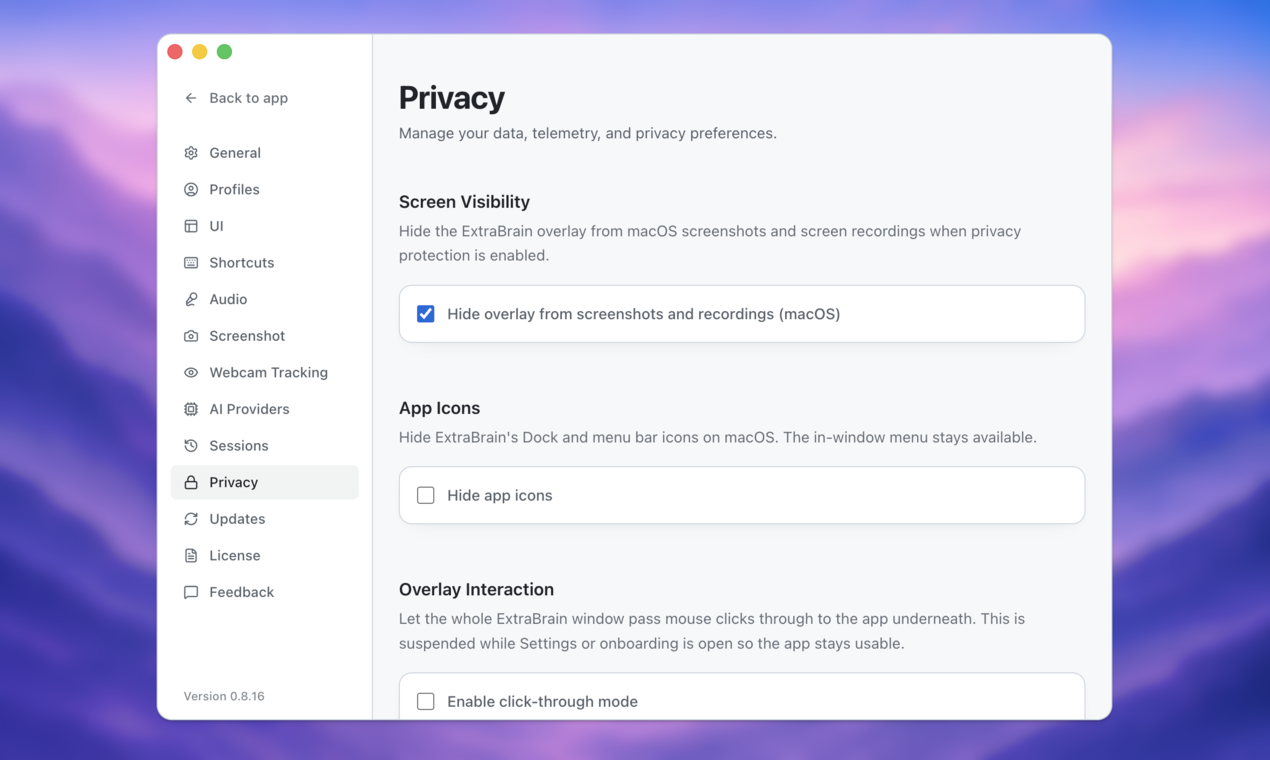
ExtraBrain is designed to stay hidden from screen sharing and screen recording on major meeting tools, while users remain responsible for following all rules. That privacy posture is useful for allowed interviews and meetings where you do not want private notes or assistant UI exposed. It is not permission to use AI in a restricted CodeSubmit assessment.
If AI assistance is explicitly allowed, keep your use simple, transparent, and within the stated boundaries. If AI assistance is not allowed, use ExtraBrain before the assessment for practice and after the assessment for debriefing.
Practice With AI Mock Tests
Mock tests are where AI is most valuable and least risky. Build a practice loop that resembles the real CodeSubmit environment as closely as possible.
Use this sequence:
- Choose a representative assignment.
- Read the prompt without AI and write your first interpretation.
- Ask AI to identify requirements, edge cases, and likely pitfalls.
- Solve the task under a timer.
- Run tests and fix failures.
- Ask AI to review the final code for bugs, security issues, readability, and missing tests.
- Close the AI tool and explain the solution aloud from memory.
If the explanation falls apart, repeat the exercise with a smaller problem. The goal is not to memorize a generated solution. The goal is to build fluency.
Step-by-Step: Using AI Around CodeSubmit Tests
A responsible AI workflow changes depending on timing. Before the assessment, AI can be a tutor and practice partner. During the assessment, AI use depends entirely on the rules. After the assessment, AI can help you debrief and prepare for follow-ups.
Step 1: Analyze Questions With AI Before the Real Test
Start with practice prompts that resemble the role. Ask AI to summarize the problem in plain language, list assumptions, identify tricky constraints, and suggest clarifying questions.
For example, a good prompt might be:
I am practicing for a CodeSubmit-style backend assignment.Summarize this prompt, list the hidden edge cases, and suggest a minimal test plan.Do not write the final implementation yet.That prompt keeps the AI in a coaching role. It helps you think before you code.
Step 2: Generate and Refine Code for Practice
During preparation, it is fine to ask AI for sample implementations. The key is to treat them as study material.
A useful practice process looks like this:
- Ask for a high-level approach before asking for code.
- Implement the first version yourself.
- Use AI to compare your implementation with alternatives.
- Ask why one approach is easier to test or maintain.
- Rewrite the code in your own style.
- Add tests that prove you understand the edge cases.
Avoid copying large blocks into a real restricted assessment. Even aside from rules, copied code can introduce dependencies, patterns, or assumptions that you cannot defend later.
Step 3: Test and Submit Answers Carefully
Testing is where many AI-assisted candidates lose points. The code can look polished and still fail important cases.
Before submitting an allowed assessment solution, check:
- Empty inputs, null inputs, malformed inputs, and missing fields.
- Very large inputs, duplicate values, and boundary values.
- Error handling, permissions, and network failure paths.
- Time complexity, memory behavior, and unnecessary global state.
- Security issues such as injection, unsafe file handling, and exposed secrets.
- Whether the README explains setup, assumptions, and tradeoffs.
Then explain the solution aloud. If you cannot walk through the main functions, tests, and design choices, keep reviewing before you submit.
Maximizing Success While Minimizing Risk
The strongest CodeSubmit strategy is boring in the best way. Know the rules, prepare with realistic practice, keep your environment clean, and submit work you can explain.
Avoiding Flags Without Deception
The best way to avoid getting flagged is not to hide prohibited behavior. It is to avoid prohibited behavior and make your legitimate work easy to review.
Do this instead:
- Read the assessment instructions before opening any tool.
- Close apps, tabs, and devices that are not allowed.
- Keep your coding style consistent.
- Commit or save work in clear increments when the platform supports it.
- Write comments only where they clarify real decisions.
- Test edge cases and include a concise README if the assignment expects one.
- Prepare to explain every major choice in a follow-up conversation.
This protects you even when the platform is strict. It also gives the hiring team a better signal of how you actually work.
Handling Unexpected Issues
Technical problems happen during online assessments. Plan for them before the timer starts.
Common issues include:
| Issue | Better response |
|---|---|
| Internet drops | Use a prepared backup connection if the rules and platform allow it. |
| Code fails hidden tests | Reproduce the failure class, add a local test, and debug from first principles. |
| Platform freezes | Document what happened and contact platform or recruiter support through the official channel. |
| Prompt seems ambiguous | State your assumption clearly in the README or comments if clarification is not available. |
| Time runs low | Submit a smaller correct solution with known limitations rather than a broad broken one. |
AI can help you practice these situations before the real test. During the actual assessment, follow the stated rules.
Post-Test Reputation Management
After you submit, prepare for the next conversation. Many employers use CodeSubmit as one step in a larger hiring process, not as the final proof of skill.
Review your code and notes while the context is fresh. Write down the tradeoffs you made, the tests you added, the shortcuts you took, and what you would improve with more time. If a hiring manager asks about your process, answer directly and focus on your reasoning.
If you used AI in a way the rules allowed, be ready to explain how it supported your work. If you did not use AI during the assessment, you can still discuss how you used AI for preparation.
FAQ
Can I use my phone to access AI tools during a CodeSubmit test?
Only if the assessment rules explicitly allow it. If the rules prohibit outside help, using a phone, second screen, hidden chat, or remote helper can violate the assessment policy and create obvious proctoring risk.
What if the AI gives me wrong code?
Assume AI can be wrong. Run the code, write edge-case tests, inspect the logic, and ask why each part exists. If you cannot verify the answer yourself, do not rely on it.
How do I avoid getting flagged for cheating?
The responsible answer is to follow the rules, keep your setup clean, and submit work you understand. Use AI for preparation, mock interviews, debugging drills, and post-test review unless the assessment explicitly allows live AI assistance.
Will companies know if I used ExtraBrain?
No tool can guarantee how every employer, platform, proctor, or reviewer will evaluate a candidate. ExtraBrain is designed with privacy controls and screen-aware workflows for allowed use cases, but users remain responsible for following interview, workplace, school, and platform rules.
Is it possible to get banned from CodeSubmit?
Yes, candidates can face consequences if they violate assessment rules. Those consequences may include disqualification, an invalid result, a withdrawn offer, or platform restrictions. Read the instructions before the test and decide your AI workflow accordingly.
Can ExtraBrain generate interview answers?
ExtraBrain can help generate answer outlines, STAR structures, technical explanations, and follow-up questions from live transcript and screen context. Candidates remain responsible for honest and allowed use.
Can ExtraBrain run fully local?
A fully local ExtraBrain posture requires local Parakeet transcription plus local Gemma 4 on-device AI where installed and compatible, with no external provider requests. External providers may receive selected prompts, transcript text, screenshots, audio, or context depending on configuration.