
ExtraBrain Blog
A Better CTRLpotato Alternative for Live Interview Support
Compare CTRLpotato with ExtraBrain for live interview help, screen context, privacy controls, desktop workflow, and responsible AI use.

Why look for a CTRLpotato alternative?
CTRLpotato appears in a lot of searches from candidates who want live help during technical interviews, coding assessments, and behavioral rounds. That makes sense because modern interviews can move quickly, especially when a platform combines a video call, a coding editor, screen sharing, follow-up questions, and time pressure.
The problem is that the best live interview tool is not just the one that can produce an answer. It also has to fit your real workflow, respect privacy expectations, support your interview format, and help you stay clear, calm, and honest.
That is where ExtraBrain is worth considering. ExtraBrain is a free, local-first desktop AI interview assistant and meeting copilot for Mac with live transcription, screen-aware context, local AI options where installed and compatible, bring-your-own provider setup, and privacy controls.
This article compares CTRLpotato-style live interview assistance with ExtraBrain as a practical alternative for candidates who want more control over their interview setup. Use any AI interview assistant only where interview, employer, school, workplace, and platform rules allow AI assistance, transcription, screenshots, or notes.
Quick comparison: CTRLpotato vs ExtraBrain
The original reason many candidates compare these tools is simple: they want a live interview copilot that can follow the conversation, understand coding prompts, and help structure better answers. The difference is in the surrounding experience.
| Feature area | ExtraBrain | CTRLpotato-style live interview tools |
|---|---|---|
| Product type | Mac desktop AI interview assistant and meeting copilot | Desktop live interview assistant |
| Core app pricing | Free core Mac app | Varies by plan and vendor policy |
| Platform support | macOS today, including Apple Silicon and Intel Macs | Check current platform support before paying |
| Live transcription | Local Parakeet transcription and optional Deepgram | Usually includes speech recognition or live input |
| Screen context | Screen-aware context and screenshot-based support | Often supports visual question capture |
| AI providers | Local Gemma 4 where installed and compatible, Anthropic, OpenAI, custom OpenAI-compatible endpoints, Claude Subscription, and Codex Subscription | Provider choice may be more limited or bundled |
| Privacy posture | Local-first options with clear controls | Depends on vendor architecture and settings |
| Interview formats | Coding, system design, behavioral, product, customer calls, lectures, and research meetings | Often focused on live interview use |
| Post-session value | Sessions, transcripts, notes, and review workflow | May be more focused on real-time answers |
| Responsible use | Built around user-controlled settings and rule-aware usage | Users still need to verify allowed use |
The real issue is not just “undetectability”
Many comparison posts frame the entire decision around whether an interview assistant is invisible. That is too narrow.
Screen sharing and screen recording matter, but they are only one part of the risk and usefulness equation. A better question is whether the tool helps you participate naturally while following the rules that apply to your interview.
Interview platforms and interviewers may pay attention to several signals:
- What appears in your shared screen or recording.
- Whether you leave the active interview tab or window.
- Whether large blocks of code are pasted into an editor.
- Whether your answer style changes in a way that seems disconnected from your own reasoning.
- Whether a second device, unusual eye movement, or repeated delays makes the session feel unnatural.
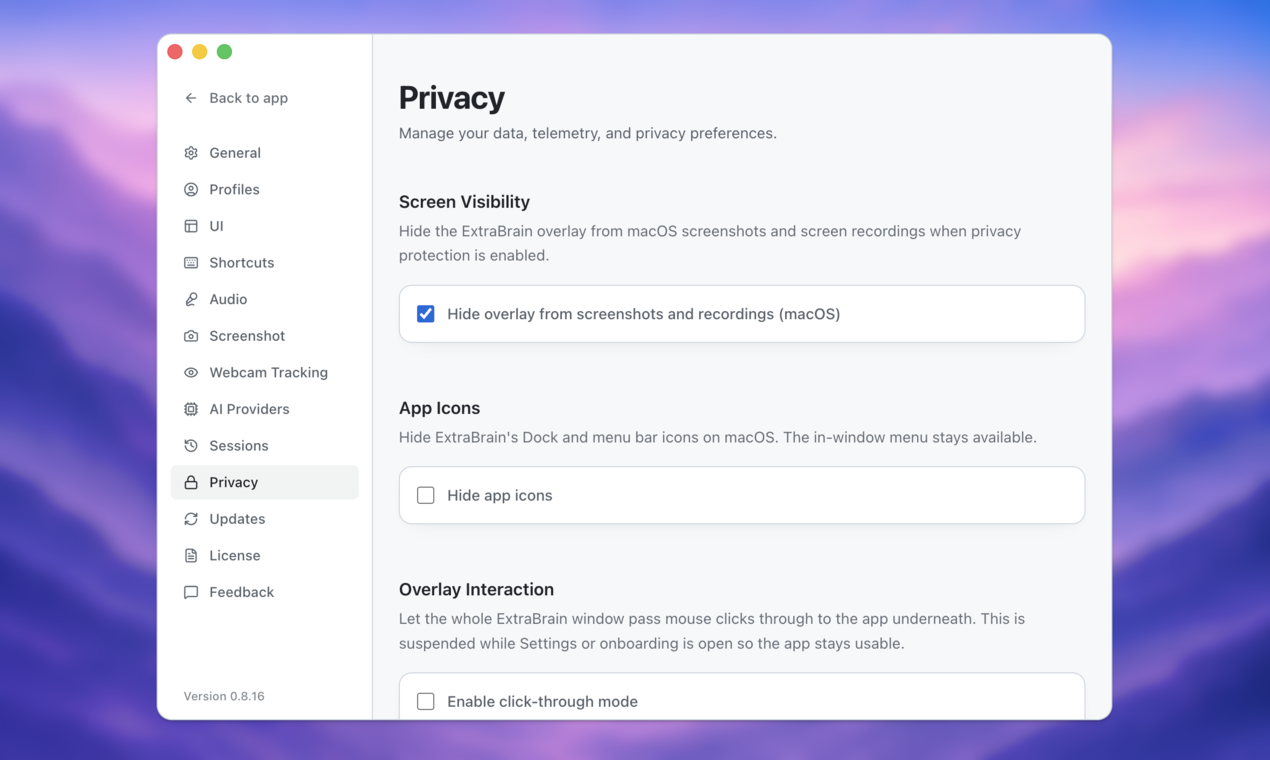
ExtraBrain is designed to stay hidden from screen sharing and screen recording on major meeting tools. That does not make every use acceptable. You are still responsible for following the rules of the interview, workplace, school, or assessment platform.
The strongest setup is not secretive dependency on an answer machine. The strongest setup is a tool that helps you track context, organize your thinking, ask better clarifying questions, and review what happened afterward.
Live coding interview workflow
A coding interview is rarely just a coding problem. It is a conversation about constraints, tradeoffs, implementation choices, edge cases, debugging, and communication.
A useful CTRLpotato alternative should help with the full loop:
- Capture the prompt and discussion clearly.
- Identify the actual task, not just keywords.
- Suggest clarifying questions before jumping into code.
- Outline an approach in the language you plan to use.
- Keep edge cases visible while you implement.
- Help explain time complexity, space complexity, and tradeoffs.
- Preserve notes and transcript context for review after the call.
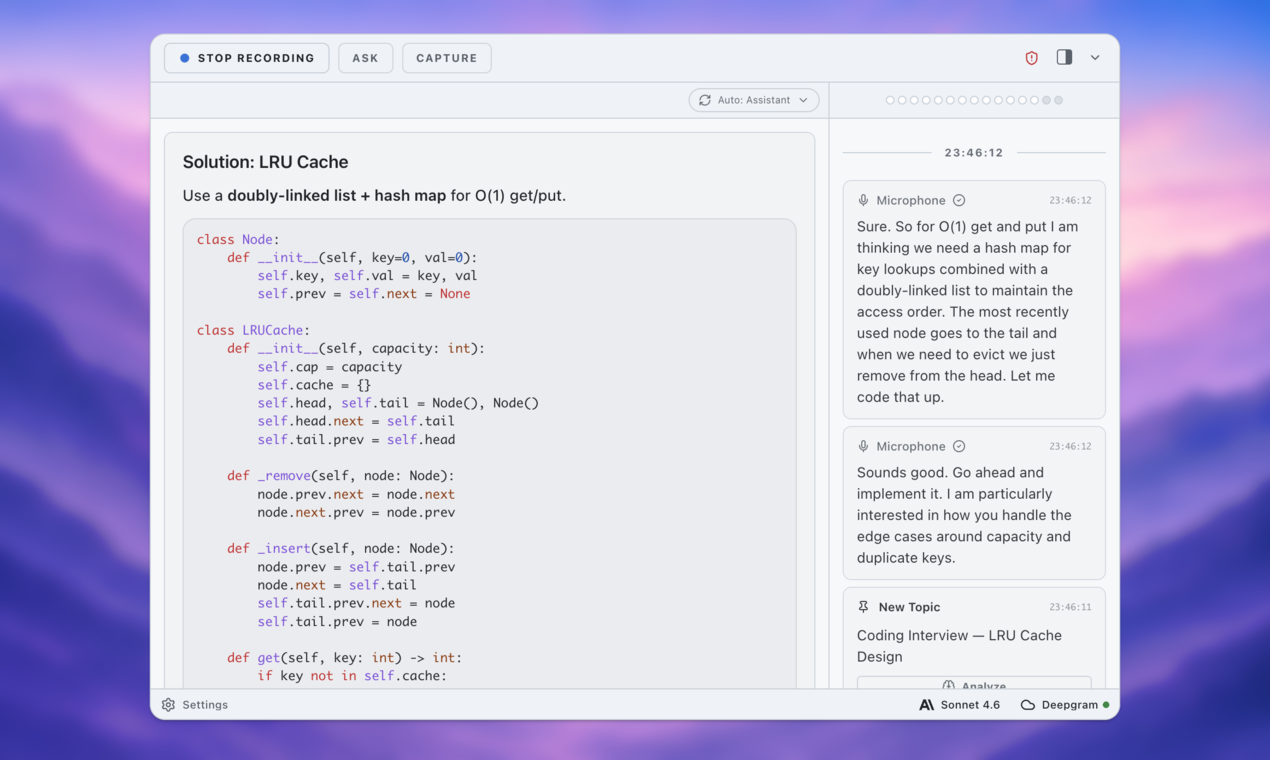
ExtraBrain is built for that broader workflow. It can use live transcript and screen context to help you form answer outlines, technical explanations, follow-up questions, and review notes.
For example, if the interviewer asks you to implement an LRU cache, the useful help is not just a final code snippet.
Useful help is remembering to discuss the hash map plus doubly linked list structure, capacity eviction, update behavior, get and put complexity, and the edge case where capacity is one.
System design and behavioral interviews need memory, not just answers
CTRLpotato alternatives are often evaluated through coding interview examples, but live assistance matters just as much in system design and behavioral interviews.
In system design, the assistant should help you structure the conversation rather than dump a generic architecture. A strong workflow keeps track of requirements, traffic assumptions, storage choices, API boundaries, failure modes, and tradeoffs.
In behavioral interviews, the assistant should help you stay grounded in your own experience. It should not invent stories or push you into answers that contradict your resume, previous responses, or actual background.
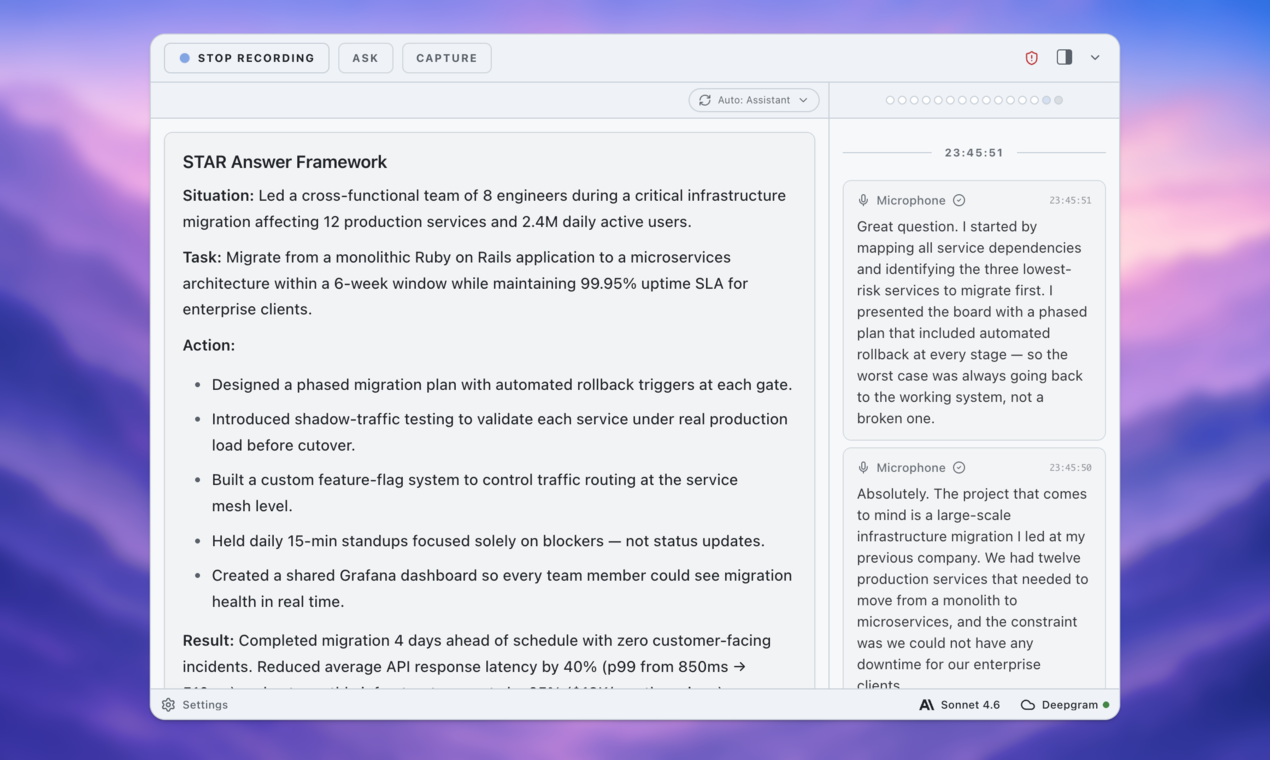
ExtraBrain can work like a focused second brain for interviews and meetings. It gives you a workspace for live sessions, transcripts, notes, screen context, and review, without trying to replace a general note-taking database.
That is especially useful when an interviewer asks a follow-up like, “What would you do differently?” or “How did you handle disagreement?” The answer has to connect to your real example. A generic AI response is less valuable than a structured reminder of your actual story, stakes, action, result, and lesson learned.
Privacy and provider control
Privacy is one of the biggest reasons to look beyond a simple live answer tool. Interview transcripts, screenshots, resumes, company names, code prompts, and meeting notes can all be sensitive.
ExtraBrain is local-first. With local Parakeet transcription plus local Gemma 4 on-device AI where installed and compatible, transcription and AI prompts can stay local. Local Gemma 4 requires installation and compatible hardware, so it may not be available on every Mac or customer environment.
ExtraBrain also supports external providers such as Anthropic, OpenAI, custom OpenAI-compatible endpoints, Claude Subscription, and Codex Subscription. If you choose an external provider, prompts, transcript text, screenshots, audio, or other context may leave your device depending on your configuration.
That distinction matters. A serious CTRLpotato alternative should not hide how data flows. It should help you decide which provider posture is appropriate for a live interview, a workplace meeting, a lecture, or a research call.
Price and value comparison
Pricing pages and subscription terms can change, so you should always check CTRLpotato’s current plan details before paying. Instead of treating a single price as the whole comparison, evaluate the value model.
Ask these questions:
- Can you try the core workflow before committing to a paid plan?
- Does the product work on your actual computer and meeting setup?
- Are AI and transcription costs included, bundled, or billed separately?
- Can you choose your own AI provider?
- Does the tool still help after the live interview ends?
- Are privacy controls clear enough for sensitive interview and workplace contexts?
ExtraBrain’s core Mac app is free. ExtraBrain Pro is $9.99 per month, $79 per year, or $149 Lifetime launch pricing. External AI and transcription provider usage is billed separately by the providers users choose.
For many Mac users, that makes ExtraBrain a lower-friction alternative because you can start with the free core app and decide later whether Pro features or external provider usage are worth it.
When ExtraBrain is the better CTRLpotato alternative
ExtraBrain is likely the stronger fit if you want a Mac desktop assistant that supports more than quick answer generation.
Choose ExtraBrain if you care about:
- A free core desktop app for Mac.
- Live transcription during interviews and meetings.
- Screen-aware context for coding, system design, product, and behavioral conversations.
- Local-first options with local Parakeet transcription and local Gemma 4 where installed and compatible.
- Bring-your-own provider control instead of being locked into one bundled model path.
- Post-interview review through sessions, notes, transcripts, and context.
- A tool that can also support meetings, lectures, customer calls, and research conversations.
CTRLpotato may still be worth evaluating if its current workflow matches your exact interview setup and you are comfortable with its platform support, pricing, data handling, and usage rules. The best choice is the one that helps you think clearly without pushing you into behavior that violates expectations.
Practical checklist before using any live interview copilot
Before using CTRLpotato, ExtraBrain, or any other AI interview assistant, run through this checklist.
Confirm the rules
Read the interview invitation, assessment policy, employer guidance, school policy, or platform terms. If AI assistance, transcription, screen capture, or notes are not allowed, do not use them.
Test your setup before the call
Run a mock session with the same meeting tool, microphone, screen sharing flow, and coding editor. Do not wait until the real interview to discover permission, audio, or display issues.
Prepare your own examples
For behavioral interviews, write down real stories from your work and projects. An assistant can help structure those stories, but it should not invent them.
Practice speaking, not reading
A live copilot should support your thinking. If you sound like you are reading a hidden script, the tool is hurting your performance.
Review afterward
The best improvement often happens after the interview. Use transcripts and notes to identify where you hesitated, where you missed a constraint, and which follow-up questions you should practice next.
FAQ
What is the best CTRLpotato alternative for Mac?
ExtraBrain is a strong CTRLpotato alternative for Mac users who want a free core desktop app, live transcription, screen-aware context, local-first options, provider control, and post-interview review.
Is ExtraBrain only for coding interviews?
No. ExtraBrain supports coding interviews, system design rounds, behavioral interviews, product interviews, customer calls, lectures, and research meetings.
Can ExtraBrain run fully local?
A fully local ExtraBrain posture requires local Parakeet transcription plus local Gemma 4 on-device AI where installed and compatible, with no external provider requests. If you use external providers, selected prompts, transcripts, screenshots, audio, or context may be sent according to your configuration.
Does ExtraBrain work on Windows or Linux?
ExtraBrain is available for macOS today, including Apple Silicon and Intel Macs. Windows and Linux are planned future platforms.
Can ExtraBrain generate interview answers?
ExtraBrain can help generate answer outlines, STAR structures, technical explanations, and follow-up questions from live transcript and screen context. You remain responsible for honest and allowed use.
Is Extra Brain the same as ExtraBrain?
Yes. ExtraBrain is the official product name, and Extra Brain is a common spaced search alias for the same app.