
ExtraBrain Blog
The Ethical Way to Bring AI Into Your Job Search

A responsible AI framework for job seekers using AI for resumes, interview prep, practice, privacy, and post-interview review.
AI has created a strange new pressure in the job search: if you do not use it, you worry you are falling behind; if you do use it, you worry you are cheating.
The hiring process has become AI-shaped on both sides, but the rules still feel vague. The useful question is not, “Is AI allowed in a job search?” It is: does this use of AI help me present my real ability more clearly, or does it create a version of me that is not true?
That is the ethical line. AI can be a preparation layer, memory aid, privacy-conscious workspace, and communication coach. It should not become an impersonator. It should not invent achievements, secretly answer live assessments, or help you win a job you cannot actually do.
The Cheating Debate Is Real, but It Is Too Small
Most arguments about AI in hiring collapse into one dramatic word: cheating.
That concern is legitimate. If a candidate secretly uses AI to solve a coding challenge, write a case-study answer, or feed them real-time responses during an interview where independent work is being evaluated, the candidate is misrepresenting what they can do. The problem is not that software was involved. The problem is deception.
But focusing only on cheating misses the larger reality. Many job seekers use AI because hiring is noisy, inconsistent, and exhausting: job descriptions are vague, resumes need translation, strong candidates ramble under pressure, and experienced professionals may not have interviewed in years. Those are not cheating problems. They are clarity problems.
A responsible AI job-search workflow starts by separating two categories:
- Support: AI helps you prepare, organize, remember, practice, or reflect.
- Substitution: AI performs the skill, invents the evidence, or hides material assistance.
Support can make the process fairer. Substitution breaks trust.
Use AI to Translate Your Experience, Not Upgrade It
The resume stage is where ethical drift often begins because the incentive is obvious: make the resume match the job.
There is nothing wrong with using AI to compare a job description against your resume. In fact, it can be one of the most practical uses of AI in the entire search. Ask for the core responsibilities, must-have skills, repeated phrases, and likely evaluation criteria. Then compare those against your actual experience.
The responsible move is translation.
Maybe the job description says “stakeholder management,” while your resume says “worked with product and support.” If you did coordinate across teams, resolve priorities, and keep people aligned, AI can make that real experience legible. The irresponsible move is inflation: adding revenue numbers you never measured, leadership responsibilities you never held, or tools you barely touched.
A simple rule helps: never put a sentence on your resume that you cannot explain calmly in a live conversation.
Use AI to find missing evidence, weak phrasing, unclear bullets, and role-specific language. Do not use it to create a fictional candidate.
Build a Story Bank Before You Build Scripts
Interviews reward prepared candidates, but overprepared candidates can sound fake.
This is where many people misuse AI. They ask for “perfect answers” to common interview questions and then try to memorize them. The result is usually a polished paragraph that sounds like everyone else:
I thrive in fast-paced environments and enjoy collaborating cross-functionally to deliver impact.
That sentence is not wrong. It is just empty.
A better approach is to use AI to build a story bank from your real experience. Start with the role. Ask AI to identify likely interview themes: conflict, ownership, ambiguity, technical depth, customer empathy, leadership, deadlines, tradeoffs, mistakes, or collaboration. Then choose true examples from your own work for each theme.
For every story, capture five points:
- What was happening?
- What was your responsibility?
- What action did you personally take?
- What changed because of it?
- What did you learn?
AI can help tighten the story. It can tell you where the stakes are unclear, where you sound passive, where the result is missing, or where the answer takes too long to reach the point. But the raw material should be yours.
This distinction matters because interviews are not only about content. They are about ownership. If an interviewer asks a follow-up, you need to be able to go deeper. You need to explain the messy parts. You need to remember what actually happened.
AI-generated scripts collapse under follow-up questions. Real stories get stronger.
Practice Out Loud, Because Written Answers Lie
A job seeker can write a great answer and still struggle to say it naturally.
That gap matters. Interviews happen in conversation. You pause, restart, lose a detail, over-explain one part, under-explain another, and sometimes realize halfway through that you are answering a slightly different question than the one asked.
This is where AI can be genuinely useful without becoming ethically questionable. Record a mock answer. Transcribe it. Review what you actually said, not what you wish you had said.
A tool like ExtraBrain fits this workflow because it is built around conversation context rather than generic prompt-and-response drafting. As an AI interview preparation workspace, it can help you review practice sessions, notice rambling, capture follow-up questions, and refine your explanations while keeping the substance under your control.
The ethical use is not “tell me what to say in the interview.”
The ethical use is:
- “Where did my answer become unclear?”
- “Which point should come first?”
- “What follow-up question would test this story?”
- “Did I explain my role, or did I hide behind the team?”
- “What should I practice before the next round?”
That kind of AI support makes you more prepared. It does not replace you.
During Live Interviews, Permission Decides the Boundary
The ethical line gets sharpest during live interviews and assessments.
Before an interview, AI can help you research, prepare, practice, and organize. After an interview, AI can help you debrief and improve. During an interview, the rules depend on what the employer allows and what is being evaluated.
If you are in a normal conversational interview, private notes may be acceptable. If you are in a technical screen, writing exercise, case study, coding challenge, or take-home assignment, assume the company expects your own work unless it explicitly says otherwise.
The safest question is also the simplest: “Are candidates allowed to use notes, documentation, search, or AI tools during this exercise?” That question is professional. If AI is allowed, use it transparently and be ready to explain how. If AI is not allowed, do not use it. If the answer is vague, stay conservative.
A private AI interview copilot should be used to support memory, preparation, notes, and reflection in ways that respect the interview rules. It should not secretly generate answers in a closed assessment or create the impression that you independently solved something you did not understand.
The ownership test is useful here:
- Could I disclose this use of AI without damaging trust?
- Am I still doing the skill being evaluated?
- Can I explain and defend the answer without the tool?
- Did the interviewer give permission for this type of support?
If the honest answer is no, stop.
Privacy Is an Ethical Issue Too
Most people talk about AI ethics in hiring as if it is only about fairness to employers. Candidates also need to think about privacy.
A job search contains sensitive data: your resume, salary expectations, career gaps, manager names, health or scheduling constraints, immigration status, confidential project details, customer examples, and personal doubts. Interview practice can reveal even more because it captures how you explain pressure, conflict, failure, ambition, and change.
Before pasting that material into any AI tool, ask:
- Does the tool need the full detail, or can I redact names?
- Do I know where the data is processed?
- Is the content stored, shared, or used for training?
- Can I delete it later?
- Am I exposing confidential information from a current or former employer?
You do not need to become paranoid. You need to become deliberate.
Replace customer names with placeholders. Generalize internal systems. Remove compensation details unless they are necessary. Do not paste proprietary documents into a tool just to get a smoother answer.
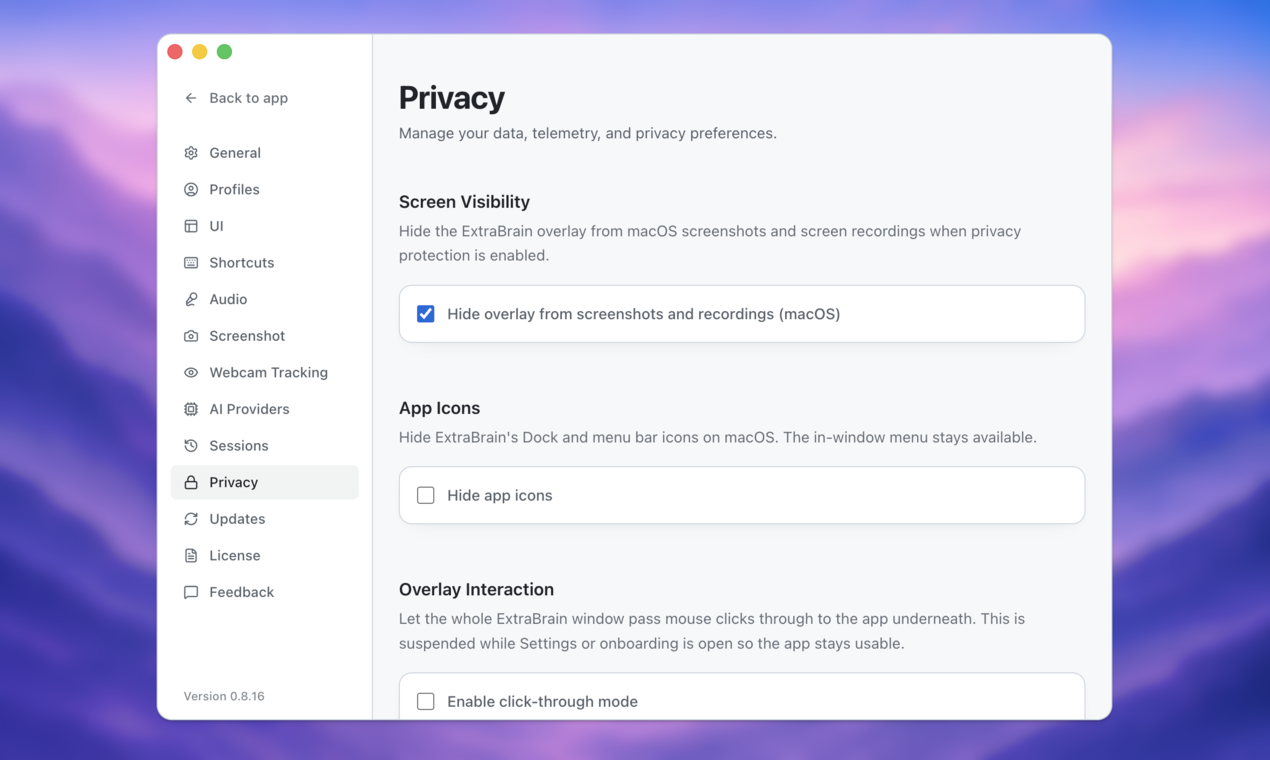
This is why local-first and user-controlled AI tools matter. A local-first AI meeting copilot is not just a technical preference; it is a better default for sensitive conversations. The less unnecessary data you send away, the easier it is to use AI responsibly.
Use AI After the Interview to Learn, Not Spiral
After an interview, most candidates replay the conversation emotionally. They remember the awkward pause, forget the strong answer, and try to infer the outcome from a facial expression.
AI is not good at mind-reading. Do not ask it whether you got the job.
Use it to debrief instead.
Right after the call, write or record quick notes:
- What questions did they ask?
- Which answer felt strongest?
- Where did you ramble or miss the point?
- What did the interviewer emphasize?
- What follow-up should you send?
- What should you practice before the next round?
Then ask AI to organize those notes into a short improvement plan. This is where responsible AI becomes a compounding advantage. Each interview teaches you something. Each debrief makes the next conversation sharper.
The goal is not to optimize yourself into a different person. The goal is to notice patterns you would otherwise miss.
Maybe your examples are strong but too long. Maybe you talk about team outcomes without explaining your contribution. Maybe you avoid numbers. Maybe you undersell leadership because you do not have a manager title. Maybe you need a clearer answer for why this role, why now, and why you.
That is useful. That is ethical. That is learning.
A Practical Responsible AI Policy for Job Seekers
Do not wait for every employer to publish perfect AI rules. Create your own policy first.
Here is a simple one:
Before applying: Use AI to understand the role, identify real matches, improve resume clarity, and prepare truthful materials.
Before interviews: Use AI to build a story bank, practice out loud, identify weak explanations, and generate follow-up questions for practice.
During interviews: Use only the tools the employer allows. Ask when unclear. Do not use hidden AI to perform the skill being evaluated.
After interviews: Use AI to debrief, summarize lessons, draft follow-up notes, and prepare for the next stage.
For privacy: Redact sensitive details, avoid confidential employer data, and prefer tools that keep you in control of your context.
For ownership: Never submit, say, or imply anything you cannot explain yourself.
That policy will not remove every gray area. But it gives you a grounded default when the pressure rises.
The Best AI Advantage Is Integrity Plus Clarity
The future of job searching will not be AI-free. That is already over. The real choice is whether AI becomes a hidden substitute or a responsible support system.
Used badly, AI can make candidates sound more qualified than they are. It can flood employers with polished sameness. It can reward deception, encourage surveillance, and turn interviews into an arms race between hidden copilots and detection tools.
Used well, AI can do something much better. It can help candidates understand roles, tell true stories clearly, practice under realistic conditions, remember what happened, protect sensitive context, and improve after every conversation.
That is the ethical path: clarity without counterfeit, support without impersonation, confidence without deception.
If you want a private place to prepare, practice, debrief, and stay in control of your own interview context, try ExtraBrain before your next job-search conversation.