
ExtraBrain Blog
Haven’t Interviewed Since Before AI? A Calm Guide to Using AI Without Losing Your Voice
Returning to interviews after years away? Learn how mid-career candidates can use AI prep responsibly and reduce anxiety.
If you have not interviewed in years, the process can feel like returning to a city where every street changed names. The questions are familiar, but the rituals have changed. There are AI resume tools, AI mock interviewers, AI meeting copilots, and a quiet new anxiety: Am I supposed to use these? And if I do, will I stop sounding like myself?
Reasonable. A good interview is not a performance of perfect answers. It is a conversation where a hiring team tries to understand how you think, how you work, and whether the role fits both sides. AI can help you prepare, but it should not replace your judgment, your stories, or your voice.
The new interview anxiety is not just about answering questions
Mid-career candidates carry a specific kind of interview stress. You are not new to work. You have led projects, handled conflict, shipped things, mentored people, and learned lessons that do not fit neatly into a thirty-second answer.
Then you open a job search tab and see advice built for someone optimizing a funnel: keyword-match your resume, rehearse STAR answers, generate cover letters, practice behavioral questions, research the company, and now, apparently, use AI.
The problem is not any one step. The problem is feeling like you need to become a polished candidate-bot.
That is the wrong goal.
The real goal is calmer recall. You want to remember the stories you already have, organize them clearly, and practice saying them in a way that feels natural under pressure. AI is useful when it helps you do that. It becomes harmful when it tempts you to outsource the parts of the interview that should come from you.
Use AI as a mirror, not a mouthpiece
The simplest rule I have found is this: AI should reflect and refine your thinking, not speak in your place.
A mouthpiece gives you lines. A mirror helps you notice what you meant, what you skipped, and where your answer got muddy.
If you ask an AI tool to “write the perfect answer” to “Tell me about a time you handled conflict,” you may get something smooth and useless. It will not carry your actual experience, and it may disappear the moment a follow-up question gets specific.
A better prompt is grounded in your real material:
I’m preparing for a product leadership interview. Here is what happened in a cross-functional conflict I handled. Help me identify the decision point, the tradeoff, the action I took, and the outcome. Then ask me three follow-up questions a skeptical interviewer might ask.
That prompt keeps you in control. You provide the experience. AI helps you structure it and pressure-test it.
Start by building your story bank
Most interview prep fails because people start with questions instead of evidence. They search for the top 50 behavioral interview questions and try to invent answers one by one. That creates repetition, panic, and a lot of thin stories.
Start with a story bank instead.
Open a document and list eight to twelve moments from your career that still feel vivid. Do not polish them yet. Just name them.
Examples: the launch that almost slipped, the customer escalation you stabilized, the deadline you pushed back on, the teammate you coached, the project you would redo, or the ambiguous problem nobody owned.
Once you have the list, ask AI to help you map each story to interview themes: leadership, conflict, execution, ambiguity, collaboration, failure, judgment, influence, and learning.
The point is not to manufacture answers. The point is to realize you already have enough raw material. You are organizing memory, not inventing a candidate persona.
Turn long experience into clear answers
Mid-career candidates often struggle for the opposite reason junior candidates do. You do not lack examples. You have too many, and each one has context.
You know the politics behind the project. You remember the constraints, the personalities, the messy timeline, and the six things that happened before the important thing. The interviewer does not need all of that at once.
AI can help you compress without flattening.
Take one story and talk it through out loud for three minutes. Record yourself or transcribe it with a tool you trust. Then ask:
What is the clearest one-minute version of this story? Preserve my meaning, but identify where I over-explained background or skipped the result.
Notice the wording: preserve my meaning. You are not asking for a corporate rewrite. You are asking for an editor.
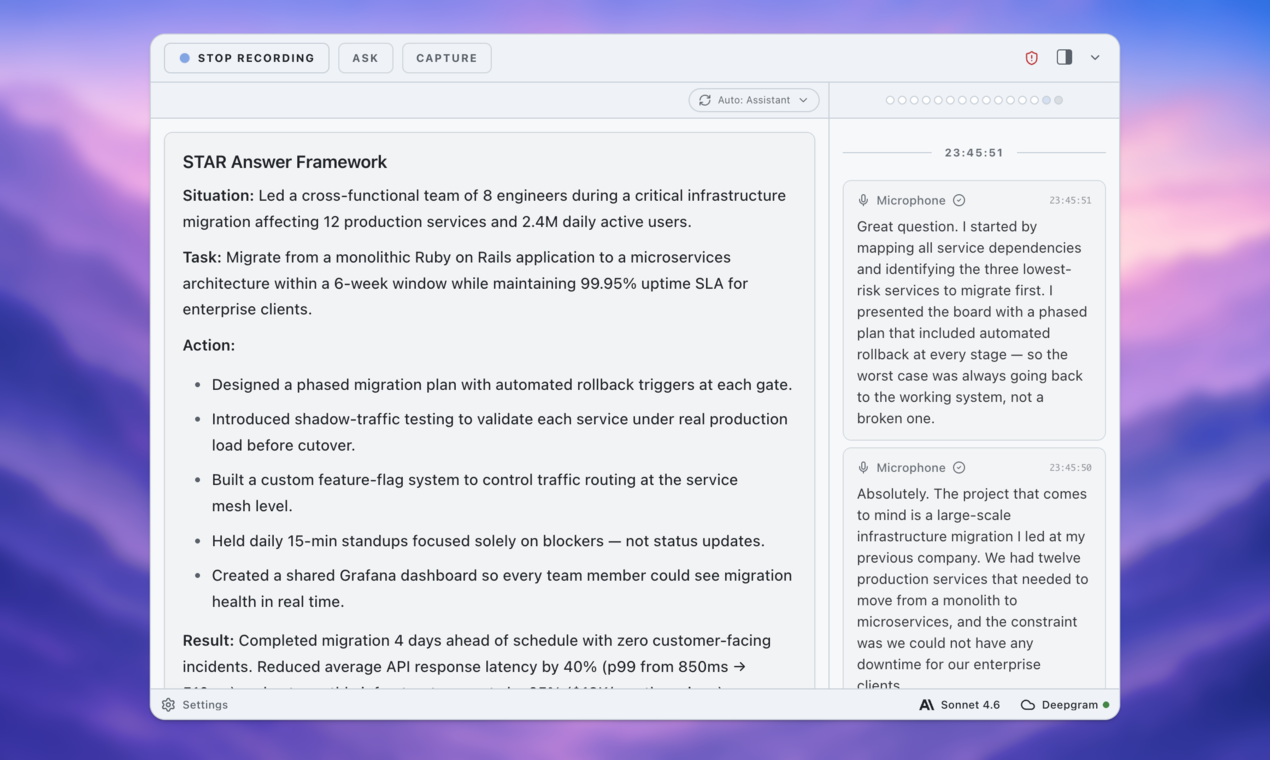
A good one-minute answer usually has four beats: context (what was happening), tension (what made it difficult), action (what you personally did), and result (what changed and what you learned).
You can still sound like yourself inside that structure. In fact, structure often makes your natural voice easier to hear because you are not fighting through clutter.
Practice follow-up questions, not scripts
The biggest risk of AI interview prep is false confidence. A generated answer can make you feel prepared because it sounds complete. Real interviews rarely reward completeness on the first pass. They reward clarity under follow-up.
That is why your practice should include interruptions.
After you shape an answer, ask AI to behave like a thoughtful interviewer:
Ask five follow-up questions that would test whether this story is real. Focus on tradeoffs, my specific contribution, measurable outcomes, and what I would do differently.
Then answer those questions without looking at a script.
This is where AI becomes useful for anxiety. The fear behind many interviews is not “I know nothing.” It is “What if they ask the one question I did not prepare for?” Practicing follow-ups teaches your nervous system that you can respond from understanding, not memorization.
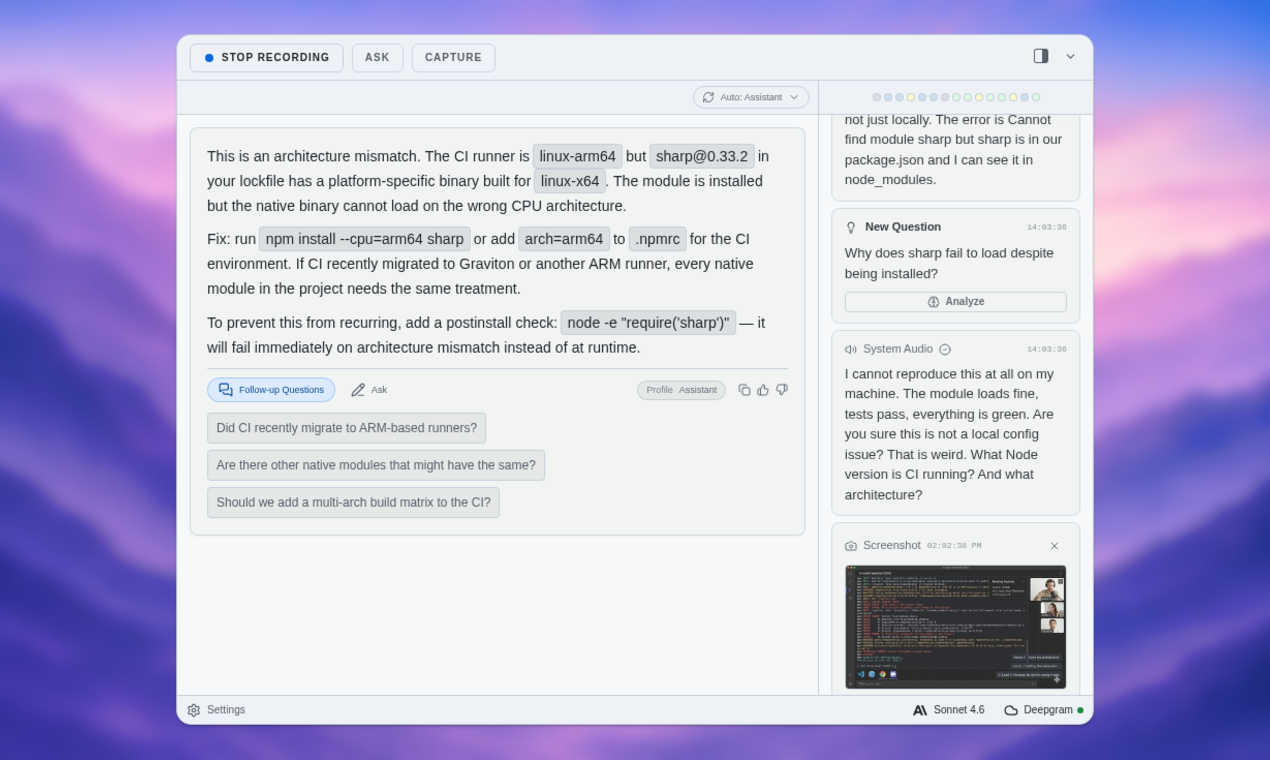
If you are using a tool like ExtraBrain, a local-first AI meeting copilot, you can talk through a mock answer, review the transcript, and use the analysis to spot where you drifted, rushed, or lost the thread. That kind of review is most helpful when it stays private, grounded in your own words, and under your control.
Keep a “do not say it that way” list
One underrated way to preserve your voice is to name what does not sound like you.
AI tools often default to phrases that are technically acceptable but emotionally wrong. “I spearheaded a cross-functional initiative to drive alignment” may be accurate in some universe, but if you would never say that out loud, do not bring it into an interview.
Create a short list of banned phrases for your prep: “I am passionate about leveraging synergies,” “I thrive in fast-paced environments” without an example, “I single-handedly” for team work, “my weakness is perfectionism,” or any answer that makes conflict sound tidier than it was.
Then give AI a simple instruction:
Keep the answer conversational. Do not use buzzwords. If the phrasing sounds like a LinkedIn post, rewrite it in plainer language.
Better yet, read every answer out loud. Your ear is a strong filter. If a sentence makes you cringe in your own voice, cut it.
Be honest about AI use and interview boundaries
Responsible AI interview prep has a bright line: preparation is fine; deception is not.
Using AI before an interview to organize your stories, practice follow-ups, research themes, or review your own mock responses is similar to working with a coach, a friend, or a notebook. Using AI during a live interview to secretly generate answers you present as spontaneous judgment is different. It can violate the employer’s process, damage trust, and prevent both sides from learning whether the role is actually a fit.
If an interview allows tools, follow the stated rules. If it does not, do not try to outsmart the format. For technical interviews, take-home exercises, presentations, or live case work, clarify expectations when needed. A simple question is enough: “Are there any tools or references you prefer candidates not use for this exercise?”
This is not just ethics. It is practical. If you get a job by performing a version of yourself that cannot show up on day one, you have created a worse problem than interview anxiety.
Use AI to prepare questions for them, too
Interviews are not only a test of you. They are also your chance to understand the company, manager, team, and role.
AI can help you prepare better questions by turning vague concerns into specific, fair prompts.
Instead of asking, “What is the culture like?” try: “When priorities conflict, how does this team decide what not to do?” or “What would make someone successful in the first six months?” or “Where does this role have real decision authority, and where does it need influence?”
These questions help you evaluate fit and sound like someone who has worked inside real organizations. You are not trying to impress with cleverness. You are trying to have an adult conversation about work.
A simple AI prep routine for the week before
If you are returning to interviews after a long gap, do not spend a week bouncing between tools. Use a small routine.
Seven days before: Build your story bank. List career moments and map them to themes.
Five days before: Choose six core stories and shape each into a one-minute version.
Three days before: Practice follow-up questions. Focus on specifics: what you did, why it mattered, what changed, and what you learned.
Two days before: Research the company and role. Prepare questions that test fit, not just enthusiasm.
One day before: Do one calm mock interview. Do not cram. Review only the patterns: where you ramble, where you undersell, where you need a sharper result.
Day of: Read your story bank, not a script. Remind yourself that the goal is a clear conversation, not a flawless performance.
This routine works because it gives AI a defined job at each step. You are not asking it to become you. You are asking it to help you prepare the version of you that already exists.
The goal is not to beat the interview
The best interviews feel less like a test and more like a working session. You explain how you think. They explain what the role needs. Both sides discover whether there is a match.
AI can support that if you use it with restraint. Let it help you remember, organize, compress, and practice. Let it ask the follow-up you hope you do not get. Let it show you when your answer is buried under too much context.
But keep the source material yours. Your voice is your judgment: what you noticed, what you chose, what you learned, and how you explain tradeoffs when the answer is not obvious.
If you have not interviewed since before AI became part of the job search, you do not need to become an AI-generated candidate. You need a calmer prep process, a clearer story bank, and tools that stay in the background.
Use AI to get ready. Then walk into the conversation as yourself.