
ExtraBrain Blog
How to Cheat on CodeAid 2026 Without Getting Caught? A Responsible Reality Check

A practical, responsible guide to CodeAid 2026 assessments, AI proctoring risk, allowed preparation, and using ExtraBrain only where rules permit.
People search for “how to cheat on CodeAid 2026 without getting caught” because online coding assessments are stressful, time-limited, and increasingly monitored. The more useful answer is blunt: if CodeAid or an employer says the assessment must be completed without outside help, do not secretly use AI, another person, a second device, or copied code. That kind of shortcut can cost you the score, the interview, the offer, and your credibility.
There is still a practical reason to understand CodeAid detection, AI proctoring, copy-paste checks, and suspicious behavior patterns. Knowing what assessment platforms look for helps you avoid accidental flags, prepare in ways that are allowed, and decide whether a tool is appropriate before the test begins.
ExtraBrain is a free, local-first desktop AI interview assistant and meeting copilot for Mac. It can help with coding interview practice, system design preparation, behavioral interview drills, live transcription in allowed settings, screen-aware context, local Gemma 4 where installed and compatible, bring-your-own AI providers, and post-session review. It should only be used where interview, employer, school, workplace, meeting, and platform rules allow AI assistance, transcription, screenshots, or notes.
Key Takeaways
- CodeAid-style assessments can monitor browser behavior, screen activity, timing, copy-paste events, webcam signals, audio, and code similarity.
- The highest-risk tactics are pasted AI solutions, public-code copying, hidden collaboration, external devices, and answers you cannot explain.
- The safer path is to use AI before the assessment for study, mock interviews, debugging practice, and explanation drills.
- If AI assistance is explicitly allowed, confirm the rules, use it transparently, and remain responsible for the final solution.
- ExtraBrain is useful for preparation and review, but it is not a license to bypass CodeAid rules or employer instructions.
How CodeAid Detection Usually Works
CodeAid and similar coding assessment platforms are built to evaluate whether the submitted work reflects the candidate’s own ability. Exact systems vary, and platforms change over time, but most detection strategies look at a combination of environment signals, behavior signals, and code signals.
Proctoring and Monitoring
Proctored coding assessments may ask for camera, microphone, screen, browser, or identity verification access. Some tests are fully automated, while others include a live interviewer or human review after the assessment.
| Signal | What It Can Indicate | Why It Matters |
|---|---|---|
| Webcam behavior | Looking away repeatedly, reading from another screen, or unusual face movement | The reviewer may suspect outside help. |
| Audio behavior | Voices, whispers, repeated pauses, or background conversation | The platform may suspect collaboration. |
| Screen activity | Leaving the test window, opening tools, or using a second display | The test may prohibit outside resources. |
| Timing | Perfect answers submitted unusually quickly | The solution path may not look organic. |
| Identity checks | Mismatch between profile, camera, and session data | The platform may suspect impersonation. |
The point is not to perform for the camera. The point is to follow the stated rules and make sure your setup does not create misleading signals.
Browser and Tab Tracking
Many coding assessments track browser focus, tab switching, clipboard events, display configuration, and sometimes network or device changes. Some platforms warn you when you leave the tab. Others log the event silently and leave it for later review.
Before a CodeAid assessment, read the rules carefully. If the instructions say no external websites, no AI tools, no second monitor, or no clipboard use, treat those as hard constraints. If the instructions allow documentation, notes, or a specific IDE, keep your workspace within that boundary.
Avoid unnecessary setup changes during the assessment. Changing VPN locations, adding a monitor, switching browsers, moving between devices, or opening unrelated apps can create avoidable review risk even when you are not cheating.
AI and Copy-Paste Detection
AI-generated code can be detected in several ways. Some signals are direct, such as large pasted blocks or a sudden shift in typing speed. Other signals are indirect, such as a solution that appears instantly, uses a style you cannot explain, or matches common generated answers.
| Detection Pattern | What Reviewers May Notice |
|---|---|
| Code similarity | Your answer matches public solutions, generated templates, or other submissions. |
| Typing pattern | A large block appears at once instead of being written and revised. |
| Solution pathway | The final answer skips the normal reasoning, testing, and correction process. |
| Style mismatch | Variable names, abstractions, or idioms do not match your earlier work. |
| Follow-up failure | You cannot explain the algorithm, tradeoffs, edge cases, or complexity. |
The real risk is not only being detected by software. The bigger risk is being unable to defend the work in a follow-up interview.
The Responsible Answer to “Can I Cheat CodeAid?”
If the test rules prohibit outside help, the responsible answer is no. Do not use ExtraBrain, ChatGPT, a friend, a hidden document, a phone, or another assistant to complete the live assessment.
That does not mean AI has no place in your interview process. It means the timing and use case matter.
Allowed Preparation Before the Test
AI can be extremely useful before a CodeAid assessment. Use it to build a study plan, practice core patterns, review old mistakes, explain algorithms, generate similar practice questions, and rehearse how you will talk through tradeoffs.
ExtraBrain can help you structure that preparation on Mac. You can use it as a coding interview copilot during mock sessions, capture transcripts from practice calls where everyone has agreed, review notes afterward, and turn weak areas into follow-up drills.
For CodeAid-style assessments, useful preparation areas often include:
- Arrays, strings, hash maps, stacks, queues, trees, graphs, heaps, recursion, and dynamic programming.
- Time complexity, space complexity, edge cases, input validation, and test strategy.
- Debugging under time pressure without losing your reasoning thread.
- Explaining why you chose one approach over another.
- Writing clean code that looks like your own work because it is your own work.
Allowed Use During the Test
Some assessments are open-book, take-home, or explicitly AI-permitted. If CodeAid, the employer, or the school allows AI assistance, use it within the stated boundaries.
That usually means you should confirm:
- Whether AI tools are allowed at all.
- Whether generated code must be disclosed.
- Whether documentation and search are allowed.
- Whether copying snippets is allowed.
- Whether screen recording, transcription, or note taking is allowed.
- Whether external providers can receive prompt text, screenshots, audio, or transcript content.
ExtraBrain supports bring-your-own AI providers, local Gemma 4 where installed and compatible, local Parakeet transcription, optional Deepgram transcription, and clear privacy controls. With a fully local posture using local Parakeet plus local Gemma 4 where installed and compatible, transcription and AI prompts can stay local. If you select external providers, selected prompts, transcript text, screenshots, audio, or context may leave the device depending on configuration.
Not Allowed Use
Hidden real-time help is different from preparation. If the rules say independent work, secretly receiving answer frameworks, code, debugging steps, or explanations during the live assessment is misrepresentation.
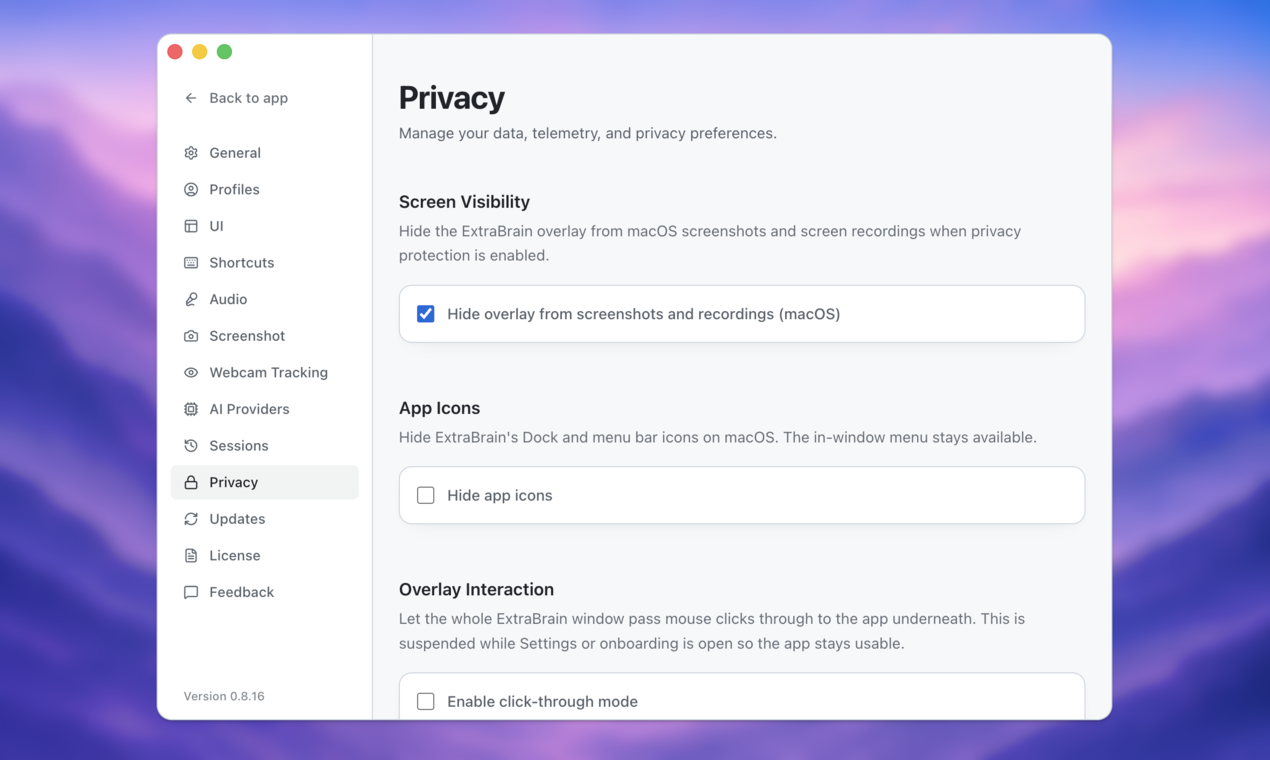
Screen-sharing privacy controls also do not change the rules. ExtraBrain is designed with privacy-conscious desktop controls, but those controls should be used to manage permitted workflows, not to hide prohibited assistance.
High-Risk Tactics That Get Candidates Flagged
The original temptation is understandable. You may feel underprepared, worry the problem will be unfair, or think everyone else is using AI anyway. Even so, some tactics are especially likely to fail.
Pasting AI-Generated Code
Pasting a finished answer is one of the easiest patterns to review. It can show up in clipboard logs, timing data, code similarity, and your inability to explain intermediate decisions.
If you use AI while studying, do not memorize finished solutions. Practice reconstructing the solution from first principles, writing tests, explaining the complexity, and handling variations.
Copying Public Solutions
Stack Overflow, GitHub, forums, and solution blogs are useful for learning before the test. They are risky during an assessment unless the rules explicitly allow them.
Public code can appear in many submissions. Even small cosmetic edits may not be enough if the structure, helper functions, variable order, and edge-case handling remain the same.
Real-Time Collaboration
Group chats, friends, shared documents, voice calls, and remote-control sessions create obvious integrity problems. They also create practical detection signals through audio, timing, focus changes, and inconsistent reasoning.
If you need coaching, get it before the assessment. During an independent test, the submitted work should be yours.
External Devices and Second Screens
Phones, tablets, spare laptops, and hidden monitors are high risk because proctoring often focuses on eye movement, gaze direction, hand movement, screen configuration, and audio. Even if a device is not detected automatically, the behavior around it can still look suspicious.
Use the simplest allowed setup. Close unrelated apps, silence notifications, keep required documents ready only if permitted, and avoid changing the environment mid-test.
| Tactic | Risk Level | Better Alternative |
|---|---|---|
| Pasting generated code | Very high | Practice deriving and typing your own solution. |
| Copying public answers | Very high | Study patterns before the test and write fresh code. |
| Hidden collaboration | Very high | Schedule mock interviews before the assessment. |
| Second-device assistance | High | Use only tools permitted by the rules. |
| Unclear AI use | High | Ask the recruiter or proctor before the test starts. |
A Better Strategy for CodeAid 2026
The best way to avoid getting flagged is not to imitate suspicious behavior more carefully. It is to prepare so your real work looks like real work.
Practice the Reasoning, Not Just the Answer
For each problem you practice, write down the path from prompt to solution. What is the brute-force approach? What makes it too slow? What data structure changes the runtime? What edge cases break the first attempt? What tests prove the final version works?
This matters because assessments rarely end at submission. Recruiters, hiring managers, and interviewers may ask how you solved the problem later. If you cannot explain the path, the score will not help you much.
Use ExtraBrain for Mock Sessions
ExtraBrain is strongest when it helps you turn practice into reviewable evidence. During allowed practice sessions, it can capture live transcription, help organize screen-aware context, generate follow-up questions, and help you review where your explanation became vague.
For example, after a mock CodeAid-style problem, you can ask:
- What assumptions did I miss?
- Where did my explanation become hard to follow?
- Which edge cases should I have tested earlier?
- Did my solution have a simpler data structure?
- How should I explain this in a follow-up interview?
That use builds skill instead of replacing it. It also creates a feedback loop that is useful for coding interviews, system design rounds, behavioral interviews, meetings, lectures, and research calls.
Build a Personal Pattern Library
Many candidates fail coding assessments because every prompt feels new. The fix is to build a pattern library from real practice.
Create short notes for common patterns:
- Sliding window when the prompt asks for a best contiguous range.
- Hash map counting when repeated lookup matters.
- Stack when the problem involves matching, nesting, or monotonic order.
- Two pointers when sorted input or inward movement is useful.
- BFS when shortest path by number of steps matters.
- DFS when exhaustive traversal or connected components matter.
- Heap when you need repeated access to the smallest or largest item.
Use AI to quiz you on when each pattern applies. Do not use AI to skip the thinking during the actual assessment.
If AI Is Explicitly Allowed
Some companies now allow AI because they want to evaluate how candidates work with modern tools. That is different from hidden assistance.
If AI is allowed, treat it like a professional tool:
- Keep the rules visible and follow them literally.
- Ask the AI for hints, tests, or tradeoff analysis instead of a full replacement answer when possible.
- Read and understand every line before submitting.
- Be ready to explain what the AI helped with.
- Avoid sending confidential employer, customer, or personal data to external providers unless permitted.
- Prefer local or approved provider configurations when privacy matters.
ExtraBrain gives Mac users control over provider choices. You can use local Gemma 4 where installed and compatible, connect supported external providers, or use OpenAI-compatible endpoints according to your own setup and the assessment rules.
What to Do If You Get a Warning
If CodeAid displays a warning, do not try to outsmart it. Stop the behavior that triggered the warning, return to the test window, and follow the platform instructions.
If the warning seems wrong, calmly document what happened after the test and contact the recruiter or support channel. For example, explain that a notification appeared, a browser shortcut misfired, your camera froze, or your internet connection changed.
Do not keep repeating the same action. Multiple warnings can look like a pattern even when the first event was accidental.
FAQ
How do I cheat on CodeAid without getting caught?
You should not try to cheat on CodeAid or any other assessment. If the rules require independent work, use AI before the test for preparation and after the test for review, not secretly during the live assessment.
How do I avoid getting flagged for AI use?
Use AI only where the rules allow it. If AI is allowed, disclose or document it as required, understand the final solution, avoid pasting unexplained code, and keep your workflow inside the permitted tool boundary.
Can ExtraBrain help me prepare for CodeAid?
Yes. ExtraBrain can help Mac users practice coding interviews, review transcripts, organize screen-aware context from allowed practice sessions, generate clarifying questions, and turn mistakes into targeted drills.
Can ExtraBrain be used during a live CodeAid assessment?
Only if CodeAid, the employer, school, or platform rules allow that specific use. Responsible use means following the rules for AI assistance, transcription, screenshots, notes, screen sharing, and provider data flow.
Can ExtraBrain run fully local?
A fully local ExtraBrain posture requires local Parakeet transcription plus local Gemma 4 on-device AI where installed and compatible, with no external provider requests. External providers may receive selected prompts, transcript text, screenshots, audio, or context depending on configuration.
Is using a phone, VPN, or second monitor safe during CodeAid?
Use only what the assessment instructions allow. Phones, VPN changes, second monitors, and extra devices can create review risk, especially if the test requires a locked-down or proctored environment.
How can I make my coding look natural?
Do real work. Think aloud when allowed, write tests, explain tradeoffs, fix mistakes honestly, and make sure the final answer is something you can defend in a follow-up interview.