
ExtraBrain Blog
TestGorilla AI Help in 2026: What Candidates Should Know

A practical guide to TestGorilla AI help, detection risks, responsible use, and how ExtraBrain supports allowed interview prep.

A lot of candidates search for how to cheat in interview on TestGorilla because they feel squeezed by timed tests, unfamiliar formats, webcam checks, and pressure to perform perfectly. The better question in 2026 is not how to bypass the platform. It is how to understand what TestGorilla measures, what gets flagged, and how to use AI tools only where the employer, school, workplace, and platform rules allow them.
ExtraBrain is a free, local-first desktop AI interview assistant and meeting copilot for Mac. It can help with live transcription, screen-aware context, coding practice, system design thinking, behavioral answer structure, and post-session review. It should be used responsibly and only when AI assistance, transcription, screenshots, or notes are allowed.
This guide keeps the practical intent of the original TestGorilla question while removing the risky fantasy that a tool can make dishonest use consequence-free. You will learn what TestGorilla-style assessments commonly include, which behaviors may trigger review, how to prepare with AI before the assessment, and what not to do during a live proctored test.
Before Using AI With TestGorilla, Understand the Assessment
TestGorilla is commonly used early in hiring funnels to screen candidates before a full interview loop. Employers can combine several short tests into one assessment, so a candidate might see a mix of reasoning, role knowledge, coding, personality, situational judgment, and custom questions.
Typical modules can include:
- Cognitive ability tests: logical reasoning, numerical calculations, critical thinking, attention to detail, and pattern recognition.
- Role-specific skills tests: accounting, marketing, SEO, Google Ads, operations, customer support, sales, data analysis, or other domain tasks.
- Coding tests: algorithmic problems, debugging tasks, language-specific questions, or small practical programming exercises.
- Personality and culture tests: work-style inventories, motivation questions, communication preferences, or culture-fit scenarios.
- Situational judgment tests: workplace scenarios where you choose the best and worst response.
- Custom questions: written answers, short video responses, or employer-specific prompts.
That variety matters because AI is not equally appropriate for every module. Using an AI copilot to practice beforehand, review past mistakes, or create a study plan is very different from using AI during a closed-book assessment that forbids outside help.
What TestGorilla-Style Proctoring May Watch For
Candidates often underestimate how many signals modern assessment platforms can collect. Even when the platform cannot see everything on your computer, it may still combine browser activity, timing, webcam snapshots, answer similarity, and review workflows.
Webcam and browser monitoring
Some TestGorilla assessments can require webcam access and periodic snapshots. A reviewer may use those images to check whether the same person stayed in frame, whether another person appeared, or whether the candidate repeatedly looked away in suspicious patterns.
Browser-level controls may also limit copy and paste, track full-screen exits, detect tab changes, or flag unusual interaction patterns. These checks are designed to protect assessment integrity, and candidates should assume that visible browser behavior can be reviewed later.
| Signal | Why it matters |
|---|---|
| Webcam snapshots | They can show whether the candidate stayed present and alone. |
| Copy and paste blocking | It discourages dumping answers from another source. |
| Full-screen exits | They can suggest that the candidate left the test environment. |
| Tab switching | It can indicate outside search or tool use. |
| IP and device signals | They can help detect unusual access patterns. |
| Randomized questions | They reduce answer sharing between candidates. |
Timing and answer similarity
Assessment platforms and employers may look at how long a candidate spends on each question. A very fast answer to a complex task can look odd. A long pause followed by a flawless essay or perfectly formatted solution can also look odd.
Plagiarism checks can compare written answers or code against other sources. That is one reason copied AI output is risky even when it sounds polished. A strong candidate answer should include your own reasoning, your own tradeoffs, and your own language.
Behavior tracking
The most common red flags are not exotic. They are basic behaviors like switching tabs, leaving full-screen mode, opening developer tools, pasting large blocks of text, moving the mouse strangely, or suddenly changing writing style.
| Behavior | Why it can trigger review |
|---|---|
| Tab switching | The platform may interpret it as outside lookup. |
| Full-screen exit | The candidate may have left the controlled environment. |
| Developer tools use | It can look like an attempt to inspect or modify the page. |
| Repeated copy attempts | It suggests answer transfer from another source. |
| Strange pacing | It can conflict with a natural problem-solving process. |
| Inconsistent voice or writing style | It can suggest that the answer was not produced by the candidate. |
What People Really Mean by “Invisible AI Help”
When people ask for invisible AI help on TestGorilla, they usually mean one of three things.
First, they may want a private preparation assistant before the test. That use case can be legitimate when it is outside the assessment window and follows the employer’s rules.
Second, they may want a note-taking or accessibility workflow during an allowed live interview. That can be appropriate only when the rules permit transcription, screenshots, notes, or AI assistance.
Third, they may want to hide outside help during a closed assessment. That is the dangerous category. ExtraBrain is not a license to ignore assessment rules, and candidates remain responsible for honest use.
ExtraBrain is designed as a desktop AI assistant for live sessions, transcripts, screen context, notes, and review. It can stay hidden from screen sharing and screen recording on major meeting tools, but that product design does not change the rules of an assessment. If a test says no outside tools, do not use outside tools.
A Responsible ExtraBrain Workflow for TestGorilla Prep
The safest and most useful way to use ExtraBrain around TestGorilla is to prepare before the assessment and review afterward. This gives you the benefit of AI support without creating a mismatch between your real ability and your submitted work.
1. Build a study map from the job description
Before the assessment, paste the role description into your own prep notes and ask ExtraBrain to help identify likely skill areas. For a marketing role, that might mean Google Ads, SEO, analytics, and writing judgment. For a developer role, that might mean data structures, debugging, language fundamentals, and practical coding.
The goal is not to memorize answers. The goal is to know which muscles to train before the timer starts.
2. Practice the likely question types aloud
Use ExtraBrain as an interview practice partner. For behavioral and situational judgment questions, rehearse concise answers that explain context, action, tradeoff, and outcome. For cognitive questions, practice explaining your reasoning step by step. For coding questions, practice narrating the approach before writing code.
This matters because many candidates fail not because they know nothing, but because they freeze under pressure. A live transcript and post-session review can show whether your explanation is clear, too vague, or too robotic.
3. Create a coding review loop
For coding preparation, use ExtraBrain to review practice prompts after you solve them yourself. Ask for edge cases, time complexity, alternative approaches, and likely follow-up questions. Then rewrite the solution in your own style.
A responsible coding workflow looks like this:
- Solve the problem without assistance for a fixed amount of time.
- Explain your approach aloud.
- Ask ExtraBrain to critique the solution.
- Fix the code and retest it.
- Write a short note about the pattern you missed.
That process builds durable skill instead of one-off answer dependency.
4. Rehearse without copying AI language
AI-generated answers can sound clean but generic. They often miss the personal details, uncertainty, and tradeoffs that make a candidate sound real.
When you use ExtraBrain for preparation, turn its output into your own words. Add examples from your actual projects, tools you have used, mistakes you have made, and decisions you can defend. That is especially important for situational judgment and video questions.
5. Configure privacy before any session
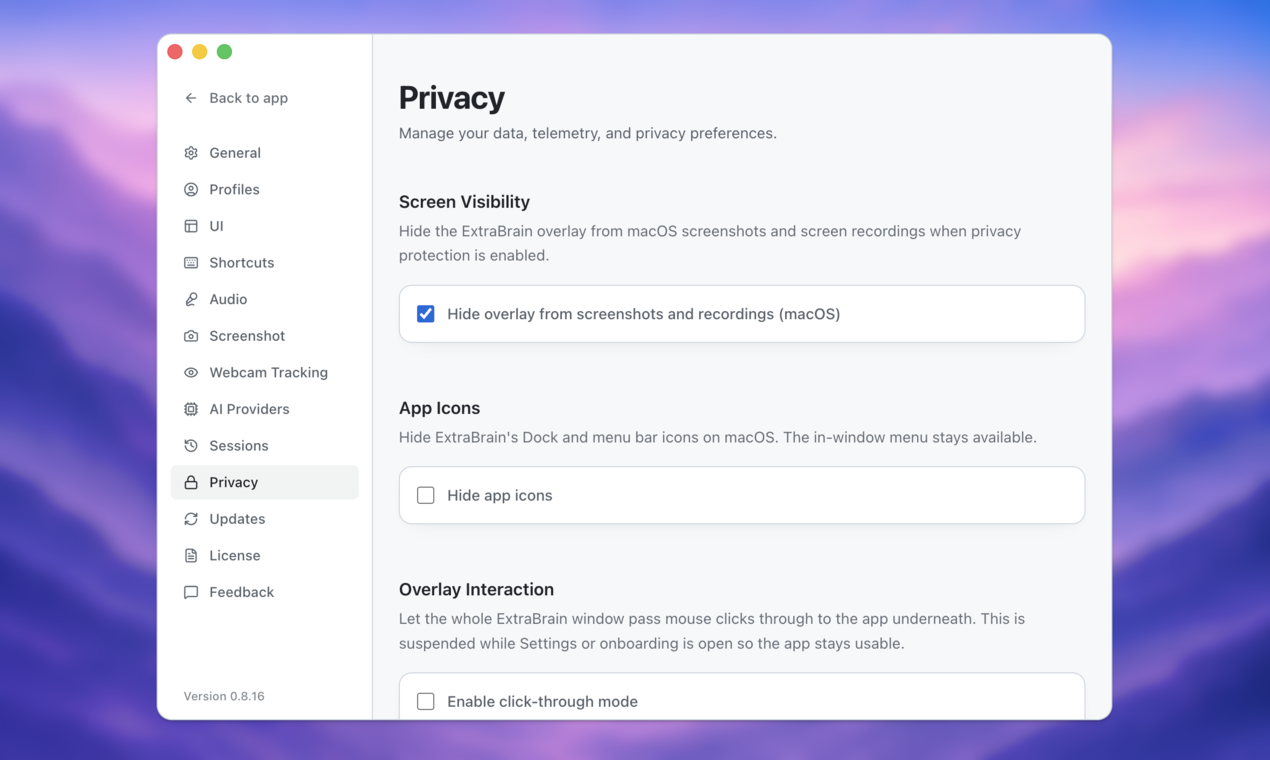
ExtraBrain supports local-first setups on Mac. A fully local posture requires local Parakeet transcription plus local Gemma 4 on-device AI where installed and compatible, with no external provider requests. External AI or transcription providers may receive selected prompts, transcript text, screenshots, audio, or context depending on your configuration.
Before using any AI tool around interviews or assessments, review your provider settings, transcript settings, screenshot settings, and data handling choices. Use only the setup that matches your privacy expectations and the rules you agreed to.
What Not to Do During a TestGorilla Assessment
The risky methods people discuss online usually create more problems than they solve. They can violate hiring rules, produce detectable behavior, and leave you unprepared for follow-up interviews.
Do not use remote desktop assistance
Remote desktop tools such as third-party screen control software can create strange cursor movement, timing anomalies, and obvious integrity issues. If another person controls the test, you are no longer demonstrating your own skill. That can cost you the opportunity and damage trust with the employer.
Do not paste answers from chatbots
Large pasted blocks are easy to notice. They also create a style mismatch between your normal writing and the submitted answer. Even when paste is technically possible, it is a poor signal of your ability.
Do not rely on a friend off-camera
A helper in another room, a phone under the desk, or a second device can create visible behavior changes. Looking away repeatedly, pausing unnaturally, or reacting to another person can be obvious on webcam review.
Do not install browser extensions to manipulate the page
Browser extensions can leave a footprint and may interact directly with the test environment. If a platform blocks copy and paste, monitors tabs, or reviews browser behavior, extensions add avoidable risk.
Do not pretend AI output is your own thinking
This is the deepest problem with cheating workflows. Even if an answer gets through the first assessment, the next interview may ask you to explain the reasoning. If you cannot defend the answer, the gap becomes visible quickly.
Better Ways to Use ExtraBrain for TestGorilla Readiness
ExtraBrain is most useful when it improves your preparation, not when it replaces your judgment. Here are practical ways to use it before an assessment or during a session where AI assistance is explicitly allowed.
Practice with screen-aware prompts
During practice, show ExtraBrain a sample prompt or screenshot and ask it to identify the skill being tested. Then ask it to generate a similar practice problem. This helps you build pattern recognition without copying answers from the live test.
Turn transcripts into a review plan
If you rehearse aloud, ExtraBrain can help you review your transcript afterward. Look for vague phrases, missing assumptions, unclear tradeoffs, and moments where you stopped explaining your thought process.
Prepare STAR stories for video questions
For custom video questions, build a small bank of truthful stories. Use the STAR method as a loose structure, but do not make every answer sound identical. ExtraBrain can help you shorten stories, clarify impact, and make your examples easier to remember.
Build a personal coding checklist
For coding assessments, create a checklist you can memorize before the test:
- Restate the problem.
- Identify inputs, outputs, and constraints.
- Start with a simple solution.
- Check edge cases.
- Explain complexity.
- Test with at least two examples.
- Clean up names and formatting.
This checklist is allowed preparation. It also makes your live work look more natural because it is actually your process.
Responsible Use Checklist
Before using ExtraBrain or any AI interview assistant around TestGorilla, ask these questions:
- Does the employer allow AI assistance for this assessment?
- Does the platform allow outside tools, notes, transcription, or screenshots?
- Am I using AI for preparation, or am I trying to hide help during a closed test?
- Can I explain every answer I submit without AI?
- Could my use of AI misrepresent my ability or experience?
- Have I reviewed where transcript text, screenshots, audio, and prompts may be sent?
If any answer makes you uncomfortable, pause and choose the safer path. A job process is not only about getting through a screen. It is also about starting a relationship with trust.
FAQ
Can I use ExtraBrain during a TestGorilla assessment?
Only if the assessment, employer, school, workplace, and platform rules allow AI assistance, transcription, screenshots, or notes. If the rules prohibit outside help, use ExtraBrain before the assessment for practice and after allowed sessions for review instead.
Is ExtraBrain an invisible AI interview assistant?
ExtraBrain is a Mac desktop AI interview assistant and meeting copilot with live transcription, screen-aware context, local-first options, bring-your-own AI providers, and privacy controls. It is designed to stay hidden from screen sharing and screen recording on major meeting tools, but users remain responsible for following all rules.
Can ExtraBrain run fully local?
A fully local ExtraBrain posture requires local Parakeet transcription plus local Gemma 4 on-device AI where installed and compatible, with no external provider requests. If you choose external providers, selected prompts, transcripts, screenshots, audio, or context may leave your device depending on configuration.
What is the safest way to use AI for TestGorilla?
Use AI to study before the test, rehearse explanations, create practice prompts, review coding patterns, and improve your answer structure. Do not use AI to secretly answer questions during a closed assessment.
Why not just copy AI answers?
Copied AI answers can be generic, inconsistent with your style, hard to defend in follow-up interviews, and potentially detectable through timing, behavior, or plagiarism review. A better strategy is to build real fluency before the assessment.
Does TestGorilla allow breaks?
Rules can vary by assessment setup. Assume the timer may continue and that leaving the camera frame can create a review signal unless the instructions explicitly allow a break. Prepare water, charger, browser permissions, and a quiet room before you begin.
Final Takeaway
The phrase how to cheat in interview on TestGorilla captures a real anxiety, but the best answer is not a hidden shortcut. The best answer is preparation that makes you faster, clearer, and more confident without violating the rules.
ExtraBrain can help you practice coding explanations, structure behavioral answers, review transcripts, and build a calmer workflow for interviews and assessments. Use it where AI help is allowed, keep your privacy settings intentional, and make sure every answer you submit is one you can honestly explain.