
ExtraBrain Blog
Cappfinity CAPP Assessment AI Help Without Crossing the Line

A practical Cappfinity CAPP guide covering question types, video interviews, AI prep, detection risks, and responsible ExtraBrain use.
Searches for how to cheat on a Cappfinity assessment usually come from pressure, not laziness. A candidate gets a CAPP assessment link, sees timed reasoning questions, webcam setup, and a recorded video interview, then worries that one weak section will end the application. That pressure is real. The mistake is assuming that hidden AI, tab switching tricks, a second device, or copied answers can remove the risk.
A better question is how to use AI to prepare for Cappfinity without misrepresenting your ability or breaking the rules. ExtraBrain is a free, local-first desktop AI interview assistant and meeting copilot for Mac with live transcription, screen-aware context, local Gemma 4 on-device AI where installed and compatible, bring-your-own AI providers, and privacy controls. It can help with assessment practice, behavioral interview structure, technical explanations, transcript review, and allowed interview support. Use it only where your employer, school, recruiter, interview platform, or assessment instructions allow AI assistance, transcription, screenshots, or notes.

This guide keeps the practical Cappfinity search intent intact. It explains the CAPP assessment format, the four common question types, the recorded video interview, what monitoring may look for, why common cheating tactics create risk, and how to use ExtraBrain responsibly before the assessment or during a session where assistance is explicitly allowed.
Key takeaways
- Understand the Cappfinity CAPP assessment format before test day.
- Practice situational judgment, verbal reasoning, inductive reasoning, and numerical reasoning separately.
- Treat the video interview as a real interview, not a quick add-on.
- Avoid relying on generic AI answers that you cannot explain in your own words.
- Use ExtraBrain for preparation, practice, and allowed support instead of trying to bypass assessment rules.
- Read the instructions for your specific assessment because employers can configure Cappfinity differently.
My Cappfinity CAPP assessment process
Many Cappfinity hiring flows start with a browser-based online assessment and a short video setup check. Some employers also add a follow-up technical assessment on platforms such as HackerRank within a short deadline. If you receive a second assessment email, check the deadline carefully and plan your time before starting.
The important point is that Cappfinity may not be the only stage. You may move from CAPP reasoning questions into a coding assessment, recruiter screen, live interview, or recorded video interview. That means you should prepare for both the test format and the explanation phase afterward.
Video setup
The setup section usually checks your camera, microphone, browser permissions, and recording environment. It may not be scored, but it still matters. Use it to confirm that your face is visible, your audio is clear, your lighting is stable, and your desk does not include unapproved materials.
Do not rush through setup. A technical issue during the real recording can create more stress than the question itself.
Online assessment
The CAPP online assessment commonly includes four broad question areas. Your exact mix can vary by employer, role, location, and assessment configuration.
- Situational judgment tests how you respond to workplace scenarios. You may be asked to choose the most effective or least effective response based on judgment, values, collaboration, customer impact, or escalation.
- Verbal reasoning tests whether you can read a passage quickly and decide whether a statement is true, false, or cannot be determined from the text. The key is to answer only from the evidence shown, not from outside knowledge.
- Inductive reasoning tests pattern recognition through shapes, sequences, symbols, or abstract diagrams. This section rewards calm visual scanning and a repeatable pattern checklist.
- Numerical reasoning tests chart reading, percentages, ratios, tables, trends, and quick calculation. The challenge is often speed plus careful interpretation, not advanced math.
If you have recently taken Korn Ferry, Wonderlic, SHL, or other psychometric assessments, do not assume the format is identical. Cappfinity-style questions can feel different, especially in verbal reasoning and strength-based judgment sections. Review sample questions before the official test so the interface and wording do not surprise you.
Video interview
Some Cappfinity flows include a recorded motivation-based video interview. A common format is a short preparation window followed by a timed answer, such as 30 seconds to prepare and 2 minutes to respond. That can feel harder than a live conversation because there is no interviewer to clarify the question or react to your answer.
Prepare for common motivation prompts before the assessment. Examples include why you want the role, why you chose the company, what motivates you at work, how you handle pressure, and what strengths you would bring to the team.
ExtraBrain can help during practice by turning your resume, target role, and project history into short answer outlines. The responsible goal is to make your real experience easier to retrieve under pressure, not to read a generated script during a closed interview.
Cappfinity question types to practice
You do not need leaked questions to prepare well for Cappfinity. You need enough familiarity with the question types that the real assessment feels like a variation, not a brand-new situation.
Situational judgment questions
Situational judgment questions usually ask what you would do in a workplace scenario. The scenario might involve a missed deadline, a difficult customer, a disagreement with a teammate, unclear instructions, a quality issue, or competing priorities.
A strong answer usually shows good judgment across several dimensions. It balances ownership, communication, collaboration, customer impact, ethics, and escalation.
Practice by asking:
- What is the real problem in this scenario?
- Who is affected?
- What information is missing?
- What action protects quality and trust?
- When should I ask for help or escalate?
Do not try to guess a fake personality profile. Try to answer consistently with the way a reliable employee would behave in that specific workplace context.
Verbal reasoning questions
Verbal reasoning questions often look simple until the wording becomes precise. The most common trap is answering from general knowledge instead of the passage.
For true, false, and cannot determine questions, use a strict standard. Choose true only when the passage directly supports the statement. Choose false only when the passage directly contradicts the statement. Choose cannot determine when the statement might be true but the passage does not prove it.
During practice, slow down on absolute words such as always, never, all, none, only, and must. Those words often change the answer.
Inductive reasoning questions
Inductive reasoning questions test pattern recognition under time pressure. The pattern may involve rotation, reflection, position, number of shapes, fill color, line style, symmetry, sequence direction, or a combination of rules.
Use a repeatable scan instead of staring at the whole image. Check one property at a time. If color is changing, isolate color first. If position is changing, track movement next. If shape count is changing, count only after you understand the movement.
ExtraBrain’s screen-aware context can be useful for practice sets when screenshots and AI assistance are allowed. It can help you talk through what visual properties to inspect, but you should still train yourself to recognize the pattern without needing live help.
Numerical reasoning questions
Numerical reasoning questions often use charts, tables, percentages, and business metrics. The calculation may be simple, but the wording can be easy to misread.
Before calculating, identify:
- The exact metric being requested.
- The unit of measurement.
- The relevant row, column, year, or category.
- Whether the question asks for a difference, percentage change, ratio, average, or estimate.
- Whether the answer options require exact calculation or approximation.
Practice mental math, but do not make speed the only goal. A fast wrong answer is still wrong.
What Cappfinity-style monitoring may watch for
Different assessment owners configure monitoring differently. Some Cappfinity assessments may be relatively light. Others may include stricter browser, camera, audio, timing, or behavior review.
Assume the assessment owner can evaluate more than your final answer. They may care about whether your behavior is consistent with the rules.
Browser activity and tab switching
Browser-based assessments can often detect whether the assessment window loses focus or whether the candidate leaves the page. Some tests may also restrict copy and paste, extensions, multiple tabs, or full-screen exits.
Trying to work around those controls is risky. A warning event, suspicious activity log, or interrupted test can hurt more than one imperfect question.
If outside resources are not allowed, do not use outside resources during the live assessment. Use AI before the test to practice the format and after the test to review your performance.
Webcam and audio review
Recorded video interviews can capture gaze, posture, background movement, other voices, phones, notes, and repeated off-screen glances. Even if a tool is not visible, your behavior may still look unusual.
The cleanest setup is also the least stressful setup. Use a quiet room, stable lighting, one screen, a clear desk, and no visible phone. Tell people nearby not to interrupt you. Turn off notifications before you begin.
Timing and response consistency
Assessment owners may review how long you spend on each question, how quickly you answer, and whether your responses look consistent with normal reasoning. For video interviews, a perfectly polished answer after a short preparation window can sound unnatural if it does not match your normal speech.
For reasoning questions, slow down enough to read carefully. For video answers, speak from a short structure instead of memorizing full paragraphs.
Why hidden AI tactics are risky
Many candidates think the main problem is choosing the right invisible tool. The bigger problem is behavioral mismatch. If your final answer is stronger than your explanation, or your delivery looks like you are reading from somewhere else, the risk remains.
A second device does not solve the problem
A phone, tablet, second laptop, or hidden monitor can still change your behavior. You may look away repeatedly, pause at odd moments, miss instructions, or type answers that appear too suddenly.
It also splits your attention. Instead of thinking through the question, part of your brain is managing the concealment workflow.
Generic AI answers are easy to outgrow
Generic AI can produce polished text quickly. That does not make the answer good for a Cappfinity video interview or strength-based assessment.
The best answers include your real examples, your actual constraints, and your own speaking style. If the answer sounds like a template, it can feel less credible even when the grammar is perfect.
Invisibility is not permission
ExtraBrain is designed to stay hidden from screen sharing and screen recording on major meeting tools, while users remain responsible for following all rules. That can be useful for private notes, allowed meeting assistance, practice workflows, and permitted interview support.
It does not turn a closed assessment into an open-book assessment. If the instructions prohibit AI assistance, screenshots, transcription, or outside help, follow those instructions.
A responsible ExtraBrain workflow before Cappfinity
The safest and most useful AI workflow happens before the assessment starts. That is when you can use AI intensively without creating a live-session integrity problem.
ExtraBrain is available for macOS today, including Apple Silicon and Intel Macs. Windows and Linux are planned future platforms. It supports local Parakeet transcription, optional Deepgram transcription, local Gemma 4 on-device AI where installed and compatible, and bring-your-own AI providers such as Anthropic, OpenAI, custom OpenAI-compatible endpoints, Claude Subscription, and Codex Subscription.
1. Build a clean preparation environment
Practice in the same kind of environment you expect on test day. Use one screen if the assessment allows one screen. Close unrelated tabs. Silence notifications. Put your phone away. Use a timer.
This makes practice more realistic. You learn how you behave when the clock is running and the workspace is clean.
2. Create practice prompts for each CAPP section
Use ExtraBrain to generate practice loops, not final answers. Good prompts include:
- “Create five Cappfinity-style situational judgment scenarios for a customer-facing graduate role.”
- “Give me a short verbal reasoning passage and ask true, false, or cannot determine questions one at a time.”
- “Teach me a checklist for solving inductive reasoning shape patterns.”
- “Generate numerical reasoning practice using a small table of sales, costs, and percentage changes.”
- “Ask me a motivation-based video interview question, wait for my answer, then critique clarity and specificity.”
The goal is repetition with feedback. You should become faster because the question type is familiar, not because you are outsourcing the live test.
3. Practice speaking in timed conditions
The video interview can be the hardest part because the preparation window is short. Practice with the same constraint. Give yourself 30 seconds to outline and 2 minutes to answer.
Use a simple structure:
- Answer the question directly.
- Give one specific example.
- Explain your action.
- Name the result or lesson.
- Connect it back to the role.
ExtraBrain can transcribe your practice answer and help you review it afterward. Ask where you sounded vague, where the example lacked evidence, and where the answer became too long.
4. Prepare real examples before the test
Most candidates struggle in recorded video interviews because they cannot retrieve examples quickly. Before the assessment, prepare a small story bank.
Include examples for teamwork, conflict, pressure, learning quickly, customer impact, leadership, mistake recovery, and motivation for the company. Each story should be short enough to deliver in about two minutes.
ExtraBrain can help convert rough notes into STAR outlines. Keep the facts yours. Use AI to improve structure, not to invent experience.
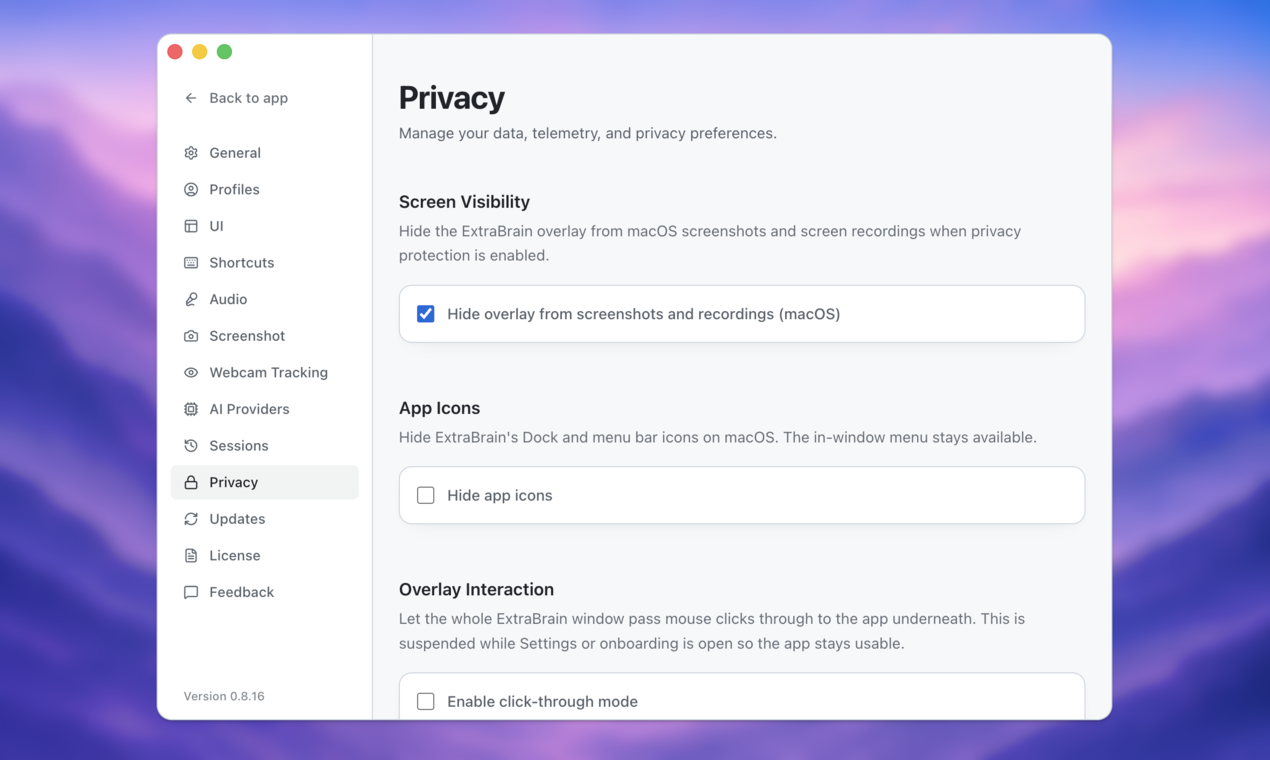
5. Configure privacy intentionally
Assessment prep can involve sensitive personal data, employer materials, screenshots, notes, and recordings. ExtraBrain gives you privacy controls and local-first options.
A fully local ExtraBrain posture requires local Parakeet transcription plus local Gemma 4 on-device AI where installed and compatible, with no external provider requests. If you use an external provider, selected prompts, transcript text, screenshots, audio, or context may leave your device depending on configuration.
Choose the setup that matches your privacy needs and the rules for your situation.
If AI assistance is allowed during the assessment
Some assessments, interviews, workplace exercises, or open-resource tasks may allow notes, AI tools, transcription, screenshots, or external references. If that is true, get the rules clear before starting.
When assistance is allowed, keep the workflow simple. Use ExtraBrain for concise outlines, clarification, and review rather than long generated paragraphs. For a video answer, you want a few anchor points you can speak naturally. For a reasoning practice prompt, you want the method, not just the answer.
Good allowed-use prompts include:
- “Summarize the visible question into the key decision I need to make.”
- “List the assumptions I should state before answering.”
- “Give me a short answer outline in my own speaking style.”
- “Point out any wording in the question that could change the answer.”
- “After my answer, critique whether I addressed the prompt.”
Do not use an allowed AI workflow as an excuse to stop thinking. The best use of AI is to keep your reasoning organized while you remain responsible for the answer.
Common Cappfinity mistakes
Cappfinity assessments are often lost through ordinary mistakes, not only hard questions. Avoid these before worrying about advanced tactics.
| Mistake to avoid | What to do instead |
|---|---|
| Starting without reading the rules | Read the assessment instructions before opening the first question. |
| Assuming every CAPP test is the same | Review the specific employer instructions and sample format. |
| Overusing generic AI phrasing | Practice with your own examples and natural voice. |
| Answering too quickly | Read the wording and confirm what is being asked. |
| Ignoring time pressure | Practice with a timer before the real assessment. |
| Leaving notifications on | Silence messages, calendar alerts, and calls. |
| Keeping a messy desk | Remove unapproved notes, devices, and distractions. |
| Forgetting the follow-up stage | Prepare to explain your reasoning in later interviews. |
The strongest preparation lowers the urge to cheat. When you know the format, have practiced the timing, and can explain your answers, the assessment feels less like a trap.
A practical Cappfinity preparation checklist
Use this checklist before the real assessment.
- Confirm the deadline and expected duration.
- Read the rules on AI assistance, notes, screenshots, transcription, calculators, and external resources.
- Test your camera, microphone, browser, and internet connection.
- Prepare a quiet room with stable lighting.
- Close unrelated apps and tabs.
- Put your phone and extra devices away unless the rules allow them.
- Practice situational judgment questions for the role type.
- Practice verbal reasoning with true, false, and cannot determine statements.
- Practice inductive reasoning with visual pattern sets.
- Practice numerical reasoning with charts and percentage changes.
- Record at least three timed video answers and review the transcript.
- Prepare a short story bank for motivation and behavioral prompts.
- Configure ExtraBrain privacy settings before practice sessions.
Safer alternatives to cheating
If you are worried about Cappfinity, the safest move is to make the assessment less unfamiliar. You can do that without leaked answers or hidden live help.
Use sample tests
Sample tests help you learn the pacing and wording. They also reveal whether your weakest area is reading accuracy, pattern recognition, calculation speed, or video delivery.
Practice aloud
For video interviews, silent preparation is not enough. You need to hear yourself answer under time pressure. Use ExtraBrain to transcribe practice answers, then review whether you sounded specific, concise, and grounded in real experience.
Review mistakes by category
Do not only mark questions right or wrong. Label the mistake type. Was it a misread passage, a calculation error, a rushed assumption, a missed visual pattern, or an unclear spoken answer?
That makes the next practice session more targeted.
Use AI as a coach
Use ExtraBrain as a coach before the assessment. Ask it to generate practice questions, critique your answer structure, explain reasoning methods, and help you review transcripts.
That is different from using AI to impersonate your judgment during a closed test. The first builds skill. The second creates integrity risk.
FAQ
How should I prepare my setup for a Cappfinity assessment?
Use a quiet room, stable internet, one clean workspace, and a tested camera and microphone. Close unrelated apps and tabs. If you use ExtraBrain for preparation, configure it before the practice session and make sure your use follows the assessment rules.
Can I use ChatGPT for Cappfinity tests without getting caught?
If the assessment rules prohibit outside assistance, do not use ChatGPT or any other AI tool during the live test. Browser activity, webcam behavior, timing, and later follow-up interviews can all create risk. Use AI for preparation, practice, and allowed support instead.
Can ExtraBrain help with Cappfinity video interviews?
Yes, ExtraBrain can help you practice video interview answers, build STAR outlines, transcribe spoken practice, and review where your answer was vague or too generic. During an actual assessment, use it only if the employer, school, platform, and instructions allow that kind of assistance.
What if a Cappfinity question spans more than one screen?
During preparation or an allowed open-resource session, you can break the material into smaller chunks and analyze each part carefully. For a live closed assessment, follow the platform rules and avoid screenshots or external tools if they are not allowed.
What risks should I watch for?
The biggest risks are breaking the assessment rules, relying on answers you cannot explain, sounding unlike yourself in a video interview, and creating suspicious behavior through tab switching or off-screen attention. Good preparation reduces all of those risks.