
ExtraBrain Blog
HackerEarth AI Help in 2026 Without Risking Your Interview
A safer guide to HackerEarth proctoring in 2026, cheating risks, AI detection, hidden test case traps, and responsible ExtraBrain prep.

Searches for how to cheat on HackerEarth usually start from panic. A candidate gets a bank interview, a campus assessment, or a technical screen on HackerEarth, sees webcam monitoring and browser restrictions, and worries that one blank moment will cost them the offer. That pressure is real. The dangerous part is assuming that a hidden AI tool, second device, remote helper, or test-case trick can turn a stressful assessment into a consequence-free shortcut.
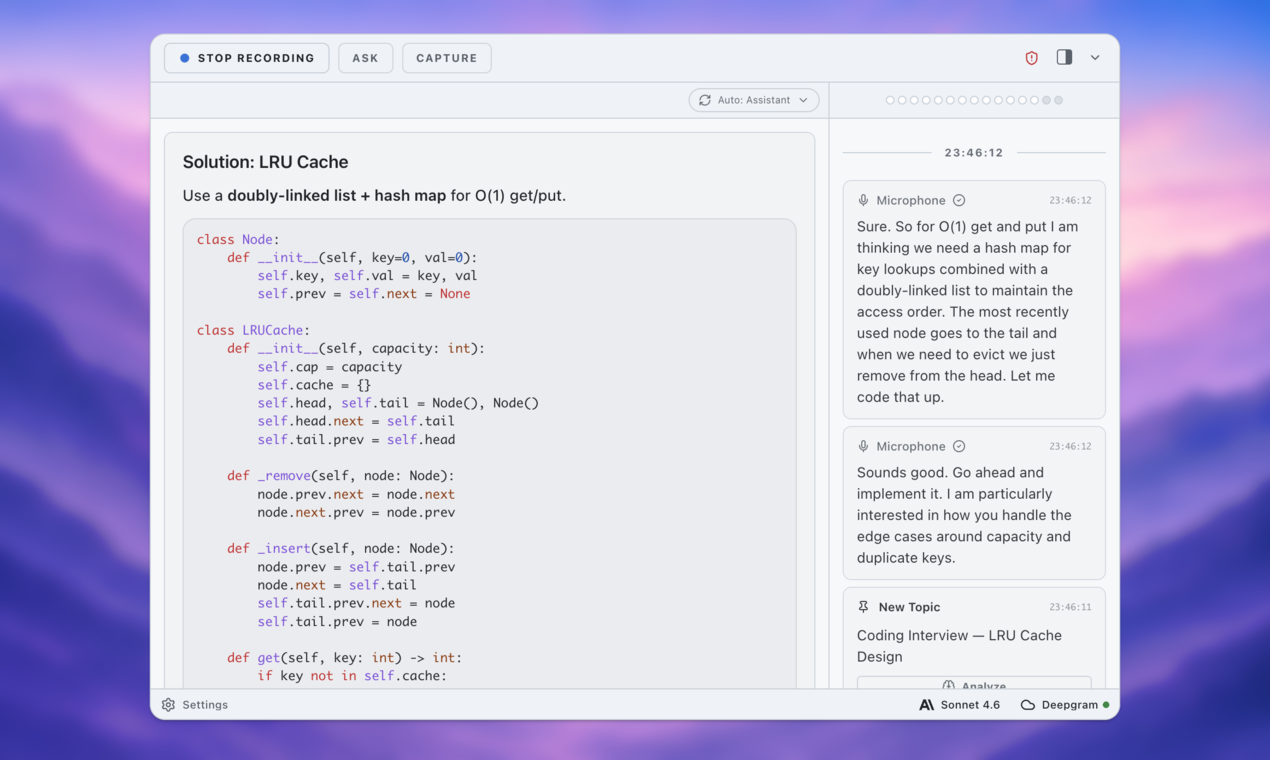
The better question in 2026 is how to prepare for HackerEarth with AI without misrepresenting your ability or breaking the rules. ExtraBrain is a free, local-first desktop AI interview assistant and meeting copilot for Mac with live transcription, screen-aware context, bring-your-own AI providers, local Gemma 4 on-device AI where installed and compatible, and clear privacy controls. It can help with coding interview practice, system design rounds, behavioral answers, transcript review, and post-session learning. Use it only where the employer, interviewer, school, workplace, and platform rules allow AI assistance, transcription, screenshots, or notes.
This guide keeps the practical HackerEarth search intent intact. It explains what proctored coding assessments may watch for, why common cheating tactics fail, how hidden test case probing can backfire, and how to use ExtraBrain responsibly before a live assessment or during a session where assistance is explicitly allowed.
Why HackerEarth Feels So High Stakes
HackerEarth is often used for technical hiring because it can combine coding tasks, multiple-choice questions, live interviews, plagiarism checks, and assessment reporting. For candidates, that can feel like two tests at once. You have to solve the technical problem, and you also have to stay calm while being watched by software and sometimes by an interviewer.
That pressure can be especially hard if you are unemployed, interviewing for a role you really want, or returning to technical interviews after a long break. It is understandable that candidates look for ways to reduce panic. It is not wise to solve that problem by hiding outside help during a closed assessment.
The strongest path is to train for the assessment before it starts. You want to recognize common problem shapes, explain your reasoning naturally, debug under time pressure, and avoid behavior that looks inconsistent with your own skill level.
What HackerEarth-Style Proctoring May Watch For
Different HackerEarth assessments can be configured differently. Some are lighter practice tests. Some are strict enterprise hiring assessments with identity checks, browser restrictions, webcam review, screen monitoring, code analysis, and follow-up interviews.
Assume the assessment owner can review more than the final answer. They may care about how you got there.
Pre-test checks
A proctored assessment may begin with setup steps before you see the first problem. Those steps can include webcam permission, microphone permission, ID verification, room visibility, browser compatibility checks, and instructions about allowed materials.
Treat this setup as part of the assessment. Use the same legal name expected by the recruiter or school. Remove phones, smartwatches, unapproved notes, extra screens, and unrelated apps from the environment. Read the rules carefully before starting.
Browser and application controls
Some assessments may use a secure browser or lockdown mode. That can restrict tab switching, copy and paste, full-screen exits, screenshots, multiple monitors, shortcuts, or background applications.
Trying to fight those controls is a poor strategy. A frozen test, forced logout, warning event, or integrity flag can be more damaging than one imperfect answer. The safer preparation move is to practice in the same kind of clean setup you expect on test day.
Webcam, audio, and behavior review
Visual and audio monitoring can look for whether the candidate stays in frame, whether another person appears, whether a phone is visible, whether voices are heard, or whether gaze and posture look unusual. These systems are not perfect, but they create a review trail.
You can reduce false flags with boring preparation. Use a quiet room, good lighting, a stable camera angle, and a clear desk. Tell people around you not to interrupt. Silence notifications before the assessment begins.
Timing, typing, and code signals
Technical assessments can also be reviewed through timing and code behavior. A long pause followed by a complete polished solution may raise questions. A sudden change in coding style may raise questions. Repeated submissions that do not look like real debugging may raise questions.
Generated code can also be fragile. It may use patterns you do not normally use, miss hidden edge cases, or produce an answer that you cannot explain when the interviewer asks a follow-up.
| Signal | Why it matters |
|---|---|
| Tab or window changes | They can suggest that the candidate left the assessment environment. |
| Copy and paste attempts | They can look like answer transfer from another source. |
| Webcam and audio events | They can show off-camera help, room changes, or interruptions. |
| Submission rhythm | It can reveal guessing, probing, or non-human iteration patterns. |
| Code similarity | It can suggest copied, shared, or generated solutions. |
| Explanation mismatch | It can show that the candidate cannot defend the submitted work. |
Common HackerEarth Cheating Myths
Many candidates imagine cheating as a technical puzzle. In practice, most cheating methods fail because they create inconsistent behavior. The platform may see one part of the inconsistency, and an interviewer may see another.
Myth 1: A second device solves everything
A phone under the desk, tablet beside the laptop, or second monitor outside the camera frame can still affect your behavior. You may look away repeatedly, pause at strange moments, type answers that appear too suddenly, or miss interviewer cues.
Even if the device is not directly seen, the behavior can be visible. It also makes the interview harder because part of your attention is spent hiding the workflow instead of solving the problem.
Myth 2: Generic AI answers are enough
Chatbot output can look impressive at first glance. It can also be too clean, too generic, or written in a style that does not match your normal reasoning.
For coding interviews, the bigger issue is follow-up. If you cannot explain the time complexity, edge cases, failure mode, or tradeoff behind the code, the answer becomes a liability.
Myth 3: Small tab switches do not matter
A single tab switch may not always end an assessment, but candidates should not assume it is invisible. If the rules say no outside resources, leaving the test window creates a risk.
If documentation is allowed, clarify that before the assessment begins. If documentation is not allowed, practice without it.
Myth 4: Invisible AI tools remove the risk
Some AI assistants are designed as desktop overlays rather than browser extensions. ExtraBrain is designed to stay hidden from screen sharing and screen recording on major meeting tools, while users remain responsible for following all rules.
That design detail does not turn a closed assessment into an open-book assessment. If a HackerEarth test forbids outside help, do not use outside help during the live test. Use AI for preparation, review, and allowed interview support instead.
The Hidden Test Case Trap
Candidates sometimes call hidden test case probing “legal cheating.” The phrase is misleading. In hiring assessments, it is usually a serious integrity risk.
The idea is to submit artificial code that tries to infer hidden inputs from runtime errors, timeouts, exit behavior, or repeated condition checks. This is not the same as normal debugging. It is an attempt to extract information the assessment intentionally hides.
Do not treat hidden test cases as something to reverse engineer during a hiring test. That approach can create multiple red flags.
- High submission frequency can look abnormal.
- Repeated near-identical submissions can look like probing rather than problem solving.
- Artificial branches, intentional failures, or meaningless loops can look unlike real code.
- A sudden final solution that appears tailored to hidden data can be easy to question.
- Playback or review logs may show that the candidate was not actually solving the stated problem.
The better way to handle hidden tests is to prepare for edge cases before the assessment. For arrays, think about empty input, duplicates, negative numbers, sorted input, unsorted input, and large constraints. For strings, think about case, whitespace, Unicode if relevant, repeated characters, and empty strings. For graphs, think about cycles, disconnected components, one-node cases, and large traversal limits. For SQL, think about nulls, duplicates, grouping, joins, and tie cases.
A Responsible ExtraBrain Workflow Before HackerEarth
The safest and most useful way to use AI around HackerEarth is before the assessment starts. That is when you can practice hard, review mistakes, build confidence, and avoid a live-session integrity problem.
ExtraBrain fits this workflow because it can help you work with live transcripts, screen-aware context, coding explanations, system design tradeoffs, behavioral answer structure, and review notes. It is available for macOS today, including Apple Silicon and Intel Macs. Windows and Linux are planned future platforms.
1. Recreate the test environment
Practice in an environment that resembles the real assessment. Use one monitor if the real test allows one monitor. Close messaging apps and unrelated browser tabs. Put your phone away. Use a timer. Work without unapproved notes.
This makes practice emotionally useful, not just technically useful. You learn how your brain reacts when the clock is running and the screen is clean.
2. Build a topic map from the role
Start with the job description, recruiter instructions, and any sample assessment details. Turn them into a topic map.
For a backend role, the map might include arrays, hash maps, SQL, APIs, caching, concurrency basics, and debugging. For a frontend role, it might include JavaScript, components, async data loading, forms, accessibility, and browser behavior. For a data role, it might include SQL joins, aggregation, statistics, Python data structures, and interpretation of results.
Use ExtraBrain during preparation to generate practice prompts in those areas. Do not memorize one answer. Train the pattern.
3. Practice thinking aloud
Many candidates can solve a problem quietly but struggle when asked to explain it. That becomes a problem in HackerEarth FaceCode-style interviews, live technical screens, or follow-up reviews.
During practice, say your reasoning out loud. State the brute-force approach first. Explain why it may be too slow. Choose a better approach. Name the edge cases before coding. After the solution, explain the complexity and one improvement you would make with more time.
ExtraBrain can help review the transcript afterward. Look for vague phrases, skipped assumptions, and moments where the answer jumps from problem to code too quickly.
4. Ask AI for critique, not a finished answer
The best preparation prompts keep you in control. They make the assistant a reviewer, not a substitute.
Use prompts like this during practice:
I solved this practice problem.Review my approach for missed edge cases, complexity mistakes, and unclear reasoning.Do not rewrite the whole solution unless I ask.Another useful prompt is:
Give me three follow-up questions an interviewer might ask about this solution.Focus on tradeoffs, edge cases, and why this approach works.This kind of AI use builds durable skill. It also prepares you for the moment when an interviewer asks why your code works.
5. Turn mistakes into a review system
A mistake log is more valuable than a pile of copied solutions. For each missed problem, capture the category, the wrong assumption, the edge case you missed, and the signal you should notice next time.
ExtraBrain can help summarize practice sessions into reusable notes. That makes it a focused AI second brain for interviews and meetings rather than a broad note-taking database replacement.
What To Do If AI Is Explicitly Allowed
Some interviews and take-home tasks allow AI tools. Some even expect candidates to use modern developer workflows. The key is to follow the written rules and be transparent when needed.
If AI is allowed, use ExtraBrain to organize context and improve your thinking. Do not let it erase your ownership of the answer.
Good allowed-use patterns include:
- Summarizing the prompt in plain English.
- Listing edge cases before coding.
- Comparing two possible approaches.
- Reviewing a solution for bugs after you write it.
- Practicing an explanation of time and space complexity.
- Turning a live transcript into post-interview notes.
- Preparing STAR-style answers for behavioral follow-ups.
Weak allowed-use patterns include:
- Asking for a complete final answer before you understand the problem.
- Submitting code you cannot explain.
- Keeping generated variable names, comments, or structure that do not match your style.
- Ignoring privacy settings for transcripts, screenshots, audio, and provider requests.
ExtraBrain supports local Parakeet transcription and optional Deepgram. For AI providers, it supports local Gemma 4 where installed and compatible, Anthropic, OpenAI, custom OpenAI-compatible endpoints, Claude Subscription, and Codex Subscription. A fully local posture requires local Parakeet transcription plus local Gemma 4 on-device AI where installed and compatible, with no external provider requests. External providers may receive selected prompts, transcript text, screenshots, audio, or context depending on configuration.
A Practical HackerEarth Prep Plan
Use the days before the assessment to create a repeatable preparation loop. The goal is not to become perfect. The goal is to become predictable under pressure.
Day 1: Understand the format
Read the assessment email carefully. Identify the language options, time limit, allowed resources, proctoring requirements, and any setup steps.
Then run a short practice session in the same conditions. If the real test is closed-book, practice closed-book. If the real test allows documentation, practice with only that documentation.
Day 2: Drill common patterns
Pick five to eight likely problem categories. For each one, solve a small problem, explain the approach aloud, and ask ExtraBrain to critique your reasoning after you finish.
Focus on patterns such as sliding window, hash map counting, two pointers, binary search, recursion, dynamic programming basics, graph traversal, SQL grouping, and string parsing.
Day 3: Practice under time pressure
Run a timed mock assessment. Use the same machine, same monitor setup, and same restrictions you expect in the real session.
Afterward, review the transcript and notes. Mark where you froze, where you skipped edge cases, and where your explanation became unclear.
Day 4: Clean up your explanation style
Practice explaining three solved problems without looking at the code. For each one, say the requirement, the key insight, the algorithm, the complexity, and the edge cases.
This is the skill that makes AI-assisted preparation translate into real interview performance. If you can explain it, debug it, and adapt it, the work is becoming yours.
Test day: Keep the environment boring
Restart your computer before the assessment. Close unrelated apps. Check camera, microphone, power, internet, and permissions. Keep your desk clean. Do not improvise new tools or workflows during the live test.
If the rules do not allow AI, do not use AI during the assessment. If the rules do allow AI, use it in the allowed way and be ready to explain every answer.
Ethical Use Is Also Practical
There is a fairness argument against cheating, but there is also a practical argument. Cheating creates a gap between the submitted work and your actual ability. That gap tends to show up later.
It may show up in a follow-up interview. It may show up when the interviewer asks you to modify the solution. It may show up when the job starts and the team expects you to operate at the level the assessment implied.
Responsible AI use has a different goal. It helps you manage pressure, organize thoughts, practice explanations, and learn from mistakes. It does not pretend that someone else’s output is your own capability.
ExtraBrain is best used in that responsible lane. Use it to prepare deeply, to review honestly, and to support live work only when the rules allow it.
FAQ
Can I use ExtraBrain during a HackerEarth assessment?
Only if the assessment rules allow AI assistance, transcription, screenshots, notes, or external tools. If the rules prohibit outside help, use ExtraBrain before the assessment for preparation and after the assessment for review.
Is ExtraBrain invisible during screen sharing?
ExtraBrain is designed to stay hidden from screen sharing and screen recording on major meeting tools. That design does not override interview, employer, school, workplace, or platform rules. You are still responsible for allowed use.
What is the safest way to use AI for HackerEarth?
Use AI before the assessment to practice coding patterns, review your mistakes, rehearse explanations, and build confidence. During a live assessment, use AI only when the rules explicitly permit it.
Can AI help with hidden test cases?
AI can help you prepare for edge cases during practice. It should not be used to probe, extract, or reverse engineer hidden test data during a live hiring assessment.
What if I freeze during coding interviews?
Practice a simple recovery script. Restate the problem, list inputs and constraints, propose a brute-force solution, identify why it may be too slow, then improve one step at a time. ExtraBrain can help you rehearse this pattern before the interview and review your transcript afterward.