
ExtraBrain Blog
How to Use AI Help for Karat Interviews Without Losing Trust

A practical 2026 guide to Karat interviews, AI help, detection risks, and responsible ExtraBrain prep without sounding scripted.
People search for “how to cheat on Karat” because Karat interviews can feel unusually high pressure. A live interviewer is present, the session may be recorded, and the company that hired Karat may review both the evaluation and the recording afterward.
That pressure makes many candidates look for invisible AI help, especially when the coding round is timed and the questions feel closer to real LeetCode medium problems than warm-up exercises. The honest answer is simple: do not use AI in a way that violates Karat, employer, school, or platform rules.
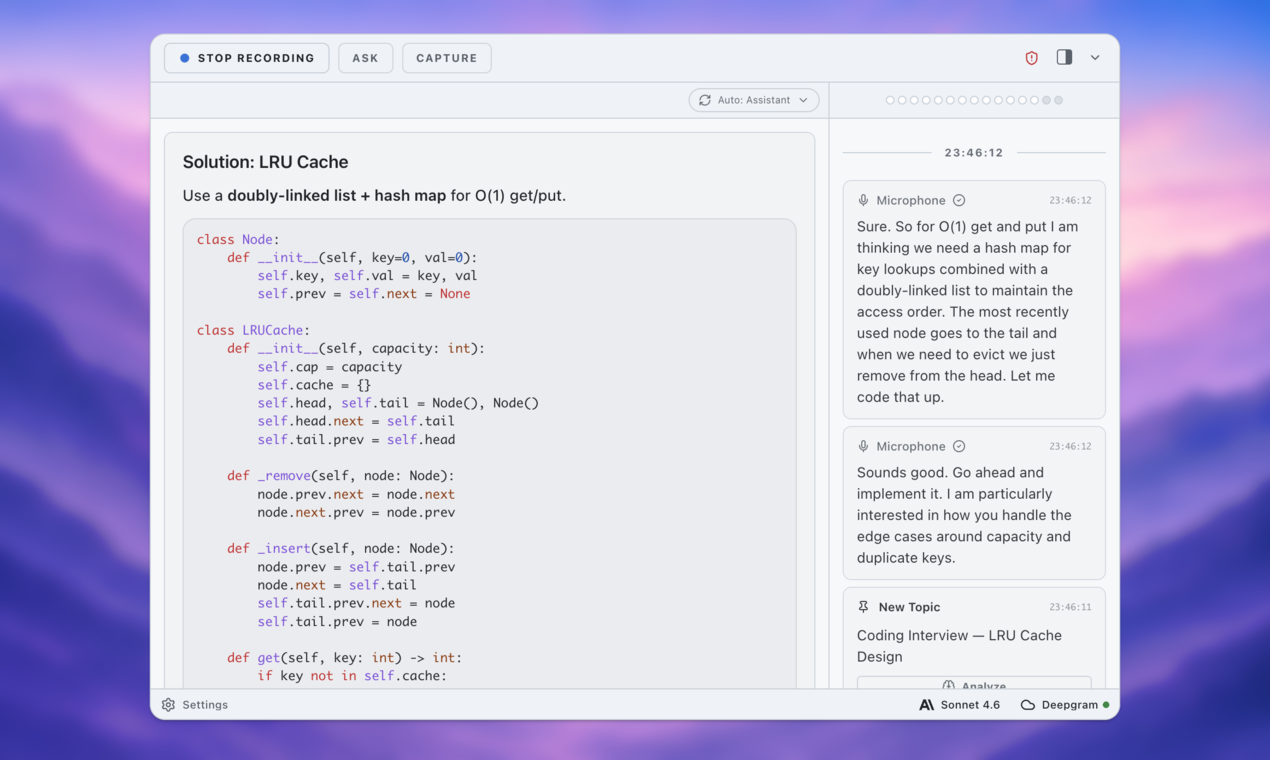
A better goal is to use an AI interview assistant responsibly before and around the interview so you can think clearly, explain your own reasoning, and review your performance afterward. ExtraBrain is built for that kind of workflow: a free, local-first Mac desktop AI interview assistant and meeting copilot with live transcription, screen-aware context, local-first options, bring-your-own AI providers, and privacy controls.
Why Karat Interviews Feel Different
A Karat technical interview is not just a take-home test or a silent online assessment. It is usually a live technical conversation where you solve problems, explain tradeoffs, and respond to follow-up questions under time pressure.
The format can vary by role and employer, but candidates often experience two broad parts.
- Domain knowledge or technical discussion. The interviewer may ask about fundamentals, prior projects, language choices, data structures, debugging, or role-specific concepts.
- Programming or problem solving. The interviewer may ask you to implement one or more coding tasks, explain complexity, test edge cases, and improve the solution.
The difficult part is not only writing code. You also need to narrate your thinking, ask clarifying questions, recover from mistakes, and avoid sounding like you are reading an answer you do not understand.
What People Mean by “Cheating” on Karat
Most searches for cheating on Karat are really about fear. Candidates worry that they will blank out, miss an edge case, or fail to explain a solution quickly enough.
There are three very different uses of AI here.
- Responsible preparation. You use AI before the interview to practice likely topics, generate mock prompts, review previous sessions, and improve explanations.
- Allowed live assistance. You use AI during a session only if the interview rules explicitly allow it, and you disclose or follow the stated policy.
- Hidden rule-breaking. You secretly use AI to generate answers during a live assessment where outside help is not allowed.
This article is about avoiding the third path. ExtraBrain should be used only where interview, employer, school, workplace, meeting, and platform rules allow AI assistance, transcription, screenshots, or notes.
How Karat-Style Interviews Can Reveal Misuse
Even if a browser cannot see every app on your computer, a live interview is not just a browser security problem. It is a human evaluation of how you think.
Screen sharing and visible workspace
A live interviewer may ask you to share your screen, show your editor, open a browser tab, or explain what is visible. If a tool, note, prompt, or answer window appears where it should not, that can raise obvious concerns.
ExtraBrain has desktop privacy controls and is designed for Mac users who want live transcription, screen-aware context, local-first options, and provider control. That does not make secret assistance acceptable when the rules forbid it.
Active tab and browser behavior
Many technical interview environments run in a browser. A browser-based interview may notice focus changes, copy and paste behavior, or unusual navigation inside the assessment environment.
A standalone desktop app may sit outside the browser sandbox, but that is not a loophole you should rely on to break rules. Use desktop tools for preparation, note review, and permitted support rather than trying to outsmart a platform.
Recording review
Karat-style interviews can involve recordings, transcripts, scorecards, or later review by the hiring company. That means your behavior may be evaluated after the live call ends.
Robotic phrasing, long silent pauses before perfect answers, sudden jumps in solution quality, and weak follow-up explanations can all look suspicious. The best defense is not invisibility. The best defense is real understanding.
Interviewer follow-up questions
A strong interviewer can quickly tell whether you understand an answer. They may ask you to change a constraint, explain time complexity, test a corner case, or compare two approaches.
If you only copied an answer, the follow-up is where the performance usually falls apart. If you practiced with AI as a coach, the follow-up is where you can show your own thinking.
A Responsible ExtraBrain Workflow for Karat Prep
ExtraBrain is most useful when it helps you prepare, organize, and review rather than impersonate competence. Here is a practical workflow that keeps the focus on your own ability.
1. Build a role-specific prep profile
Before the interview, write down the role, company, language, likely topics, and constraints. For a data analyst role, that might include SQL joins, aggregation, window functions, Python data structures, experiment analysis, dashboards, and communication tradeoffs. For a software engineering role, that might include arrays, hash maps, trees, graphs, dynamic programming, system design basics, and debugging.
Use ExtraBrain to turn those notes into practice prompts, explanation drills, and follow-up questions. The goal is not to memorize scripts. The goal is to strengthen the mental paths you will need under time pressure.
2. Practice saying the solution out loud
Many candidates can solve a problem silently but struggle when they need to narrate. Karat interviews reward clear thinking, not just final code.
Use ExtraBrain as an AI interview copilot during practice sessions to capture your transcript and help you review where you sounded vague. Ask it to identify unclear assumptions, missing edge cases, and places where your explanation jumped too quickly.
3. Rehearse the domain knowledge section
The non-coding section can feel deceptively easy until the interviewer asks for a concise, accurate explanation. Practice short answers for fundamentals in your target domain.
For example, prepare clear answers to prompts like these.
- “Explain the difference between a hash map and a balanced tree.”
- “When would you choose a SQL window function over a grouped aggregate?”
- “How would you debug a metric that suddenly dropped after a release?”
- “Tell me about a project where you made a technical tradeoff.”
ExtraBrain can help generate answer outlines and follow-up questions from your notes, but you should rewrite the answers in your own words.
4. Simulate the timed coding block
A common Karat pain point is the 45-minute coding block. You may need to solve more than one part while still explaining your reasoning.
Practice in strict time boxes. Spend the first few minutes clarifying input and output, then state a brute force idea, improve it, code it, test it, and discuss complexity. After the session, use ExtraBrain to review the transcript and identify exactly where time was lost.
5. Review screenshots only when rules allow
ExtraBrain supports screen-aware context, which can be useful for permitted practice, meetings, lectures, research calls, and allowed interview workflows. If an interview rule allows notes, screenshots, or AI assistance, configure your workflow accordingly.
If the rule does not allow it, do not capture or send interview content to an AI provider. With local Parakeet transcription and local Gemma 4 on-device AI where installed and compatible, ExtraBrain can support a more local posture, but responsible use still depends on the rules of the setting.
Setup Checklist Before a Karat Interview
Use this checklist for legitimate preparation and permitted workflows.
- Confirm the employer and platform rules for AI assistance, transcription, screenshots, notes, and external tools.
- Decide whether you are practicing only, using allowed live support, or reviewing afterward.
- Choose your programming language and practice environment.
- Prepare a short role brief with the job title, likely topics, and examples from your experience.
- Configure your AI provider choices in ExtraBrain.
- Use local Parakeet transcription and local Gemma 4 where installed and compatible if you want the most local posture.
- Remember that external AI and transcription providers may receive selected prompts, transcript text, screenshots, audio, or context depending on your configuration.
- Practice keyboard shortcuts before the real interview so you are not distracted.
- Run a mock session and review the transcript for clarity, pacing, and weak explanations.
What Not to Do During a Karat Interview
Do not paste AI-generated code you cannot explain. Do not read long generated answers while pretending they are spontaneous. Do not use hidden tools if the interview rules ban outside assistance. Do not send confidential employer, customer, or assessment content to an external provider without permission. Do not assume that “not visible on screen share” means “allowed.”
The more you depend on hidden help, the more fragile your performance becomes. A single follow-up question can expose the gap between the answer and your understanding.
Better Ways to Use ExtraBrain for Karat
The strongest ExtraBrain use cases happen before and after the high-stakes moment.
Before the interview
Use ExtraBrain to create a realistic mock interview from your resume, target role, and weak topics. Ask for concise feedback on your explanations. Ask for new variations of the same problem until you can solve the pattern without help.
During permitted sessions
If AI assistance is explicitly allowed, use ExtraBrain to stay organized rather than to replace your thinking. Ask it for clarifying questions, edge-case reminders, complexity prompts, or structure for an answer you already understand.
After the interview
Use the session transcript to debrief while the experience is still fresh. Identify the questions you missed, the explanations that sounded uncertain, and the follow-ups you want to practice next. This is where an AI interview assistant becomes a career memory tool instead of a shortcut.
FAQ
Can ExtraBrain hear and see during a live interview?
ExtraBrain can support live transcription and screen-aware context depending on your settings and permissions. Use those capabilities only where interview, workplace, school, and platform rules allow transcription, screenshots, notes, or AI assistance.
Can ExtraBrain run fully local?
A fully local ExtraBrain posture requires local Parakeet transcription plus local Gemma 4 on-device AI where installed and compatible, with no external provider requests. External providers may receive selected prompts, transcript text, screenshots, audio, or context depending on configuration.
Is ExtraBrain available for Windows?
ExtraBrain is available for macOS today, including Apple Silicon and Intel Macs. Windows and Linux are planned future platforms.
What is the biggest mistake candidates make with AI interview tools?
The biggest mistake is relying on AI for answers instead of using it to improve their own reasoning. Interviewers notice when a candidate sounds polished but cannot explain tradeoffs, test cases, or changes to the problem.
Is it safe to use AI for Karat preparation?
Yes, AI-assisted preparation is usually the safest and most useful path. Use it to practice, review, and improve, and always follow the rules for the actual interview.
Final Takeaway
If you came here searching for how to cheat on Karat, the better question is how to avoid needing to cheat. Use ExtraBrain to practice under realistic pressure, sharpen your explanations, remember your own experience, and review what happened afterward.
That approach is more durable than hidden answers. It also gives you something every interviewer is actually looking for: clear, honest, well-practiced thinking.