
ExtraBrain Blog
How to Use AI Responsibly in a Lark Interview
A practical guide to using AI support for Lark interviews responsibly, naturally, and within interview rules in 2026.
If you searched for how to cheat on a Lark interview, you are probably not looking for a moral lecture. You are probably anxious about a remote interview, worried about being watched, and wondering whether real-time AI help can keep you from freezing.
The better question is not how to fake your way through a Lark interview. The better question is how to use AI support in a way that is useful, natural, and allowed by the rules of the interview.
That is the line this guide follows. It covers the same practical problems candidates worry about: screen sharing, webcam pressure, coding rounds, behavioral answers, technical glitches, and AI-generated responses that sound too polished. It also keeps the advice grounded in responsible use.
ExtraBrain is a free, local-first desktop AI interview assistant and meeting copilot for Mac. It can help with live transcription, screen-aware context, answer outlines, STAR structures, coding explanations, system design tradeoffs, follow-up questions, and post-interview review. You should only use it where your interview, employer, school, workplace, meeting, or platform rules allow AI assistance, transcription, screenshots, or notes.
What Lark interviews usually test
Lark is often used as a meeting and collaboration platform for remote hiring conversations. Depending on the company, a Lark interview may look like a normal video call, a recruiter screen, a technical interview, a coding session, a product discussion, or a structured panel interview.
Most candidates worry about four things:
- Whether the interviewer can see everything during screen sharing.
- Whether camera behavior makes them look suspicious.
- Whether AI-generated answers sound too robotic.
- Whether recordings, transcripts, or follow-up reviews expose inconsistent thinking.
Those concerns are real. But the safest response is not to build a fake performance. The safest response is to practice with AI beforehand, use permitted support transparently where required, and stay capable of explaining every answer in your own words.
The wrong way to think about cheating on a Lark interview
The riskiest approach is trying to outsource the interview in real time. That usually creates the exact signals interviewers dislike: long pauses, unnatural eye movement, sudden perfect answers, code that appears too quickly, and explanations that do not match the candidate’s actual experience.
It also creates an ethical and professional problem. If the role requires judgment, collaboration, technical ownership, or customer-facing communication, the interview is testing whether you can perform those tasks when the stakes are real. If AI hides your true skill level instead of supporting your thinking, the result can hurt both you and the team hiring you.
A stronger approach is to use AI as a preparation and reasoning layer. That means you use it to organize your memory, rehearse your examples, notice missing context, and review your performance. During the interview, you remain the person answering.
A responsible AI setup before a Lark interview
Before the interview, decide what kind of AI help is allowed. Some companies explicitly permit AI tools for coding, research, note-taking, or accessibility. Some prohibit real-time AI assistance. Some allow notes but not answer generation. Some require disclosure.
If the rules are unclear, treat the interview as if hidden real-time answer generation is not allowed. You can still use AI for preparation, mock interviews, resume review, and post-session improvement.
Prepare your resume stories
A common failure in Lark interviews is not lack of intelligence. It is failing to recall the right example under pressure.
Use ExtraBrain before the interview to turn your resume into reusable story material:
- A project where you solved an ambiguous problem.
- A time you handled conflict or disagreement.
- A technical decision with tradeoffs.
- A failure that changed how you work.
- A measurable result you can explain without exaggeration.
For behavioral interviews, ask for STAR outlines instead of word-for-word scripts. A good outline gives you structure without making you sound memorized.
Practice with your real speaking style
AI-generated answers often sound too smooth. That is not how most people speak in a real interview.
Use AI to create a draft, then rewrite it in your own voice. Replace generic phrases with details from your actual work. Add the hesitation, prioritization, and tradeoff language you would naturally use.
For example, instead of saying, “I optimized cross-functional alignment to drive stakeholder success,” say something closer to what you actually did. A better version might be, “The backend team and support team were measuring the bug differently, so I wrote down the customer-visible failure first and used that as the shared definition of done.”
Build a clean interview environment
A clean setup helps even when you are not doing anything wrong. It reduces distractions and makes the call feel more professional.
Before a Lark interview:
- Restart your Mac.
- Close unrelated apps and tabs.
- Check your camera, microphone, headphones, and internet.
- Use a clean browser profile if the interview involves shared docs or coding tools.
- Keep your resume, portfolio, and allowed notes organized.
- Disable notifications that could reveal private information.
- Test Lark permissions before the call if possible.
This is not about hiding misconduct. It is about avoiding avoidable chaos.
How ExtraBrain fits into Lark interview preparation
ExtraBrain is built for live interview and meeting workflows on Mac. It supports live transcription, screen-aware context, local-first options, bring-your-own AI providers, and privacy controls. Where installed and compatible, local Gemma 4 on-device AI can be used. For transcription, ExtraBrain supports local NVIDIA Parakeet and optional Deepgram. External providers may receive selected prompts, transcript text, screenshots, audio, or context depending on your configuration.
That matters because different candidates have different privacy needs. Some want local transcription and local AI where available. Some want Anthropic, OpenAI, custom OpenAI-compatible endpoints, Claude Subscription, or Codex Subscription. Some want the tool mainly for after-interview review.
ExtraBrain is available for macOS today, including Apple Silicon and Intel Macs. Windows and Linux are planned. The core Mac app is free, with ExtraBrain Pro available for users who want paid features.
Screen sharing in a Lark interview
Screen sharing is common in remote interviews. For coding interviews, the interviewer may ask you to share an IDE, a browser-based editor, a whiteboard, or a problem statement. For product and behavioral interviews, they may ask you to present a portfolio, case study, spreadsheet, or document.
The responsible goal is simple: only share what is appropriate for the interview. Do not expose private notes, personal messages, confidential employer material, or unrelated apps.
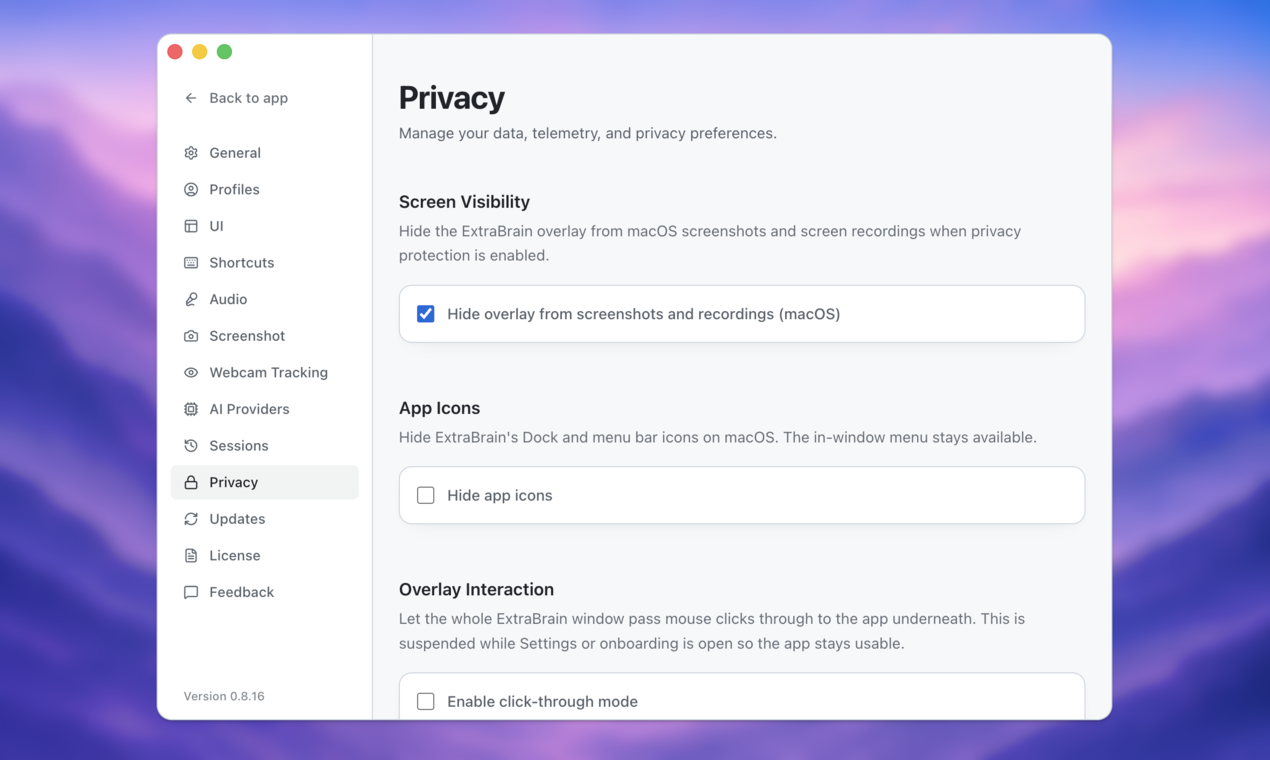
ExtraBrain is designed as a desktop assistant with privacy-conscious controls, but you remain responsible for following the rules of the interview. If an interviewer says no AI assistance, do not use AI assistance during that interview. If they allow notes, use notes. If they allow AI for specific tasks, stay within those limits.
What interviewers may notice during screen sharing
Interviewers are usually not trying to run a spy operation. They are trying to understand whether your workflow is coherent.
They may notice:
- Long pauses before simple answers.
- Sudden switches in wording or technical depth.
- Copy-pasted code that appears without intermediate reasoning.
- Tabs, notifications, or documents unrelated to the interview.
- A mismatch between what you say and what appears on screen.
The fix is not a trick. The fix is to practice a workflow where your reasoning is visible. Talk through assumptions, constraints, alternatives, and decisions. If you use a permitted tool, treat it as support for your thinking rather than a replacement for your thinking.
Camera behavior and natural communication
Remote candidates often overthink eye contact. They worry that looking away means they look guilty. They worry that looking at notes means they look scripted. They worry that pausing means they look unprepared.
In reality, natural interviews include all of those behaviors. People glance at the prompt. People think. People look down while taking notes. People pause before answering hard questions.
What feels unnatural is a repeated pattern that does not match the conversation. If every answer starts with a long silence and then turns into a polished paragraph, the interviewer may lose trust. If your eyes keep moving in a fixed rhythm while you deliver a perfect monologue, it may feel rehearsed.
A better pattern is conversational:
- Repeat the question briefly in your own words.
- State your assumption.
- Give the answer in small chunks.
- Check whether the interviewer wants more detail.
- Admit uncertainty when needed.
- Ask clarifying questions instead of pretending to know everything.
Coding interviews on Lark
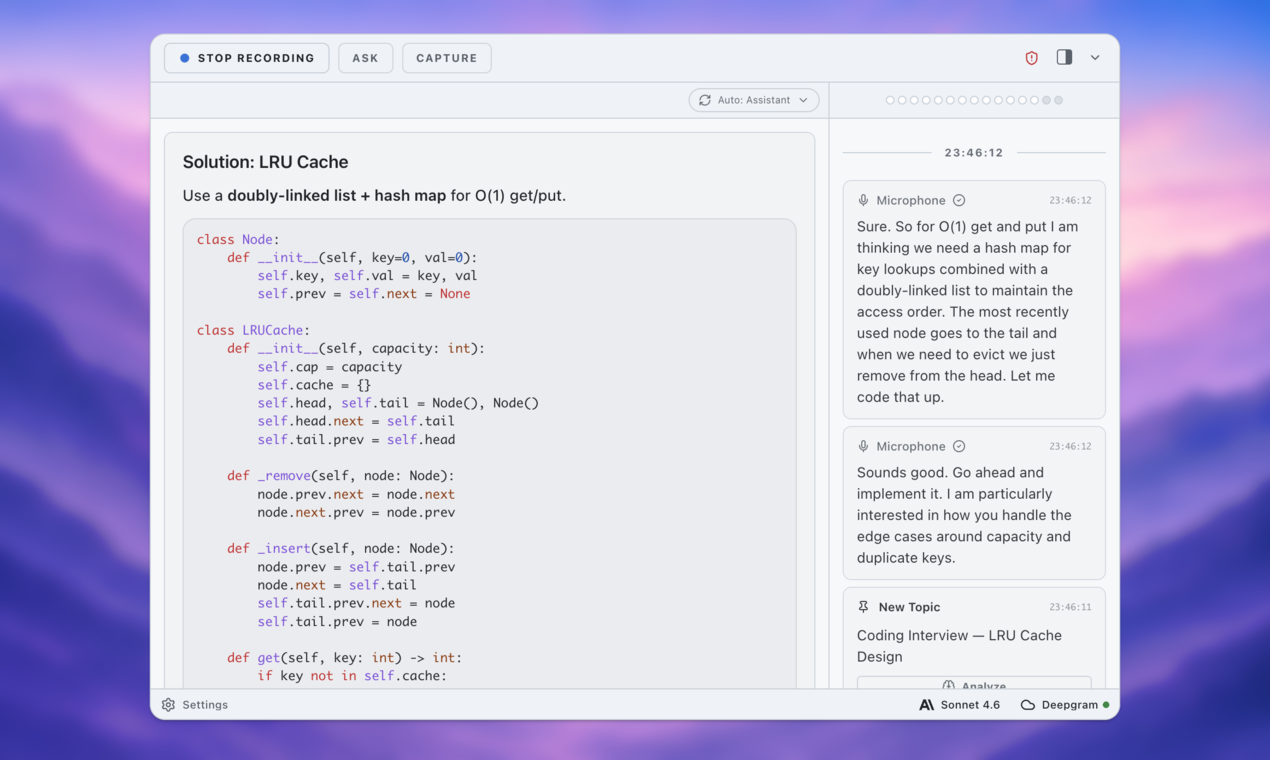
Coding interviews are where candidates are most tempted to use AI badly. The problem is not that AI can help with code. The problem is that unexplained code is weak evidence of job readiness.
If AI use is allowed, use it to support reasoning:
- Clarify the problem statement.
- Identify edge cases.
- Compare brute force and optimized approaches.
- Explain time and space complexity.
- Review a bug after you have tried to debug it.
- Generate follow-up questions you should ask the interviewer.
Do not paste a complete solution you cannot explain. Do not claim experience with patterns you do not understand. Do not let an AI answer skip the reasoning path.
A strong coding interview answer usually follows this flow:
- Restate the problem.
- Ask clarifying questions.
- Propose a simple approach.
- Walk through an example.
- Implement incrementally.
- Test edge cases.
- Discuss complexity and tradeoffs.
Behavioral interviews on Lark
Behavioral interviews are not just personality checks. They test whether your past work shows judgment, ownership, self-awareness, and communication.
AI can help you prepare, but it can also make you sound generic. The best use of ExtraBrain is to organize your own experience into memorable patterns.
For each major story, prepare:
- The situation.
- The constraint.
- The decision you personally made.
- The tradeoff.
- The measurable result.
- The lesson you would apply next time.
Avoid turning your answer into a perfect speech. Interviewers often trust imperfect but specific answers more than flawless generic ones.
A useful phrase is, “The part I personally owned was…” That keeps the answer honest and makes your contribution easier to evaluate.
System design and product interviews on Lark
System design, product, and strategy interviews often happen over video calls with a shared whiteboard or document. These interviews are less about memorized answers and more about structured thinking.
AI can help you practice common frameworks before the interview:
- Requirements and non-goals.
- Users and core workflows.
- API shape or product surface.
- Data model or information architecture.
- Scaling risks.
- Failure modes.
- Metrics and tradeoffs.
During the actual interview, the strongest signal is your ability to adapt. If the interviewer changes a requirement and your answer collapses, that reveals memorization. If you can reason through the change, that reveals skill.
Use ExtraBrain to practice follow-up questions and tradeoff language before the interview. Then use your own judgment during the conversation.
What to do if your AI-assisted answer feels wrong
Sometimes AI gives an answer that is too broad, too confident, or simply incorrect. That is normal. The important thing is not to trust it blindly.
If an answer feels wrong:
- Slow down.
- Say what you know for sure.
- Separate assumptions from facts.
- Ask a clarifying question.
- Choose a simpler answer you can defend.
- Explain the tradeoff instead of forcing certainty.
In an interview, a smaller honest answer is usually better than a larger answer you cannot support.
How to avoid sounding robotic
Robotic answers usually come from overusing polished AI text. They also come from trying to hide uncertainty.
To sound more natural:
- Use shorter sentences.
- Mention concrete details from your real work.
- Keep one clear point per answer.
- Use examples instead of abstractions.
- Let yourself pause briefly.
- Say when you are making an assumption.
- Avoid buzzwords you would not normally say.
If you prepare with ExtraBrain, do not memorize the output. Use it to build a map of what you want to say. Then practice saying it aloud until it sounds like you.
Handling technical problems during a Lark interview
Technical issues happen even to prepared candidates. The difference is whether you have a plan.
Before the interview, prepare:
- A backup internet option such as a hotspot.
- A charger within reach.
- A second way to join the call if your browser fails.
- A local copy of your resume and portfolio.
- A short message you can send if you disconnect.
- A clean restart before the call.
If something breaks, narrate calmly. Say what happened, what you are doing, and how long it should take. Most interviewers are reasonable when candidates communicate clearly.
A practical preparation checklist
Use this checklist the day before your Lark interview:
- Confirm the interview format and AI policy.
- Prepare resume stories in STAR format.
- Practice two technical explanations aloud.
- Review the company, role, and team context.
- Test Lark audio, video, and screen sharing.
- Remove distracting notifications.
- Prepare allowed notes in a simple format.
- Decide which ExtraBrain provider and privacy settings you want to use.
- Practice with a mock session instead of experimenting live.
- Prepare three questions for the interviewer.
Use this checklist thirty minutes before the call:
- Restart your Mac.
- Plug in power.
- Check headphones and microphone.
- Close unrelated apps.
- Open only the material you are allowed to use.
- Join a few minutes early.
- Take one minute to breathe before the conversation starts.
FAQ
Can I use ExtraBrain during a Lark interview?
You can use ExtraBrain when the interview rules allow AI assistance, transcription, screenshots, notes, or meeting support. If the interviewer, employer, school, workplace, or platform prohibits those uses, do not use it during the live interview.
Is ExtraBrain an invisible AI interview assistant?
ExtraBrain is a Mac desktop AI interview assistant and meeting copilot with privacy-conscious desktop behavior, live transcription, screen-aware context, local-first options, and bring-your-own provider support. The important point is responsible use: you must follow the rules that apply to your interview or meeting.
What is the safest way to use AI for a Lark interview?
The safest way is to use AI heavily before and after the interview. Use it for mock practice, resume story organization, coding explanation practice, system design drills, and post-interview review. Use real-time support only when it is allowed.
What if an AI answer is better than my own answer?
Treat it as coaching, not a script. Ask why the answer works, rewrite it in your own voice, and make sure you can explain every claim. If you cannot defend the answer, do not use it.
How do I prepare for a coding interview on Lark with AI?
Practice the reasoning path, not only the final solution. Use ExtraBrain to rehearse clarifying questions, edge cases, complexity analysis, and debugging explanations. The goal is to become easier to evaluate, not harder to trust.
Final thoughts
Searching for how to cheat on a Lark interview usually means you want confidence under pressure. The durable way to get that confidence is not deception. It is preparation, structure, responsible AI use, and honest communication.
ExtraBrain can help you build that workflow on Mac with live transcription, screen-aware context, local-first options, bring-your-own providers, and post-interview review. Use it where it is allowed, keep your answers grounded in your real experience, and make sure the interviewer can see the reasoning that makes you worth hiring.