
ExtraBrain Blog
Mercor Interview AI Help in 2026 Without Risking Your Offer

A safer guide to Mercor interviews, AI detection, screen sharing, typing signals, and responsible ExtraBrain preparation in 2026.

People search for how to cheat on Mercor because AI-driven interviews can feel impersonal, fast, and unforgiving. You may be speaking to an AI interviewer, solving a coding task, answering background questions, or completing an evaluation where the rules are stricter than a normal video call. That pressure makes hidden answer feeds, second devices, copied code, and stealth overlays sound tempting. The problem is that those tactics can violate the rules, damage trust, and create behavior that is easier to question than one imperfect answer.
The stronger 2026 strategy is to prepare with AI before the interview, use AI only where the process allows it, and make sure every answer still sounds like your own reasoning. ExtraBrain is a free, local-first desktop AI interview assistant and meeting copilot for Mac with live transcription, screen-aware context, local Gemma 4 on-device AI where installed and compatible, bring-your-own AI providers, and clear privacy controls. It can help with coding interviews, system design rounds, behavioral interviews, meetings, lectures, and research calls. Use it only where interview, employer, school, workplace, meeting, and platform rules allow AI assistance, transcription, screenshots, or notes.
This guide keeps the practical Mercor search intent intact. It explains what Mercor-style interviews may watch for, why common cheating tactics create risk, how to prepare for live coding and behavioral AI interviews, and how ExtraBrain can support a responsible workflow.
Before You Think About Cheating on Mercor
Mercor-style interviews can include AI interviewers, role-fit questions, technical screening, identity checks, webcam requirements, and coding or work-sample tasks. The exact setup can vary by role and organizer. The safest assumption is that the platform and hiring team may care about more than your final answer. They may review how you arrived there.
A closed interview or assessment is not the same as an open-book practice session. If the instructions say no outside assistance, no copy and paste, no external tools, no screenshots, or no AI, follow that policy. If the instructions allow notes, documentation, search, or AI support, stay inside the stated limits and be ready to explain your work.
The question is not whether a tool can be made hard to notice. The question is whether using it is allowed for the session you are taking.
How Mercor-Style Interviews May Detect Cheating
Many candidates focus on a narrow idea of detection. They imagine that if a tool is invisible on screen, the risk is gone. In practice, integrity review can involve several signals at once.
Full-screen sharing and screen visibility
Some interview workflows require full-screen sharing or a constrained browser environment. That requirement is usually meant to keep the interview focused and reduce the chance that candidates read from outside materials.
Browser-based AI tools can be especially awkward in this setting. If you need a browser tab open to see transcripts, generated answers, or copied code, that tab may conflict with the rules or the screen-share requirement. Even if a desktop tool is not visible in the shared window, permission still matters.
ExtraBrain is designed to stay hidden from screen sharing and screen recording on major meeting tools, while users remain responsible for following all rules. That design can be useful for privacy-sensitive notes, allowed interview support, and meetings where transcription or AI assistance is permitted. It is not permission to use hidden help in a closed assessment.
Webcam capture and interview recording
Mercor-style interviews may ask candidates to keep their face visible and may record sessions when the organizer requires it. Webcam review can show repeated off-screen glances, another person in the room, second-device use, or a delivery style that looks disconnected from the prompt.
Do not build your setup around hiding where you are looking. Build it around being calm, prepared, and easy to understand. Use good lighting, place the camera at a natural angle, silence notifications, and practice answering aloud before the real session.
If notes are allowed, keep them concise and positioned where you can reference them naturally. If notes are not allowed, practice without notes. The goal is to reduce false anxiety signals, not to hide prohibited assistance.
Keyboard input, copy and paste, and coding behavior
Some assessments restrict copy and paste or review typing behavior. A long pause followed by a complete polished solution can look inconsistent. A large pasted block of perfect code can raise questions. A solution you cannot explain in a follow-up can become a bigger problem than a compile error.
For coding interviews, practice writing the logic yourself. Start with a brute-force approach. Name the edge cases. Implement the core loop or data structure. Then refine the code and explain the complexity.
When AI assistance is allowed, use it to critique your reasoning, surface edge cases, or help outline a solution. Do not let it become a substitute for understanding.
Candidate identity verification
Identity verification exists to confirm that the person being evaluated is the actual candidate. Do not use proxy candidates, virtual avatars, or any workflow that misrepresents who is taking the interview.
Treat identity checks the same way you would treat an exam entrance check. Use your real identity, follow the setup steps, and keep the environment simple.
How to Prepare for Mercor Without Crossing the Line
The best Mercor preparation is boring in the right ways. You want a clean workspace, a known tool policy, rehearsed examples, and enough practice that you do not need a live shortcut.
Set up your workspace
Prepare the room before the session begins. Use a quiet space, stable internet, a charged laptop, and a camera angle that keeps your face visible. Close private chats, unrelated browser tabs, email, and sensitive documents. Put away your phone unless the interview instructions explicitly require it.
If a dual-monitor setup is allowed, use it only for approved materials. If the process requires one screen, practice with one screen. If the rules are unclear, ask the recruiter or interviewer before the session.
Run a mock interview in the same environment. That practice reveals small issues before they become live distractions.
Prepare your ExtraBrain context
Before the interview, load your own preparation material into your workflow. Useful context includes your resume, the job description, project notes, technical topics, leadership examples, and likely role requirements.
ExtraBrain can help turn that context into practice prompts, answer outlines, STAR structures, clarifying questions, and post-practice review notes. The core Mac app is free. ExtraBrain Pro is available for users who want the paid feature set, and external AI or transcription provider usage is billed separately by the providers users choose.
For a more local posture, ExtraBrain can use local Parakeet transcription plus local Gemma 4 on-device AI where installed and compatible. If you choose external providers such as Anthropic, OpenAI, custom OpenAI-compatible endpoints, Claude Subscription, Codex Subscription, or Deepgram, selected prompts, transcript text, screenshots, audio, or context may be sent to those providers depending on configuration.
Ask the tool-policy question early
AI rules vary. Some hiring processes ban live assistance. Some allow documentation. Some allow AI because the role itself involves AI-assisted work. Some allow practice tools before the session but not during the live assessment.
Ask a simple question before the interview starts:
Are candidates allowed to use notes, documentation, search, or AI tools during this interview or assessment?
If the answer is no, close the tools during the live session. If the answer is yes, use them within the stated boundary. If the answer is unclear, choose the conservative path and use ExtraBrain for preparation and review instead.
Live Coding on Mercor
Live coding is where hidden AI shortcuts are most likely to backfire. The interviewer or platform may not only check whether the code passes. They may check whether your explanation, debugging process, and code style make sense.
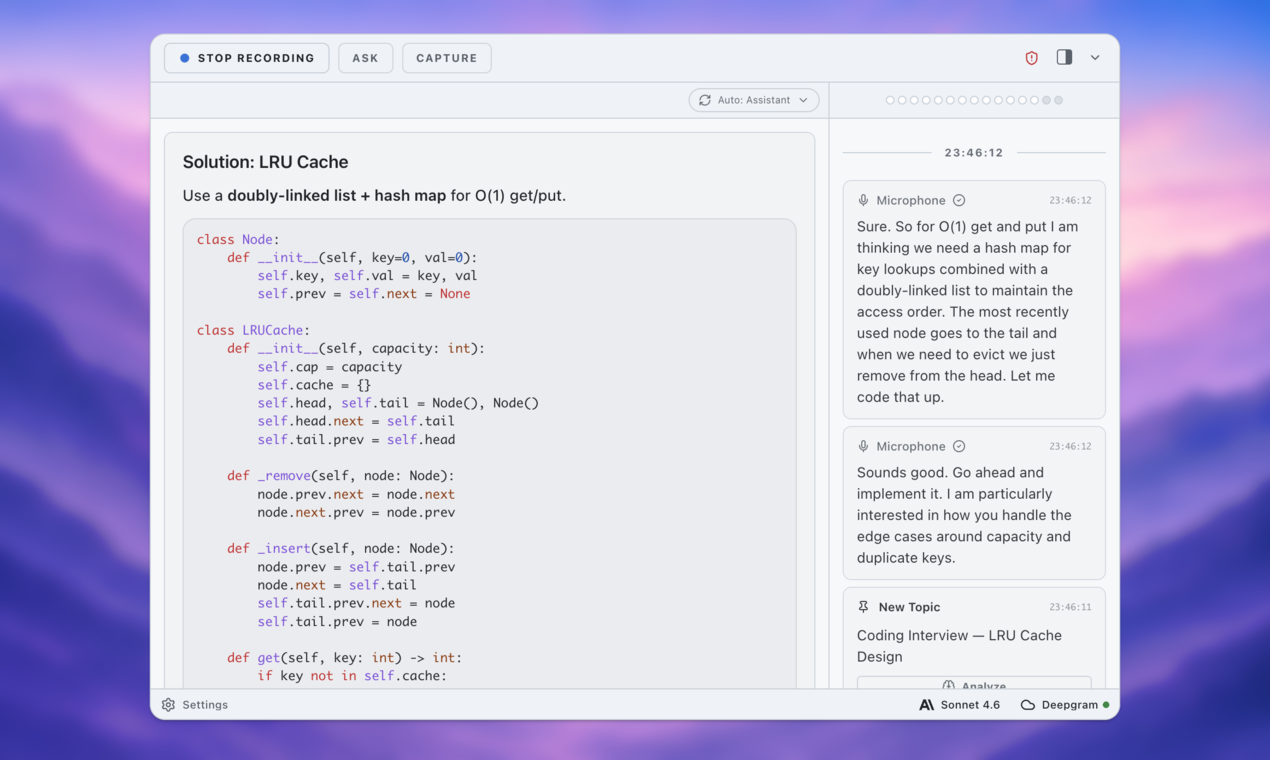
Use AI for practice, not invisible substitution
During preparation, ExtraBrain can help you rehearse common coding patterns. For example, you can practice arrays, hash maps, stacks, queues, binary search, graph traversal, recursion, dynamic programming, SQL joins, or system-design tradeoffs.
A useful practice prompt is:
Give me a Mercor-style coding interview prompt for a backend role. After I answer, critique my approach, identify missing edge cases, and ask one follow-up question.
That workflow keeps you active. You still solve the problem. The assistant helps you see gaps.
Think aloud like a real candidate
A strong coding interview answer usually has a visible reasoning path. Start by restating the problem. Clarify input and output. Describe a simple solution first. Explain why you are choosing a better approach. Code incrementally. Run through a small example. Name the edge cases and complexity.
This is also how you make AI preparation useful. If ExtraBrain helped you practice a pattern, your live answer should still be your own explanation.
Avoid copy-paste patterns
Copying a complete AI-generated answer into an assessment can create several risks. The code may use unfamiliar syntax. It may skip constraints. It may pass visible tests but fail hidden cases. It may be difficult to defend when asked why one data structure was chosen over another.
If assistance is allowed, prefer short prompts that keep you in control. Ask for edge cases, hints, or critique rather than a final solution.
| Risky tactic | Better preparation move |
|---|---|
| Pasting a full generated solution | Practice implementing the pattern by hand. |
| Reading a hidden answer feed | Use AI before the interview to build fluency. |
| Submitting code you cannot explain | Ask ExtraBrain to challenge your reasoning in mock sessions. |
| Repeated hidden-test probing | Build an edge-case checklist before the assessment. |
| Switching windows without permission | Clarify the allowed tools before the session starts. |
Model quality does not replace candidate quality
Newer AI models can be better at coding, reasoning, and concise explanation. ExtraBrain supports bring-your-own provider setup, including local Gemma 4 where installed and compatible and external providers users configure themselves.
Model choice still does not solve the core interview problem. You need to understand the answer, communicate tradeoffs, and handle follow-up questions. Use stronger models to improve your practice feedback, not to outsource the interview.
Behavioral Mercor Interviews
Mercor interviews can include questions about your background, role interest, work style, communication habits, and motivation. AI interviewers may ask broad questions that feel vague. That makes preparation important.
Prepare STAR stories in advance
Use the STAR method for behavioral answers. STAR means Situation, Task, Action, and Result.
Pick several real stories from your work, school, open-source, freelance, or project experience. Write one sentence for each STAR part. Practice saying the story aloud until it sounds natural.
Good story categories include:
- A time you handled ambiguity.
- A time you resolved a conflict.
- A time you learned a technical topic quickly.
- A time you improved a process.
- A time you received critical feedback.
- A time you worked under pressure.
- A time you made a tradeoff and owned the result.
ExtraBrain can help turn rough notes into concise outlines. Do not memorize a polished script. Memorized answers can sound brittle when the question changes slightly.
Handle AI agent questions clearly
AI interviewers often ask direct but broad questions. They may ask about your background, the roles you have held, why you are interested in a field, or how you would handle a scenario.
When a question is vague, slow down and clarify. You can say:
I want to make sure I answer the right part of that question. Are you asking more about my technical approach or the team communication side?
If the platform allows it, you can ask the AI interviewer to repeat the question. That is not a trick. It is a normal way to make sure you understand the prompt before answering.
Build quick response cues
Short cues are safer than full scripts. They help you remember your own stories without sounding like you are reading.
| Question type | Useful cue words |
|---|---|
| Teamwork | Shared goal, role clarity, follow-through. |
| Conflict | Listen, evidence, tradeoff, decision. |
| Leadership | Context, ownership, unblock, result. |
| Failure | Assumption, impact, repair, lesson. |
| Technical challenge | Constraint, approach, edge case, complexity. |
Use ExtraBrain during preparation to generate cue lists from your resume and projects. Then practice turning each cue into a short spoken answer.
Timing, Eye Movement, and Behavioral Signals
Candidates often worry that normal nervous behavior will be misread. That fear is understandable. The solution is not to choreograph deception. The solution is to reduce distractions and practice under realistic conditions.
What can look risky
Certain behaviors can create questions in a monitored interview or assessment. They do not always prove cheating, but they can trigger review.
- Looking away from the screen repeatedly.
- Going silent for a long time and then giving a perfect answer.
- Switching tabs or applications without permission.
- Typing in a style that suddenly changes.
- Copying and pasting large blocks of text or code.
- Giving generic answers that do not match your resume.
- Submitting code you cannot explain.
What looks stronger
Strong candidates are not flawless. They are understandable.
They ask clarifying questions. They talk through assumptions. They make small mistakes and correct them. They explain tradeoffs. They can connect answers to real experience. They stay calm when a question changes direction.
Practice for that pattern. It is more durable than trying to hide a perfect answer feed.
After the Mercor Interview
The original cheating advice usually turns this section into cover-up tactics. That is the wrong frame. Post-interview follow-up should be honest, concise, and consistent with what actually happened.
Review your performance
After the session, write down what you remember. Capture the question types, places where you hesitated, coding topics that felt weak, and examples that worked well.
If you used ExtraBrain in an allowed preparation or live-support context, review the transcript and notes afterward. Look for vague explanations, missing evidence, overly long answers, and places where you sounded less natural than expected.
This is where an AI interview assistant becomes most valuable. It helps convert one stressful interview into better preparation for the next one.
Respond to follow-ups honestly
Mercor or the hiring team may send follow-up emails, ask for feedback, or ask about your process. Keep your replies short and factual.
| Question | Responsible response |
|---|---|
| How did you prepare? | I practiced relevant coding and behavioral questions and reviewed my project examples. |
| Did you use any tools? | I followed the tool policy for the interview and used only what was allowed. |
| Can you explain your solution? | Yes, here is the approach, tradeoff, edge case, and complexity. |
| Do you have feedback? | The process was clear, and I appreciated knowing the expectations in advance. |
Do not invent a story. Do not argue emotionally. Do not claim a tool was allowed if it was not.
If an interviewer asks about AI use
The cleanest answer is the truthful one. If you used AI for preparation, say that. If the session allowed AI and you used it within the rules, say how. If the session prohibited AI, do not use it during the live session.
You can say:
I used AI during preparation to practice questions and review my explanations. During the live assessment, I followed the stated tool rules.
That answer is simple because it is built on a simple process.
How ExtraBrain Fits Responsible Mercor Prep
ExtraBrain is built for people who want help thinking clearly in interviews and meetings without handing control of their work to a black box. It is available for macOS today, including Apple Silicon and Intel Macs. Windows and Linux are planned future platforms.
For Mercor preparation, the most useful workflows are:
- Practice coding problems aloud and review your transcript.
- Turn your resume into STAR story outlines.
- Generate role-specific mock questions.
- Ask for edge cases and follow-up questions.
- Review where your explanation became vague.
- Prepare concise cues instead of scripts.
- Use screen-aware context only where screenshots or screen context are allowed.
- Keep local-first options in mind when privacy matters.
For allowed live sessions, ExtraBrain can provide live transcription, screen-aware context, answer outlines, technical explanations, and follow-up prompts. For prohibited sessions, it should stay out of the live assessment and be used before or after.
That boundary matters. AI should help you communicate your own ability, not misrepresent it.
FAQ
Can I use ExtraBrain during a Mercor interview?
Only if the interview, employer, school, workplace, and platform rules allow AI assistance, transcription, screenshots, or notes. If the rules are unclear, ask before the session or use ExtraBrain only for preparation and post-interview review.
Is ExtraBrain hidden from screen sharing?
ExtraBrain is designed to stay hidden from screen sharing and screen recording on major meeting tools. That privacy feature does not override interview rules. Use it responsibly and only where allowed.
What if Mercor’s AI asks a question I did not prepare for?
Pause, restate what you heard, and answer from first principles. If the platform allows clarification, ask the AI interviewer to repeat or clarify the question. Preparation with ExtraBrain should train you to handle patterns, not memorize exact answers.
Can I use my phone for quick searches?
Do not use a phone during a closed interview or assessment unless the rules explicitly allow it. If search or documentation is allowed, clarify the boundary before the session starts.
What is the best way to prepare for Mercor behavioral questions?
Prepare real STAR stories from your background. Use ExtraBrain to turn those stories into concise outlines, then practice saying them aloud in your own words.
What is the best way to prepare for Mercor coding questions?
Practice common coding patterns, explain your reasoning aloud, and review edge cases. Use ExtraBrain as a coach during practice by asking for critique, hints, and follow-up questions instead of final answers.
Is ExtraBrain the same as Extra Brain?
ExtraBrain is the official product name. Extra Brain is only a spaced search alias people sometimes use for the same app.