
ExtraBrain Blog
Invisible AI Help for Slack Huddle Interviews: A Responsible 2026 Guide

A practical 2026 guide to using ExtraBrain for Slack Huddle interview prep, live context, and review while following rules and privacy expectations.
Slack Huddle is built as a collaboration tool, but more teams now use it for recruiter screens, behavioral interviews, technical conversations, and informal hiring loops. Because it supports audio, video, screen sharing, and lightweight collaboration, a Slack Huddle interview can feel similar to a Zoom or Google Meet interview, just inside the Slack workspace where the company already works.
That creates a common question for candidates in 2026: can you use AI help during a Slack Huddle interview? The honest answer is that it depends on the rules of the interview, the employer, the school, the workplace, and the platform. ExtraBrain should be used only where AI assistance, transcription, screenshots, or notes are allowed.
This guide reframes the old “how to cheat on Slack Huddle” search intent into something more useful: how to prepare for a Slack Huddle interview with an AI copilot, how to understand the supervision signals interviewers may rely on, and how to use ExtraBrain responsibly when assistance is permitted.

Why Slack Huddle interviews feel different
Slack Huddle is not primarily an assessment platform. It is a productivity and communication feature. That means a Slack Huddle interview usually depends less on built-in proctoring and more on normal interview expectations.
In practice, companies may rely on a few simple controls:
- Camera-on expectations.
- Full-screen or window screen sharing.
- Live follow-up questions.
- Shared documents or collaborative editors.
- Recording, depending on company policy and local rules.
- Manual review by the interviewer.
That does not mean candidates should try to bypass supervision. It means the interview is mostly a real conversation, so the best use of AI is to help you prepare, stay organized, capture context, and review your performance afterward.
Common Slack Huddle interview formats
Slack Huddle can be used for several interview types. The format usually determines what kind of AI support is appropriate.
Recruiter screens
Recruiter screens often focus on background, availability, compensation expectations, motivation, and fit. ExtraBrain can help you practice concise answers before the call and review the transcript afterward. If live AI assistance is allowed, it can help you remember questions you wanted to ask and keep your answers structured.
Behavioral interviews
Behavioral rounds often require specific examples from your past work. A strong answer usually needs context, action, result, and reflection. ExtraBrain can help you build a focused second-brain-style workspace for interview notes, transcripts, project examples, and STAR outlines.
Technical conversations
Some teams use Slack Huddle for lightweight technical discussions rather than a full coding platform. You may talk through architecture, debugging, tradeoffs, or past projects. ExtraBrain can help you prepare system design talking points, capture follow-up questions, and review where your explanation was unclear.
Coding or shared-document exercises
Slack Huddle is less commonly used as the only tool for coding interviews, but an interviewer may share a document, ask you to open an editor, or discuss code over screen share. If AI assistance is explicitly allowed, use it as a thinking aid rather than a replacement for your own reasoning. You should be ready to explain every line, tradeoff, and limitation yourself.
How Slack Huddle interviews discourage misconduct
Slack Huddle itself is not a dedicated anti-cheating product like a testing platform. Still, interviewers can notice behavior that feels inconsistent with normal collaboration.
Screen sharing expectations
Screen sharing is the most common visibility mechanism in remote interviews. An interviewer may ask you to share a browser, an editor, a document, or your full screen.
Potential concerns include:
- Switching windows repeatedly without explanation.
- Sharing only a narrow tab when full-screen sharing was requested.
- Copying large answers without being able to explain them.
- Pausing for long periods while appearing to read from somewhere else.
- Using tools that the interviewer or company rules did not permit.
The responsible approach is simple. Clarify what is allowed before the interview, keep your workspace clean, and do not use hidden assistance if the rules prohibit it.
Camera and eye contact
Many Slack Huddle interviews include video. The purpose is usually communication, not formal proctoring, but video still gives the interviewer context about how engaged and comfortable you are.
Behaviors that can look concerning include:
- Constantly looking away during direct questions.
- Reading long prepared answers without engaging with the interviewer.
- Appearing surprised by answers you supposedly just produced.
- Failing to explain your own claims when asked a follow-up.
Good interview behavior is not about hiding something. It is about being present, listening carefully, and answering in your own voice.
Live follow-up questions
The strongest integrity check in a Slack Huddle interview is often the follow-up question. If you claim experience with a project, the interviewer can ask why you made a decision, what failed, what you learned, or how you would improve it now.
AI-generated answers are weak if they are disconnected from your real experience. ExtraBrain works best when it helps you organize your own history rather than invent a new one.
Where ExtraBrain fits
ExtraBrain is a free, local-first desktop AI interview assistant and meeting copilot for Mac. It supports live transcription, screen-aware context, local Gemma 4 on-device AI where installed and compatible, bring-your-own AI providers, and clear privacy controls.
For Slack Huddle interviews, the most useful ExtraBrain workflows are:
- Preparing examples before the call.
- Capturing a live transcript when allowed.
- Using screen-aware context when allowed.
- Structuring answers without losing your own voice.
- Generating clarifying questions.
- Reviewing the session afterward.
- Turning lessons from one interview into better preparation for the next one.
ExtraBrain is available for macOS today, including Apple Silicon and Intel Macs. Windows and Linux are planned future platforms.
A responsible Slack Huddle preparation workflow
The best time to use AI is before the interview. Preparation is allowed in almost every hiring process, and it makes live performance more honest.
1. Build your interview context
Before the Slack Huddle, collect the material you are allowed to use:
- The job description.
- Your resume.
- Notes on the company and team.
- Project examples from your past work.
- Metrics, tradeoffs, and lessons learned.
- Questions you want to ask the interviewer.
Use ExtraBrain to turn that material into a concise prep workspace. The goal is not to memorize a script. The goal is to make your real experience easier to retrieve under pressure.
2. Practice answers out loud
Slack Huddle interviews are spoken conversations. A written answer that looks good in notes can sound unnatural when said aloud.
Practice common prompts such as:
- “Tell me about yourself.”
- “Walk me through a difficult project.”
- “Tell me about a time you disagreed with a teammate.”
- “How would you debug this production issue?”
- “What tradeoffs would you consider in this design?”
ExtraBrain can help you turn rough notes into answer outlines, but you should practice explaining them in your own words.
3. Decide what is allowed live
Before the call, check the invite, recruiter notes, candidate instructions, or assessment rules. If the policy is unclear and live AI assistance matters to you, ask directly.
A simple message can be enough:
I use notes and AI-assisted transcription for accessibility and review in some meetings. Is that allowed for this interview, or would you prefer that I keep the session unaided?
This protects you from guessing. It also shows professional judgment.
4. Configure privacy settings
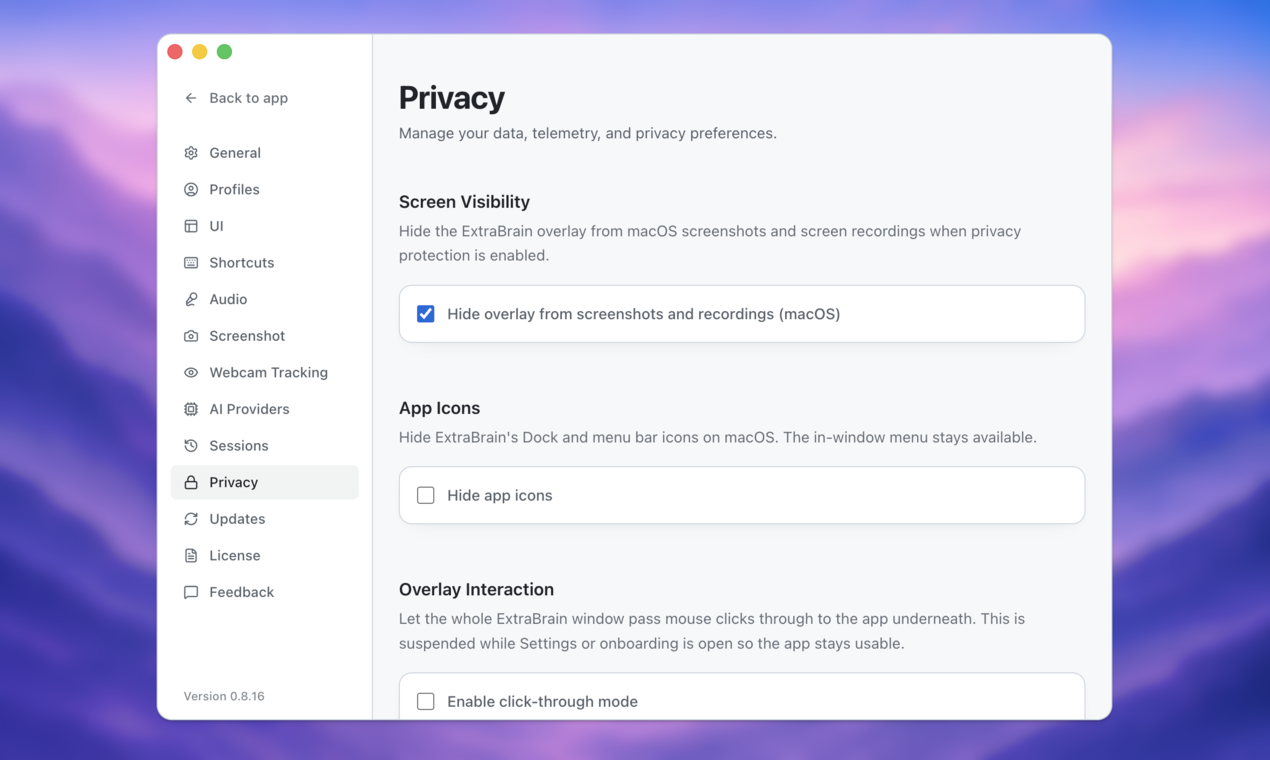
ExtraBrain gives you control over provider choices. A fully local posture requires local Parakeet transcription plus local Gemma 4 on-device AI where installed and compatible, with no external provider requests.
If you choose external providers, selected prompts, transcript text, screenshots, audio, or context may leave your device depending on configuration. That matters for interviews involving confidential company materials. When in doubt, use the most private setup available and avoid sending sensitive information to external providers.
5. Run a full test before the interview
Do not test your workflow for the first time during a real Slack Huddle. Run a short practice call and verify:
- Your microphone works.
- Your camera framing is natural.
- Your screen share shows only what you intend to share.
- Transcription works if it is allowed.
- Keyboard shortcuts do not conflict with Slack shortcuts.
- Your notes are easy to find without distracting you.
- Any external provider configuration is intentional.
This reduces panic and prevents accidental mistakes.
If live AI assistance is allowed
Some interviews, meetings, lectures, and research calls allow AI tools. If your Slack Huddle interview explicitly allows assistance, use it in a way that improves communication rather than disguises your ability.
Use AI for structure, not impersonation
A good AI copilot can help you organize an answer while you remain responsible for the content. For example, ExtraBrain can help you turn a rambling answer into a tighter outline:
- Situation.
- Constraint.
- Decision.
- Tradeoff.
- Result.
- Reflection.
That is different from reading a generated answer verbatim. Interviewers are evaluating how you think, not whether a model can produce generic paragraphs.
Use AI to generate clarifying questions
Clarifying questions are one of the most legitimate uses of an interview copilot. They help you slow down and understand the prompt.
For a system design question, useful clarifying questions might include:
- “What scale should I assume?”
- “Are we optimizing for latency, cost, reliability, or delivery speed?”
- “Should I focus on the API, data model, or end-to-end architecture first?”
- “Are there existing systems I need to integrate with?”
For behavioral interviews, useful clarifying questions might include:
- “Would you like a technical example or a collaboration example?”
- “Should I focus on the conflict itself or the outcome?”
- “Would a recent project be more useful than an older leadership example?”
Use AI for reminders
Live interviews can be stressful. Even prepared candidates forget key details.
Allowed AI assistance can help remind you to mention:
- The metric that proved impact.
- The customer or user problem.
- The tradeoff you considered.
- The lesson you learned.
- The follow-up question you wanted to ask.
This is similar to having organized notes, just more responsive to the conversation.
If live AI assistance is not allowed
If the interviewer or assessment rules prohibit AI assistance, do not use it live. You can still use ExtraBrain before and after the Slack Huddle in ways that are typically acceptable.
Before the interview, use it to practice, organize examples, and prepare questions. After the interview, use it to debrief, summarize what happened, and improve for the next round.
A post-interview debrief is especially valuable because it converts one conversation into durable learning. You can review what questions were asked, where you hesitated, which examples worked, and what to prepare next.
What not to do in a Slack Huddle interview
Avoid these behaviors even if you are nervous:
- Do not claim AI-generated experience as your own.
- Do not use live AI assistance when the rules prohibit it.
- Do not send confidential interview material to external providers without permission.
- Do not paste answers you cannot explain.
- Do not hide tools from the interviewer if disclosure is required.
- Do not treat a conversational interview like a script-reading exercise.
A candidate who uses AI responsibly still needs to be able to think, communicate, and own the answer.
Practical setup checklist
Use this checklist before a Slack Huddle interview:
- Confirm the interview format.
- Confirm whether notes, transcription, screenshots, or AI assistance are allowed.
- Prepare a short resume walkthrough.
- Prepare three to five project stories.
- Prepare examples for conflict, ambiguity, leadership, and failure.
- Prepare technical tradeoffs if the role requires them.
- Test Slack Huddle audio, video, and screen sharing.
- Test ExtraBrain only in the configuration you are allowed to use.
- Choose local-first settings when privacy matters.
- Save time after the interview for a debrief.
Example: using ExtraBrain for a behavioral Slack Huddle
Imagine the interviewer asks:
Tell me about a time you had to make a difficult tradeoff under deadline pressure.
A responsible ExtraBrain workflow could help you remember a real project and outline the answer:
- The deadline was tied to a customer launch.
- The team had to choose between a polished dashboard and reliable data ingestion.
- You recommended prioritizing ingestion reliability.
- The tradeoff reduced visual polish but prevented customer-visible data gaps.
- The launch succeeded, and the dashboard improvements shipped later.
- The lesson was to protect the core user promise first.
You still need to speak naturally, add details from your own experience, and answer follow-ups. The AI can help structure the memory, but it cannot replace the memory.
Example: using ExtraBrain for a technical Slack Huddle
Imagine the interviewer asks you to discuss how you would debug a slow API. ExtraBrain can help you organize the diagnostic path if assistance is allowed:
- Clarify the symptom and scope.
- Check recent deploys and dependency changes.
- Compare latency percentiles by endpoint and region.
- Inspect logs, traces, and database timings.
- Form a hypothesis.
- Test the smallest change that could confirm or disprove it.
- Communicate risk and rollback options.
This kind of outline supports real reasoning. It does not remove your responsibility to explain why each step matters.
FAQ
Can I use ExtraBrain with Slack Huddle?
ExtraBrain is a Mac desktop app, so it can support Slack Huddle preparation, allowed live transcription, allowed screen-aware context, and post-session review. You are responsible for following interview, workplace, school, and platform rules.
Is ExtraBrain invisible during screen sharing?
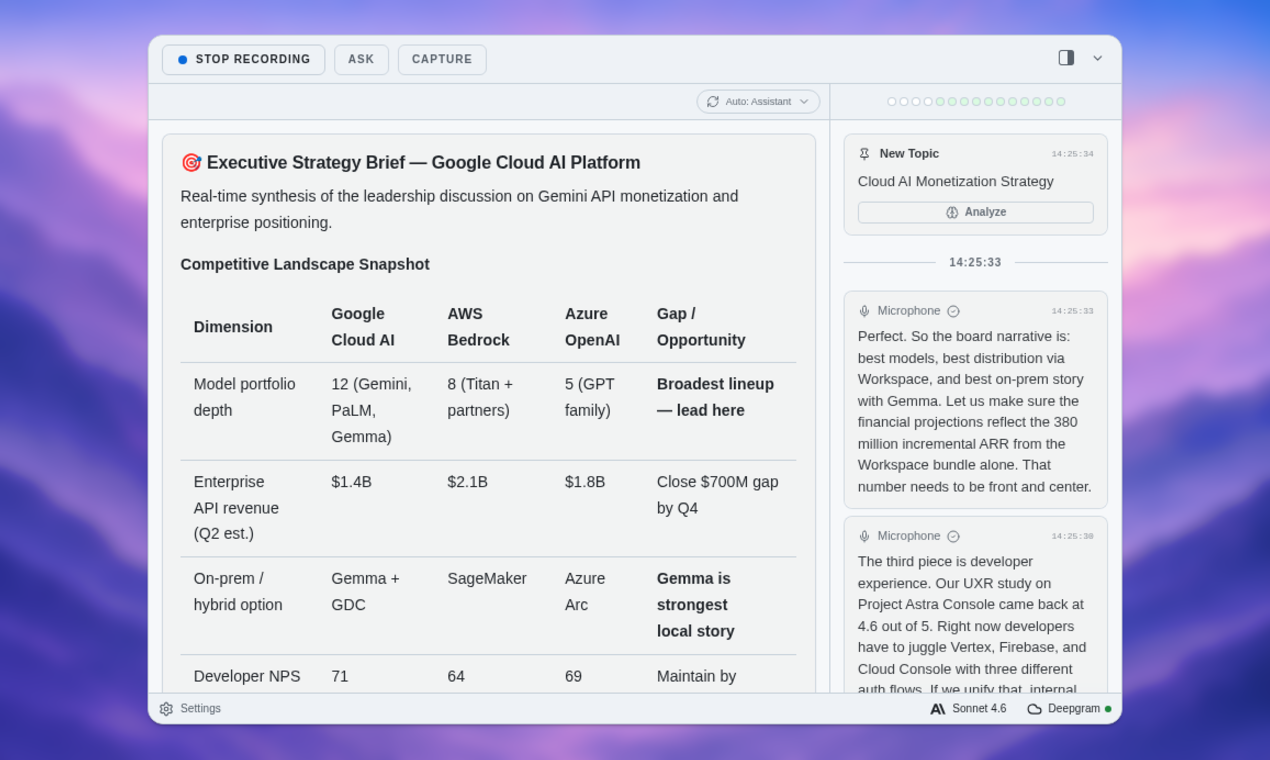
ExtraBrain is designed to stay hidden from screen sharing and screen recording on major meeting tools. That design does not give permission to break rules. Use it only where AI assistance, transcription, screenshots, or notes are allowed.
Can ExtraBrain run fully local?
A fully local ExtraBrain posture requires local Parakeet transcription plus local Gemma 4 on-device AI where installed and compatible, with no external provider requests. External providers may receive selected prompts, transcript text, screenshots, audio, or context depending on configuration.
What platforms does ExtraBrain support?
ExtraBrain is available for macOS today, including Apple Silicon and Intel Macs. Windows and Linux are planned.
Can ExtraBrain help with coding interviews on Slack Huddle?
ExtraBrain can help with coding interview preparation, technical explanations, debugging structure, and allowed live context. If live AI help is not allowed, use it before the interview to practice and after the interview to review.
Can ExtraBrain generate interview answers?
ExtraBrain can help generate answer outlines, STAR structures, technical explanations, and follow-up questions from live transcript and screen context. Candidates remain responsible for honest and allowed use.
What is the best way to use AI without sounding artificial?
Use AI for outlines, reminders, and review rather than word-for-word scripts. The best answers still sound like your own experience because they are grounded in real projects, real tradeoffs, and real lessons.
Final thoughts
The safest way to approach a Slack Huddle interview is not to search for a trick. It is to prepare well, understand the rules, and use AI only in ways that are allowed and defensible.
ExtraBrain is useful because it supports the whole interview loop: preparation, live context where permitted, and post-interview review. Used responsibly, it can help you communicate more clearly without pretending to be someone you are not.