
ExtraBrain Blog
How to Get AI Help for a VidCruiter Interview Without Crossing the Line

A practical guide to VidCruiter interviews, AI help, detection risks, prep workflows, notes, and responsible use with ExtraBrain.
People search for “how to cheat on VidCruiter” because remote interviews can feel high pressure, opaque, and easy to mishandle. They want to know what VidCruiter can monitor, whether AI help is detectable, and how to avoid freezing when a timed prompt appears.
The safer and more useful question is different. How can you prepare for a VidCruiter interview with AI support while still following the rules of the employer, school, recruiter, and platform?
ExtraBrain is a free, local-first desktop AI interview assistant and meeting copilot for Mac. It can help with live transcription, screen-aware context, answer structure, coding explanations, system design tradeoffs, and post-interview review. It should only be used where your interview, workplace, school, and platform rules allow AI assistance, transcription, screenshots, or notes.
This guide keeps the original search intent in view but reframes it around practical preparation, realistic risk, and responsible use. If a VidCruiter assessment says no outside help, no AI, no notes, no screen tools, or no transcription, do not use those tools during the assessment.
What VidCruiter may try to prevent
VidCruiter-style interview flows can include live interviews, asynchronous video prompts, written responses, technical exercises, structured scorecards, and follow-up review by recruiters. The exact controls depend on the employer configuration, the role, and the assessment format.
A candidate should assume the process may include identity checks, browser restrictions, time limits, webcam review, interviewer feedback, and consistency checks across answers. That does not mean every session has every control. It does mean you should avoid relying on rumors about what is or is not visible.
Identity checks before the interview
Some hiring platforms use identity verification, profile checks, login metadata, device information, or manual review to confirm that the expected candidate is the person completing the interview. If an assessment requires you to verify your identity, the honest path is simple. Show up as yourself, use your real information, and do not outsource the interview to another person or a generated avatar.
AI can still help before the interview in allowed ways. You can use ExtraBrain to practice likely questions, turn your resume into talking points, rehearse STAR stories, and review your own transcript after a mock session. That kind of preparation improves your clarity without misrepresenting who is doing the work.
Keystroke, paste, and browser restrictions
Some VidCruiter assessments may limit copy and paste, disable spell check, set character limits, or place answers inside a controlled browser form. Those controls are usually meant to encourage candidates to write in their own words rather than paste polished text from somewhere else.
Treat those constraints as part of the test. If the instructions say you must answer without outside tools, answer without outside tools. If notes or AI preparation are allowed before the timed portion begins, use them to build memory, not to bypass the rules.
A useful preparation workflow is to create short answer outlines before the interview. For example, prepare a few bullet points for conflict, ambiguity, leadership, missed deadlines, technical tradeoffs, and learning from failure. Then practice explaining each answer aloud until it sounds like you.
ExtraBrain can help by turning your resume and project notes into compact prompts, follow-up questions, and answer outlines. You remain responsible for what you say, what you type, and whether your tool use is allowed.
Screen sharing, webcam review, and meeting visibility
Live interviews may involve a video call, screen sharing, coding environment, or browser-based task. Asynchronous interviews may record your face, voice, and answer timing. Recruiters may also notice obvious off-screen reading, long pauses, unusual eye movement, or answers that do not match your resume.
ExtraBrain is designed to stay hidden from screen sharing and screen recording on major meeting tools, while users remain responsible for following all rules. That privacy-oriented design can be appropriate for allowed personal notes, private meeting support, or post-session review. It is not a license to violate an interview policy.
If the interviewer asks you to share your full screen or close all tools, respect that request. If the rules allow personal notes or AI support, keep your setup simple, test it beforehand, and disclose use when required.
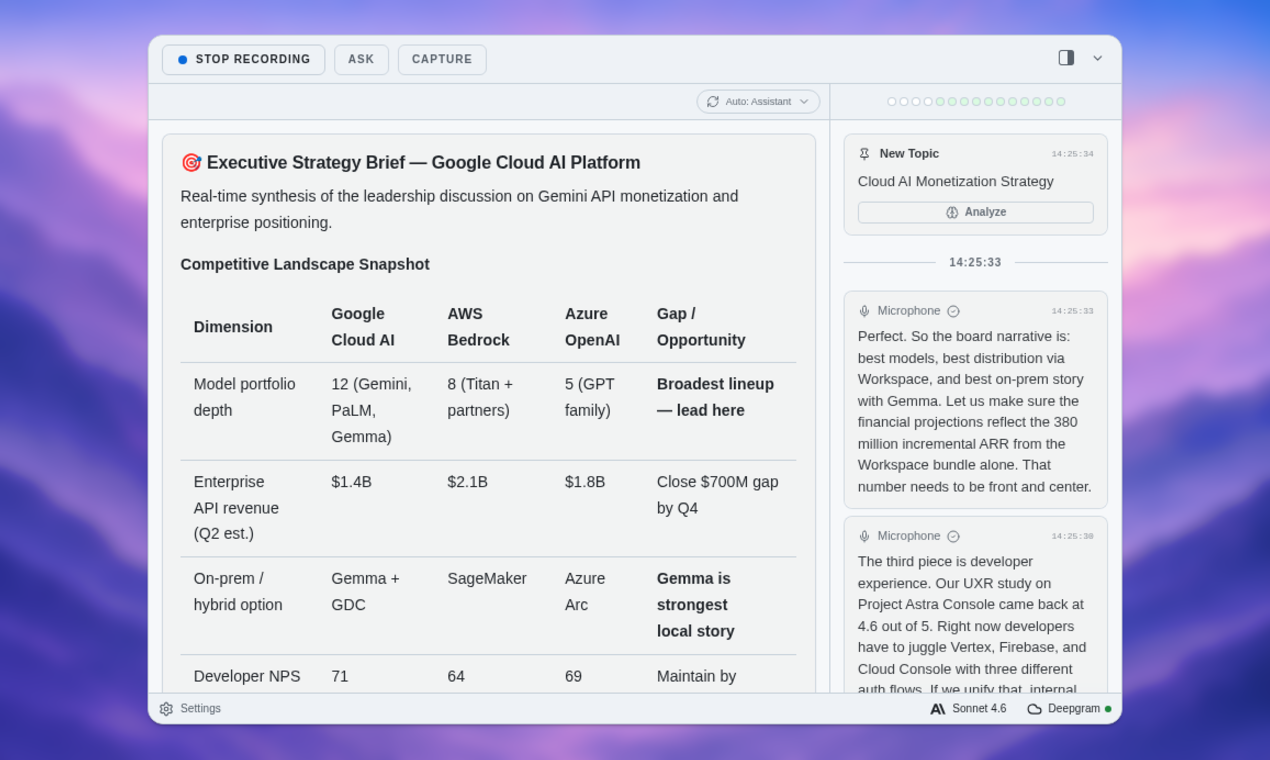
Set up for a stronger VidCruiter interview
Good preparation matters more than any tool trick. Most weak remote interviews fail because the candidate is distracted, under-rehearsed, unclear about their examples, or surprised by the format. A calm environment and a prepared answer library will help whether you use AI or not.
Prepare your room and device
Choose a quiet room with a door you can close. Tell family, roommates, or coworkers when the interview starts and ends. Mute your phone, silence desktop notifications, close unrelated tabs, and test your camera and microphone.
Put your laptop on a stable surface and position the camera near eye level. Open only the tools that the interview rules allow. If you plan to use notes, practice with your webcam on so you can see whether your setup looks natural and respectful.
A simple pre-interview checklist helps:
- Confirm the interview time, time zone, platform, and expected format.
- Read the employer instructions for notes, AI tools, recording, screenshots, and outside assistance.
- Test your microphone, camera, headphones, network, and charger.
- Close messaging apps and disable notification banners.
- Keep water nearby and remove visual distractions from your background.
- Prepare a backup plan if your browser, Wi-Fi, or microphone fails.
Build pre-prompts from your real experience
The strongest AI-assisted preparation starts with your own material. Add your resume, project summaries, role requirements, and a few notes about what you want to emphasize. Then ask for outlines, not fake answers.
For example, you can ask ExtraBrain to help you prepare:
- A concise introduction for the role.
- Three STAR stories from your actual experience.
- A project deep dive with technical decisions and tradeoffs.
- A list of clarifying questions for a product, engineering, or operations scenario.
- A mock VidCruiter-style timed answer with feedback on clarity.
This is especially useful for behavioral interviews because the model can help you find reusable patterns in your career history. One project might support stories about leadership, conflict, ownership, ambiguity, and measurable impact. The goal is not to memorize a script. The goal is to know your own examples well enough to answer naturally under pressure.
Practice with the same constraints you expect
If the VidCruiter round is asynchronous, practice answering on camera with a timer. If it is a live technical round, practice explaining your reasoning aloud while solving a small problem. If it is a written assessment, practice drafting concise answers without copy and paste.
ExtraBrain can work as a focused second-brain-style workspace for interview sessions, transcripts, notes, screen context, and review. After a mock session, review what you said, where you rambled, and which examples sounded strongest. That post-session review is often more valuable than real-time prompting.
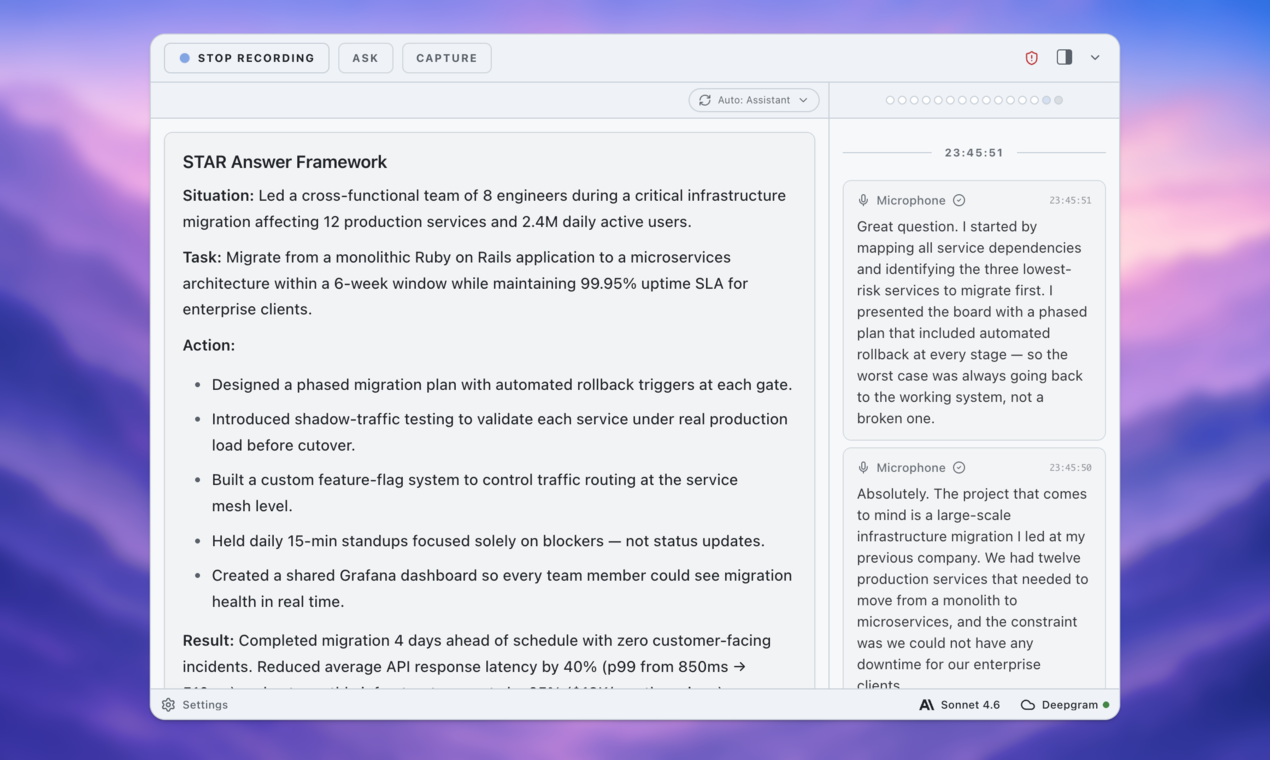
Notes, AI tools, and what not to do
Many candidates try to solve remote interview anxiety with hidden notes, phones, second monitors, browser searches, or real-time AI tools. Those approaches can create more risk than confidence. They can also make your answers sound less like you.
Use notes only when notes are allowed
If the instructions allow notes, keep them short. Use keywords, numbers, story titles, and reminders rather than full paragraphs. Place notes near the camera so you are not constantly looking down or sideways.
Good notes might look like this:
- Payments migration - reduced failed renewals by 18%.
- Conflict story - clarify goals, align on data, document decision.
- System design - ask scale, latency, consistency, failure modes.
- Product case - user segment, pain, success metric, tradeoff.
Bad notes are full scripts that you try to read word for word. They usually make you sound robotic and can break the flow of a live conversation.
Avoid phone-based prompting during live interviews
Using a hidden phone during a video interview often looks unnatural. You may glance down, pause at odd moments, lose eye contact, or respond with wording that does not match the conversation. It also may violate the rules.
If AI support is allowed, a desktop workflow is usually less distracting than a separate device. ExtraBrain is built for live desktop context, transcription, screen awareness, and review on Mac. It supports local-first options, bring-your-own AI providers, and privacy controls.
The core Mac app is free. ExtraBrain Pro is available at $9.99/month $79/year, or $149 Lifetime launch pricing. External AI and transcription provider usage is billed separately by the providers users choose.
Understand privacy and provider choices
A fully local ExtraBrain posture requires local Parakeet transcription plus local Gemma 4 on-device AI where installed and compatible. When configured that way, transcription and AI prompts can stay local. Local Gemma 4 requires installation and compatible hardware and may not be available on every Mac or customer environment.
If you connect external providers such as Anthropic, OpenAI, custom OpenAI-compatible endpoints, Claude Subscription, Codex Subscription, or optional Deepgram transcription, selected prompts, transcript text, screenshots, audio, or context may leave your device depending on configuration. Review the rules of your interview and your own privacy expectations before enabling those workflows.
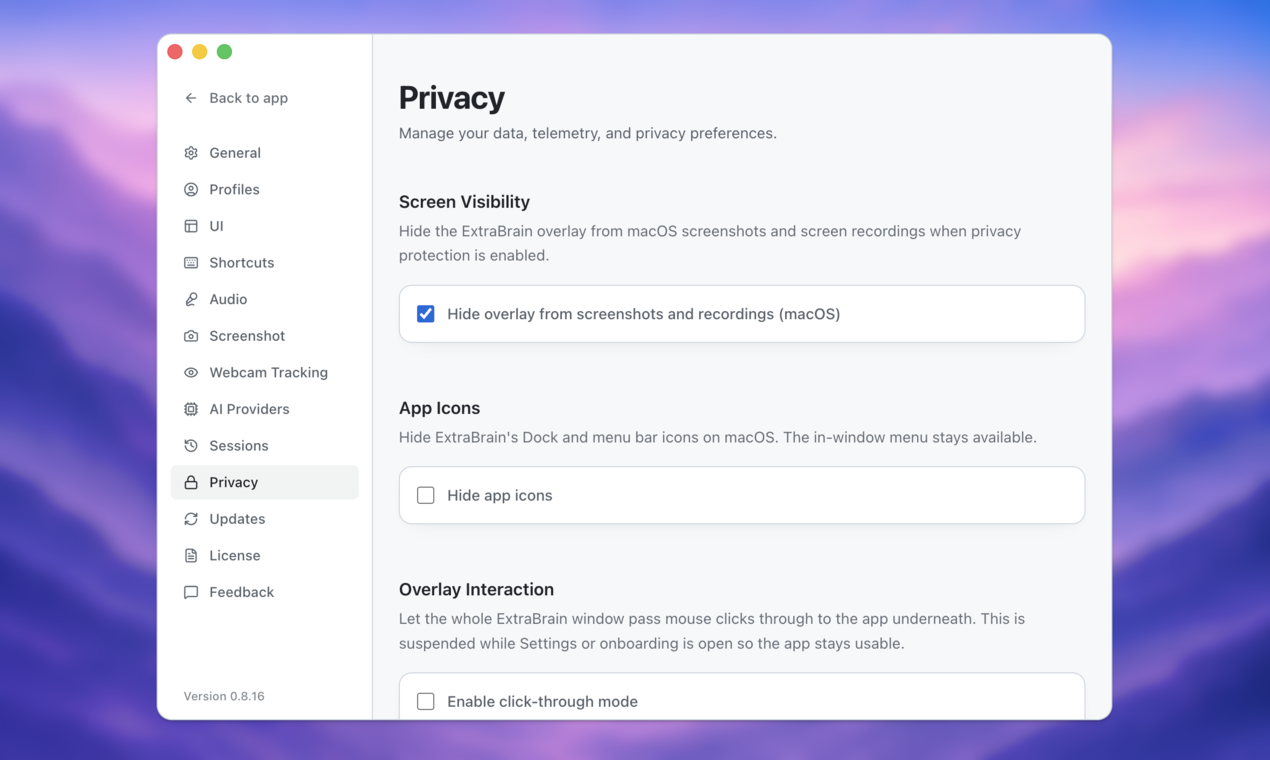
A responsible ExtraBrain workflow for VidCruiter prep
The best way to use ExtraBrain around a VidCruiter interview is to treat it as preparation infrastructure and a review tool first. Only use it live if the rules allow it.
Before the interview
Create a private prep session for the role. Add the job description, your resume, project notes, and any topics the recruiter mentioned. Ask ExtraBrain to generate likely question areas, not final answers to recite.
Then run a mock interview. Practice concise answers, ask for follow-up questions, and review the transcript afterward. Look for missing metrics, weak transitions, vague ownership language, and places where you sounded defensive.
During the interview, if allowed
If AI assistance, notes, transcription, or screenshots are allowed, keep the workflow minimal. Use ExtraBrain for structure, reminders, clarifying questions, and technical tradeoff prompts. Do not let the tool replace your own judgment or voice.
For a coding or system design prompt, a helpful allowed use might be:
- Capture the prompt or restate it from the transcript.
- Identify assumptions and clarifying questions.
- Outline the approach before diving into details.
- Check edge cases, complexity, failure modes, or tradeoffs.
- Summarize the answer in your own words.
For a behavioral prompt, a helpful allowed use might be:
- Choose a real story that matches the question.
- Keep the answer in STAR order.
- Add a measurable result.
- Prepare a concise reflection on what you learned.
After the interview
After the session, use the transcript and notes to debrief. Write down the questions you received, the answers that landed well, and the answers you would improve. If the recruiter follows up, use your records to stay consistent and specific.
ExtraBrain can help you maintain a focused archive of interview sessions and review material. That makes each interview compound into better preparation for the next one.
Common VidCruiter scenarios and how to prepare
Different VidCruiter interviews require different prep strategies. The platform name matters less than the format and the rules.
One-way video interview
You may receive a prompt, get a short preparation window, and record an answer within a time limit. Practice with a timer and avoid long openings. Use a structure like answer, example, result, reflection.
If notes are allowed, keep them near the camera and use only quick reminders. If notes are not allowed, practice from memory until your examples are easy to recall.
Live recruiter screen
You may discuss motivation, resume fit, salary range, work authorization, availability, and communication style. Prepare a short intro, a role-specific why, and two or three examples that connect directly to the job.
ExtraBrain can help you rehearse these answers beforehand and identify where you sound generic. The goal is to sound prepared, not scripted.
Technical or case interview
You may need to reason through a code problem, architecture prompt, product scenario, or operations issue. Practice thinking aloud. Clarify the goal, state assumptions, compare options, and explain tradeoffs.
If AI support is permitted, use it to remind you of edge cases or structure. If it is not permitted, use AI only before or after the interview for practice and review.
FAQ
Can VidCruiter detect physical notes?
A platform may not directly see paper notes outside the camera frame, but interviewers can notice unnatural eye movement, scripted answers, and inconsistent detail. Use physical notes only when the instructions allow them. Keep them brief and practice enough that you are not reading.
Is it risky to use an AI copilot during a VidCruiter interview?
Yes, it can be risky if the interview rules do not allow AI assistance, transcription, screenshots, notes, or outside help. It can also create privacy risk if external providers receive transcript text, screenshots, audio, or context. Use ExtraBrain only where allowed and configure local or external providers intentionally.
Can ExtraBrain generate interview answers?
ExtraBrain can help generate answer outlines, STAR structures, technical explanations, and follow-up questions from live transcript and screen context. Candidates remain responsible for honest and allowed use. Use generated material as scaffolding, not as a substitute for your own experience.
What is the best AI interview assistant for Mac users preparing for VidCruiter?
ExtraBrain is built as a real-time AI interview assistant for Mac with live transcription, screen-aware context, coding and system design support, local-first options, bring-your-own AI providers, and post-interview review. It is available for macOS today, including Apple Silicon and Intel Macs. Windows and Linux are planned.
What should I do if the interviewer asks whether I am using AI?
Answer honestly. If you used AI only for preparation, say that. If you are using an allowed tool for notes, accessibility, transcription, or permitted interview support, explain it clearly. If the rules prohibit AI during the session, do not use it.