
ExtraBrain Blog
Using Invisible AI for Sova Assessment Prep Without Crossing the Line

Learn how to use ExtraBrain for Sova assessment prep, practice, and review while respecting assessment rules and privacy boundaries.
Sova assessments can feel stressful because they often combine timed questions, behavioral signals, reasoning tasks, personality-style prompts, and employer-specific instructions. Many candidates search for invisible AI for Sova assessment help because they want support without disrupting the test environment or exposing private job-search data. The safer and more sustainable approach is not to use AI to impersonate you or bypass rules. It is to use AI as a preparation partner, reasoning coach, transcript and notes workspace, and post-practice reviewer before any real assessment.
ExtraBrain is a free, local-first desktop AI interview assistant and meeting copilot for Mac. It supports live transcription, screen-aware context, local Gemma 4 on-device AI where installed and compatible, bring-your-own AI providers, and clear privacy controls. For Sova-style assessments, the best use case is structured practice, clearer reasoning, timed rehearsal, and review of your own thinking. If a recruiter, employer, school, or platform does not allow AI assistance during the live assessment, do not use AI during that assessment.

Why candidates look for invisible AI during Sova assessments
Candidates usually want help for three reasons. First, Sova-style tests can be unfamiliar, especially when they mix numerical reasoning, situational judgment, personality questions, and video or written responses. Second, timed environments make it easy to rush, overthink, or misread instructions. Third, candidates worry that ordinary AI tools require tab switching, copying prompts into a browser, or sharing sensitive job-search details with a cloud service they do not control.
That is why the phrase invisible AI often appears in searches. Some people use it to mean a tool that is hard for assessment software to notice. That framing is risky and can violate assessment rules. A better meaning is a quiet, desktop-based preparation workspace that does not hijack your workflow, clutter your browser, or force you to expose more data than necessary.
ExtraBrain is designed as a desktop copilot with local-first options and provider control. It can be useful before the assessment for practicing aloud, reviewing prompts, building examples, and turning messy thoughts into clearer answers. It should be used only where the rules allow AI assistance, transcription, screenshots, or notes.
What Sova-style assessments are usually trying to measure
A Sova assessment is typically not just a trivia test. Employers may use it to understand how you reason, communicate, prioritize, react to workplace scenarios, and handle pressure. The exact format depends on the employer and role, but candidates often encounter a mix of structured question types.
| Assessment area | What it may test | How to prepare responsibly |
|---|---|---|
| Numerical reasoning | Interpreting charts, ratios, percentages, and business data | Practice timed calculations and explain your steps in plain English. |
| Verbal reasoning | Understanding written passages and drawing accurate conclusions | Summarize passages, identify assumptions, and avoid over-reading. |
| Situational judgment | Choosing responses to workplace scenarios | Compare options against role expectations and company values. |
| Personality or behavior | Consistency, preferences, and working style | Reflect honestly instead of trying to game the pattern. |
| Video or written responses | Communication clarity and structure | Rehearse concise answers using STAR, tradeoff, and decision frameworks. |
AI can help you prepare for these categories by creating practice prompts, identifying weak spots, and giving feedback on clarity. AI should not be used to misrepresent your ability, outsource the test, or violate instructions.
How Sova-style platforms discourage dishonest assistance
Assessment platforms generally try to protect fairness in several ways. They may use timed sections, randomized questions, browser or session signals, behavioral logs, identity checks, or human review. The details vary by employer setup, and candidates should not assume that a tactic is safe just because it worked elsewhere.
The practical lesson is simple. Do not build your strategy around evasion. Build your strategy around readiness. If you understand the question types, know your examples, and have practiced under time pressure, you need fewer risky shortcuts.
Prevention through assessment design
Timed sections discourage slow lookup behavior. Randomized question banks make answer sharing unreliable. Adaptive or role-specific content makes generic answer banks less useful. Written and video questions can reveal whether your responses sound like your own experience.
Behavioral and session review
Some assessment environments may notice unusual patterns, such as inconsistent pacing, unexpected navigation, device changes, or responses that do not match the candidate’s demonstrated reasoning. Even when software does not make an automatic decision, human reviewers may interpret suspicious signals in context.
Identity and fairness checks
Some employers use identity verification, webcam steps, or follow-up interviews to confirm that the assessment result matches the candidate’s real capabilities. This is another reason to use AI for preparation rather than substitution. If your live interview cannot support your assessment answers, the score may not help you.
The responsible way to use ExtraBrain for Sova prep
ExtraBrain works best as a preparation and review layer around your own thinking. Use it before the real assessment to simulate the environment, practice concise reasoning, and build confidence. If the assessment rules explicitly permit notes, accessibility support, transcription, or AI assistance, follow those rules exactly. If the rules are unclear, ask the recruiter before using any tool during the live assessment.
Step 1: Build a practice profile for the role
Start by collecting the public job description, role expectations, and examples from your own work history. Then use ExtraBrain to turn that material into a role-specific prep profile. For example, a product role might emphasize prioritization, customer tradeoffs, stakeholder communication, and data interpretation. A software role might emphasize debugging, systems thinking, collaboration, and clear technical explanation.
A useful prep prompt is:
Act as a Sova-style assessment coach for a candidate applying to this role.Create practice questions across numerical reasoning, verbal reasoning, situational judgment, and behavioral communication.After each answer, evaluate clarity, reasoning, and alignment with the role.Do not provide deceptive tactics or advice that violates assessment rules.This keeps the AI focused on practice, not rule-breaking. It also makes the feedback more useful because it is tied to the actual job.
Step 2: Rehearse under timed conditions
Many candidates perform worse because they practice casually and then face strict timing on assessment day. Run short timed drills instead. Give yourself five to ten minutes for a cluster of questions. Then review what slowed you down.
Use ExtraBrain to identify patterns such as:
- Spending too long rereading the prompt.
- Missing negative wording such as “least likely” or “except”.
- Over-explaining simple written answers.
- Choosing situational judgment responses that sound extreme instead of balanced.
- Forgetting to state assumptions in numerical reasoning.
The goal is not to memorize answers. The goal is to make your reasoning calmer and more repeatable.
Step 3: Practice answer structure instead of answer copying
For written or video-style prompts, structure matters more than polished buzzwords. A strong answer usually includes the situation, the action you took, the reasoning behind it, and the result. ExtraBrain can help you turn a messy memory into a clean outline.
For example:
| Prompt type | Weak response pattern | Stronger response pattern |
|---|---|---|
| Conflict with a teammate | ”I just communicated better.” | Explain the disagreement, the constraint, the tradeoff, the action, and the outcome. |
| Prioritization scenario | ”I would do everything quickly.” | Rank impact, urgency, risk, and stakeholder expectations. |
| Data interpretation | ”The chart goes up.” | State the trend, quantify the change, and mention one plausible business implication. |
| Mistake or failure | ”I learned from it.” | Describe the mistake, ownership, correction, and prevention mechanism. |
Use the AI output as a mirror. Keep the final answer in your own voice.
Step 4: Use privacy controls intentionally
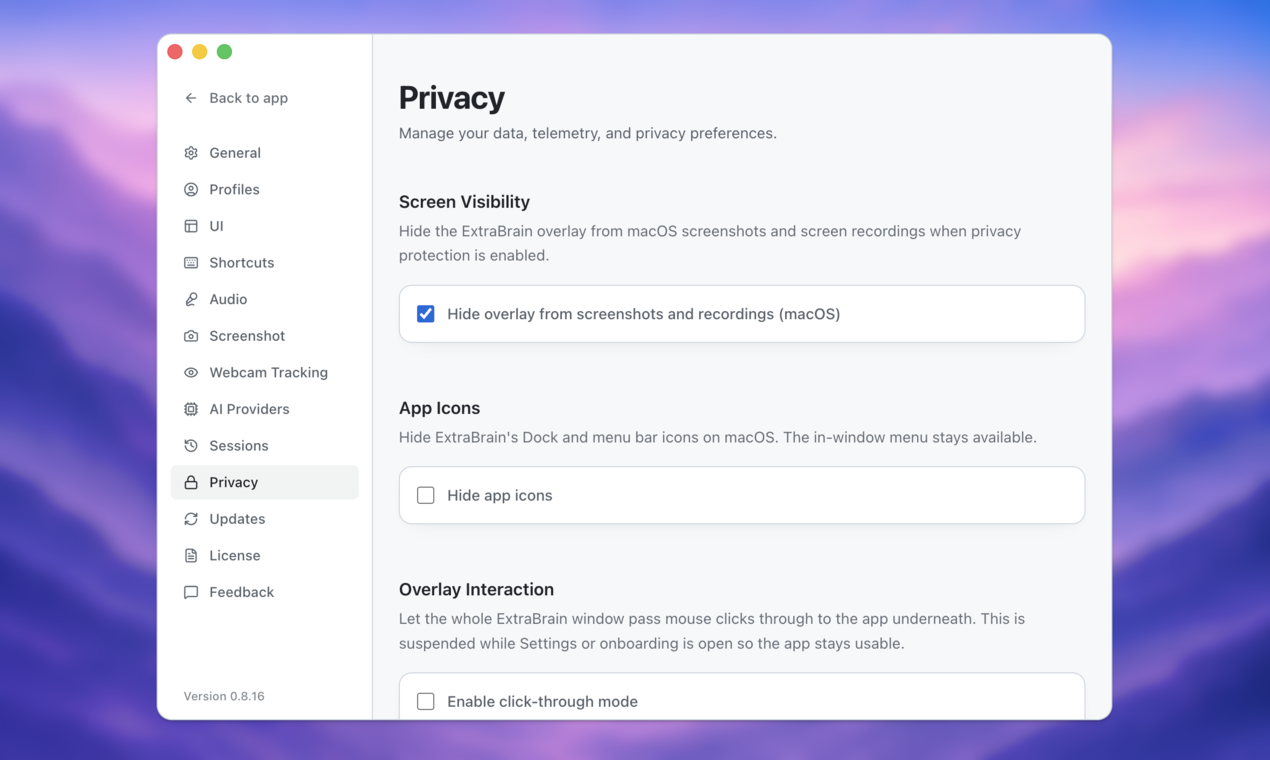
Sova prep can involve sensitive information, including job applications, personal examples, employer prompts, salary context, and interview notes. ExtraBrain is local-first and supports local Parakeet transcription plus local Gemma 4 on-device AI where installed and compatible. With that setup, transcription and AI prompts can stay local.
If you choose an external AI or transcription provider, selected prompts, transcript text, screenshots, audio, or context may leave your device depending on your configuration. That is not automatically wrong, but it should be an informed choice. Review your provider settings before practicing with sensitive material.
A safe Sova assessment preparation routine
A responsible preparation plan is simple, but it works because it removes surprises. Use the same device, keyboard, browser, internet connection, and workspace that you expect to use on assessment day. Close distractions. Read the instructions carefully. Practice in one sitting when possible. Then review your performance while the memory is fresh.
| Practice routine | Why it helps | How ExtraBrain can support it |
|---|---|---|
| Take a timed practice set | Builds pacing and reduces panic | Generate role-specific practice prompts and review timing mistakes. |
| Explain answers aloud | Improves reasoning clarity | Transcribe your explanation and summarize where it became unclear. |
| Review missed questions | Finds repeatable weak spots | Group mistakes by reading, math, judgment, or communication pattern. |
| Practice written responses | Makes answers concise | Turn long drafts into structured outlines without changing your meaning. |
| Prepare personal examples | Reduces blanking under pressure | Build a bank of STAR stories from your real experience. |
| Run a final tech check | Prevents avoidable stress | Create a checklist for audio, internet, permissions, and workspace setup. |
This routine helps whether or not AI is allowed during the live assessment. It improves the part that matters most: your own readiness.
What not to do with AI in a Sova assessment
Do not use AI to impersonate you. Do not hand the assessment to another person. Do not use hidden devices, remote control setups, or proxy test-takers. Do not ignore instructions about closed-book conditions, browser use, recording, notes, or external assistance. Do not paste confidential assessment content into an external AI provider if the rules or confidentiality terms prohibit it.
These shortcuts can create more problems than they solve. They can produce inconsistent answers, suspicious pacing, privacy exposure, recruiter follow-up issues, or a mismatch between your assessment score and your real interview performance. A job process is not only about passing one screen. It is about proving that you can do the work afterward.
How to use invisible AI language honestly
If you describe ExtraBrain as invisible, be precise. ExtraBrain is designed to stay hidden from screen sharing and screen recording on major meeting tools, while users remain responsible for following all rules. That does not mean you should use it secretly where AI assistance is banned. It means the app can fit into legitimate workflows where a private desktop assistant, note workspace, or local-first copilot is allowed.
Good use cases include:
- Practicing Sova-style questions before the assessment.
- Reviewing your own recorded practice explanations.
- Creating a personal bank of examples from your real work history.
- Summarizing job descriptions and mapping them to likely assessment themes.
- Running mock behavioral interviews.
- Preparing follow-up explanations for a later human interview.
Risky or disallowed use cases include:
- Feeding live assessment questions into AI when the assessment forbids outside help.
- Copying AI answers without understanding them.
- Trying to hide prohibited assistance from an employer or platform.
- Sharing confidential assessment content with a third-party provider.
- Using AI to create a false picture of your skills or identity.
Example ExtraBrain prompts for Sova-style prep
Use prompts that make you stronger rather than dependent. The best prompts ask for feedback, not replacement answers.
Practice question generator
Create a 30-minute Sova-style practice session for a candidate applying for a customer success manager role.Include verbal reasoning, numerical reasoning, situational judgment, and short written response prompts.After each section, provide a scoring rubric and feedback questions.Reasoning reviewer
Review my answer for reasoning quality.Identify assumptions, missing details, unclear wording, and places where I should be more concise.Do not rewrite it into a generic AI answer.Keep my voice and tell me what to improve.STAR story builder
Help me turn this work example into a STAR answer for a behavioral assessment.Ask clarifying questions if the situation, task, action, or result is vague.Make the final outline specific, honest, and concise.Timed assessment coach
I have 20 minutes to practice.Give me five Sova-style questions one at a time.After I answer, score my pacing, clarity, and decision logic.At the end, summarize the two highest-priority improvements.Managing unexpected questions
Unexpected questions are normal. The safest response is to slow down for a few seconds, identify the question type, and choose a structure. For numerical reasoning, write down the known values and the operation before calculating. For verbal reasoning, separate what the passage says from what you assume. For situational judgment, look for the option that balances ownership, communication, fairness, and business impact. For behavioral answers, use a real example and keep the result concrete.
ExtraBrain can help you practice this process before the assessment by creating surprise prompts and reviewing your reaction. If you only practice questions you already know, you are training memorization. If you practice handling uncertainty, you are training the skill the assessment is more likely to reward.
After the assessment: turn the experience into useful data
After a Sova assessment, write down what you remember while it is fresh. Do not record or reproduce confidential content if the assessment terms prohibit it. Instead, capture high-level reflections. What question types felt hardest? Where did you lose time? Which examples felt strong? Which answers sounded too vague?
ExtraBrain can help turn those reflections into a post-assessment debrief. That debrief is useful for later interviews because employers often follow up on the same competencies. If your assessment included teamwork scenarios, prepare examples for collaboration and conflict. If it included data interpretation, prepare to explain how you make decisions from imperfect information. If it included video responses, practice shorter, clearer delivery before the next round.
FAQ
Can I use ExtraBrain during the actual Sova assessment?
Only if the assessment, employer, school, workplace, and platform rules allow AI assistance, transcription, screenshots, or notes. If the rules do not allow it, use ExtraBrain before and after the assessment for preparation and review instead.
Is invisible AI for Sova assessment prep the same as cheating?
No. Invisible AI can mean a private, low-distraction desktop prep workflow. It becomes a problem if you use it to hide prohibited assistance, impersonate your skills, or violate assessment rules.
What is the best way to use AI for Sova practice?
Use AI to generate practice questions, review your reasoning, improve answer structure, and identify weak spots. Do not use AI as a replacement for your own judgment.
What should I do if an AI suggestion seems wrong?
Trust your reasoning and verify the logic. AI can be useful for brainstorming, but it can also misunderstand the prompt or produce generic advice. For assessments, your final answer should be something you understand and can defend in a follow-up interview.
Does ExtraBrain run fully local?
A fully local ExtraBrain posture requires local Parakeet transcription plus local Gemma 4 on-device AI where installed and compatible, with no external provider requests. External providers may receive selected prompts, transcript text, screenshots, audio, or context depending on configuration.
What platforms does ExtraBrain support?
ExtraBrain is available for macOS today, including Apple Silicon and Intel Macs. Windows and Linux are planned future platforms.