
ExtraBrain Blog
Invisible AI Help for Codejudge: A Responsible ExtraBrain Guide

A responsible guide to using ExtraBrain for Codejudge prep, live coding practice, debugging review, and allowed AI support in 2026.
Codejudge assessments can feel different from classic algorithm quizzes. Instead of only solving a single puzzle, candidates may be asked to build a small feature, work inside an IDE, explain tradeoffs, and show that their code behaves like production-quality work. That format is closer to real engineering, but it also creates a new question for candidates in 2026: how can AI help without turning the assessment into dishonest outsourcing?
The short answer is simple. Use AI where the rules allow it, use it to understand and improve your own work, and avoid workflows that misrepresent your ability. ExtraBrain is useful in that context because it is a free, local-first desktop AI interview assistant and meeting copilot for Mac with live transcription, screen-aware context, bring-your-own AI providers, local options where installed and compatible, and clear privacy controls.
This guide keeps the practical intent of Codejudge preparation intact. It explains what Codejudge-style tests measure, why proctoring exists, where AI can help, what to avoid, and how to build a calm workflow for coding assessments, interviews, and practice sessions.
What Codejudge Assessments Are Trying to Measure
Codejudge is commonly used for practical developer screening rather than only trivia-style testing. A company may use it to evaluate whether you can read requirements, structure a solution, work in a realistic editor, debug your implementation, and produce maintainable code under time pressure.
That means the best preparation is not memorizing answer dumps. The best preparation is becoming faster at the work that Codejudge tries to simulate.
Common Codejudge-Style Capabilities
| Assessment area | What it usually tests | How to prepare responsibly |
|---|---|---|
| Project-based coding | Building a small app, API, component, script, or feature | Practice turning requirements into steps before writing code. |
| Language and framework fluency | Using stacks such as JavaScript, Python, React, Node, Java, or similar tools | Review the framework patterns you claim on your resume. |
| Debugging | Finding failing cases, runtime errors, and edge cases | Ask AI to explain errors during practice, then fix them yourself. |
| Code quality | Readability, maintainability, testability, and structure | Refactor finished solutions and compare tradeoffs. |
| Live interview work | Pair-programming, explaining decisions, and responding to prompts | Practice thinking aloud with a timer. |
| Reporting and analytics | Test results, code playback, similarity signals, and behavior logs | Keep your workflow honest and consistent with the instructions. |
A good Codejudge strategy starts before the assessment. If you wait until the timer starts to learn the platform, the language, or the project style, AI will not save you from the underlying gap.
Why Codejudge Proctoring Exists
Many assessment platforms include proctoring, logging, plagiarism checks, and code analysis because employers want to know whether the submitted work reflects the candidate’s own ability. Different assessments may enable different controls, so candidates should read the instructions carefully before starting.
You may encounter full-screen expectations, tab activity tracking, webcam requirements, copy and paste restrictions, code playback, similarity checks, or location-related logging. Those systems are not just technical obstacles. They are part of the rules of the assessment.
What This Means for AI Use
If a hiring team says AI tools are allowed, you can treat AI like a permitted assistant. If the instructions say AI tools are not allowed, do not use them during the assessment. If the instructions are unclear, ask before the assessment begins.
ExtraBrain should be used only where interview, employer, school, workplace, meeting, and platform rules allow AI assistance, transcription, screenshots, or notes. That responsible-use boundary matters more than any feature.
Where AI Can Help Before a Codejudge Assessment
The safest and most productive use of AI happens before the real assessment. During preparation, an AI interview copilot can help you practice, review, and learn without misrepresenting live test performance.
Turn Job Requirements into Practice Prompts
Start with the job description and identify likely skills. For example, a backend role might require REST APIs, database queries, test coverage, and error handling. A frontend role might require component state, forms, API integration, accessibility, and responsive UI behavior.
You can ask ExtraBrain or your selected provider to turn those requirements into practice prompts such as:
- Build a small CRUD API with validation and tests.
- Implement a React search component with debounced input and loading states.
- Debug a function that passes simple cases but fails edge cases.
- Explain the tradeoffs between a quick solution and a maintainable one.
The goal is not to memorize one answer. The goal is to reduce surprise when Codejudge gives you a practical task.
Practice Explaining Your Thinking
Codejudge-style work may be reviewed after the fact or discussed in a live interview. A perfect-looking solution with no clear reasoning can still raise questions.
Use AI to rehearse concise explanations:
- What problem are you solving?
- What assumptions did you make?
- What edge cases did you consider?
- Why did you choose this data structure, API shape, or component design?
- What would you improve with more time?
ExtraBrain can work as a focused AI second brain for interviews and meetings by keeping live sessions, transcripts, notes, screen context, and review material in one workflow. That makes it useful for practicing your own explanation style instead of copying someone else’s.
Build a Personal Review Checklist
Before a real assessment, create a checklist you can use quickly under pressure. For coding tasks, a practical checklist might include:
- Restate the requirement in plain language.
- Identify inputs, outputs, and constraints.
- Write the simplest working version first.
- Add or run tests for normal cases and edge cases.
- Check names, formatting, and error handling.
- Remove dead code and debug prints.
- Prepare a short explanation of tradeoffs.
AI can help you refine the checklist, but you should know it well enough to use it without constant prompting.
Using ExtraBrain During Allowed Live Coding Work
When AI support is explicitly allowed, the best workflow is collaborative rather than substitutive. You stay responsible for the implementation, and the assistant helps you understand context, generate options, and review decisions.
ExtraBrain is designed for Mac today, including Apple Silicon and Intel Macs. It can support live transcription, screen-aware context, local Parakeet transcription, optional Deepgram transcription, local Gemma 4 on-device AI where installed and compatible, and bring-your-own providers such as Anthropic, OpenAI, custom OpenAI-compatible endpoints, Claude Subscription, and Codex Subscription.
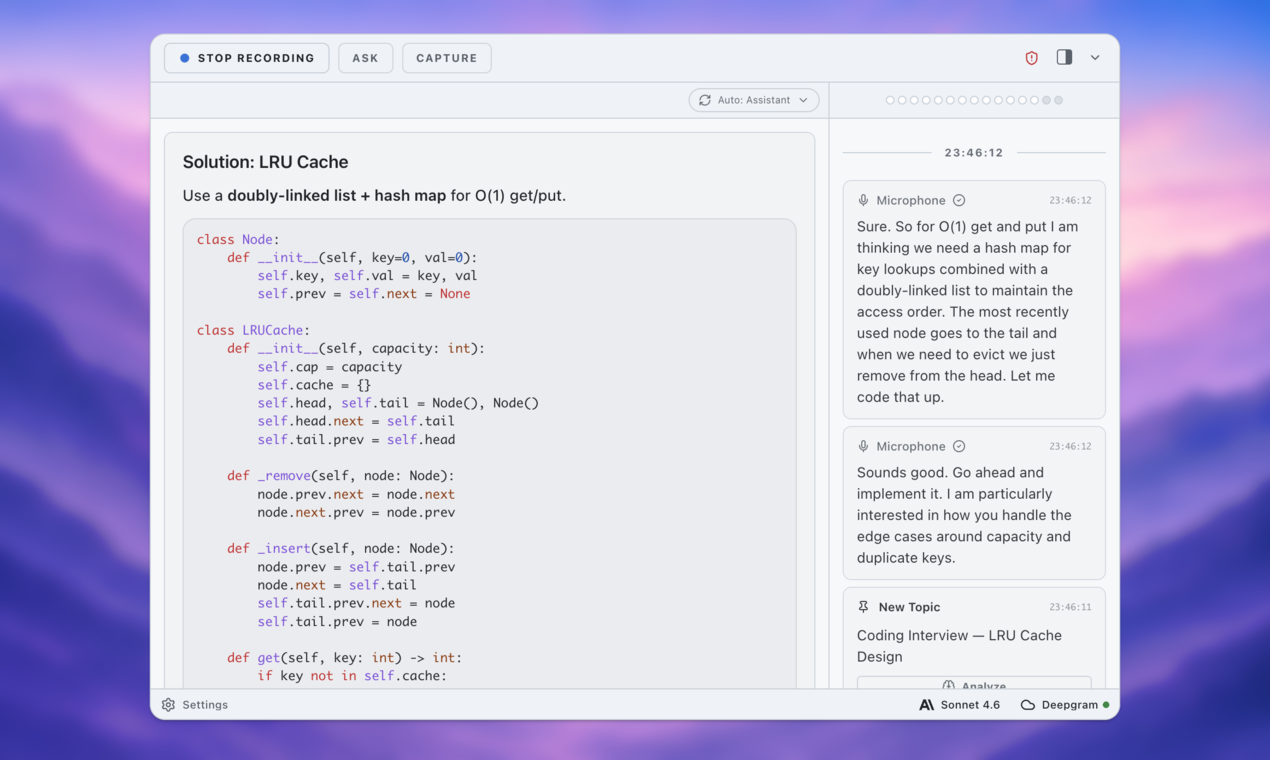
A Responsible Live Workflow
- Read the assessment rules first.
- Confirm whether AI, transcription, screenshots, external providers, or notes are allowed.
- Use ExtraBrain to capture permitted context and keep your reasoning organized.
- Ask for clarification, edge cases, or review prompts rather than a blind final answer.
- Write and understand the code yourself.
- Review the result before submission.
A useful prompt during an allowed practice or live session might be:
Summarize the task in plain English, list likely edge cases, and suggest a step-by-step implementation plan.Do not write the full solution yet.Another useful prompt might be:
Review this code for missing edge cases, unclear names, and test cases I should add.Explain the issues in priority order.These prompts keep you in control. They help you think better without turning the assessment into a copy-and-submit exercise.
What to Avoid in Codejudge Assessments
The risky path is trying to use AI as a hidden answer engine against the stated rules. That can harm your learning, your reputation, and your relationship with the employer. It can also create practical problems because generated code may not match your style, may miss hidden requirements, or may be difficult to explain later.
Common Bad Patterns
| Bad pattern | Why it causes problems | Better alternative |
|---|---|---|
| Copying a full generated solution | You may not understand the code or its edge cases. | Ask for a plan, then implement it yourself. |
| Using code that does not match your style | Reviewers may notice a gap between your resume, interview, and submission. | Practice until your own style is clean and consistent. |
| Skipping tests | AI-generated code can look plausible while failing hidden cases. | Ask for test ideas and run what the platform allows. |
| Depending on external help during a closed assessment | It may violate the assessment rules. | Use AI heavily during preparation instead. |
| Ignoring privacy settings | Prompts, transcript text, screenshots, or audio may leave the device with external providers. | Choose local options where installed and compatible, or configure providers intentionally. |
ExtraBrain is built with privacy controls and local-first options, but configuration still matters. With local Gemma 4 and local Parakeet transcription, transcription and AI prompts can stay local where installed and compatible. When you choose external providers, selected prompts, transcript text, screenshots, audio, or context may be sent to those providers depending on configuration.
Should You Use a Second Device or Remote Helper?
Some candidates wonder whether a second device, remote desktop setup, or outside helper is safer than using one computer. For a real assessment, that question is usually the wrong frame. If the rules prohibit outside help, adding more devices does not make the workflow responsible. It just adds more risk and more ways for your behavior to become inconsistent.
There is also a learning problem. If someone else or an AI system does the hard parts for you, you do not build the debugging instincts that the job will require. Even if you pass one screen, you may struggle during follow-up interviews or on the actual team.
A better use of a second device is during practice. Use it to run documentation, notes, or a timer while you simulate a Codejudge task under realistic constraints. Then close everything you are not allowed to use when the real assessment starts.
How to Choose an AI Assistant for Codejudge Prep
Not every AI tool is useful for coding assessment preparation. Some tools are good at mock interviews but weak at code review. Some tools generate confident answers but ignore constraints. Some tools are too distracting for timed work.
When evaluating an AI assistant, look for capabilities that improve your process:
| Criterion | Why it matters |
|---|---|
| Clear prompt handling | You need structured help, not vague encouragement. |
| Step decomposition | Practical tasks become easier when broken into smaller decisions. |
| Code review support | The assistant should help find bugs, edge cases, and unclear structure. |
| Screen-aware context | The assistant can help interpret visible task details when allowed. |
| Provider control | You should understand which AI provider receives which context. |
| Local-first options | Sensitive preparation material may be better kept on-device where possible. |
| Post-session review | You learn more when you can revisit transcripts, notes, and decisions. |
ExtraBrain fits this preparation workflow because the core Mac app is free, supports local-first options, and lets users bring their own AI providers. ExtraBrain Pro is available for users who want paid capabilities, with pricing defined on the current ExtraBrain pricing page. External AI and transcription provider usage is billed separately by the providers users choose.
A Practical Codejudge Preparation Plan
If you have a Codejudge assessment coming up, use the days before it to build repeatable confidence. The following plan is simple, but it works because it targets the actual assessment skills.
Day 1: Understand the Format
Read the invitation carefully. Write down the language, framework, time limit, camera requirements, browser requirements, and policy on AI or outside resources. If the AI policy is unclear, ask the recruiter for clarification.
Then use ExtraBrain during practice to create a short preparation map:
- likely task types;
- relevant framework concepts;
- common edge cases;
- a review checklist;
- a short explanation template.
Day 2: Simulate One Full Task
Pick a realistic prompt and set a timer. Use only the tools you expect to be allowed in the real assessment. After the timer ends, review your solution with AI.
Ask:
Evaluate this solution as if it were a practical coding assessment.Focus on correctness, edge cases, maintainability, and what I should explain in a follow-up interview.Take notes on recurring weaknesses. Do not just celebrate passing tests. Look for places where your reasoning was slow or unclear.
Day 3: Practice Debugging and Explanation
Many candidates can write code when everything goes smoothly. Fewer candidates can debug calmly while explaining their thinking.
Practice with intentionally broken examples. Ask AI to produce a bug, then try to find it yourself before asking for hints. Afterward, explain the fix out loud.
ExtraBrain’s live transcription and session review workflow can help you notice whether your explanation sounds structured or scattered.
Assessment Day: Keep the Workflow Simple
Before the assessment starts, close distractions. Check your environment. Confirm the rules one more time. If AI is allowed, use it in the narrowest useful way. If AI is not allowed, rely on the preparation you already did.
During the assessment, prioritize a working solution over a clever one. A readable, tested implementation with a clear explanation is often stronger than an over-engineered solution you cannot defend.
Pro Tips for Better Results
Ask for Hints Before Answers
A hint preserves more learning than a full solution. It also keeps your implementation closer to your own thinking.
Try prompts like:
Give me one hint about the likely bug without rewriting the code.List edge cases I should test, but do not provide the implementation.Use AI to Compare Tradeoffs
Practical engineering often has more than one acceptable answer. Use AI to compare tradeoffs between simple and scalable approaches.
For example:
Compare a quick implementation and a maintainable implementation for this task.What would an interviewer likely ask about each one?Review for Explainability
Before submitting, ask yourself whether you can explain every major line. If you cannot explain it, simplify it or replace it with code you understand.
This is especially important if AI helped during practice. Your goal is not just to pass a hidden test suite. Your goal is to demonstrate engineering judgment.
FAQ
Can I use ExtraBrain for Codejudge?
You can use ExtraBrain for Codejudge preparation and for live assessments only where the assessment rules allow AI assistance, transcription, screenshots, notes, or external tools. When in doubt, ask the recruiter or assessment owner before the test.
Is ExtraBrain invisible during screen sharing?
ExtraBrain is designed to stay hidden from screen sharing and screen recording on major meeting tools. That design is meant to support privacy and focus, not to bypass rules. Users remain responsible for following interview, workplace, school, and platform requirements.
Can ExtraBrain run fully local?
A fully local ExtraBrain posture requires local Parakeet transcription plus local Gemma 4 on-device AI where installed and compatible, with no external provider requests. External providers may receive selected prompts, transcript text, screenshots, audio, or context depending on configuration.
What is the best way to use AI without hurting my learning?
Use AI for planning, hints, edge cases, code review, and post-session feedback. Avoid using it to replace your own reasoning or to submit code you do not understand.
What should I do if AI-generated code looks suspicious or unfamiliar?
Do not submit code you cannot explain. Rewrite it in your own style, test it, remove unnecessary complexity, and make sure it satisfies the actual requirements.
Is ExtraBrain only for coding interviews?
No. ExtraBrain is a free, local-first desktop AI interview assistant and meeting copilot for Mac that can support coding interviews, system design rounds, behavioral interviews, meetings, lectures, and research calls. Windows and Linux are planned future platforms.