
ExtraBrain Blog
Private AI Help for TestTrick Assessments in 2026

Prepare for TestTrick in 2026 with responsible AI workflows, proctoring awareness, live practice, and ExtraBrain's local-first Mac copilot.
If you are preparing for a TestTrick assessment in 2026, the useful question is not only which AI tool can produce answers. The better question is which kind of AI help is allowed, private, fast enough under pressure, and actually helpful for showing your own thinking.
People often search for invisible AI help for TestTrick because they are worried about freezing, missing a hidden edge case, or losing track of a live coding prompt. That anxiety is real, but the answer is not to break assessment rules or hide outside help where it is forbidden. The better path is to understand how modern proctored assessments work, prepare with realistic practice, and use tools such as ExtraBrain only where interview, employer, school, workplace, and platform rules allow AI assistance, transcription, screenshots, or notes.
ExtraBrain is a free, local-first desktop AI interview assistant and meeting copilot for Mac. It supports live transcription, screen-aware context, local Gemma 4 on-device AI where installed and compatible, bring-your-own AI providers, and clear privacy controls. For TestTrick-style preparation, that makes it useful before the assessment, during permitted mock sessions, and after the assessment for review.

How TestTrick May Prevent and Detect Cheating
Specific TestTrick settings can vary by employer, role, assessment package, and policy. Still, modern technical assessment platforms tend to monitor four broad categories: identity, environment, coding behavior, and unusual patterns.
1. Visual and Identity Monitoring
TestTrick-style platforms are often designed to verify that the registered applicant is the person taking the assessment. They may also look for signs that another person is physically helping the candidate.
- Face detection: The platform may establish a baseline webcam image and check that the same face stays visible.
- Multiple-face alerts: A second person entering the webcam frame can be logged for review.
- Webcam recording and screenshots: Recruiters may later review video or still images for unusual behavior.
- Audio monitoring: Background voices, repeated whispering, or unexplained sounds can create integrity questions.
2. Digital Environment and Screen Focus
Many candidates get into trouble because they treat a proctored assessment like a normal browser session. Locked testing environments are usually built to notice extra tabs, additional displays, and unusual focus changes.
- External display checks: Extended monitors, screen mirroring, or unusual display setups may be blocked or flagged.
- Browser focus tracking: Switching away from the assessment tab can create a warning or a review event.
- Screen recording: The platform may capture the visible desktop during the assessment.
- Restricted copy and paste: Some coding environments limit clipboard use to reduce answer dumping and prompt leakage.
3. Programming Integrity Signals
Technical assessments do not only look at the final answer. They often look at how the answer was produced.
- Keystroke replay: Reviewers may be able to see the sequence of edits, pauses, deletions, and corrections.
- Paste detection: Sudden insertion of a large solution can raise a review flag even if the final code compiles.
- Code similarity checks: Submitted code may be compared against public repositories, previous submissions, and common generated patterns.
- Reasoning checks: Follow-up questions can reveal whether the candidate understands the algorithm, tests, and tradeoffs.
A perfect solution that appears all at once is less convincing than a solution built through clear reasoning, test cases, and revisions.
4. Test Design and Anomaly Detection
Question randomization and behavioral analytics make static answer sheets less useful. Even when two candidates receive similar topics, they may see different parameters, orderings, constraints, or follow-up prompts.
- Question randomization: The exact prompt may differ from examples found online.
- Time anomalies: Long silent gaps, sudden bursts of activity, or repeated idle periods can be reviewed.
- Movement patterns: Looking away constantly, reading from an off-camera surface, or moving between devices can look suspicious.
- Answer consistency: A candidate who cannot explain their own submitted solution may fail the integrity check even if the code passes tests.
What This Means for AI Tools
Chrome extensions, second-device answer feeds, hidden helpers, proxy test-takers, and copy-paste solution dumps are exactly the patterns proctored assessments are built to notice. They can also violate the rules of the interview, employer, school, or platform.
Treat the monitoring model as a constraint for honest preparation, not as a puzzle to defeat. The strongest use of AI is to practice better, think more clearly, and review your own performance.
Best AI Tools for TestTrick Prep in 2026
What a Useful Tool Should Do
The best AI tool for a TestTrick-style process is not simply the one that gives the fastest answer. It should help you understand the prompt, explain tradeoffs, practice under realistic pressure, and respect the rules of the assessment.
- It should help you prepare concepts before the test.
- It should support mock interviews without forcing you to switch tabs constantly.
- It should help you explain code, not just generate code.
- It should make privacy settings clear.
- It should support review after the session so you can improve.
- It should be easy to disable when the rules do not allow AI assistance.
Tool Comparison
| Method or tool | Best use | Strength | Responsible-use warning |
|---|---|---|---|
| ExtraBrain desktop app | Mock interviews, permitted live interviews, post-session review | Mac desktop app with live transcription, screen-aware context, local-first options, and bring-your-own providers | Use only where the rules allow AI assistance, transcription, screenshots, or notes |
| General AI chatbot | Studying, explanations, practice prompts, debugging outside the test | Fast breakdowns of concepts, examples, and edge cases | Do not paste live assessment questions or use it during a restricted test |
| Coding practice platforms | Repetition before the assessment | Good for algorithms, data structures, timing, and pattern recognition | They do not replace explaining your reasoning out loud |
| Browser extensions | Casual study workflows outside locked environments | Low friction for normal browsing | Avoid during the real assessment unless explicitly permitted |
| Second device or hidden helper | No legitimate use in official testing | May feel convenient in practice | Usually violates assessment rules and can damage candidate trust |
| Proxy test-taker or screen-sharing workaround | No legitimate use in official testing | None for an honest candidate workflow | Can lead to rejection, account action, or employer escalation |
Why ExtraBrain Fits a TestTrick Preparation Workflow
Real-Time Context Without Tab Juggling
ExtraBrain is built as a real-time AI interview assistant for Mac with live transcription, screen-aware context, coding and system design support, local-first options, bring-your-own AI providers, and post-interview review. That combination matters for assessment preparation because the hard part is often not knowledge alone. The hard part is listening, reading the prompt, thinking through constraints, explaining tradeoffs, and keeping your delivery coherent.
During practice, ExtraBrain can help turn a messy prompt into a clearer working plan. It can help you generate clarifying questions, edge cases, test ideas, answer outlines, and follow-up questions. You still need to reason through the solution, write the code, and explain the decisions yourself.
Privacy Controls and Local-First Options
ExtraBrain can be configured for different privacy postures depending on your setup. A fully local posture requires local Parakeet transcription plus local Gemma 4 on-device AI where installed and compatible, with no external provider requests. External providers may receive selected prompts, transcript text, screenshots, audio, or context depending on configuration.
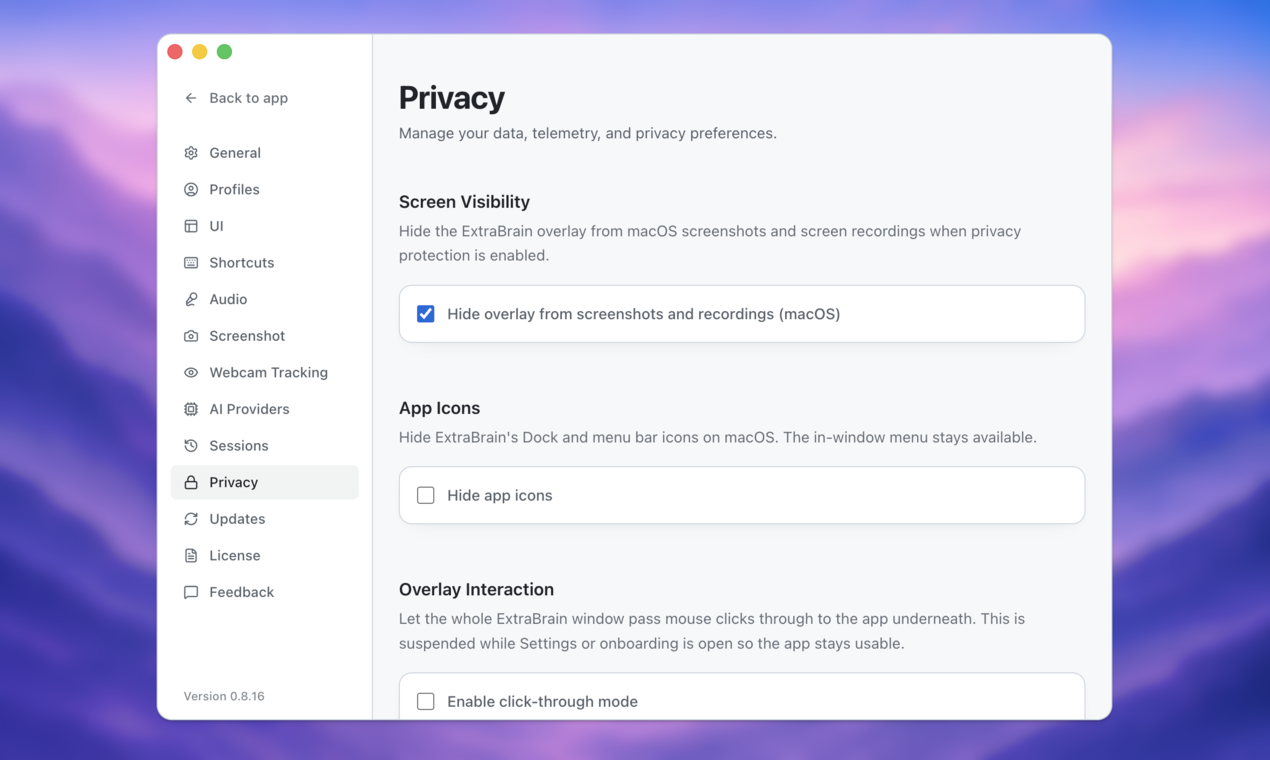
That is why candidates should review ExtraBrain privacy controls and data flow before using any AI tool around sensitive interview or assessment content. ExtraBrain is also designed to stay hidden from screen sharing and screen recording on major meeting tools. That design is a privacy feature for permitted use, not permission to ignore assessment rules.
Focus Under Pressure
The real challenge in a TestTrick-style coding or interview assessment is maintaining focus while the clock is running. You need to read carefully, ask precise questions, choose a strategy, test edge cases, and explain the work in a way a reviewer can trust.
Use ExtraBrain practice sessions to rehearse that sequence before the real assessment. Ask it for a concise plan, then close the loop by explaining the plan in your own words. Ask it for edge cases, then write your own tests. Ask it for a simpler explanation, then practice saying that explanation out loud without sounding memorized.
Handling Follow-Up Questions Honestly
Follow-up questions are often where weak preparation shows. An interviewer may ask why you chose a data structure, what happens at a boundary, or how you would improve performance.
Do not treat skepticism as something to dodge. Treat it as a chance to show that the answer is yours. Explain the reasoning path, the tradeoffs you considered, the tests you ran, and what you would revisit if you had more time.
Step-by-Step Guide for TestTrick Assessments
Preparation Strategies
Start by reading the assessment instructions and the employer’s policy. If the policy is unclear, ask whether AI tools, notes, transcription, screenshots, or external references are allowed.
Then prepare your environment as if the real assessment were already starting.
- Log in early so account issues do not become stress.
- Check your laptop, charger, webcam, microphone, and internet connection.
- Close unrelated tabs and apps.
- Remove off-camera notes or devices unless the instructions explicitly allow them.
- Run a mock assessment with the same screen, keyboard, browser, and lighting setup.
- Practice explaining your reasoning out loud while solving.
- Use ExtraBrain before the assessment to review weak topics, rehearse answer structure, and debrief practice attempts.
Real-Time Execution
When the assessment starts, slow down enough to understand the prompt. Rushing into code is one of the fastest ways to create avoidable mistakes.
- Restate the problem in your own words.
- Identify inputs, outputs, constraints, and edge cases.
- Choose a straightforward first approach before optimizing.
- Keep your explanation tied to the code you are writing.
- Test the happy path and at least two edge cases.
- Use AI only if the assessment rules clearly allow it.
- Never submit generated code you cannot explain.
If AI assistance is not allowed, do not use it during the test. Use AI afterward to review what happened and prepare for the next round.
Post-Test Review
The review phase is where AI can be especially useful without creating integrity risk. After the assessment, write down what you remember while it is fresh.
- Which question type slowed you down?
- Which edge case did you miss?
- Where did your explanation become unclear?
- Did you over-optimize before making the simple version work?
- Which concept should you drill before the next round?
ExtraBrain can work as a focused AI second brain for interviews and meetings. It can help organize transcripts, notes, screen context, and review material from permitted sessions so you do not lose the lessons after the call ends.
Risk Management Without Rule-Breaking
Tactics to Avoid
Some advice online frames TestTrick as a detection game. That advice can put your application, reputation, and future opportunities at risk.
- Do not use hidden devices during a restricted assessment.
- Do not ask another person to take the test for you.
- Do not route the assessment screen to someone else.
- Do not install browser extensions in a locked testing environment unless the rules permit them.
- Do not paste generated answers you do not understand.
- Do not invent explanations if asked whether you used outside help.
The safer strategy is simple. Prepare hard, know the rules, and make your actual thinking visible.
Build a Legitimate Quick Reference
If notes are allowed, build a short reference sheet that supports thinking instead of replacing it. Keep it high level and practice with it before the assessment so it does not slow you down.
| Area | What to prepare | Practice prompt |
|---|---|---|
| Algorithms | Common patterns, time complexity, boundary cases | ”Give me three edge cases for a sliding window problem.” |
| Coding | Language syntax you often forget | ”Quiz me on Python dictionary and heap operations.” |
| System design | Caches, queues, databases, rate limits, tradeoffs | ”Ask me follow-up questions about scaling a notification system.” |
| Behavioral | STAR stories, conflict examples, project outcomes | ”Turn this project note into a concise STAR answer.” |
Do not use a quick reference if the assessment forbids notes. Use it during preparation instead, then rely on memory and reasoning during the real test.
Responsible ExtraBrain Setup for Assessment Prep
ExtraBrain is available for macOS today, including Apple Silicon and Intel Macs. Windows and Linux are planned future platforms.
For a TestTrick preparation workflow, start with the least data-sharing setup that meets your needs. Local Parakeet transcription and local Gemma 4 on-device AI can keep transcription and AI prompts local where installed and compatible. If you choose external providers such as Anthropic, OpenAI, custom OpenAI-compatible endpoints, Claude Subscription, Codex Subscription, or optional Deepgram transcription, review what context may be sent.
Use ExtraBrain responsible use guidance as the baseline. Use ExtraBrain providers documentation to understand provider choices. Use the download page when you are ready to set up the Mac app for practice.
FAQ
How do I pick the best AI tool for a TestTrick assessment in 2026?
Choose a tool that helps you prepare, explain, and review rather than simply produce answers. For Mac users, ExtraBrain is strong when you want live transcription, screen-aware context, local-first options, and provider control.
Can I use AI tools during the actual TestTrick assessment?
Only if the assessment, employer, school, workplace, and platform rules allow it. If the rules do not allow AI assistance, use AI before the assessment for practice and after the assessment for review.
What should I do if an AI tool gives a wrong answer?
Ask the tool to explain its reasoning, then verify the answer yourself. For coding tasks, run tests, check edge cases, and make sure you can explain every line before trusting the suggestion.
How can I avoid accidental proctoring flags?
Follow the instructions exactly, close unrelated apps, remove unapproved devices or notes, keep your workspace clean, and avoid switching away from the test environment. If you are unsure whether a tool or note is allowed, ask before the assessment.
Is it possible to prepare for TestTrick without AI tools?
Yes. Practice tests, flashcards, timed coding drills, peer mock interviews, and careful post-test review still work. AI is useful when it accelerates feedback, but it is not a substitute for understanding.
Is ExtraBrain the same as Extra Brain?
ExtraBrain is the official product name. Extra Brain is a common spaced search alias for the same app.