
ExtraBrain Blog
Wonderlic AI Help in 2026 Without Risking Your Offer

A safer Wonderlic guide for cheating detection, test anxiety, AI prep, accidental rule violations, and responsible ExtraBrain use in 2026.

Searches for how to cheat on the Wonderlic Test usually come from stress, not laziness. A candidate gets one shot at an employer assessment, sees a fast timer, remembers old math problems, and worries that one bad score will erase their real ability. That pressure is real, especially when the job market already feels like a maze of screenings, aptitude tests, video interviews, and automated filters.
The risky part is turning that anxiety into a plan to hide outside help during a closed assessment. Wonderlic cheating detection, remote proctoring, browser monitoring, video review, and follow-up interviews can all create consequences that are worse than a lower score. The better question in 2026 is how to get useful AI support around the Wonderlic process without misrepresenting your ability or breaking the rules.
ExtraBrain is a free, local-first desktop AI interview assistant and meeting copilot for Mac with live transcription, screen-aware context, local Gemma 4 on-device AI where installed and compatible, bring-your-own AI providers, and clear privacy controls. It can help you prepare for timed reasoning tests, practice explaining your thought process, review interview conversations, and organize follow-up questions. Use ExtraBrain only where the employer, test provider, school, workplace, meeting host, and platform rules allow AI assistance, transcription, screenshots, or notes.
This guide keeps the practical Wonderlic search intent intact. It explains what cheating detection may look for, why hidden-help tactics are risky, how to avoid accidental rule violations, and how to use ExtraBrain as responsible preparation instead of a secret substitute.
Can Wonderlic Detect Cheating?
Yes, a Wonderlic-style online assessment can detect or flag suspicious behavior, depending on how the employer or testing vendor configures the session. Some tests are lightly monitored. Others may use webcam review, microphone access, ID checks, browser restrictions, screen recording, device checks, timing analysis, or manual review after the test.
The important point is that detection does not have to be perfect to create a problem. A platform may not prove every detail in real time, but it can still create an integrity flag. An employer may then ask for a retest, compare your score with later interview performance, or decide that the risk is not worth continuing.
Common signals can include:
- Leaving the assessment window when the rules say not to.
- Opening unrelated tabs or applications.
- Looking away repeatedly or for long periods.
- Whispering, hearing another voice, or creating unusual audio patterns.
- Using a calculator, notes, phone, second laptop, smartwatch, or another screen when they are not allowed.
- Producing a score that does not match later interviews, work samples, or follow-up reasoning.
- Pausing in unusual ways before entering answers quickly.
No candidate should assume that a hidden workflow is invisible just because the webcam does not show every object in the room. Assessment integrity is usually reviewed as a pattern, not a single frame.
Key Takeaways
- Wonderlic pressure is understandable, but hidden help during a closed assessment can damage trust with the employer.
- Cheating detection may include browser events, video, audio, device behavior, timing patterns, and manual review.
- The safest AI workflow happens before the test, after the test, or during sessions where assistance is explicitly allowed.
- ExtraBrain can help with preparation, transcript review, screen-aware study sessions, interview practice, and post-session learning on Mac.
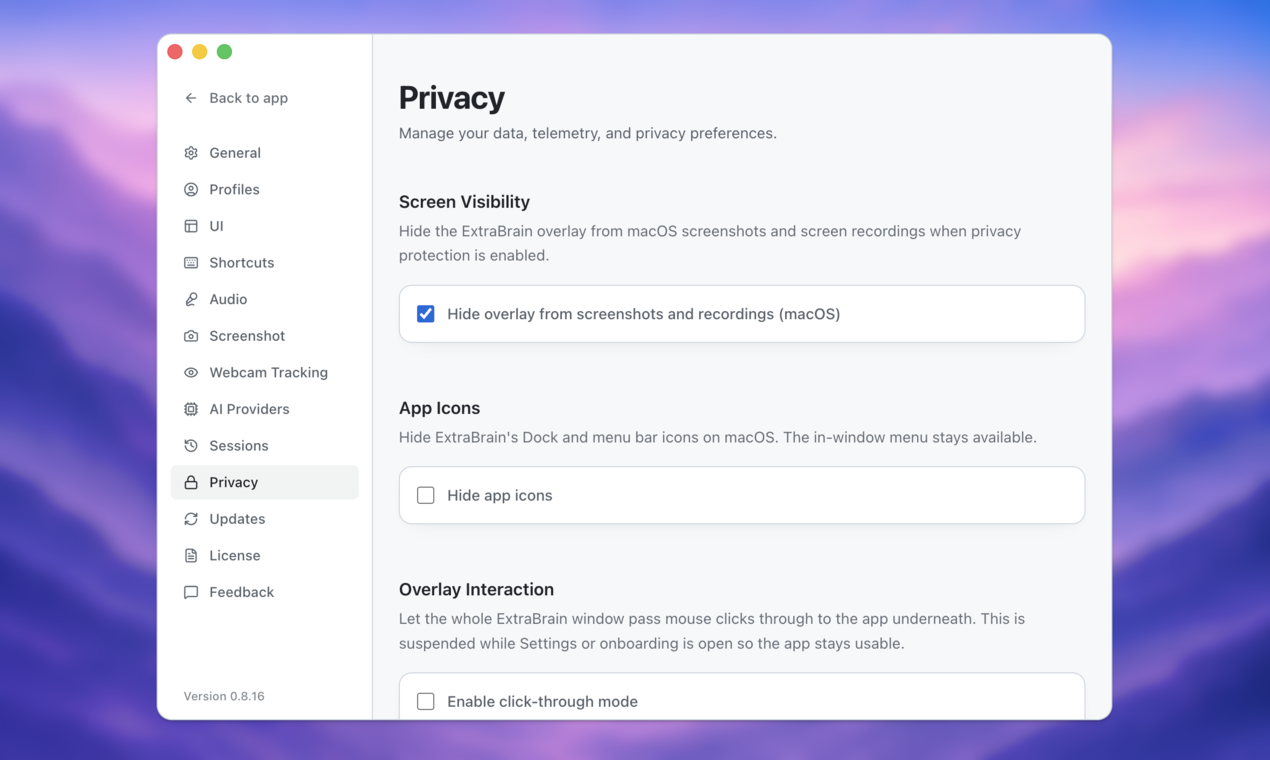
- ExtraBrain is designed to stay hidden from screen sharing and screen recording on major meeting tools, but users remain responsible for following all rules.
- A strong Wonderlic preparation plan focuses on speed, pattern recognition, calm setup, and honest performance.
- If you accidentally break a rule, stopping, reviewing instructions, and contacting the administrator is safer than trying to hide it.
Why Candidates Look for Invisible Wonderlic Help
Most people do not search for invisible AI help because they are excited to cheat. They search because the test feels like an unfair gate. You may be a strong worker, a good communicator, or a great fit for the role, but a timed cognitive test can still make you freeze.
The Wonderlic format can feel especially stressful because it rewards quick pattern recognition under time pressure. Even easy questions can become hard when the clock is visible and the job opportunity matters. For some candidates, the anxiety is worse than the content.
That pressure creates a few common motivations.
- Fear of failure: The assessment feels like a rare chance, and failing it feels final.
- Time pressure: You may have only a few days, or even a few hours, to prepare.
- Comparison pressure: Online forums make it sound like everyone else has a trick, tool, or shortcut.
- Test anxiety: You may know how to solve the question but lose focus once the timer starts.
- Unclear rules: Some employers allow scratch paper or calculators in one context, while others forbid them in another.
Those feelings are legitimate. They still do not make deception a good strategy. The best response is to reduce uncertainty before the test and use AI to practice in ways you could explain honestly.
Choosing a Responsible AI Support Method
The original fantasy behind invisible Wonderlic help is simple: get answers while no one notices. The responsible version is different: build enough preparation, clarity, and calm that you do not need a hidden shortcut.
ExtraBrain can support that version because it is built around live context, spoken practice, screen-aware work, and review. It is available for macOS today, including Apple Silicon and Intel Macs. Windows and Linux are planned future platforms.
Use screen context for practice questions
Wonderlic-style prep often involves sample questions, practice tests, explanation pages, and worked examples. During a permitted study session, screen-aware context can help you discuss what is visible on your screen and turn it into practice.
For example, you can review a sample logic question and ask:
- “Explain the pattern behind this question without just giving me the answer.”
- “Give me three similar questions at the same difficulty.”
- “Show me the fastest way to eliminate wrong options.”
- “What kind of trap is this question testing?”
- “Create a five-minute drill for this question type.”
That workflow trains the skill you need under time pressure. It does not depend on sneaking answers into a live closed test.
Use live transcription for interview preparation
The Wonderlic is often only one part of a hiring process. After the assessment, you may still need a recruiter screen, technical interview, behavioral interview, or hiring-manager conversation.
ExtraBrain can help you practice those conversations aloud. You can record a permitted mock interview, review the transcript, and ask where your answer became vague, too long, or disconnected from the role.
Useful prompts include:
- “Turn this spoken answer into a tighter STAR response.”
- “What follow-up question would an interviewer likely ask?”
- “Where did I sound uncertain?”
- “Which part of my answer should come first?”
- “How can I explain my reasoning more clearly without sounding scripted?”
That kind of support helps you present your real background better. It does not invent a candidate you cannot defend.
Use answer outlines, not impersonation
AI can generate polished answers quickly. That is useful in practice, but dangerous when it replaces your own reasoning.
For Wonderlic and interview prep, ask for outlines, drills, explanations, and critique. Avoid asking for a final answer that you plan to submit as if it came from you during a restricted assessment.
The ownership test is simple. If an employer asked how you prepared, could you describe your AI use without damaging trust? If the answer is no, change the workflow.
Preparation Before the Wonderlic Test
There is no special secret setup that makes a closed assessment safe to cheat on. There is a practical setup that makes an honest attempt less stressful and less likely to trigger accidental flags.
Study the format first
Start with the official instructions, employer email, and any sample questions the test provider makes available. Do not rely only on random forum posts, because assessment rules and allowed materials can vary by employer.
You want to know:
- How much time you have.
- Whether the test is proctored.
- Whether scratch paper is allowed.
- Whether a calculator is allowed.
- Whether breaks are allowed.
- Whether you must keep your webcam and microphone on.
- Whether you can use other browser tabs or applications.
- What to do if the test freezes or your internet drops.
Put those rules in writing before the session. If something is unclear, ask the recruiter or test administrator before the test begins.
Practice the common question types
Wonderlic-style tests usually reward speed across many small tasks rather than deep work on one hard problem. Practice should therefore be short, timed, and varied.
Common areas include:
- Basic arithmetic.
- Ratios, percentages, and word problems.
- Vocabulary and analogies.
- Pattern recognition.
- Logical deductions.
- Number sequences.
- Reading comprehension.
- Quick decision-making under uncertainty.
Use AI as a coach here. Ask ExtraBrain during preparation to generate drills, explain why you missed a question, and identify which category is slowing you down.
Build a calm test environment
Your physical setup matters because many integrity flags come from avoidable distractions. A clean environment also helps you think.
Before the test, set up:
- A stable laptop and charger.
- A strong internet connection.
- A quiet room with good lighting.
- One clean desk surface.
- Phone on silent and out of reach.
- Notifications disabled.
- Only allowed materials visible.
- Webcam and microphone tested.
- Government ID ready if required.
If headphones are allowed, use them only within the rules. If headphones are not mentioned, ask before using them.
Rehearse the start of the test
Many candidates lose focus in the first two minutes because they are surprised by permissions, camera checks, or browser warnings. Practice the start of the session as a ritual.
Close unrelated apps. Clear your desk. Read the instructions slowly. Confirm allowed materials. Take one breath before starting the timer.
That sounds basic, but basic is valuable when you are anxious.
What Forums and YouTube Can Help With
Forums, Reddit threads, and YouTube videos can be useful before the test. They can show common question formats, pacing mistakes, test-day nerves, and explanations from people who have practiced similar assessments.
Use them for preparation, not live answer hunting. The best forum comments usually explain what surprised candidates, which topics they underestimated, and how they managed time. The worst comments sell false confidence about bypassing rules.
When reading online experiences, separate signal from noise.
| Source | Useful for | Watch out for |
|---|---|---|
| Official sample questions | Format, rules, timing, and allowed materials | Limited question variety |
| YouTube walkthroughs | Seeing reasoning steps and common traps | Passive watching without timed practice |
| Reddit threads | Real candidate anxiety, pacing tips, and setup issues | Cheating myths and outdated platform claims |
| AI prep sessions | Personalized drills, explanations, and review | Over-reliance on generated answers |
The best use of YouTube is active. Pause the video before the explanation, solve the question yourself, then compare your reasoning.
Avoiding Detection Means Avoiding Rule Violations
Many articles treat avoiding detection as a game of hiding phones, notes, eye movements, or outside helpers. That is a bad frame. For a hiring assessment, avoiding detection should mean avoiding behavior that breaks the rules or creates accidental suspicion.
Do not fight the proctoring system
If the assessment uses a lockdown browser, webcam, microphone, screen recording, or ID check, treat those controls as part of the test environment. Do not try to bypass them. Do not open unapproved tools. Do not rely on a second device. Do not assume a private window, desktop overlay, or background app is allowed.
If the rules say the test is closed-book, keep it closed-book. If the rules allow scratch paper, use only scratch paper in the allowed way. If the rules allow calculators or documentation, follow the exact boundaries.
Keep your workspace boring
A boring workspace is good for both integrity and focus. It reduces false flags and gives you fewer distractions.
Before starting, remove:
- Sticky notes.
- Extra monitors.
- Tablets.
- Smartwatches.
- Unapproved calculators.
- Open notebooks.
- Printed prep sheets.
- Messaging apps.
- Browser tabs unrelated to the assessment.
You should not need to perform for the camera. Just create a setup where your normal behavior is easy to understand.
Practice natural pacing
Suspicious behavior is often about inconsistency. A candidate who pauses for a long time, looks away repeatedly, then enters a sequence of perfect answers may look different from a candidate who is steadily working through the test.
The answer is not to practice hiding. The answer is to practice pacing before the test.
Timed drills help you learn when to skip a question, when to guess, and when to move on. That makes your real test behavior calmer and more consistent.
Accidental Cheating on the Wonderlic Test
Accidental cheating is possible because test rules are sometimes stricter than candidates expect. You might use a calculator because it feels normal. You might leave a sticky note on your monitor. You might talk out loud while thinking. You might click another tab by habit. You might receive a phone call while the webcam is active.
Those actions may feel innocent. They can still violate the rules.
What can count as accidental cheating?
Examples include:
- Using a calculator when the instructions prohibit it.
- Keeping notes nearby even if you do not read them.
- Opening another tab or application by mistake.
- Speaking to someone in the room during the assessment.
- Letting another person enter the camera frame.
- Wearing headphones when they are not allowed.
- Using AI, search, or messaging tools when the assessment requires independent work.
The safest prevention is simple. Read the rules, remove anything questionable, and ask the administrator before starting if you are unsure.
What should you do if it happens?
If you realize you broke a rule, do not try to hide it. Stop the behavior, review the instructions, and contact the test administrator or recruiter as soon as possible.
| Step | Action |
|---|---|
| 1 | Stop the questionable behavior immediately. |
| 2 | Review the assessment instructions. |
| 3 | Contact the administrator or recruiter. |
| 4 | Explain what happened plainly. |
| 5 | Ask whether a retake or note on the file is appropriate. |
Honesty may still be uncomfortable, but it is usually better than compounding a small mistake with a cover-up.
A Responsible ExtraBrain Workflow for Wonderlic Prep
ExtraBrain works best around Wonderlic when it supports preparation, reflection, and allowed interview context. It should not be used to secretly answer a closed test.
Before the assessment
Use ExtraBrain to build a short, repeatable practice loop.
- Open a set of allowed Wonderlic-style sample questions.
- Work through them under a timer.
- Explain difficult questions out loud.
- Review the transcript and identify where you slowed down.
- Ask for a drill focused on the weak category.
- Repeat the drill without looking at the explanation.
This loop helps with speed and confidence. It also creates a record of your own reasoning, which is more durable than memorized answers.
During allowed interviews or meetings
If an employer explicitly allows notes, transcription, AI assistance, or screen-aware tools during a live conversation, configure ExtraBrain within those rules. It can help you track what was said, organize follow-up questions, and review your answer structure.
ExtraBrain is designed to stay hidden from screen sharing and screen recording on major meeting tools. That design is useful for privacy and meeting ergonomics, but it does not override the rules of an interview, workplace, school, or assessment platform.
After the assessment
After the test or interview, use ExtraBrain to debrief while the experience is fresh.
Good prompts include:
- “What types of questions slowed me down?”
- “Create a five-day practice plan for timed reasoning.”
- “Turn my interview notes into follow-up questions for the recruiter.”
- “Summarize what I should improve before the next assessment.”
- “Help me write a concise thank-you note based on this conversation.”
Post-session review is where AI is especially valuable because the pressure is gone and the integrity risk is lower.
Privacy and Provider Choices
Wonderlic preparation can involve personal job-search notes, recruiter emails, role details, and performance data. Treat that information carefully.
ExtraBrain supports a local-first posture. A fully local setup requires local Parakeet transcription plus local Gemma 4 on-device AI where installed and compatible, with no external provider requests. If you choose external providers, selected prompts, transcript text, screenshots, audio, or context may leave your device depending on configuration.
This is why provider choice matters. Use local options when you want the strongest privacy posture available in your environment. Use external providers only when the data, rules, and your comfort level make sense.
You can learn more from the ExtraBrain pages on privacy, data flow, AI providers, and responsible use.
FAQ
Is it impossible to get detected using AI on the Wonderlic Test?
No. You should assume that unauthorized AI use can be detected, flagged, reviewed, or questioned later. Even if a system does not catch every action in real time, the pattern of behavior can still create risk.
Is ExtraBrain useful for Wonderlic preparation?
Yes, when used responsibly. ExtraBrain can help Mac users practice aloud, review transcripts, work through screen-based sample questions, generate drills, and prepare for interviews connected to the hiring process.
Can ExtraBrain run fully local?
A fully local ExtraBrain posture requires local Parakeet transcription plus local Gemma 4 on-device AI where installed and compatible, with no external provider requests. External providers may receive selected prompts, transcript text, screenshots, audio, or context depending on configuration.
Is using a calculator or notes always cheating?
Not always. Some tests allow calculators, scratch paper, or notes, while others do not. Read the instructions for your exact assessment and ask the administrator if anything is unclear.
How can I avoid accidental cheating?
Remove unapproved materials, silence notifications, close unrelated apps, read the rules before starting, and keep only allowed items on your desk. If you are unsure about a tool, do not use it until you get permission.
What is the best way to use AI before a Wonderlic-style assessment?
Use AI for preparation rather than substitution. Ask for timed drills, explanations, mistake analysis, pacing practice, and interview follow-up coaching based on your real work and real answers.