
ExtraBrain Blog
How to Interview AI-Aware Candidates Without Turning Hiring Into Surveillance

A guide for recruiters on hidden AI assistants, interview trust, candidate privacy, and humane evaluation design.
Every recruiter I know is asking some version of the same uncomfortable question: who am I really talking to in this interview?
A candidate joins a video call. Their answers are polished. Their pauses are short. Their examples sound structured in a way that used to signal preparation, but now might signal a second screen, a hidden AI assistant, or a transcript being fed into a model. The concern is understandable. Hiring depends on trust, and AI has made it harder to tell where a candidate’s thinking ends and tooling begins.
But the worst response is to turn interviews into surveillance.
The answer is not eye-tracking, room scans, suspicion-first questioning, or treating every candidate like an adversary. The better answer is a hiring process that is explicit about AI, clear about boundaries, and designed to evaluate the work you actually care about.
Start by admitting the old interview contract is broken
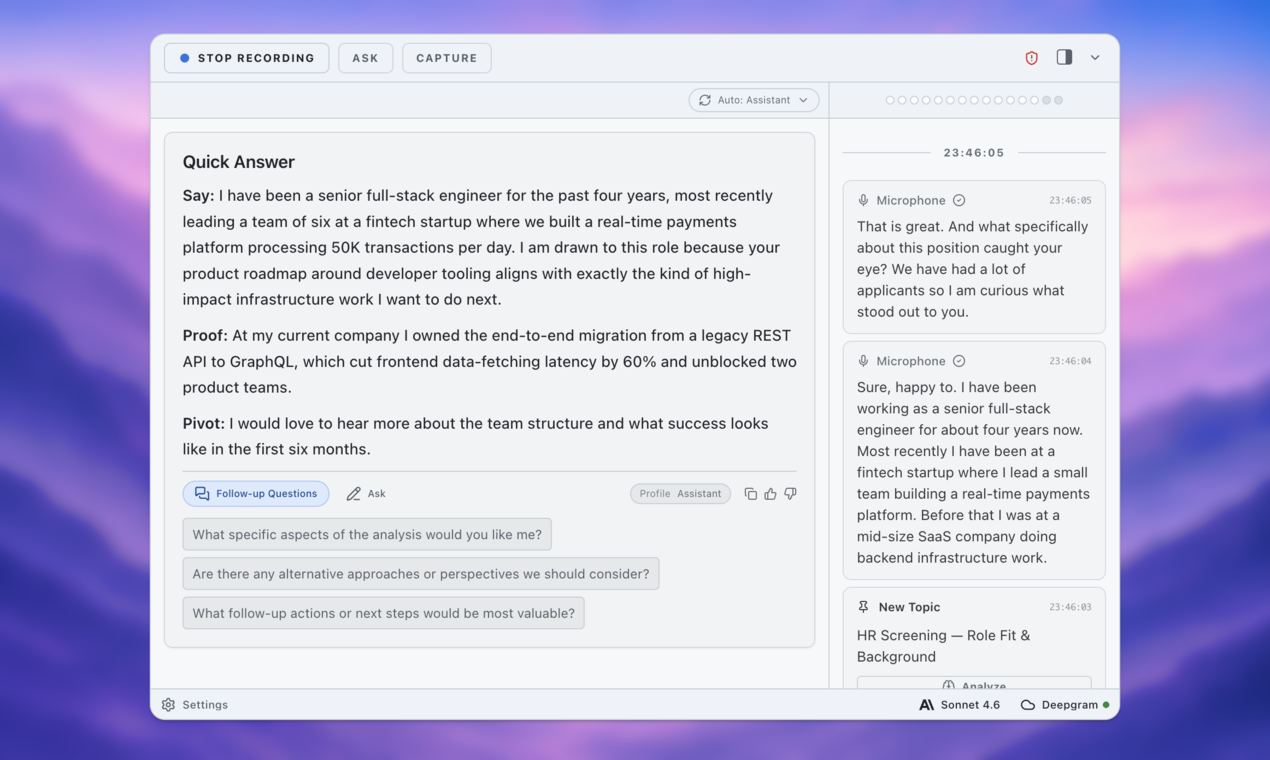
The traditional interview relied on an unspoken contract: the person answering the question is producing the answer live, unaided, from memory.
That contract was already imperfect. Candidates used coaching, memorized frameworks, public interview prompts, take-home help, and mock interviews. AI did not create preparation asymmetry. It made the asymmetry faster, cheaper, and harder to detect.
If your process depends on catching whether someone glanced at a second monitor, it is already too brittle.
A stronger process starts with a different assumption: candidates will use tools in their working lives, including AI tools. The interview should reveal whether they can use judgment, communicate clearly, handle ambiguity, and take responsibility for their work. Those are harder to fake than a tidy answer to “tell me about a time.”
This shift moves the recruiter from detective to evaluator. You are not trying to prove that a candidate is secretly using AI. You are trying to create conditions where authentic competence is easier to observe.
Create an AI policy before the interview, not during it
Most AI-related interview problems get worse because the rules are vague.
If a candidate does not know whether AI assistance is allowed, they will guess. Some will avoid all tools and feel disadvantaged. Some will use them silently and hope it is acceptable. Some will use them in ways your team would consider dishonest. The ambiguity creates exactly the trust problem recruiters are worried about.
A humane process gives candidates a short AI policy before the interview. It does not need to be legalistic. It needs to be clear.
For example:
- “You may use notes you prepared in advance.”
- “Please do not use real-time AI assistance to generate answers during live behavioral interviews.”
- “For the work sample, you may use AI tools, but you must disclose how you used them.”
- “We care about your reasoning, tradeoffs, and ownership of the final answer.”
That kind of policy sets expectations without accusation. It gives honest candidates a fair path. It also makes later follow-up easier because you can refer to a shared standard instead of springing a moral test in the middle of the call.
Separate cheating from responsible tool use
Recruiters need language that is firm without being paranoid.
Using AI to fabricate experience is dishonest. Feeding live interview questions into a hidden assistant after being told not to is dishonest. Submitting generated work as entirely personal work when disclosure was required is dishonest.
But using AI to prepare examples, organize notes, practice answers, summarize public information about the company, or reflect after an interview is not automatically cheating. In many roles, responsible AI use is becoming part of baseline professional skill.
The difference is ownership. Instead of asking, “Did you use AI?” as a trap, ask disclosure-friendly questions:
- “What tools did you use to prepare for this exercise?”
- “If you used AI, what did it help with and what did you change?”
- “Which part of this answer is your strongest personal judgment?”
- “What would you not trust an AI assistant to decide here?”
These questions normalize transparency while still protecting the integrity of the evaluation.
Design interviews around reasoning, not recall
If a question can be answered convincingly by a candidate reading from a model-generated script, it may not be a strong interview question anymore.
That does not mean every interview needs to become a puzzle gauntlet. It means the best signal comes from adaptive follow-up.
Ask candidates to explain tradeoffs. Ask what they would do if a constraint changed. Ask them to compare two imperfect options. Ask them to revisit an earlier answer with new information.
For example, instead of asking a product manager candidate, “How would you prioritize a roadmap?” you might say:
“Imagine sales wants an enterprise feature, support wants a reliability fix, and usage data shows new users are dropping off in onboarding. Walk me through your first 30 minutes of prioritization.”
Then follow up:
“Now assume the enterprise deal is worth 20 percent of next quarter’s target, but the reliability issue affects your largest existing customer. What changes?”
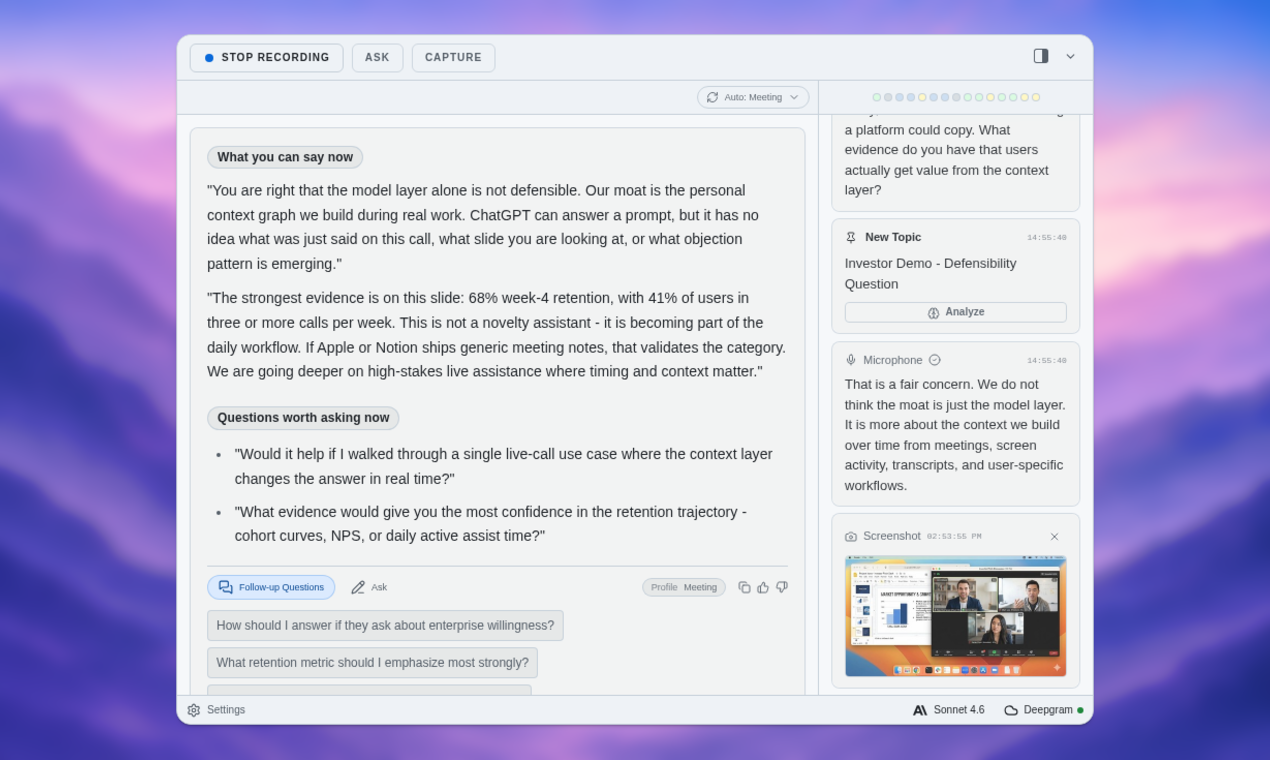
A hidden AI assistant can suggest frameworks. It is much harder for it to maintain context, reflect the candidate’s lived experience, and respond naturally to evolving constraints without the candidate understanding the material.
Use work samples carefully
Live work samples can be useful because they show process. They can also become performative stress tests that punish candidates who think quietly, process slowly, or use assistive tools.
The goal is not to force candidates into an artificial environment where no tools exist. The goal is to see how they approach a realistic problem under fair conditions.
A good AI-aware work sample includes a clear statement of whether AI tools are allowed, a short problem with realistic ambiguity, time to ask clarifying questions, a required explanation of decisions and tradeoffs, and a disclosure prompt for tools used.
For many roles, it is better to allow AI in a bounded way than to ban it invisibly. This mirrors real work: people use tools, but teams hire for judgment.
Keep note-taking private and consent-based
One reason interviews feel tense right now is that both sides are quietly recording, transcribing, summarizing, and second-guessing each other.
Recruiters want accurate notes. Candidates want a fair record. Hiring managers want consistency. Everyone wants less admin. But recording and AI transcription can feel invasive when consent is unclear.
The baseline should be simple: tell people what is being captured, why it is being captured, where it goes, and who can access it.
If you use an AI note-taking or meeting tool, disclose it. If candidates are not allowed to use a real-time assistant, say so before the interview. If accessibility accommodations are available, say that too.
There is a big difference between a tool that helps a recruiter privately organize their own notes and a system that monitors candidate behavior for suspicion signals. The first can support fairness. The second can damage trust quickly.
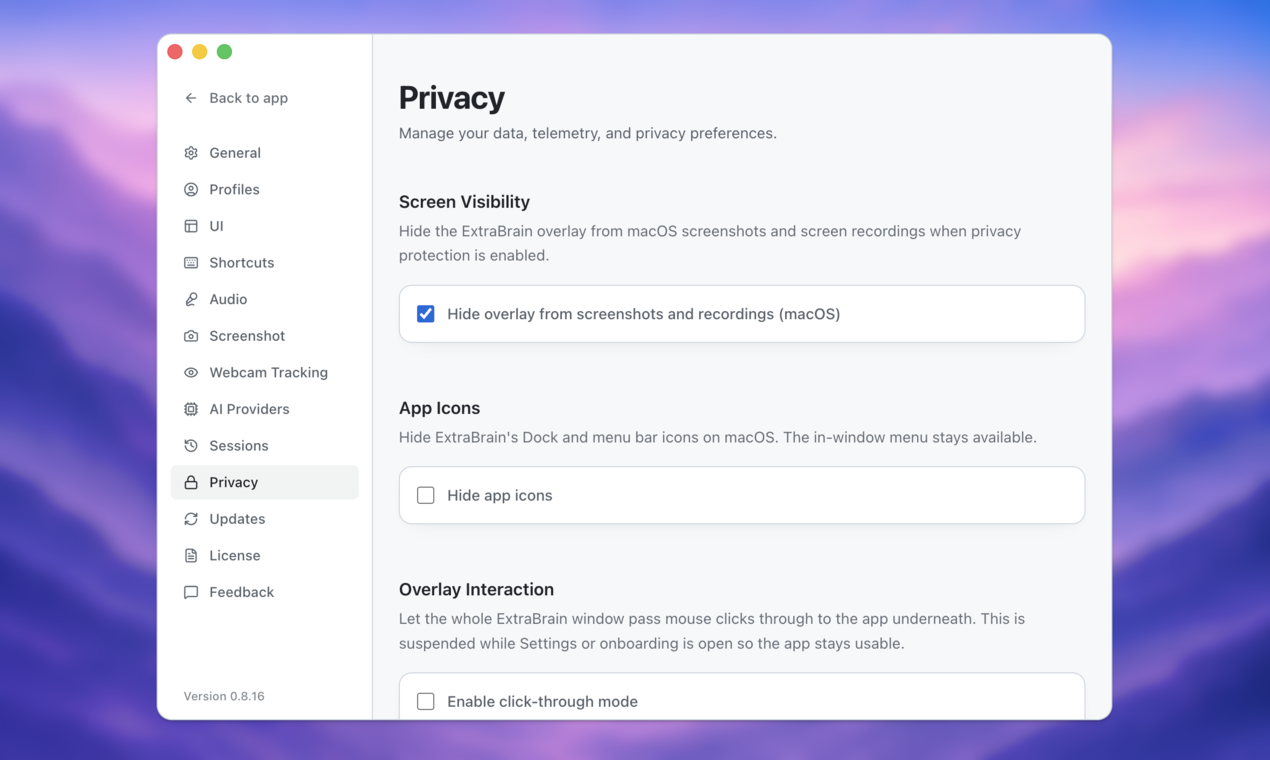
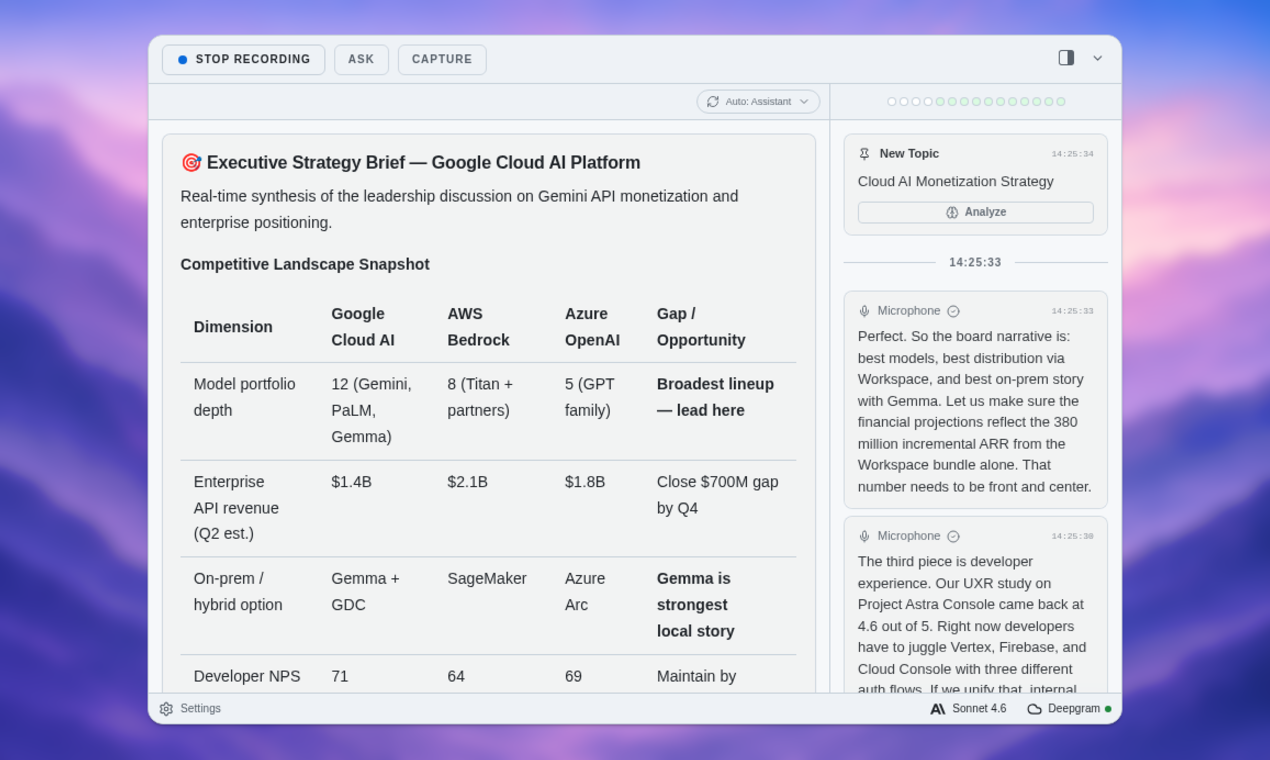
This is why privacy-conscious tooling matters. A local-first AI meeting copilot is a useful mental model for where the market should go: assistance that helps the user capture and reason over their own conversations while emphasizing privacy, user control, and clear boundaries.
Train interviewers to ask without sounding accusatory
Even a good policy can fail if interviewers deliver it badly.
Candidates can feel judged the moment AI comes up. That makes honest disclosure less likely. Recruiters should use neutral language that treats AI as a normal tool with boundaries, not as a confession.
Try this:
“Before we start, I want to clarify our AI policy for this interview. Prepared notes are fine. For this live conversation, please answer without real-time answer-generation tools. Later, in the work sample, we will let you know what tools are allowed and ask you to disclose anything you use.”
That is direct, calm, and fair.
For work samples, try:
“We are not scoring you down for responsible tool use. We are evaluating your judgment and ownership. If you use AI, please tell us where it helped, where you disagreed with it, and what final decisions were yours.”
The candidate is not being hunted. They are being invited into a professional standard.
Watch for signal, not vibes
The danger of hidden AI is real, but so is the danger of biased suspicion.
A candidate who pauses may be thinking, not reading. A candidate who speaks fluently may be well prepared, not assisted. A candidate with an accent, neurodivergent communication style, or unusual eye movement should not be treated as suspicious because an interviewer has become hyper-aware of AI.
That is why “AI detection” based on vibes is a bad hiring practice.
Instead, define observable signals before the interview:
- Can the candidate explain the reasoning behind an answer?
- Can they adapt when the scenario changes?
- Can they identify risks or limitations in their own proposal?
- Can they connect examples to real experience?
- Can they disclose tool use clearly when asked?
Those signals are job-relevant. They are also more defensible than “they seemed like they were reading.”
If an interviewer has a concern, the next step should be a structured follow-up, not an accusation. Ask the candidate to go deeper. Ask for a specific example. Ask what they would change with more time. Ask them to critique their own answer.
Real understanding usually survives follow-up. Scripts usually thin out.
Make the process consistent across candidates
Fairness depends on consistency.
If one candidate is allowed to use AI in a take-home exercise and another is not told the rules, the comparison is weak. If one interviewer warns candidates about AI and another says nothing, disclosure rates will vary. If one hiring manager treats AI use as initiative and another treats it as disqualifying, the process becomes arbitrary.
Create a simple rubric for AI-aware evaluation. It should include which interview stages allow AI assistance, which uses require disclosure, which uses are prohibited, how interviewers should ask follow-up questions, how disclosed AI use affects scoring, and what counts as a serious integrity concern.
The rubric does not need to be long. It needs to be shared.
Trust is designed, not demanded
Recruiters are right to care about hidden AI assistants. Hiring depends on authentic signal, and AI can blur that signal when rules are unclear.
But surveillance is a trap. It may create the feeling of control while damaging candidate trust, increasing bias, and distracting from the real goal: understanding whether this person can do the work responsibly.
The better path is explicit policy, humane evaluation design, privacy-conscious tooling, and interviews that reward reasoning over performance theater.
AI-aware candidates are not the problem. Ambiguous hiring processes are.
Build a process where candidates know the rules, interviewers know what to evaluate, and tools support the conversation rather than secretly policing it. That is how hiring teams can protect integrity without losing their humanity.
If your team is rethinking how AI should support sensitive conversations, tools like ExtraBrain point toward a healthier model: private, user-controlled assistance that helps people remember and reason without turning every interaction into surveillance.