
ExtraBrain Blog
Interview Coder Review 2026: Useful Coding Help, Real Tradeoffs

A practical Interview Coder review for 2026, covering coding help, workflow gaps, privacy risks, and when ExtraBrain may fit better.
Interview Coder has become one of the more visible names in the coding interview assistant category. It promises faster technical answers, screenshot-based problem solving, and less pressure during live coding rounds. That makes it understandable that candidates want a clear Interview Coder review before trusting it in a high-stakes interview.
The harder question is not simply whether Interview Coder can generate code. The harder question is whether it fits the way real interviews actually work. A real interview includes spoken clarification, partial information, changing constraints, eye contact, screen sharing, debugging, and professional judgment.
This review looks at Interview Coder through that lens. It covers where the tool can help, where it feels limited, what privacy and safety questions matter, and how a local-first assistant like ExtraBrain fits into the same decision.
Responsible use matters throughout this discussion. You should only use AI assistance, transcription, screenshots, overlays, or notes where the interview, employer, school, meeting, and platform rules allow them.
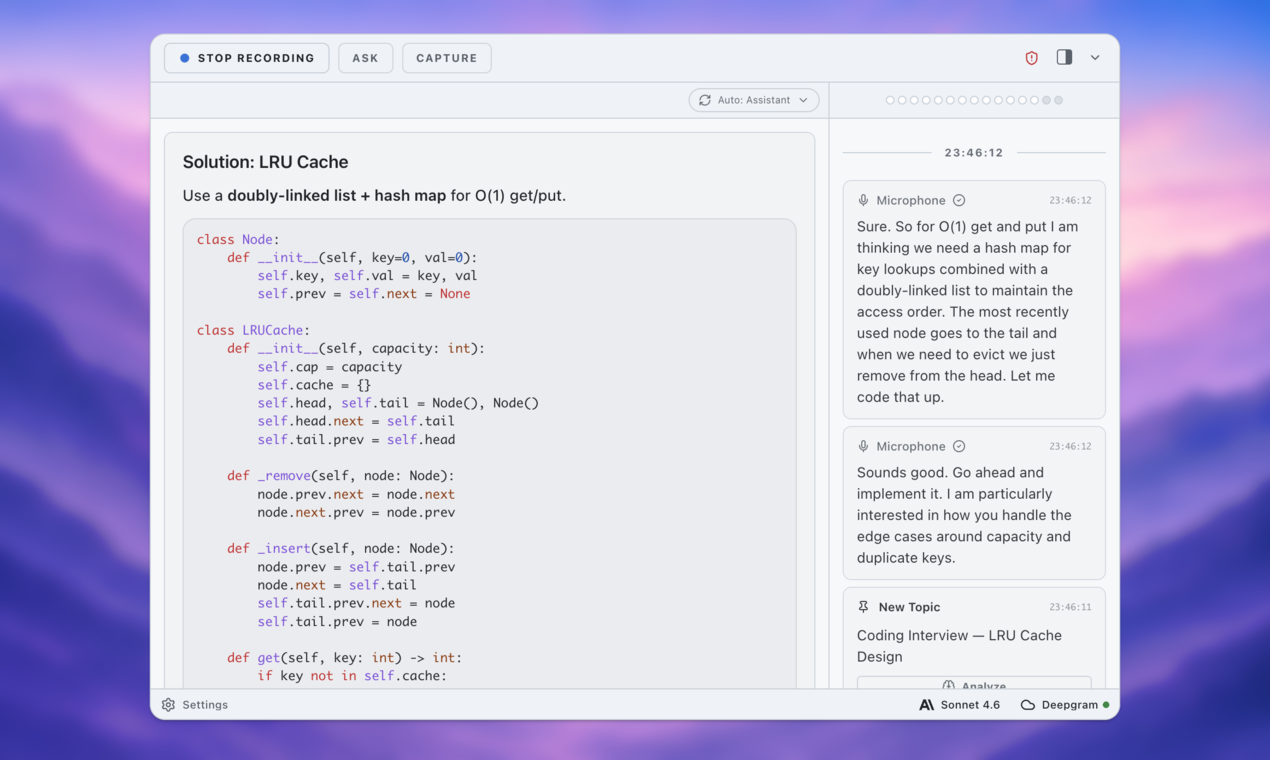
What is Interview Coder?
Interview Coder is an AI coding interview tool built around fast assistance for technical questions. Its core idea is simple: capture the coding prompt, ask AI for a solution, and use the answer while solving the problem.
The product is most closely associated with individual coding tasks. That means it is usually discussed in the context of LeetCode-style questions, online coding screens, and algorithmic interviews.
That focus can be useful if your main need is quick help with a single prompt. It can also feel narrow if your interview includes deeper discussion, system design, behavioral questions, product tradeoffs, or a live debugging conversation.
Interview Coder review summary
Interview Coder is easiest to understand as a focused coding helper rather than a complete interview workspace. It may help with straightforward algorithmic problems, but candidates should be careful about relying on it as a full interview strategy.
Where Interview Coder can help
Interview Coder can be useful when the task is clear, bounded, and mostly text-based. For example, a candidate practicing an array, string, hash map, graph, or dynamic programming problem may want a quick solution outline and implementation direction.
That kind of help can reduce blank-page anxiety. It can also show a candidate how a common pattern is usually implemented.
Where Interview Coder feels weaker
Real interviews often move beyond the first prompt. The interviewer may add constraints, ask why a tradeoff was chosen, request complexity analysis, introduce edge cases, or ask the candidate to debug live.
In those moments, a tool that mainly reacts to screenshots can feel disconnected from the full conversation. It may solve the visible problem but miss the spoken context that explains what the interviewer actually wants.
Core features candidates usually evaluate
Most Interview Coder reviews revolve around four practical areas. Those areas are screen sharing behavior, answer quality, workflow fit, and pricing transparency.
| Area | What candidates want | Why it matters |
|---|---|---|
| Screen sharing behavior | A predictable app that does not accidentally expose sensitive UI | A single visible overlay can damage trust during an interview |
| Coding assistance | Correct solutions, clear explanations, and useful debugging help | The candidate still needs to explain and adapt the solution |
| Workflow integration | Low-friction controls that do not interrupt the conversation | Interviews are already cognitively demanding |
| Transparency | Clear pricing, model behavior, privacy posture, and refund terms | Candidates need to judge risk before paying or using the tool |
Screen sharing and visibility risk
Many candidates are drawn to interview copilots because they want quiet help during a live call. That makes screen sharing behavior one of the most important parts of any Interview Coder review.
The risk is simple. If a tool appears in the shared screen, appears in a recording, creates an unexpected pop-up, or behaves differently after an operating system or meeting app update, the candidate may be exposed at exactly the worst time.
Even when an app is designed to stay hidden, users should not assume every button, permission prompt, system dialog, or meeting platform behaves the same way. MacOS, Windows, Zoom, Google Meet, browser capture, full-screen sharing, window sharing, and external monitors can all create different outcomes.
The practical advice is to test the complete setup before any important call. Use a second device or a trusted mock interviewer to view the shared screen exactly as the interviewer would see it. Test the meeting tool, browser, coding platform, hotkeys, screenshots, pop-ups, notifications, and display arrangement.
ExtraBrain is also designed to stay hidden from screen sharing and screen recording on major meeting tools. Even so, the right standard is responsible verification, not blind trust. Users remain responsible for following all rules and confirming their own setup.
Output quality: good enough for simple coding, less certain for complex interviews
Interview Coder can be helpful on easy and medium coding prompts when the problem is familiar and well-structured. That includes many classic interview patterns where an AI model can quickly infer the intended approach.
The limitations become more visible when the problem is ambiguous. System design questions, debugging sessions, architecture tradeoffs, and interviewer follow-ups require context over time. They also require judgment, not just code generation.
A strong answer in a real interview usually includes:
- clarifying questions;
- assumptions;
- a plain-English approach;
- tradeoffs;
- time and space complexity;
- edge cases;
- test cases;
- a clean implementation;
- a confident explanation of why the solution works.
If a tool gives only a code block, the candidate still has the hardest job. They need to understand the solution, adapt it, and communicate it naturally.
That is where a broader assistant can be more useful. ExtraBrain is built for live transcription, screen-aware context, coding interview support, system design rounds, behavioral interviews, meetings, and post-session review. It can help structure explanations and follow-up questions from the transcript and screen context while the candidate remains responsible for honest and allowed use.
Workflow and interview fit
A live interview is not a quiet homework session. The candidate is listening, speaking, reading the prompt, typing, debugging, watching the interviewer, and managing time.
Any tool that requires too much manual control can become another source of pressure. Clicking start, pause, finish, screenshot, submit, hide, and show controls may sound manageable in a product demo. During a tense interview, those actions can break flow.
This is why workflow matters as much as model quality. A good AI interview assistant should help the candidate stay present rather than pull attention away from the interviewer.
ExtraBrain approaches this as a desktop session workflow. It combines live transcription, screen-aware context, configurable providers, local-first options, and session history so candidates can prepare, follow the live conversation, and review afterward.
Pricing, value, and transparency
Interview Coder has often been discussed as a premium-priced coding interview tool. Before paying for any tool in this category, candidates should verify the current pricing, refund terms, platform support, and feature limits directly from the vendor.
Price alone is not the issue. High-quality AI systems can be expensive to build and run. The issue is whether the buyer can understand what they are paying for before relying on it.
A candidate should look for clear answers to these questions:
- What platforms are supported today?
- What meeting tools and coding platforms are supported?
- What AI model or provider is used?
- Can the user choose providers?
- Is there a free plan or realistic trial?
- What data leaves the device?
- Are screenshots, audio, prompts, or transcripts stored?
- Is there a refund policy?
- Are updates included?
- What happens if the tool fails during an interview?
ExtraBrain’s core Mac app is free. ExtraBrain Pro is available at $9.99/month $79/year, or $149 Lifetime launch pricing. External AI and transcription provider usage is billed separately by the providers users choose.
That model is useful for candidates who want more control. ExtraBrain supports local NVIDIA Parakeet transcription, optional Deepgram transcription, local Gemma 4 on-device AI where installed and compatible, Anthropic, OpenAI, custom OpenAI-compatible endpoints, Claude Subscription, and Codex Subscription.
Privacy and data handling questions
Interview tools can process sensitive information. That may include your voice, the interviewer’s voice, company prompts, private coding exercises, screenshots, resume details, compensation discussions, and meeting notes.
Before using any AI assistant, ask what data is captured and where it goes. This is especially important for employer interviews, school assessments, workplace meetings, and customer calls.
ExtraBrain is local-first by design. A fully local ExtraBrain posture requires local Parakeet transcription plus local Gemma 4 on-device AI where installed and compatible, with no external provider requests. When external providers are configured, prompts, transcript text, screenshots, audio, or context may leave the device depending on the user’s settings.
That distinction matters. Local-first does not mean every possible configuration is fully local. It means users can choose a more private setup when their hardware, provider choices, and workflow support it.
Interview Coder vs ExtraBrain
Interview Coder is best understood as a coding interview utility. ExtraBrain is broader: a free, local-first desktop AI interview assistant and meeting copilot for Mac.
| Category | Interview Coder | ExtraBrain |
|---|---|---|
| Primary focus | Coding interview assistance | Interviews, meetings, lectures, research calls, coding, system design, and behavioral sessions |
| Platform posture | Candidate should verify current platform support | macOS today, including Apple Silicon and Intel Macs, with Windows and Linux planned |
| Context | Often centered on captured coding prompts | Live transcription plus screen-aware context |
| Provider control | Candidate should verify current model and provider options | Bring-your-own AI providers plus local Gemma 4 where installed and compatible |
| Transcription | Candidate should verify audio support | Local NVIDIA Parakeet and optional Deepgram |
| Privacy posture | Candidate should verify data handling before use | Local-first options with clear external-provider tradeoffs |
| Pricing posture | Candidate should verify current pricing and refund terms | Free core Mac app, with Pro plans available |
When Interview Coder may be enough
Interview Coder may be enough if your needs are narrow. It can make sense when you only want help practicing isolated coding prompts and you are not looking for a full interview memory or meeting workflow.
It may also be enough if you are using it outside a live interview as a study aid. For example, you might compare its answer to your own solution after finishing a practice problem. That use case is lower risk than using any undisclosed assistant during a live assessment.
When ExtraBrain may be a better fit
ExtraBrain may be a better fit if your interview process is broader than code generation. That includes senior engineering interviews, system design rounds, product sense interviews, behavioral interviews, technical screens, and post-interview review.
ExtraBrain is also a stronger fit if you care about local-first options. With local Parakeet transcription and local Gemma 4 where installed and compatible, you can keep transcription and AI prompts local in a fully local posture.
It may also be better if you want a tool that remains useful after the interview. Session transcripts, notes, screen context, and review can become a focused second-brain-style workspace for future interviews and meetings.
Practical checklist before using any AI interview assistant
Use this checklist before relying on Interview Coder, ExtraBrain, or any other AI interview copilot.
Rules and consent
Confirm that AI assistance, transcription, screenshots, notes, and screen overlays are allowed in the specific setting. If the rules are unclear, do not assume permission.
Screen sharing test
Run a full mock call with the same device, meeting app, coding platform, browser, monitor setup, and sharing mode. Check what the other person can actually see.
Output understanding
Never rely on an answer you cannot explain. Practice turning AI output into your own reasoning, tradeoffs, tests, and spoken explanation.
Privacy configuration
Check whether audio, screenshots, transcript text, and prompts stay local or go to an external provider. Choose the least invasive setup that still meets your needs.
Failure plan
Assume the tool might freeze, lag, lose context, or produce a wrong answer. Have a plan for continuing the interview without it.
Final verdict
Interview Coder can be useful for candidates who want quick help with coding prompts. Its value is clearest when the task is isolated, the problem is familiar, and the candidate uses it as a study aid rather than a substitute for understanding.
The concerns are real too. Screen sharing behavior, workflow friction, limited context, unclear data handling, and pricing transparency can all affect whether the tool is worth the risk.
For candidates who want a broader Mac desktop assistant, ExtraBrain is the more complete option. It supports live transcription, screen-aware context, local-first configurations, bring-your-own providers, coding and system design help, behavioral interview support, and post-session review.
The best tool is not the one that promises the most dramatic shortcut. The best tool is the one that helps you think clearly, communicate honestly, protect sensitive context, and follow the rules of the room you are in.
FAQ
Is Interview Coder legit?
Interview Coder is a real product in the AI coding interview assistant category. Whether it is the right product for you depends on your use case, platform, budget, privacy requirements, and the rules of your interview.
Does Interview Coder help with behavioral interviews?
Interview Coder is mainly associated with coding interview assistance. If you need help with behavioral answers, STAR structure, live transcription, or post-interview review, a broader assistant such as ExtraBrain may be a better fit.
Can Interview Coder be used during a live interview?
That depends on the rules of the interview, employer, school, or platform. Use AI tools only where assistance, transcription, screenshots, overlays, and notes are allowed.
What is the best Interview Coder alternative for Mac?
ExtraBrain is a strong Interview Coder alternative for Mac users who want a free core desktop app, live transcription, screen-aware context, local-first options, provider control, and support beyond coding prompts.
Can ExtraBrain run fully local?
A fully local ExtraBrain posture requires local Parakeet transcription plus local Gemma 4 on-device AI where installed and compatible, with no external provider requests. External providers may receive selected prompts, transcript text, screenshots, audio, or context depending on configuration.
Is ExtraBrain only for interviews?
No. ExtraBrain can also be used as an AI meeting copilot for customer calls, lectures, research meetings, and other live sessions where recording, transcription, screenshots, notes, and AI assistance are allowed.