
ExtraBrain Blog
Interview Hammer Review: What I Learned Testing a Real-Time AI Copilot

A practical Interview Hammer review for 2026 covering setup, feedback quality, coding support, privacy tradeoffs, and ExtraBrain as an alternative.

Interview Hammer is one of the AI interview copilot tools candidates may find while searching for real-time help during job interviews, online assessments, and mock interview practice. This review looks at the same core question most candidates have before trusting any live interview assistant: does it actually help when the pressure is high?
The short answer is mixed. Interview Hammer appears designed around instant AI answer suggestions, interview audio, and a second-device workflow. That can be useful for simple practice and basic interview prompts, but it also introduces practical issues around reliability, visibility, coding support, and responsible use.
For candidates who want a Mac desktop workflow with live transcription, screen-aware context, local-first options, and provider control, ExtraBrain is the alternative worth comparing closely. ExtraBrain is a free, local-first desktop AI interview assistant and meeting copilot for Mac, with Windows and Linux planned. It supports live sessions, transcripts, notes, screen context, and post-session review, while giving users clear privacy controls and bring-your-own AI provider options.
Use any AI interview tool only where interview, employer, school, workplace, meeting, and platform rules allow AI assistance, transcription, screenshots, or notes. A useful copilot should help you think more clearly, not push you into hiding prohibited assistance.
Interview Hammer review summary
Interview Hammer is positioned as a real-time AI interview copilot. The promise is straightforward: listen to interview context, generate answer suggestions quickly, and help candidates respond with more confidence.
In practice, the experience depends on three things:
- Whether the app stays stable during a live session.
- Whether the answer quality is strong enough for the role.
- Whether the workflow fits the rules and setup of the interview.
The second-device design may feel clever at first because the main interview screen can stay cleaner. However, it can also feel awkward because candidates may need to look away from the interviewer, manage another device, and troubleshoot an additional connection. That matters because real interviews are already cognitively demanding.
ExtraBrain takes a different product direction. It is a Mac desktop app built for live transcription, screen-aware context, coding and system design support, behavioral interview structure, and after-session review. It can use local Parakeet transcription and local Gemma 4 on-device AI where installed and compatible, or connect to external providers such as Anthropic, OpenAI, custom OpenAI-compatible endpoints, Claude Subscription, and Codex Subscription.
What Interview Hammer is trying to solve
The main use case is real-time interview support. A candidate hears a question, the AI interprets the context, and the tool suggests a possible answer or outline. That can be helpful for common behavioral prompts, recruiter screens, and basic product or business questions.
The underlying need is real. Many candidates do not fail interviews because they know nothing. They fail because they freeze, ramble, forget examples, or struggle to convert experience into a clear answer under time pressure.
A good AI interview copilot should help with that by doing a few practical things:
- Capture live transcript context.
- Summarize what the interviewer is asking.
- Suggest a structured answer rather than a fake script.
- Surface clarifying questions.
- Help with technical tradeoffs and explanation quality.
- Preserve session notes for later review.
That is also the core reason ExtraBrain exists. ExtraBrain can work as a focused AI second brain for interviews and meetings, giving you a workspace for live sessions, transcripts, notes, screen context, and review. It is not meant to replace your judgment or your actual experience. It is meant to help you access that experience when the conversation is moving quickly.
Setup and usability
Interview Hammer’s setup is usually described as simple: create an account, choose an interview scenario, start a session, and connect the companion workflow. The key difference from a standard desktop assistant is that Interview Hammer may rely on a second device for the live-answer experience.
That design has benefits and drawbacks. On the positive side, it can separate the answer display from the screen being shared. On the negative side, it adds friction exactly when you want less friction. A second phone, tablet, or laptop becomes another thing to charge, connect, position, and monitor.
That matters in realistic interview conditions. If you are speaking with a recruiter, solving a coding problem, watching a shared document, and trying to maintain eye contact, looking down at another device can be distracting. It can also make your behavior feel less natural.
ExtraBrain is built around a desktop workflow on macOS. It supports Apple Silicon and Intel Macs today. The design goal is to keep live transcript, screen context, and session controls close to the work you are already doing, without forcing a separate second-device setup.
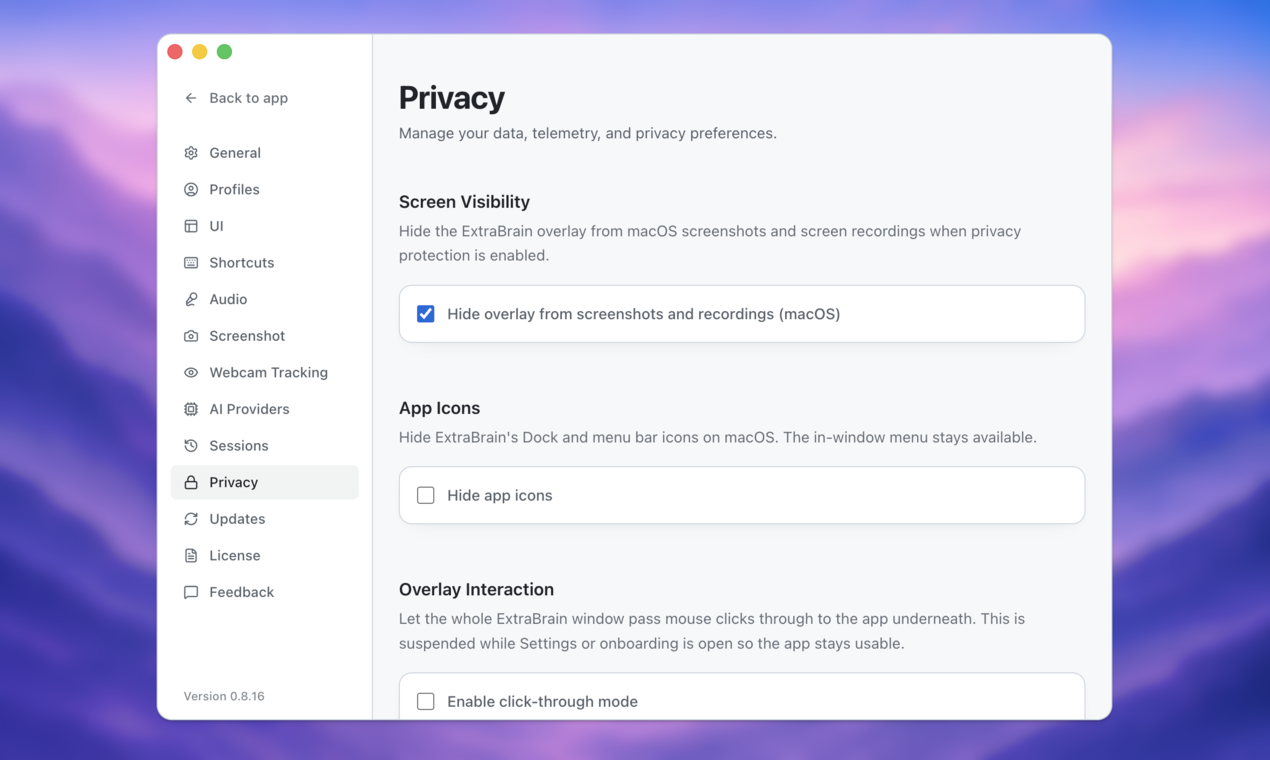
ExtraBrain is also designed to stay hidden from screen sharing and screen recording on major meeting tools, while users remain responsible for following all rules. That distinction matters. A tool can be designed for privacy and clean screen sharing, but the user still has to respect the rules of the interview, workplace, school, or platform.
Real-time feedback quality
The most important test for any AI interview assistant is not whether it can answer a simple question. It is whether it can follow live context and produce useful, specific, non-generic help.
Interview Hammer can be useful for basic prompts such as:
- “Tell me about yourself.”
- “Why are you interested in this role?”
- “Describe a time you handled conflict.”
- “What are your strengths and weaknesses?”
For those scenarios, short AI-generated suggestions may reduce panic and give candidates a starting structure. The risk is that the answer can become too generic if the tool does not know enough about your real background. A polished but shallow answer is often worse than a less polished answer that clearly comes from your own experience.
For technical or specialized interviews, the bar is higher. A candidate may need to reason through tradeoffs, explain assumptions, debug code, discuss system design constraints, or adapt to follow-up questions. If a tool loses context or gives a generic answer, the candidate can sound less credible.
ExtraBrain focuses on live context rather than canned answers. It can help generate answer outlines, STAR structures, technical explanations, and follow-up questions from transcript and screen context. That is especially useful when you want support without surrendering your voice.
A good workflow is to treat the AI output as scaffolding:
- Read the suggested structure.
- Anchor it in your real experience.
- Add the tradeoff or detail only you would know.
- Answer naturally.
- Use the transcript afterward to improve the next round.
Coding interview support
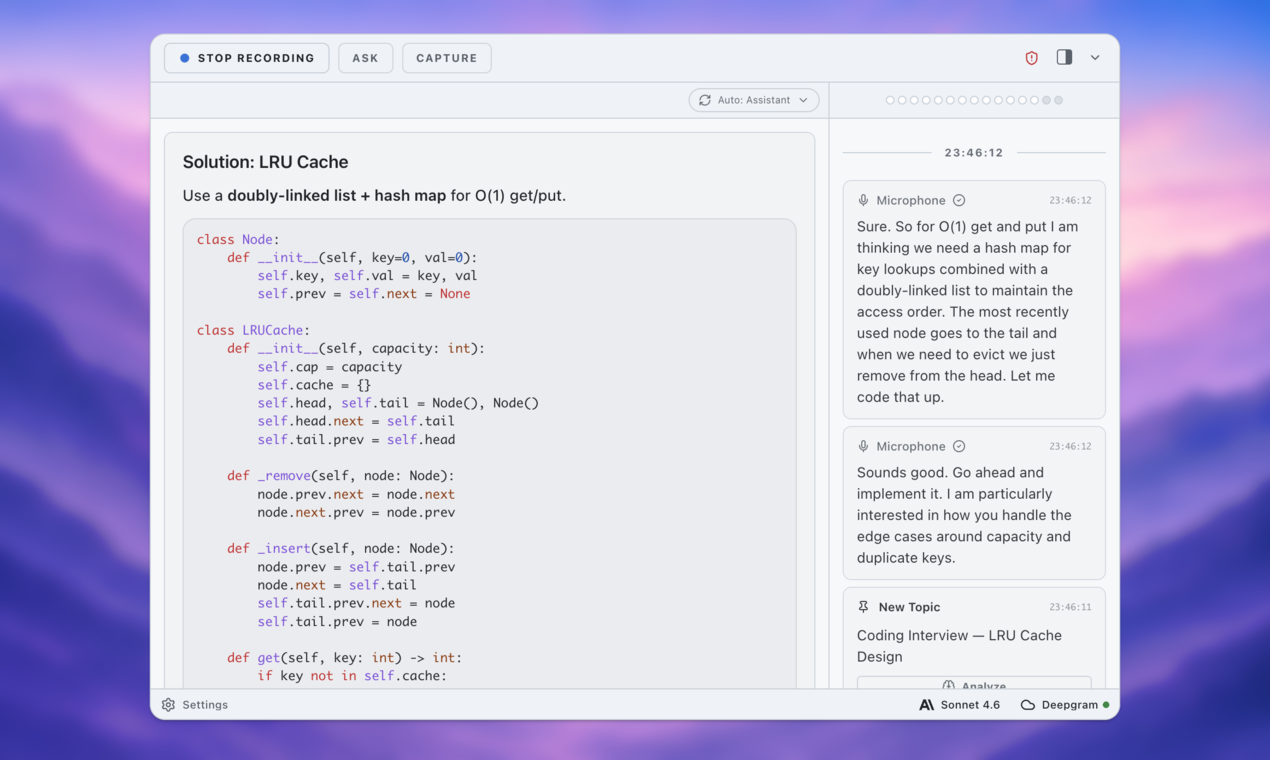
Coding interviews expose weak AI copilot design quickly. It is not enough to produce code. A useful tool needs to explain the algorithm, identify edge cases, reason about complexity, and help the candidate respond when the interviewer changes the problem.
Interview Hammer may be acceptable for general interview prompts, but it is not the strongest fit if your main need is coding interview support. Candidates preparing for software engineering roles should be careful with any tool that cannot follow code context, problem statements, screenshots, or live technical discussion well.
ExtraBrain is built for coding interviews as one of its primary use cases. Its screen-aware context can help the assistant understand coding prompts, diagrams, documents, or shared materials during a live session. It can support coding explanations, system design discussion, and technical tradeoff framing.
That does not mean candidates should use AI to violate interview rules. It means that for allowed practice, mock interviews, study sessions, and permitted live contexts, the assistant should be able to handle the kinds of information technical interviews actually include.
For a coding interview workflow, a helpful copilot should be able to support prompts like:
- “Restate the problem in simpler terms.”
- “List edge cases I should ask about.”
- “Explain the brute force approach first.”
- “Compare time and space complexity.”
- “Help me verbalize the tradeoff between a hash map and sorting.”
- “Summarize what I should test before finalizing.”
That kind of guidance helps candidates demonstrate reasoning instead of silently copying an answer.
Customization and personalization
Interview Hammer’s customization appears oriented around choosing job types, setting up prompts, and giving the assistant some context before the session. That can work for basic role preparation, but it may feel limited for candidates with specialized backgrounds.
Personalization matters because strong interview answers are specific. A good answer includes the candidate’s actual project, constraint, decision, result, and lesson. Without that memory, AI suggestions can sound smooth but interchangeable.
A practical customization prompt might look like this:
Role: Senior product managerCompany context: B2B SaaS platformInterview type: Product strategy and executionCandidate background: Led onboarding redesign, improved activation, partnered with engineering and salesAnswer style: Direct, structured, metrics-aware, collaborativeUse STAR for behavioral answers and ask clarifying questions before strategy answers.The limitation is that a one-time prompt is not the same as a durable interview workspace. If you are preparing across multiple rounds, you need a place to preserve transcript history, examples, notes, and lessons from each conversation.
ExtraBrain can serve as that focused second-brain-style workspace for interviews and meetings. It is useful before, during, and after sessions because it keeps live context and review in the same app workflow. That is a better fit for candidates who want to learn from each round rather than treat every session as a disposable chat.
Privacy and local-first considerations
Privacy is one of the biggest differences between AI interview tools. Interview conversations can include names, employers, compensation details, proprietary work, unreleased product information, personal stories, and screenshots of private systems. Candidates should understand where that data goes before using any assistant.
ExtraBrain is local-first by design. A fully local ExtraBrain posture requires local Parakeet transcription plus local Gemma 4 on-device AI where installed and compatible, with no external provider requests. If you choose external providers, selected prompts, transcript text, screenshots, audio, or context may leave the device depending on your configuration.
That clear distinction is important. Some users want maximum privacy and local processing. Others prefer a cloud model for quality, speed, or specific provider features. A strong product should make that tradeoff visible instead of hiding it.
ExtraBrain supports local NVIDIA Parakeet transcription and optional Deepgram. It also supports local Gemma 4 where installed and compatible, along with bring-your-own provider setup. Local Gemma 4 requires installation and compatible hardware and may not be available on every Mac or customer environment.
Before using any interview assistant, ask:
- Does the tool record audio?
- Does it capture screenshots?
- Does it send transcript text to an external provider?
- Can I choose which AI provider is used?
- Can I run transcription locally?
- Can I delete or review session history?
- Am I allowed to use this tool in this interview or meeting?
Pricing and value
The right way to evaluate Interview Hammer pricing is not only the subscription number. It is whether the tool is reliable enough, specific enough, and useful enough for the interviews you actually face.
If a tool mostly helps with generic behavioral practice, the value is different from a tool that supports live transcript context, screen context, coding interviews, system design, meeting notes, and after-session review. A candidate preparing for one recruiter screen has different needs from a senior engineer preparing for five rounds.
ExtraBrain has a simple pricing model. The core Mac app is free. ExtraBrain Pro is $9.99 per month, $79 per year, or $149 Lifetime launch pricing. External AI and transcription provider usage is billed separately by the providers users choose.
That model is useful for candidates who want to start without paying before they understand the workflow. It also fits users who want provider control instead of being locked into one bundled AI stack.
Pros and cons of Interview Hammer
Strengths
Interview Hammer has a few strengths that can make it appealing for some users.
- It is easy to understand as a real-time answer suggestion tool.
- It can help with common behavioral and recruiter-screen prompts.
- The second-device workflow may appeal to users who prefer separating the assistant from the main interview screen.
- Basic role setup can help candidates rehearse with more structure than a blank chat window.
- Instant suggestions may reduce anxiety for candidates who freeze during practice.
The strongest use case is simple interview rehearsal. If you want a tool to help you practice speaking answers out loud, it can provide enough structure to get started.
Weaknesses
The weaknesses matter more if you plan to use it in high-stakes or technical contexts.
- A second-device workflow can be awkward and distracting.
- Reliability issues can be costly during a live session.
- Coding interview support may not be deep enough for software engineering candidates.
- Generic answer suggestions can make candidates sound less authentic.
- Limited personalization can be frustrating for niche roles.
- The value depends heavily on whether the workflow works consistently for your devices and meeting tools.
The most important concern is reliability. An interview copilot that freezes, disconnects, or distracts you during the interview can hurt more than it helps.
Interview Hammer vs ExtraBrain
Interview Hammer and ExtraBrain overlap in one broad category: AI support for interviews. They differ in workflow, privacy posture, and breadth of use cases.
| Feature | Interview Hammer | ExtraBrain |
|---|---|---|
| Core workflow | Real-time interview answer assistance | Mac desktop AI interview assistant and meeting copilot |
| Platform focus | Multi-device workflow | macOS today, Windows and Linux planned |
| Live transcription | Intended for live interview context | Live transcription with local Parakeet and optional Deepgram |
| Screen context | Depends on workflow | Screen-aware context built into the desktop experience |
| Coding support | Limited fit for serious coding interview prep | Supports coding interviews and system design workflows |
| Local-first options | Not the main positioning | Local Gemma 4 and local Parakeet where installed and compatible |
| Provider control | Depends on product setup | Bring-your-own providers, including Anthropic, OpenAI, custom endpoints, Claude Subscription, and Codex Subscription |
| Pricing posture | Evaluate against reliability and use case | Free core Mac app with optional Pro plans |
| Best fit | Basic answer prompting and rehearsal | Interviews, meetings, lectures, research calls, transcripts, notes, and review |
ExtraBrain is a stronger fit if you want one workspace for live interview context and post-interview learning. It is also a stronger fit if privacy controls, local-first options, provider choice, and screen-aware context matter to you.
Interview Hammer may still interest users who specifically want a second-device pattern. That said, candidates should test the workflow thoroughly in a mock setting before trusting it in anything important.
Other AI interview assistant alternatives
The AI interview assistant market includes tools with different priorities. Some focus on stealth, some on mock interviews, some on coding, some on general coaching, and some on career workflows.
When comparing alternatives, do not only ask which product seems fastest or most invisible. Ask which product helps you become a better candidate while staying within the rules.
A responsible comparison should include:
- Interview rule compatibility.
- Reliability during live calls.
- Audio and transcript quality.
- Coding and system design support.
- Screen context support.
- Local and cloud privacy options.
- Provider control.
- Post-interview review.
- Price and long-term value.
ExtraBrain is a strong alternative for Mac users who want a free core app, live transcription, screen-aware context, local-first options, and AI provider access they control. It is especially relevant for candidates who want an interview copilot that also works for meetings, lectures, customer calls, and research conversations.
How to test any AI interview copilot before using it
Do not discover a tool’s weaknesses during a real interview. Run a realistic mock session first.
Use this checklist:
- Start a video call with a friend or a second account.
- Turn on the exact screen sharing mode you expect to use.
- Ask realistic behavioral, technical, and follow-up questions.
- Test audio capture from both speakers.
- Check latency after long questions.
- Test screenshots or screen context if the tool supports them.
- Confirm what appears in screen sharing and recording.
- Verify whether data is local or sent to a provider.
- Practice answering from outlines instead of reading scripts.
- Stop using the tool anywhere it is not allowed.
The goal is not to find a loophole. The goal is to avoid surprises and use AI assistance in a way that supports honest preparation.
FAQ
Is Interview Hammer good for interview prep?
Interview Hammer can be useful for basic interview prep, especially if you want quick suggestions for common behavioral or recruiter-screen questions. It is less compelling if you need deep coding support, durable personalization, or a single desktop workspace for live context and review.
Can Interview Hammer help with coding interviews?
It may help with general technical conversation, but it is not the strongest fit for serious coding interview preparation. For coding interviews, look for screen context, problem understanding, edge-case reasoning, complexity discussion, and clear explanation support. ExtraBrain is built with coding interviews and system design workflows in mind.
Is ExtraBrain an Interview Hammer alternative?
Yes. ExtraBrain is an Interview Hammer alternative for Mac users who want a free, local-first desktop AI interview assistant with live transcription, screen-aware context, privacy controls, local AI options where installed and compatible, and bring-your-own provider setup.
Can ExtraBrain run fully local?
A fully local ExtraBrain posture requires local Parakeet transcription plus local Gemma 4 on-device AI where installed and compatible, with no external provider requests. If you use external providers, selected prompts, transcript text, screenshots, audio, or context may leave the device depending on configuration.
How much does ExtraBrain cost?
The core ExtraBrain Mac app is free. ExtraBrain Pro is $9.99 per month, $79 per year, or $149 Lifetime launch pricing. External AI and transcription provider usage is billed separately by the providers users choose.
What platforms does ExtraBrain support?
ExtraBrain is available for macOS today, including Apple Silicon and Intel Macs. Windows and Linux are planned future platforms.
Is it okay to use AI during an interview?
Only if the interview, employer, school, workplace, meeting, and platform rules allow it. AI can be excellent for practice, note review, mock interviews, and permitted assistance, but candidates remain responsible for honest and compliant use.
Final verdict
Interview Hammer is worth understanding because it represents a common category of AI interview tool: fast suggestions, live support, and a workflow built around staying out of the main screen. That idea is appealing, but the real value depends on reliability, answer quality, coding support, personalization, and whether the setup feels natural under pressure.
For many Mac users, ExtraBrain is the more practical direction. It combines live transcription, screen-aware context, interview and meeting workflows, local-first options, provider control, and post-session review in a free core desktop app.
If you are preparing for interviews in 2026, do not look only for instant answers. Look for a tool that helps you think clearly, speak honestly, protect sensitive data, and improve after every session. That is the kind of AI interview copilot worth building your preparation around.