
ExtraBrain Blog
Your Interview Transcript Is Career Data. Treat It That Way.

Interview transcripts reveal salary goals, career history, communication patterns, private notes, and confidential work context.
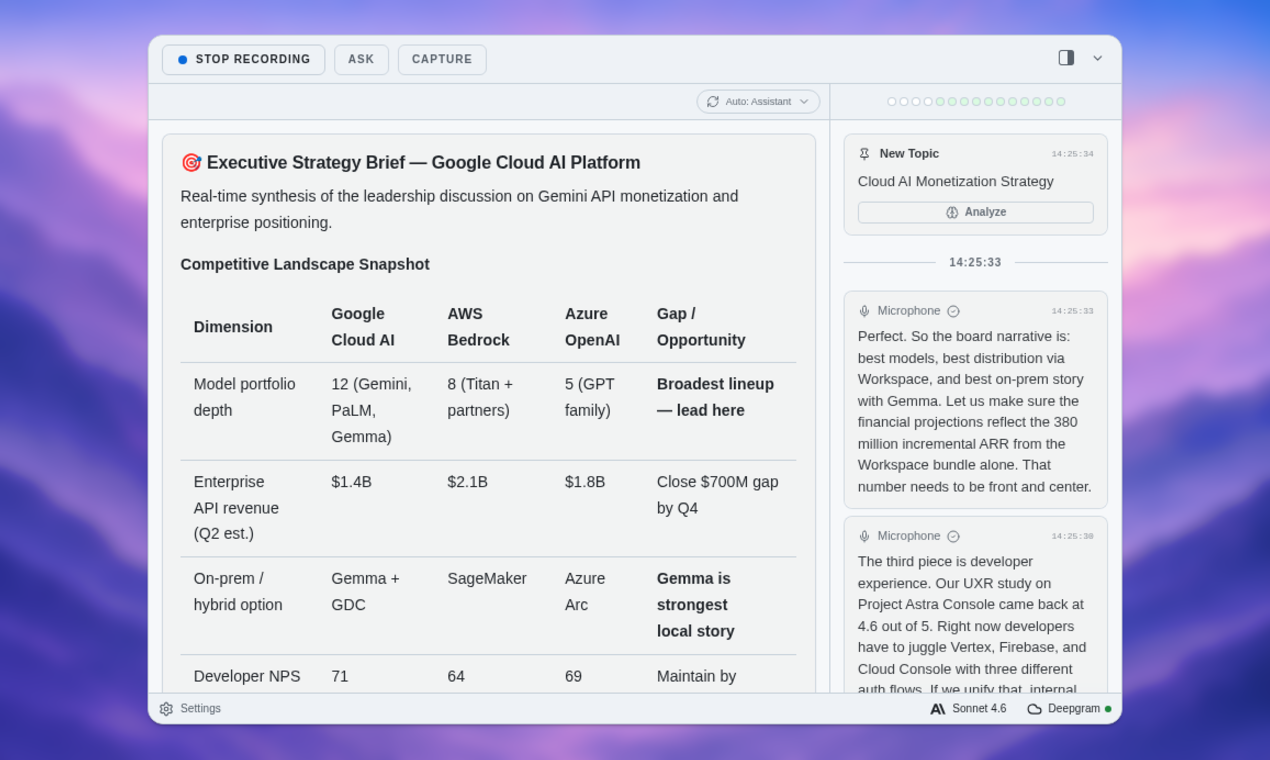
Most people do not think of an interview transcript as a data asset. They think of it as a convenience: a searchable record of what was said, a source for a follow-up email, or a useful file to paste into an AI tool before the next round.
That is understandable. It is also risky.
An interview transcript is not just text. It is a record of your career story at one of its most exposed moments: where you have worked, why you are leaving, what you want next, which systems you touched, and how you sound when someone challenges your thinking.
In other words: your interview transcript is career data.
And career data deserves better treatment than “copy, paste, summarize, forget.” AI can be incredibly useful for preparation, but a transcript that helps you improve should not quietly become a permanent trail across generic chatbots, shared documents, meeting bots, and cloud storage you barely understand.
If we want AI to support interviews responsibly, we need a better default: treat transcripts like sensitive personal records, not disposable prompt material.
A transcript contains the story behind the resume
A resume is public-facing. A transcript is not.
Your resume says you led a migration, managed stakeholders, reduced costs, improved onboarding, or built a platform. Your transcript explains the messy reality behind those bullets: the incident you inherited, the teammate who resisted the change, the customer escalation you cannot name publicly, or the compromise that never made it into the final case study.
A single transcript might include salary expectations, reasons for leaving, internal tools, architecture details, customer examples, immigration or schedule constraints, former manager names, team dynamics, conflict stories, and how you respond under pressure.
None of this is unusual. Interviews are supposed to surface real experience. The problem is that transcripts make that experience easy to copy, search, forward, summarize, train on, and store indefinitely.
A transcript is not dangerous because it exists. It becomes dangerous when nobody treats it as sensitive.
Convenience creates data sprawl
The most common privacy problem in interview prep is not one dramatic breach. It is sprawl.
You finish a recruiter screen and save the transcript. You paste it into a chatbot, copy the output into a notes app, send part of it to a friend, upload another transcript to a different tool, and store salary notes somewhere else.
Each step feels practical. Together, they create a scattered archive of your career transition.
This is exactly where AI tools need to be judged differently. The question is not only “Can this tool summarize my interview?” The better question is: “What happens to the transcript after it helps me?”
Does the raw text stay local? Is it retained by default? Can you delete it? Is it used to improve models? Is sharing obvious and intentional?
If the tool cannot answer those questions clearly, it may still be powerful. It is just not necessarily the right home for sensitive career data.
Responsible AI interview prep starts with minimization
Responsible AI use does not mean avoiding AI. It means sharing only what the tool needs.
If you want feedback on a stakeholder answer, the AI may not need your employer’s real name, customer name, revenue number, or project codename. If you want to practice salary negotiation, the tool may need a range, but not every private constraint behind it.
Before using AI on an interview transcript, ask:
- Do I need the full transcript, or only selected excerpts?
- Can I replace company, customer, manager, or teammate names with placeholders?
- Can I generalize confidential project details without losing the lesson?
- Does the tool explain where my transcript is processed and stored?
- Can I delete the raw transcript after I extract the lessons?
- Would I be comfortable if this exact text appeared in the wrong inbox?
That last question is uncomfortable because it works. If the answer is no, the data deserves more care.
A strong AI interview preparation workspace should make this workflow easier. It should help you organize real examples, practice clearly, and preserve lessons without pushing you to upload more sensitive context than necessary.
Local-first changes the privacy default
Most AI products are cloud-first by habit. You send data away, the service processes it, and the answer comes back. For many everyday tasks, that tradeoff is fine. For interview transcripts, it deserves more scrutiny.
A local-first approach starts with a different assumption: keep the user’s data close to the user whenever possible. Store locally when practical, make sharing deliberate, and treat export, deletion, and retention as core product features.
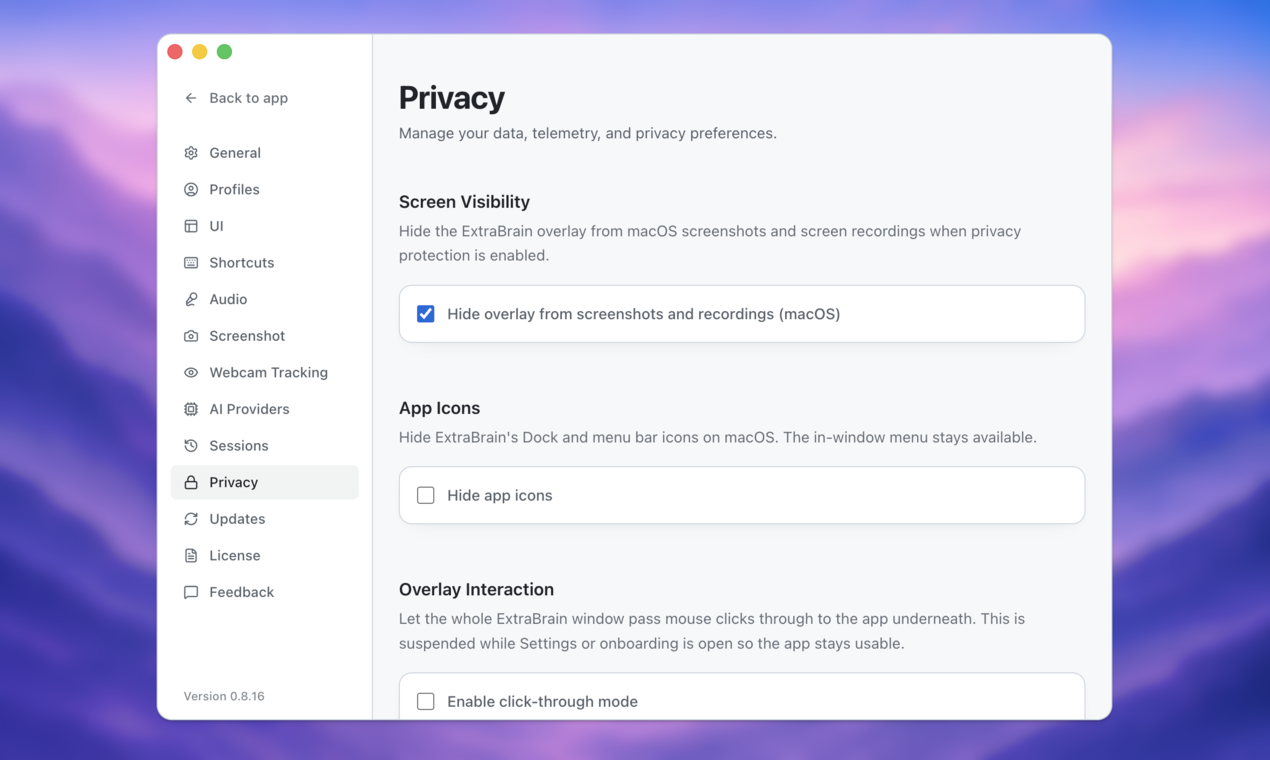
This matters because the raw transcript is often more sensitive than the final output.
A candidate may want to keep three useful lessons from a mock interview: “shorten the architecture explanation,” “prepare a better conflict example,” and “ask about team decision-making earlier.” They may not need to keep 45 minutes of raw conversation containing employer names, compensation comments, and nervous first drafts of answers.
Local-first AI makes that distinction easier. It supports a workflow where the transcript can be captured, reviewed, transformed into durable preparation notes, and then deleted or archived intentionally.
That is the promise of a private AI interview copilot: not magic answers, but useful assistance with stronger user control.
Privacy is not the opposite of performance
Some people assume privacy-first tools must be less useful. In interview prep, the opposite is often true.
The more private the workspace feels, the more honest the candidate can be. That honesty is what makes preparation valuable.
If you trust the workspace, you can save the awkward first version of an answer, admit that you rambled, compare compensation options, reflect on why a question made you defensive, and turn confusing wording into a better explanation.
If you do not trust the workspace, you sanitize too early. You remove the details that would make the coaching useful. You ask generic questions and receive generic advice. The output may sound polished, but it will not help you think.
Privacy is not just a compliance feature. It is a quality feature. The best AI support helps people work with truthful raw material while giving them control over what becomes permanent, what gets shared, and what disappears after it has served its purpose.
AI should support preparation, not impersonation
Interview data accumulates across the whole process. Before an interview, you may have job descriptions, resume versions, recruiter notes, company research, practice answers, and story banks. During the interview, you may have live notes or a transcript. Afterward, you may have reflections, follow-up drafts, lessons for the next round, and negotiation planning.
Each phase has a different ethical boundary.
Before the interview, AI can help you prepare. During the interview, you should follow the employer’s rules and use tools only in ways that are disclosed or permitted. After the interview, AI can help you debrief, summarize what happened, and prepare for the next conversation.
The principle is simple: AI should help you understand and communicate your own experience. It should not invent experience, impersonate expertise, or secretly answer on your behalf in a restricted setting.
That boundary is easier to maintain when the tool is designed for preparation and reflection rather than evasion. A private AI interview copilot should make you more grounded in your own examples, not less accountable for them.
Hiring teams should treat transcripts as candidate data too
This is not only a candidate problem. Employers and hiring teams also need better transcript discipline.
Recruiters and interviewers use AI because hiring is messy. Notes are inconsistent. Interviewers forget details. Debriefs happen quickly. Summaries can help teams compare evidence and move faster.
But AI summaries are not neutral just because they are formatted cleanly. A transcript can miss tone. A summary can flatten nuance. A model can overvalue polished language and undervalue careful thinking. People with accents, anxiety, neurodivergent communication styles, non-linear storytelling, or different cultural norms may be misunderstood if AI-generated notes are treated as objective truth.
Responsible hiring teams should use AI to organize evidence, not replace judgment. They should also disclose when interviews are recorded, transcribed, or summarized by AI, including what is captured, where it goes, who can access it, and how long it is retained.
A trustworthy policy can start with a few commitments: disclose capture, limit access, review AI summaries against human notes, avoid vague behavioral scoring, and delete raw recordings when they are no longer needed.
That is not anti-AI. It is pro-trust.
Retention is where good intentions fail
The easiest mistake is keeping everything forever.
Storage is cheap. Future usefulness feels plausible. Nobody wants to delete a transcript that might be useful later. So the raw files remain: old mock interviews, recruiter calls, debrief notes, coaching sessions, salary conversations, and recordings from roles you did not get.
A better approach is to decide what each artifact is for. Keep a short lessons-learned summary, delete raw transcripts after extracting preparation notes, redact names in long-term notes, export only what you need to share, and remove what no longer helps.
A local-first AI meeting copilot is especially useful here because meetings and interviews often generate raw conversational data that should not automatically become permanent. The product should help you move from raw capture to controlled insight, not from raw capture to endless archive.
What to look for in a privacy-first interview AI tool
If you are choosing an AI tool for interviews, mock interviews, meeting notes, or career preparation, do not evaluate only the summary quality. Evaluate the privacy workflow.
Look for tools that make these things clear: where transcripts are processed and stored, whether raw audio or text is retained by default, whether data is used for model training, how deletion works, whether sharing is opt-in and visible, whether exports can be selective, whether sensitive details can be redacted, and whether the tool supports preparation without encouraging impersonation.
The right product should make responsible behavior feel natural. It should reduce the temptation to paste your entire career history into whatever chatbot is open. It should help you turn private raw material into useful preparation without losing control of the raw material itself.
That is why ExtraBrain is building around a more private model for AI support. Interview transcripts, meeting notes, and preparation materials are not ordinary text blobs. They are personal work context. They deserve tools that understand the difference.
Treat the transcript like it belongs to your future self
Your interview transcript is not just a record of what happened. It is part of the archive you are building while your career changes.
That archive can help you spot patterns, remember which stories land well, prepare for final rounds, negotiate with more confidence, and explain the work you have actually done.
But only if you can trust it.
If your transcript becomes scattered across random tools, chat histories, cloud folders, shared docs, and forgotten exports, it stops being a preparation asset and starts becoming a liability.
Treat your interview transcript like career data because that is what it is. Use AI to learn from it. Use AI to prepare from it. Use AI to remember what matters. But choose tools that respect the boundary between assistance and extraction.
If you are preparing for interviews, reviewing sensitive meeting notes, or trying to build a more private career workflow, try ExtraBrain and look for AI tools that protect the transcript as carefully as they analyze it.