
ExtraBrain Blog
Your Interview Transcript Is Sensitive Data. Here’s Why Local-First AI Matters.

Why interview transcripts are sensitive data, and how local-first AI helps protect private, responsible interview prep and meeting notes.
A job interview can feel like a simple video call. You answer questions, explain your work, ask about the team, and maybe take a few notes afterward. But the moment that conversation is recorded, transcribed, summarized, or analyzed by AI, it becomes something more sensitive: a searchable record of your identity, career history, communication style, personal constraints, and professional judgment.
That is not paranoia. It is the reality of modern interviewing.
Interview transcripts are not just text. They can contain names, locations, salary expectations, immigration constraints, health or scheduling needs, previous employer details, customer stories, unreleased product context, and the small conversational signals that make a person recognizable. If video, voice, or identity verification is involved, the privacy stakes rise again.
This is why the next generation of AI interview tools should not be judged only by how smart their summaries are. They should be judged by where the data goes, who controls it, and whether the person in the conversation can use AI without turning their interview into a permanent surveillance artifact.
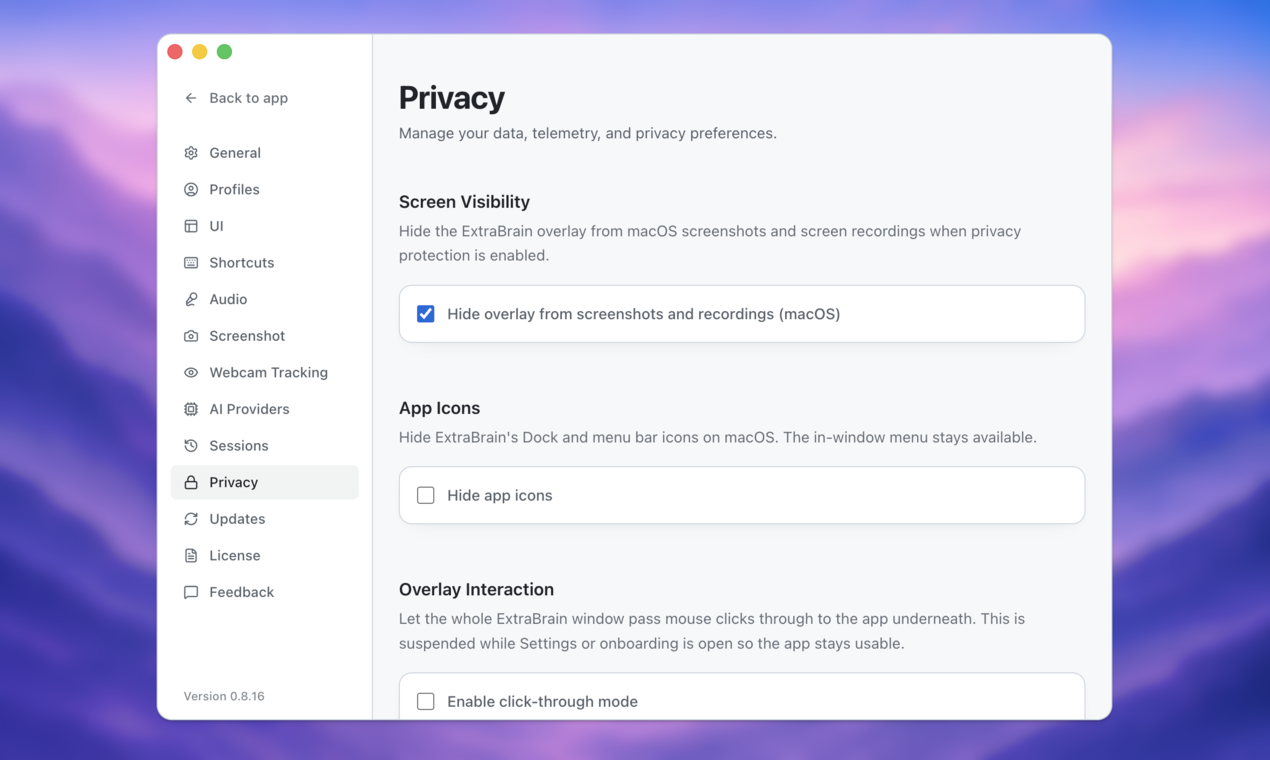
The interview transcript is the new personal dossier
A transcript looks harmless because it is formatted like notes. That is misleading.
A single interview transcript may reveal where you have worked, what systems you touched, how much responsibility you had, which conflicts you navigated, what salary range you expect, where you live, whether you need accommodations, and how you explain pressure. It may include the names of former managers, clients, internal tools, strategic priorities, or mistakes your previous company would not want published.
The more ordinary risk is that sensitive context gets copied into too many systems. A recording goes to a meeting bot. The bot sends a transcript to a cloud model. A summary lands in a shared workspace. A recruiter pastes a section into an ATS. A hiring manager forwards notes to another interviewer. A candidate uploads the transcript to a generic AI tool for feedback.
Each step may be convenient. Each step also expands the circle of access. Privacy failures often happen through convenience, not malice.
Biometrics make the stakes higher
Interview privacy is no longer only about what you said. It can also involve what identifies you.
Video interviews may capture your face, voice, home environment, accent, eye movement, typing rhythm, and the way you pause under pressure. Identity verification tools may ask for government ID, facial matching, liveness checks, or other signals meant to prove that the candidate is who they claim to be. Some companies use these tools to prevent fraud or impersonation. The motivation can be legitimate. The implementation can still be invasive.
Biometric data is different from a password. If a password leaks, you can change it. If a faceprint, voiceprint, or identity document scan is mishandled, the person cannot simply rotate their face or voice.
That does not mean every identity check is wrong. It means identity verification should be narrow, proportionate, and transparent. Candidates should know what is collected, why it is required, how long it is retained, who can access it, and whether it is used for anything beyond identity assurance.
“Welcome to 1984” is catchy. Consent is better.
It is easy to describe AI hiring as a dystopia. Cameras. Transcript analysis. Automated scoring. Identity checks. Hidden copilots. Recruiters worried candidates are using AI. Candidates worried employers are monitoring them. Everyone watching everyone else.
But the useful response is not panic. It is consent and control.
A healthy interview process should answer four questions clearly:
- What is being captured? Audio, video, transcript, notes, screen activity, identity documents, or tool-use disclosures?
- Why is it being captured? Note-taking, accessibility, fraud prevention, evaluation consistency, training, analytics, or compliance?
- Where does it go? Local device, employer systems, third-party processors, AI model providers, shared drives, or long-term archives?
- Who controls it later? Can it be deleted, exported, corrected, restricted, or kept out of training pipelines?
These questions are not anti-AI. They are pro-trust. AI should assist the participant, not quietly build a dossier around them.
Local-first AI changes the default assumption
Most AI tools are cloud-first by default. You send data away, the service processes it, and you receive an answer. That model is useful for many tasks, but it is not always the best default for sensitive conversations.
Local-first AI starts from a different premise: keep the user’s data close to the user whenever possible. Process locally when practical. Store locally when practical. Make sharing a deliberate action, not an accidental side effect. Design the product so the user can benefit from AI without surrendering unnecessary control over the raw material.
This matters for interview transcripts because the raw material is often more sensitive than the summary.
A candidate may want AI feedback on whether their behavioral answer rambled, whether they explained tradeoffs clearly, or whether they missed a follow-up question. They do not necessarily want the full transcript of their career story sitting in a generic cloud account forever.
Local-first design pushes teams to ask: what is the minimum data needed to help the user right now? What can stay on the device? What can be deleted after analysis? What should require explicit sharing?
Those are product decisions, not just legal decisions.
Private AI assistance is not the same as cheating
Interview AI privacy discussions often get tangled with cheating discussions. They are related, but they are not the same.
A candidate secretly using AI to generate live answers in a restricted interview can violate the rules and damage trust. That is an integrity issue. But a candidate using AI before an interview to practice, organize notes, review a mock transcript, or improve clarity is different. That is preparation.
The ethical line is ownership.
AI should help a candidate remember real examples, sharpen explanations, notice weak spots, and reflect afterward. It should not invent experience, impersonate expertise, or feed answers that the candidate cannot defend.
Privacy-conscious tools make responsible use easier because they reduce the temptation to paste sensitive interview material into whatever chatbot is open. A private AI interview copilot can be useful when it keeps the person’s conversation context under their control and frames AI as support for preparation and reflection, not as a hidden substitute for judgment.
For candidates, this matters because interview prep often contains details they would never post publicly: compensation goals, career doubts, rejected offers, or confidential examples from past work.
Hiring teams need privacy boundaries too
Candidates are not the only people who need better AI boundaries. Hiring teams do as well.
Recruiters and interviewers are under pressure to move quickly, compare candidates fairly, and document decisions. AI summaries can help. But the hiring team still owns the process. If an interviewer records a call, uses an AI note-taker, or relies on generated summaries, candidates should know.
A transcript can be incomplete. A summary can miss nuance. A model can overemphasize polished language and underemphasize substance. People with accents, neurodivergent communication styles, non-linear storytelling, or anxiety under pressure may be misunderstood if AI-generated notes are treated as objective truth.
Responsible hiring teams should keep humans accountable for hiring decisions. AI can organize evidence, but people must interpret it.
A practical hiring policy might say:
- We disclose recording, transcription, and AI note-taking before the interview.
- We collect only what we need for evaluation and compliance.
- We do not use biometric or behavioral signals as vague “suspicion” scores.
- We review AI summaries against interviewer notes before relying on them.
- We avoid sharing transcripts outside the hiring team unless there is a clear reason.
- We delete or retain interview data according to a defined policy.
This is not bureaucracy. It is how trust becomes operational.
The raw transcript deserves a retention plan
The easiest privacy mistake is keeping everything forever.
Teams often store transcripts because storage is cheap and future usefulness feels possible. Candidates do the same: save every recording, every transcript, every practice session, every AI analysis. But indefinite retention turns yesterday’s useful notes into tomorrow’s liability.
A better approach is to separate short-term usefulness from long-term need.
For interview prep, a candidate might keep a summary of lessons learned and delete the raw transcript after the next round. For recruiting, a hiring team might retain structured evaluation notes but avoid storing full recordings longer than necessary. For identity verification, a company might confirm identity without keeping reusable biometric templates unless there is a justified reason.
The principle is simple: if the data would be painful to explain after a breach, it should have a reason to exist.
Local-first tools help by making retention visible and controllable. If the transcript starts on your device, you can design a workflow around deletion, export, selective sharing, and minimal storage. If the transcript immediately disappears into a cloud pipeline, control becomes harder.
What to look for in an AI interview or meeting tool
If you are evaluating an AI tool for interview prep, recruiting, or sensitive meeting notes, do not stop at feature lists. Ask privacy questions as product questions.
Look for tools that make it clear:
- Whether audio and transcripts are processed locally, in the cloud, or both
- Whether user data is used for model training
- Where transcripts are stored and how they can be deleted
- Whether sharing is opt-in and visible
- Whether summaries can be generated without retaining raw recordings forever
- Whether the tool supports redaction or selective export
- Whether it explains its role clearly to meeting participants when appropriate
The best interface is not the one with the most magical summary. It is the one that helps you understand what is happening to your data while still making the workflow easier.
That is the promise of a local-first AI meeting copilot: useful assistance for conversations without making surveillance the default business model.
AI should make interviews more human, not less
The future of interviewing should not be a contest between hidden AI assistants and hidden monitoring systems.
That path leads to suspicion on both sides. Employers add more verification. Candidates add more evasion. Tools escalate. Trust shrinks. Everyone behaves as if the other side is trying to cheat them.
A better path is explicit boundaries.
Candidates should use AI to prepare honestly, protect sensitive context, and improve how they communicate real experience. Hiring teams should disclose what they capture, limit what they retain, and avoid treating biometric or behavioral surveillance as a substitute for thoughtful evaluation. Tool makers should design for user control from the start, especially when transcripts contain intimate professional and personal context.
Interview transcripts are sensitive data because interviews are sensitive moments. They are where people explain their work, negotiate their future, reveal constraints, and ask to be trusted.
AI can support that moment. It can help us remember, summarize, practice, and reflect. But it should do so with restraint.
Local-first AI matters because it changes the default from “send everything away and hope the policy is fine” to “keep control close to the person whose data it is.”
That is not anti-technology. It is the kind of technology that earns a place in high-trust conversations.
If you are preparing for interviews, reviewing sensitive meeting notes, or rethinking how AI should support private conversations, try ExtraBrain and look for tools that treat your transcript like something worth protecting.