
ExtraBrain Blog
JobJump Alternatives for Interview Prep, Live Support, and Better Follow-Through

Compare JobJump alternatives for live interview help, mock practice, privacy controls, screen context, and post-interview review.
JobJump is one of the tools job seekers consider when they want AI support for applications, practice, and live interviews. Still, not every candidate wants the same workflow. Some people want mock interview practice before the call. Some want a live desktop copilot that follows the conversation. Some care most about local-first privacy controls, post-interview review, or support for coding and system design rounds.
This guide compares five JobJump alternatives for candidates who want a more practical interview workflow. The goal is not to tell you to outsource your thinking. The goal is to help you choose tools that support preparation, calm execution, and honest reflection while following the rules of your interview, assessment, school, employer, workplace, or platform.
Why consider a JobJump alternative
Common reasons candidates look around
A JobJump alternative may make sense if your current setup feels too narrow for the way you actually interview. Candidates often need help across several moments of the job search, not just one isolated stage.
You may want a different tool if you need:
- Live transcription during interviews, meetings, or practice sessions.
- Screen-aware context for coding prompts, system design diagrams, case studies, or shared documents.
- Mock interview practice before the real conversation.
- A way to connect your own resume, notes, and past examples to stronger answers.
- Privacy controls that make it clear when information stays local and when it is sent to an external provider.
- Post-session transcripts and notes so you can improve after each call.
- A workflow that works outside the browser.
The best choice depends on the kind of interviews you take most often. A software engineer preparing for live coding needs a different setup from a project manager practicing behavioral answers or a sales candidate reviewing customer-call examples.
What a strong AI interview tool should do
A useful AI interview assistant should help you stay present rather than replace your judgment. It should help you hear the question, structure the response, ask clarifying questions, explain tradeoffs, and review the session afterward.
For live interviews, the most important features are usually context, speed, privacy, and control. For preparation, the most important features are repetition, feedback, and memory. For long-term job search improvement, the most important feature is learning from what happened instead of treating every interview as a one-off event.
1. ExtraBrain
Main features
ExtraBrain is a free, local-first desktop AI interview assistant and meeting copilot for Mac. It is built for live sessions such as coding interviews, system design interviews, behavioral interviews, product interviews, meetings, lectures, and research calls.
ExtraBrain combines live transcription, screen-aware context, session history, local-first options, and bring-your-own AI provider control. Where installed and compatible, it can use local Gemma 4 on-device AI. For transcription, it supports local NVIDIA Parakeet and optional Deepgram. It also supports providers such as Anthropic, OpenAI, custom OpenAI-compatible endpoints, Claude Subscription, and Codex Subscription.
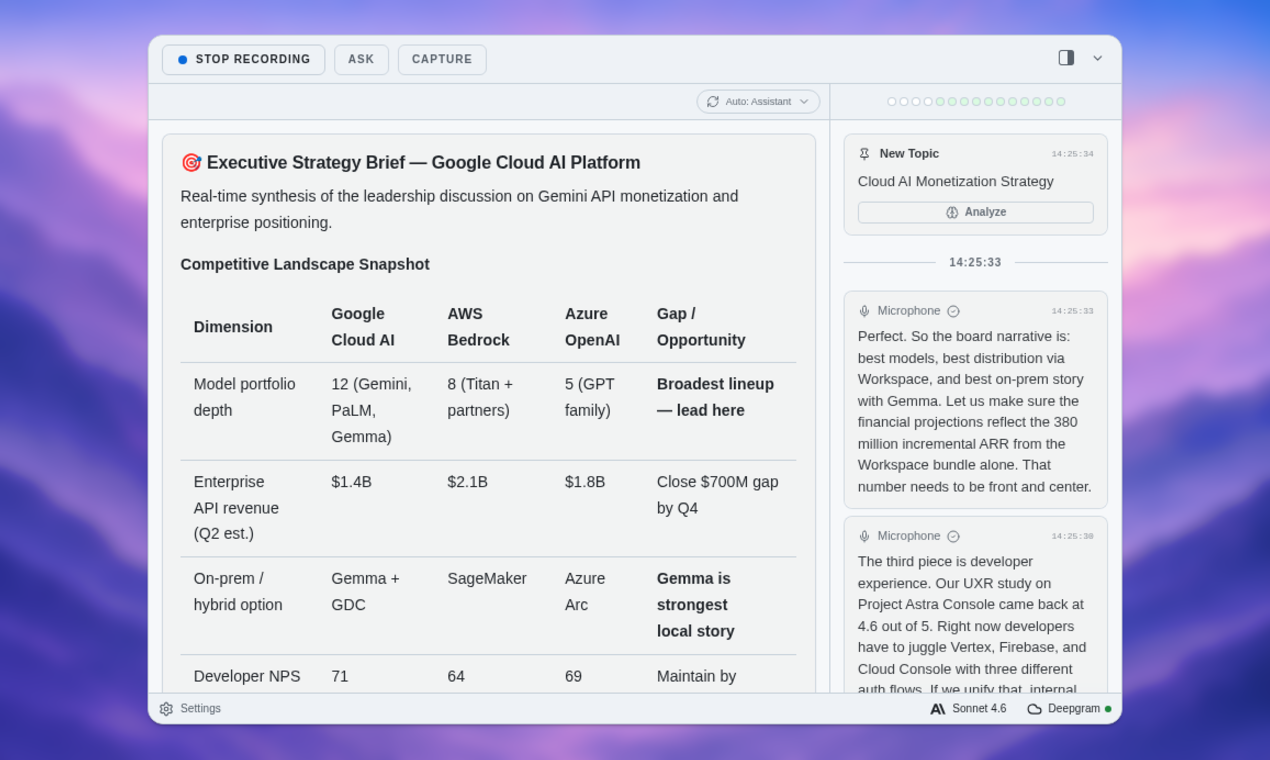
ExtraBrain is especially useful when you want the assistant to understand both what is being said and what is visible on screen. That matters in real interviews because the key prompt is often not only in the transcript. It may be in a shared coding editor, a system design diagram, a product case prompt, a spreadsheet, or a slide.
Pros and cons
| Strengths | Tradeoffs |
|---|---|
| Free core Mac desktop app | Windows and Linux are planned but not available today |
| Live transcription and screen-aware context | Local Gemma 4 requires installation and compatible hardware |
| Local-first posture with local Parakeet plus local Gemma 4 where installed and compatible | External providers may receive selected prompts, transcript text, screenshots, audio, or context depending on configuration |
| Works for coding, system design, behavioral, product, meeting, lecture, and research workflows | Candidates still need to follow the rules of the setting |
| Bring-your-own provider setup gives users more control | Setup choices matter for privacy and cost |
| Post-session review helps candidates improve after the interview | It is not a broad replacement for every note-taking database |
ExtraBrain is designed to stay hidden from screen sharing and screen recording on major meeting tools. That does not make every use acceptable. You remain responsible for using AI assistance, transcription, screenshots, and notes only where the relevant rules allow them.
Best for
ExtraBrain is the strongest JobJump alternative for Mac users who want one desktop workflow for live interviews and post-interview learning. It is a good fit if you want help during coding rounds, system design conversations, behavioral interviews, product interviews, or professional meetings.
It is also a good choice if privacy and provider control matter to you. A fully local ExtraBrain posture requires local Parakeet transcription plus local Gemma 4 on-device AI where installed and compatible, with no external provider requests. If you choose external providers, selected context can leave the device depending on your configuration.
2. Google Interview Warmup
Main features
Google Interview Warmup is useful when you want a simple way to practice interview answers before a real call. It focuses on mock interview prompts and feedback patterns rather than live interview assistance.
This makes it different from desktop copilots. It is more about rehearsal than real-time context. If you are nervous, out of practice, or preparing for common interview questions, that can be enough.
Pros and cons
Pros:
- Easy practice flow for common interview questions.
- Useful for building confidence before a call.
- Good for candidates who want a free preparation habit.
- Helpful when you need to practice speaking answers aloud.
Cons:
- Not designed as a live interview copilot.
- Limited screen context for coding, system design, case prompts, or shared documents.
- Feedback can be less personal than a tool connected to your own notes and sessions.
- It does not create the same post-session workspace as a desktop interview assistant.
Best for
Google Interview Warmup is best for candidates who need practice reps before the interview. Use it when you want to get comfortable answering common questions, reduce nerves, and hear yourself speak.
It is less suitable if you need real-time support during a technical round, a live case interview, or a meeting where the screen content matters.
3. Final Round AI
Main features
Final Round AI is another well-known option for candidates who want AI support across the interview process. It is often considered by people comparing live interview copilots, resume workflows, mock interviews, and answer guidance.
The appeal is breadth. Candidates who want one platform for preparation and interview support may find that kind of workflow attractive. However, breadth is not the same as fit. You should still evaluate whether the tool matches your device, interview type, privacy expectations, and budget.
Pros and cons
| Strengths | Weaknesses |
|---|---|
| Broad interview-prep positioning | May be more platform than some candidates need |
| Useful for candidates who want structured answer help | Personalization depends on setup and inputs |
| Can support several stages of preparation | Live workflows should be tested before a high-stakes call |
| Familiar category for people comparing AI interview copilots | Privacy and provider behavior should be reviewed carefully |
Best for
Final Round AI may fit candidates who want a broad interview preparation platform and are comfortable comparing paid tools. It is worth testing before relying on it in a serious interview.
If you mainly want a local-first Mac desktop workflow with screen-aware context and bring-your-own provider control, ExtraBrain may be a better fit.
4. aiApply
Main features
aiApply is often more relevant to the application stage than the live interview stage. Candidates may look at it for resumes, cover letters, job applications, and job search automation.
That can be valuable if your biggest bottleneck is getting more applications out the door. It may be less ideal if your main challenge is explaining your thinking in a coding interview, system design round, product case, or behavioral conversation.
Pros and cons
| Strengths | Weaknesses |
|---|---|
| Useful for application-stage workflows | Less focused on live interview context |
| Can help candidates move faster through repetitive job search tasks | Not the best fit for complex technical interview support |
| May appeal to early-career job seekers | Candidates still need to personalize and verify outputs |
| Can complement interview practice tools | Not a replacement for live discussion skills |
Best for
aiApply is best for candidates who need help with the top of the funnel. If your main problem is creating application materials, organizing outreach, or moving faster through job search admin, it may be useful.
If your main problem is performing well in live interviews, you will likely want a more interview-specific tool alongside it.
5. Interviews.chat
Main features
Interviews.chat is a flexible option for candidates who want AI help with multiple interview-related tasks. It can appeal to people who want mock practice, answer formats, cover letter support, and post-interview analysis in one place.
The biggest benefit is flexibility. The biggest risk is workflow complexity. A tool with many options can be helpful, but only if you can find the right mode quickly when pressure is high.
Pros and cons
Pros:
- Useful for candidates who want a broad set of interview and job search tools.
- Can support practice, answer framing, and post-interview review.
- May fit people who like to choose between different response formats.
- Helpful for behavioral, technical, and case-style preparation when configured well.
Cons:
- A multi-tool interface can feel confusing during high-pressure sessions.
- Live transcription and setup should be tested before a real interview.
- Candidates need to understand privacy settings and provider behavior.
- It may not feel as focused as a desktop copilot built around live session context.
Best for
Interviews.chat is best for candidates who want many interview-adjacent tools in one place. It can work well for preparation and review if you are willing to spend time learning the workflow.
If you want a simpler Mac desktop experience for live transcript, screen context, and session review, ExtraBrain is the more focused alternative.
JobJump alternative comparison
| Tool | Best use case | Live support | Preparation support | Privacy and control angle |
|---|---|---|---|---|
| ExtraBrain | Mac users who want a live desktop interview and meeting copilot | Strong fit for live transcript and screen-aware context | Strong fit for session review and answer structuring | Local-first options plus bring-your-own providers |
| Google Interview Warmup | Candidates who want free mock practice | Limited for live interviews | Strong for simple practice reps | Good for low-friction practice, but not a full desktop workflow |
| Final Round AI | Candidates comparing broad interview platforms | Potentially useful, but test before relying on it | Useful for structured prep | Review settings and data behavior before use |
| aiApply | Candidates focused on applications and job search admin | Limited fit for complex live interviews | Useful for resumes and application materials | Verify outputs and avoid over-automation |
| Interviews.chat | Candidates who want many interview tools in one place | Potentially useful after setup | Useful for practice, answer formats, and review | Understand provider and privacy settings |
How to choose the right JobJump alternative
Choose based on your interview type
For coding interviews, prioritize tools that can help you explain tradeoffs, reason through edge cases, and connect screen context with transcript context. For system design interviews, prioritize tools that help you organize requirements, architecture choices, bottlenecks, and follow-up questions. For behavioral interviews, prioritize tools that help you map real stories into STAR-style answers without making you sound scripted. For product, consulting, or finance-style interviews, prioritize tools that can follow case details and help you structure assumptions.
Choose based on when you need help
If you need help before the interview, mock interview tools may be enough. If you need help during the interview, a live copilot matters more. If you need help after the interview, transcripts, notes, and debrief workflows become important.
ExtraBrain is strongest when you want all three moments connected. You can prepare, use live context, and then review what happened afterward.
Choose based on privacy expectations
Do not assume every AI interview assistant handles data the same way. Some tools are browser-based. Some use desktop apps. Some rely on external providers. Some provide local-first options.
ExtraBrain gives Mac users a local-first path when local Parakeet transcription and local Gemma 4 on-device AI are installed and compatible. If you configure external providers, selected prompts, transcript text, screenshots, audio, or context may leave the device. That distinction matters, especially for interviews, workplace meetings, school settings, and sensitive research calls.
My recommendation
If you only want free mock practice, start with Google Interview Warmup. If you mainly need resume and application help, consider an application-focused tool like aiApply. If you want a broad interview platform, compare Final Round AI and Interviews.chat carefully.
If you want the best JobJump alternative for a Mac-based live interview workflow, start with ExtraBrain. It is free at the core, local-first, screen-aware, and designed for the moments where transcript alone is not enough. It also supports post-interview review, which is where many candidates actually improve.
FAQ
What makes an AI interview assistant better than regular practice?
Regular practice helps you rehearse. An AI interview assistant can help you structure answers, notice context, generate follow-up questions, and review transcripts afterward. The best tools make you more thoughtful and prepared rather than more dependent.
Can I use the same tool for every industry?
You can use many AI tools across industries, but the best fit depends on the interview format. Coding, system design, behavioral, product, finance, customer support, and sales interviews all require different kinds of context. Choose a tool that supports the rounds you actually face.
Is ExtraBrain a JobJump alternative?
Yes. ExtraBrain is a JobJump alternative for Mac users who want a free, local-first desktop AI interview assistant and meeting copilot. It offers live transcription, screen-aware context, local AI options where installed and compatible, bring-your-own providers, and post-session review.
Can ExtraBrain run fully local?
A fully local ExtraBrain posture requires local Parakeet transcription plus local Gemma 4 on-device AI where installed and compatible, with no external provider requests. If you use external providers, selected prompts, transcript text, screenshots, audio, or context may leave the device depending on configuration.
Is it okay to use AI during interviews?
Only use AI assistance where the rules allow it. Follow the policies of the interviewer, employer, school, workplace, assessment provider, meeting host, and platform. When in doubt, ask for permission or use AI only for preparation and post-interview review.