
ExtraBrain Blog
Using a LeetCode Interview AI Assistant Without Losing Your Own Thinking

A practical guide to using ExtraBrain for LeetCode-style coding interviews, live explanations, debugging, screen context, and responsible preparation.
A LeetCode interview AI assistant is useful only when it helps you think more clearly under pressure. The best use case is not replacing your engineering judgment. It is keeping the problem statement, interviewer comments, constraints, tradeoffs, and debugging clues in one place while you still explain and write the solution yourself.
ExtraBrain is a free, local-first Mac desktop AI interview assistant and meeting copilot built for that workflow. It supports live transcription, screen-aware context, local Parakeet transcription, local Gemma 4 on-device AI where installed and compatible, bring-your-own AI providers, and privacy controls. For coding interviews, that means it can help you capture the prompt, reason through approaches, generate clarifying questions, explain complexity, and review the session afterward.
Use any AI interview assistant only where interview, employer, school, workplace, and platform rules allow AI assistance, transcription, screenshots, or notes. If a coding assessment or live interview forbids AI help, respect that rule. The strongest long-term strategy is to use AI for preparation, practice, and permitted support, while building the skill to solve and explain problems on your own.
Key takeaways
- Treat a LeetCode interview AI assistant as a thinking aid, not a substitute for understanding.
- Practice with the assistant before the interview so your workflow feels natural and low-friction.
- Use screen context to summarize the problem, constraints, examples, and edge cases before coding.
- Use live transcription to track interviewer hints, follow-up questions, and changes in requirements.
- Ask clarifying questions first, then explain your approach before writing code.
- Type and reason through your own implementation instead of blindly copying generated code.
- Use AI feedback for debugging, complexity analysis, test cases, and post-interview review.
- Keep privacy settings, provider choices, and local-first options clear before using any tool in a sensitive setting.
What a LeetCode interview AI assistant should actually do
A strong coding interview assistant should help with the whole interview loop, not just output a final answer. Most real interviews evaluate how you understand ambiguity, choose a data structure, discuss tradeoffs, handle edge cases, and debug under time pressure. A generated solution is much less valuable if you cannot explain why it works.
For LeetCode-style problems, the assistant should help you:
- Restate the problem in plain language.
- Identify inputs, outputs, constraints, and hidden edge cases.
- Suggest two or three possible approaches.
- Compare brute force, optimized, and production-minded solutions.
- Explain time and space complexity.
- Generate test cases that expose mistakes.
- Help debug the code you wrote.
- Summarize what to improve after the interview.
That is the difference between using AI as a shortcut and using AI as an interview practice partner. ExtraBrain is designed around live context and review, so the assistant can help you stay oriented while you remain responsible for the actual interview performance.
Why desktop context matters for coding interviews
A browser tab can be a cramped place to manage a coding interview. You may have the problem statement in one panel, a code editor in another, a video call in the background, and verbal feedback arriving in real time. Switching between tools can interrupt your flow.
A desktop AI interview assistant can sit beside that workflow instead of becoming another browser tab to manage. ExtraBrain is available for macOS today, including Apple Silicon and Intel Macs. Windows and Linux are planned future platforms.
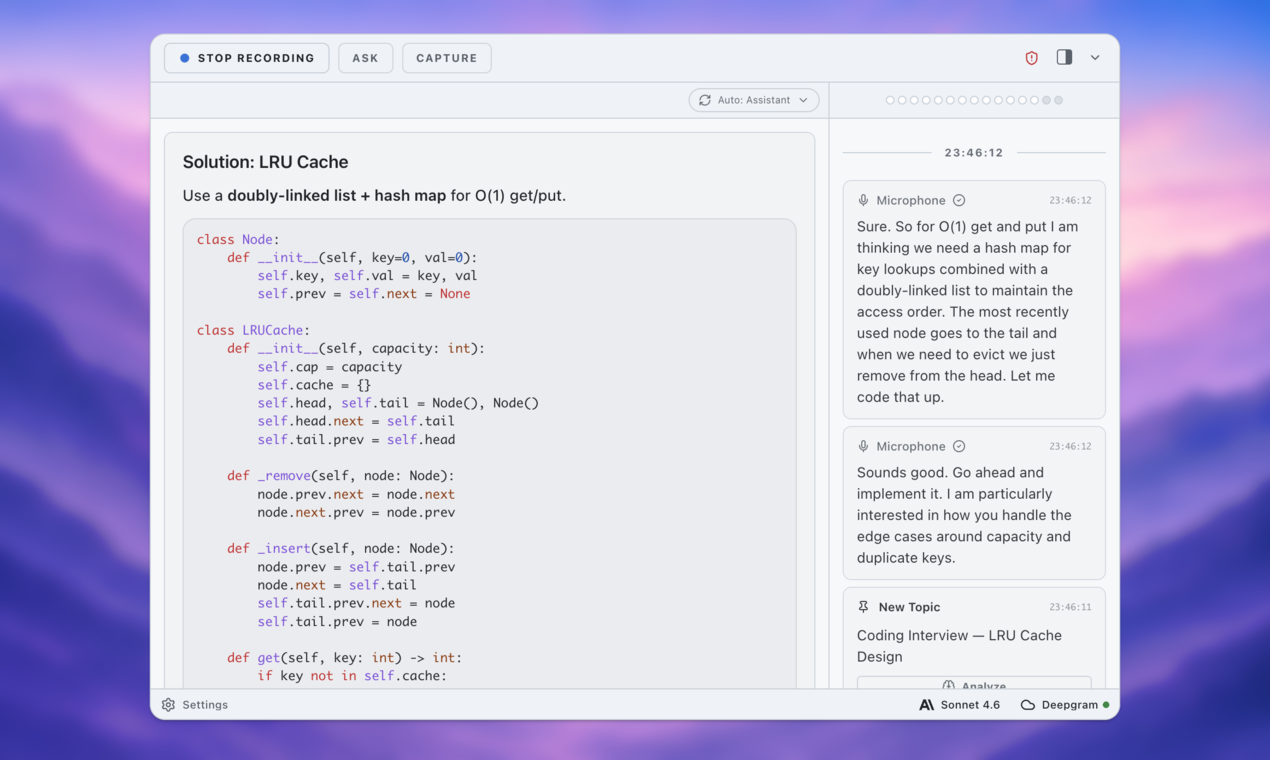
The practical advantage is context. With screen-aware input, the assistant can help you reason about the visible problem statement, examples, failing tests, diagrams, or code. With live transcription, it can also track what the interviewer said, including hints like “try optimizing the memory use” or “what happens with duplicate values?”
That combination is especially useful for problems where the written prompt and spoken conversation diverge. A common example is a standard LRU cache problem where the interviewer adds a follow-up about thread safety, eviction metrics, or production observability. If you rely only on the original prompt, you may miss the real evaluation target.
A responsible setup before the interview
The worst time to learn a tool is during a live technical interview. If you plan to use ExtraBrain in a permitted context, prepare the setup before the session.
Confirm the rules first
Before using AI during an interview, check the interview instructions, assessment policy, employer expectations, school rules, and platform terms. Some interviews allow notes, search, documentation, or AI assistance. Others explicitly prohibit outside help.
If the rules are unclear, ask. A simple question like “Are AI notes or transcription tools allowed during this session?” is better than guessing. Responsible use protects both the candidate and the interviewer.
Choose your privacy posture
ExtraBrain can be configured in different ways depending on your privacy requirements. A fully local posture requires local Parakeet transcription plus local Gemma 4 on-device AI where installed and compatible, with no external provider requests. If you choose external providers, selected prompts, transcript text, screenshots, audio, or context may leave your device depending on configuration.
This matters for coding interviews because prompts, company-specific examples, and conversation transcripts can be sensitive. Decide your provider setup before the session rather than improvising mid-call.
Practice the workflow
Run mock interviews with the same layout you expect to use live. Practice capturing a prompt, asking the assistant for an approach outline, explaining your own plan aloud, coding manually, and using the assistant to review edge cases.
Do this until the assistant becomes a quiet support layer rather than a distraction. If you are reading every generated sentence instead of thinking, you are not ready.
How I would use ExtraBrain on a LeetCode-style prompt
A good coding interview has a rhythm. You listen, clarify, plan, code, test, optimize, and reflect. ExtraBrain can support each step, but it should not erase the rhythm.
1. Capture the prompt and constraints
Start by collecting the problem statement, examples, input constraints, and any interviewer comments. For a graph problem, that might include whether the graph is directed, whether cycles exist, and how large the node set can be. For a string problem, it might include Unicode assumptions, case sensitivity, and memory limits.
A useful first assistant prompt is not “solve this.” A better prompt is:
Summarize the problem, list the constraints, identify ambiguous details, and suggest clarifying questions before proposing a solution.
This keeps the conversation focused on understanding, which is what strong interviewers care about.
2. Ask clarifying questions
Before coding, ask the interviewer about the details that affect the algorithm. Examples include:
- Can the input be empty?
- Are duplicate values allowed?
- Is the array sorted?
- Should the solution optimize for time, memory, or readability?
- Are there limits on recursion depth?
- Should the function mutate the input?
The assistant can suggest these questions, but you should choose the ones that matter. Asking every possible question sounds robotic. Asking the right two questions sounds senior.
3. Explain the approach in your own words
After the assistant proposes possible solutions, translate the best one into your own explanation. For example, if the problem is “top K frequent elements,” you might compare a hash map plus heap against bucket sort. Then you can explain why one approach fits the constraints.
Do not rush into code. Interviewers often decide a lot from the planning phase. A clear explanation can recover from small syntax mistakes later.
4. Write the code manually
Even when AI suggests code, type your own implementation. This helps you keep pace with your explanation and reduces the risk of producing code you cannot defend. It also makes debugging more natural because you understand every line you wrote.
If the assistant suggests a helper function, ask yourself whether the abstraction helps the interviewer follow the solution. In interview code, clarity usually beats cleverness.
5. Use the assistant for debugging and edge cases
After you have a working draft, use ExtraBrain to review the implementation. The best debugging prompts are specific:
Review this implementation for off-by-one errors, missed edge cases, and complexity problems.
Generate five test cases, including one empty input, one duplicate-heavy input, and one large constraint case.
Explain why this solution fails on the provided test case.
This is where AI can be especially valuable. It can point out the kind of small mistake that becomes hard to see when you are stressed.
6. Prepare the optimization discussion
Many LeetCode-style interviews are not finished when the first solution passes the sample tests. The interviewer may ask for time complexity, space complexity, or a more optimal approach.
Use the assistant to prepare a concise tradeoff summary. For example:
- Brute force is easier to explain but may be too slow for large inputs.
- A hash map improves lookup time at the cost of extra memory.
- A heap helps when only the top K values are needed.
- Dynamic programming can reduce repeated work but may require careful state design.
Your answer should sound like an engineering decision, not a memorized template.
Features that matter most in a coding interview assistant
A LeetCode interview AI assistant does not need to be flashy. It needs to be reliable, contextual, and easy to control.
Live transcription
Live transcription helps capture the exact wording of the interviewer’s hints and follow-up questions. This is important because coding interviews often change after the first solution. The interviewer might ask how the solution changes for streaming input, distributed systems, larger data, or stricter memory limits.
ExtraBrain supports local NVIDIA Parakeet transcription and optional Deepgram. If you need a local-first posture, configure local transcription before the interview.
Screen-aware context
Screen context is useful when the problem statement, code editor, failing test, or architecture diagram is visible. Instead of manually retyping everything, you can use the visible context as part of the assistant workflow.
This is helpful for:
- Long prompts with multiple examples.
- Coding tasks with failing tests.
- System design diagrams.
- Debugging sessions.
- Product or data analysis interviews.
Bring-your-own AI providers
ExtraBrain supports local Gemma 4 where installed and compatible, Anthropic, OpenAI, custom OpenAI-compatible endpoints, Claude Subscription, and Codex Subscription. External AI and transcription provider usage is billed separately by the providers users choose.
Provider choice matters because different interviews need different strengths. A coding interview may benefit from stronger code reasoning. A behavioral interview may benefit from better structure and tone. A privacy-sensitive session may require local-first configuration.
Session history and review
The interview is not over when the call ends. Post-interview review is where you turn one stressful session into better future performance.
ExtraBrain can function as a focused AI second brain for interviews and meetings. It gives you a place to review transcripts, notes, screen context, and session takeaways without trying to replace a general note-taking database.
After a coding interview, review:
- Which problem pattern appeared.
- Which clarification questions you missed.
- Where your explanation was unclear.
- Which edge case caused trouble.
- Whether your complexity analysis was accurate.
- What to practice next.
What not to do with a LeetCode interview AI assistant
AI can make preparation more effective, but it can also make candidates overconfident. Avoid these mistakes.
Do not outsource the thinking
If you cannot explain the invariant, state transition, data structure choice, or complexity, the solution is not really yours. An interviewer can usually tell when a candidate is reciting an answer without owning it.
Use the assistant to strengthen your reasoning, not to hide weak reasoning.
Do not ignore the interviewer
A generated answer may solve the written prompt but miss the interviewer’s actual request. If the interviewer asks you to optimize memory and you keep discussing runtime, you are not listening.
Live transcription helps, but attention still matters. Look for hints, corrections, and changed requirements.
Do not use prohibited tools
Some assessments are closed-book and explicitly ban AI assistance. Some employers allow AI for preparation but not live interviews. Some schools or certification programs have strict academic integrity rules.
ExtraBrain should be used only where the relevant rules allow it. When in doubt, ask or keep the tool to preparation and post-interview review.
Do not skip fundamentals
A coding interview assistant cannot replace practice with arrays, strings, hash maps, graphs, heaps, recursion, dynamic programming, intervals, trees, and binary search. It can help you learn those patterns faster, but it cannot create durable skill if you never solve problems yourself.
Example workflow for an LRU cache interview
The LRU cache prompt is a useful example because it tests both data structures and communication.
A strong solution usually combines a hash map with a doubly linked list so get and put run in constant time.
Here is how I would use ExtraBrain responsibly during preparation or a permitted live session.
Understand the requirement
First, I would ask the assistant to summarize the visible prompt and identify requirements:
get(key)should return the value if present, otherwise-1or the specified missing value.put(key, value)should insert or update a value.- Recently accessed items should move to the most-recent position.
- When capacity is exceeded, the least-recently used item should be evicted.
- Both operations should be O(1).
Then I would explain the idea aloud in my own words.
Plan the data structures
The hash map gives O(1) access from key to node. The doubly linked list gives O(1) removal and insertion when moving nodes to the front. Dummy head and tail nodes can simplify edge cases.
This is also a good place to discuss tradeoffs. A built-in ordered dictionary may be fine in some languages, but implementing the data structure manually demonstrates the underlying idea.
Test edge cases
I would use the assistant to generate tests like:
- Capacity is one.
- Updating an existing key should not increase size.
- Reading a key should make it most recent.
- Eviction should remove the least-recent key, not the oldest inserted key.
- Multiple updates and reads should preserve ordering.
Those tests reveal whether the candidate understands recency, not just storage.
FAQ
Does a LeetCode interview AI assistant support every programming language?
ExtraBrain works through your chosen AI provider and prompt context, so language support depends partly on the provider you configure. For common interview languages like Python, Java, JavaScript, TypeScript, C++, Go, and Kotlin, modern AI providers are generally useful for explanations, test cases, and debugging. Always practice in the language you plan to use before the interview.
Can ExtraBrain help with system design or behavioral interviews too?
Yes. ExtraBrain is not limited to coding interviews. It can support system design interviews, behavioral interviews, product interviews, customer calls, lectures, and research meetings. For system design, screen-aware context can help analyze diagrams and requirements. For behavioral rounds, live transcription and notes can help structure STAR-style answers from your own experience.
Can ExtraBrain run fully local?
A fully local ExtraBrain posture requires local Parakeet transcription plus local Gemma 4 on-device AI where installed and compatible, with no external provider requests. Local Gemma 4 requires installation and compatible hardware and may not be available on every Mac or customer environment. If you use external providers, selected prompts, transcript text, screenshots, audio, or context may leave the device depending on configuration.
How much does ExtraBrain cost?
The core ExtraBrain Mac app is free. ExtraBrain Pro is $9.99 per month, $79 per year, or $149 Lifetime launch pricing. External AI and transcription provider usage is billed separately by the providers you choose.
Is ExtraBrain the same as an AI second brain?
ExtraBrain can work as a focused AI second brain for interviews and meetings. It helps organize live sessions, transcripts, notes, screen context, and review. It is not trying to replace broad general-purpose note-taking databases.
A better way to think about AI and LeetCode interviews
The goal is not to make LeetCode disappear. The goal is to make the interview more representative of real engineering work. Real engineers use notes, docs, review, tests, pair programming, and debugging tools. A responsible AI interview assistant can support similar habits when the rules allow it.
For candidates, the best outcome is not merely getting a solution on the screen. The best outcome is becoming clearer, calmer, and more precise while solving problems.
If you use ExtraBrain for LeetCode-style interview preparation, use it to build that skill. Let it help you capture context, generate test cases, review mistakes, and practice explanations. Then walk into the interview ready to think for yourself.