
ExtraBrain Blog
LockedIn AI Review: What Worked, What Felt Risky, and the Better Mac Alternative

A practical LockedIn AI review covering live interview use, desktop mode, user feedback, pricing concerns, and ExtraBrain as an alternative.
LockedIn AI is one of those AI interview tools that gets attention because it promises help in high-pressure moments. Some users describe it as a confidence booster for interviews, online assessments, and live calls. Others complain that the product feels unreliable, hard to cancel, or too obvious during screen sharing.
That split is what makes a LockedIn AI review useful. The real question is not only whether the tool can generate answers. The better question is whether it can help you think clearly, stay within the rules, and avoid creating new problems during an interview.
This review looks at LockedIn AI as a browser-based interview copilot and as a desktop helper. It also explains when a local-first desktop assistant like ExtraBrain may be a better fit for Mac users who want live transcription, screen-aware context, provider control, and clearer privacy settings.
Use any interview assistant only where your interview, employer, school, meeting, or platform rules allow AI assistance, transcription, screenshots, or notes.
Quick verdict
LockedIn AI can be useful when you want fast answer suggestions during a low-stakes practice session or a call without screen sharing. Its strengths are speed, automatic transcription, and structured answer generation.
The weak points are more serious for real interviews. In a browser workflow, switching between the meeting and the answer tab can be visible. In a desktop workflow, a transparent overlay still raises practical screen-sharing questions. The answers can also sound generic if you read them directly.
My overall impression is that LockedIn AI is interesting but not a tool I would trust blindly in a serious interview. For Mac users, ExtraBrain is a stronger alternative when the priority is a free core desktop app, live transcription, screen-aware context, local-first options, and bring-your-own AI provider control.
What I looked for in this LockedIn AI review
I evaluated LockedIn AI around five practical questions:
- Can it understand a live interview question quickly enough to help?
- Are the suggested answers specific enough to be useful?
- Does the workflow fit naturally into a real video interview?
- Does the desktop mode reduce friction, or does it create new visibility concerns?
- Is the value clear enough to justify paying for it?
Those questions matter because an AI interview assistant is not a normal chatbot. During an interview, you are managing eye contact, audio, screen sharing, nerves, timing, and the interviewer’s follow-up questions. A tool that adds another window, another tab, or another source of anxiety can make the session worse even if the underlying model is fast.
LockedIn AI user feedback: mixed praise and criticism
Before testing the product experience, it is worth understanding the general pattern of user feedback. LockedIn AI appears to receive both enthusiastic praise and strong criticism. That is common in this category because people are using AI tools during emotionally intense job searches.
Some users say tools like LockedIn AI help them stay calm, organize answers, and avoid freezing. That makes sense. A live prompt that turns a rambling answer into a STAR outline can feel helpful when your mind goes blank.
Other users complain about reliability, cancellation friction, customer support, and answers that do not match the interview context well enough. Those complaints also make sense. An interview copilot is only valuable if it is dependable when the meeting is live.
The main lesson is that user reviews should not be treated as proof that the tool will work for your interview. You need to test the workflow in the exact kind of call you expect to join, including microphone settings, screen sharing, permissions, timing, and how you plan to use the suggestions responsibly.
Browser-based LockedIn AI experience
LockedIn AI’s web workflow is built around a dashboard style experience. The product can be used for mock interviews, live interview sessions, and coding-style scenarios. That sounds convenient at first because the setup is easy to understand. You open the tool, choose the session type, and let it listen for questions.
In a mock interview setting, the transcription was one of the better parts of the experience. It picked up questions quickly enough to generate useful prompts. The tool also started drafting responses automatically after it detected that the interviewer had finished asking a question. For behavioral questions, it leaned toward a STAR-style answer structure.
That part is genuinely helpful for practice. If you are rehearsing aloud, a fast outline can remind you to include situation, task, action, and result instead of jumping straight to a vague conclusion.
The problem is the live interview workflow. If your answer window lives in a browser tab or a visible dashboard, you may need to switch away from the meeting window. That is awkward during a real call. It can also be visible during screen sharing, depending on what you share and how your meeting software behaves.
The bigger issue is that the generated answers often felt too broad. They sounded like generic AI interview content rather than something grounded in a real candidate’s background, resume, project history, or the company’s role. That is risky because interviewers usually notice when an answer sounds polished but detached from the actual person speaking.
What LockedIn AI did well
LockedIn AI had several useful strengths in a practice environment:
- Transcription was quick enough to follow a mock interview.
- Answer generation started automatically without much manual prompting.
- Behavioral answers were often structured in a recognizable STAR format.
- The tool reduced the friction of asking a separate chatbot for help.
- It could be useful for rehearsing common interview questions before a real call.
Those strengths are not trivial. For candidates who panic during interviews, a tool that turns a question into a simple outline can reduce anxiety. It can also help you practice speaking more clearly.
Where LockedIn AI felt weak
The biggest weakness was answer quality. Many responses were coherent, but they did not feel personal enough. They could help as notes, but reading them directly would sound unnatural.
The second weakness was workflow visibility. A browser-based answer panel is not ideal when you are trying to stay focused on a live interviewer. If you are switching tabs or looking away repeatedly, you may look distracted. If your screen is shared, the risk is more obvious.
The third weakness was trust. When a tool is meant to support a high-stakes conversation, reliability matters more than flashy output. If you spend half the call wondering whether the tool is visible, lagging, or giving a generic answer, it is not really helping.
Desktop mode and the screen-sharing question
LockedIn AI also offers a desktop-style experience that is intended to feel more natural than a browser tab. The idea is clear. Instead of leaving your meeting to check another page, you use a floating helper while the interview continues.
A desktop assistant can be better than a web dashboard, but only if it handles screen sharing, permissions, focus, and visibility carefully. In my testing, the desktop flow did not remove every concern. A transparent or floating window can still create practical questions about what appears in screenshots, screen recordings, or shared displays.
This is where candidates should be cautious. Do not assume that a tool is safe for every interview just because it uses words like stealth, invisible, or undetectable. Every meeting platform, operating system permission, display setup, and screen-sharing mode can behave differently.
The responsible approach is simple. If a meeting or assessment does not allow AI assistance, do not use it. If AI assistance is allowed, test your setup beforehand and use the tool as a thinking aid rather than a script.
Pricing and value concerns
LockedIn AI pricing and plan details may change, so verify the current plan page before making a decision. The important value question is not only the monthly price. The important question is whether you trust the tool enough to use it during the exact situations where it claims to help.
If you are using it only for mock interview practice, a cheaper or free workflow may be enough. If you are considering it for live interviews, you need much higher confidence in answer quality, privacy posture, screen-sharing behavior, and cancellation terms.
For me, the value was not convincing enough to rely on it as the primary interview copilot. Fast generic suggestions are useful during practice, but serious interviews need better context and a calmer workflow.
ExtraBrain as a LockedIn AI alternative
ExtraBrain is a free, local-first desktop AI interview assistant and meeting copilot for Mac. It is built for live transcription, screen-aware context, session notes, coding interviews, system design rounds, behavioral interviews, product interviews, meetings, lectures, and research calls.
The core Mac app is free. ExtraBrain Pro is available at $9.99 per month, $79 per year, or $149 Lifetime launch pricing. External AI and transcription provider usage is billed separately by the providers users choose.
ExtraBrain supports local Parakeet transcription and optional Deepgram. It also supports local Gemma 4 on-device AI where installed and compatible, Anthropic, OpenAI, custom OpenAI-compatible endpoints, Claude Subscription, and Codex Subscription. Local Gemma 4 requires installation and compatible hardware, so it may not be available on every Mac or in every customer environment.
That setup matters because it gives users more control. With local Parakeet transcription plus local Gemma 4 where installed and compatible, transcription and AI prompts can stay local. If you choose an external provider, prompts, transcript text, screenshots, audio, or context may leave the device depending on your configuration.
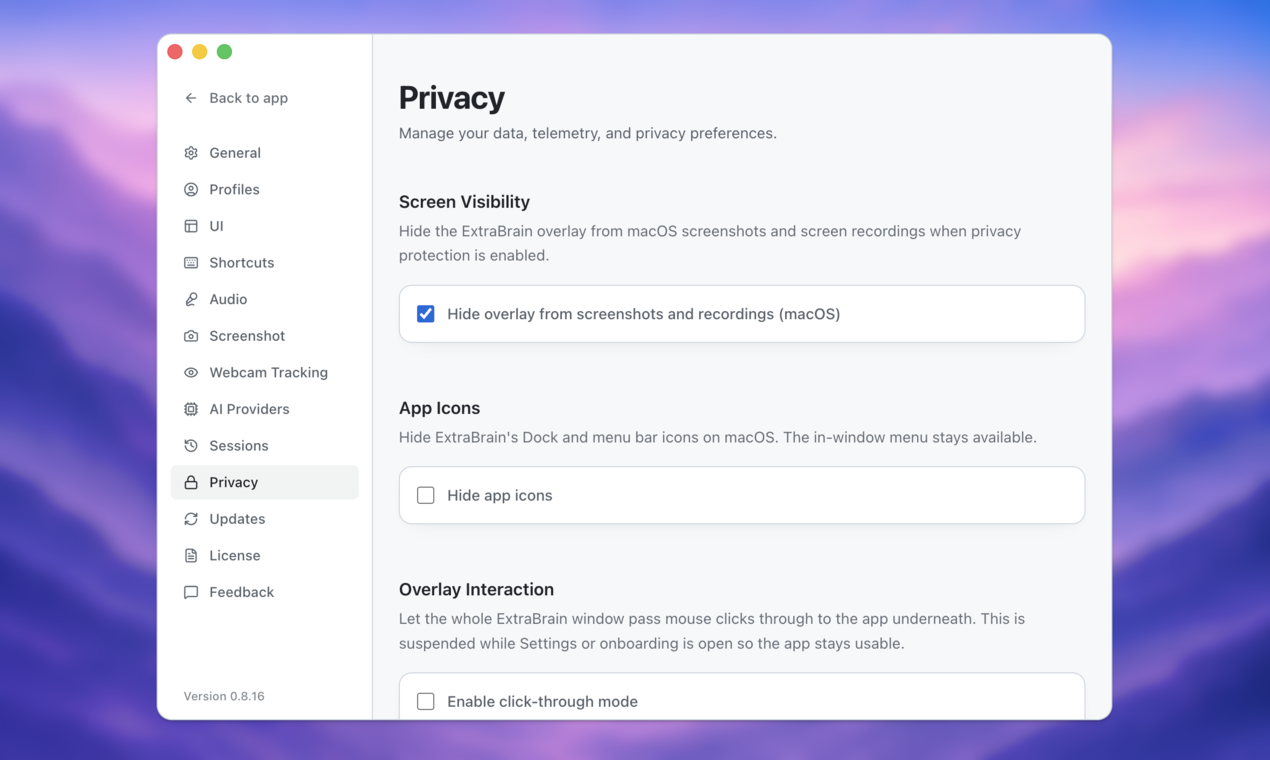
ExtraBrain is designed to stay hidden from screen sharing and screen recording on major meeting tools, while users remain responsible for following all interview, workplace, school, and platform rules.
Why ExtraBrain may fit Mac interview workflows better
ExtraBrain is not trying to be only a web dashboard. It is a desktop workflow for live sessions. That makes it better suited for people who want the assistant to follow the interview context without constantly switching tabs.
The screen-aware context is especially useful for coding and system design interviews. Instead of only listening to the interviewer, ExtraBrain can help reason from the live transcript and relevant screen context. That can support better clarifying questions, tradeoff explanations, debugging steps, and post-session review.
For behavioral interviews, ExtraBrain can help generate STAR outlines and follow-up prompts. The candidate still needs to speak honestly from their own experience. The best use is not to read an answer word for word. The best use is to remember the structure of the answer you already own.
For meetings and research calls, the same workflow becomes less ethically sensitive and more broadly useful. ExtraBrain can help capture transcript context, organize notes, and review what happened afterward.
LockedIn AI vs ExtraBrain
| Category | LockedIn AI | ExtraBrain |
|---|---|---|
| Primary workflow | Interview copilot with web and desktop flows | Mac desktop AI interview assistant and meeting copilot |
| Best use case | Mock practice and fast answer suggestions | Live interviews, meetings, lectures, research calls, and post-session review |
| Platform posture | Depends on current LockedIn AI app support | macOS today, including Apple Silicon and Intel Macs, with Windows and Linux planned |
| Local-first options | Verify current product details | Local Parakeet transcription plus local Gemma 4 where installed and compatible |
| Provider control | Verify current product details | Bring-your-own providers, including Anthropic, OpenAI, custom OpenAI-compatible endpoints, Claude Subscription, and Codex Subscription |
| Screen context | Verify current product details | Screen-aware context for interviews and meetings |
| Responsible use | Required | Required |
Who should consider LockedIn AI?
LockedIn AI may be worth testing if you mainly want a practice companion for mock interviews. It can help you hear a question, see an outline, and compare your spoken answer with a suggested structure.
It may also be useful for low-stakes phone screens where no screen sharing is involved and where AI assistance is allowed. Even then, you should treat the output as notes rather than a script.
I would be more cautious about relying on it during screen-shared technical interviews, formal assessments, or interviews with strict AI policies. The workflow needs to match the rules and the environment.
Who should consider ExtraBrain?
ExtraBrain is a better fit if you use a Mac and want a broader live-session assistant rather than a narrow answer generator. It is especially relevant if you care about local-first options, provider choice, screen-aware context, and reviewable session history.
It is also a strong LockedIn AI alternative for candidates who want to prepare for multiple interview formats:
- Coding interviews where you need to explain reasoning and tradeoffs.
- System design rounds where context and structure matter.
- Behavioral interviews where STAR outlines help you stay concise.
- Product or strategy interviews where follow-up questions are important.
- Meetings and research calls where notes and transcripts have long-term value.
ExtraBrain can work as a focused AI second brain for interviews and meetings. It is not a broad replacement for general note-taking databases. It is a second-brain-style workspace for live sessions, transcripts, notes, screen context, and review.
Practical advice before using any AI interview copilot
Run a full practice session before using any tool in a real interview. Use the same laptop, microphone, camera, meeting app, display setup, and screen-sharing mode you expect to use.
Prepare your own stories before the call. AI can help structure an answer, but it cannot invent real experience that will hold up under follow-up questions.
Do not read generated text word for word. Use it as a prompt to organize your thoughts, then answer naturally.
Check the rules. Some interviews allow notes, transcription, or AI support, and others do not. Your responsibility is to follow the rules that apply to your situation.
Pay attention to privacy settings. If you use external providers, understand what transcript text, screenshots, prompts, audio, or context may be sent outside your device.
Final verdict
LockedIn AI is fast and can be useful for mock interview practice. Its transcription and automatic answer generation are helpful when you want a quick structure for common questions.
However, the browser workflow, screen-sharing concerns, generic answer style, and trust questions make it hard to recommend as a primary tool for serious live interviews. If you test it, use it carefully and responsibly.
For Mac users, ExtraBrain is the more compelling alternative. It offers a free core desktop app, live transcription, screen-aware context, local-first options, provider control, and interview-to-meeting flexibility. That combination makes it more useful than a simple answer panel.
FAQ
What is LockedIn AI?
LockedIn AI is an AI interview assistant that offers live interview support, answer suggestions, and interview-focused workflows. Its exact features and pricing may change, so check the current product information before subscribing.
Is LockedIn AI good for technical interviews?
It can help with quick outlines and practice prompts, but technical interviews require more than fast answers. You need to explain reasoning, ask clarifying questions, discuss tradeoffs, and adapt when the interviewer changes the problem. A screen-aware desktop assistant like ExtraBrain may be a better fit for Mac users who want coding and system design support.
Is LockedIn AI safe to use during interviews?
Safety depends on the interview rules, meeting platform, screen-sharing mode, and your setup. Do not use AI assistance where it is not allowed. If assistance is allowed, test the workflow beforehand and avoid reading generated answers directly.
What is the best LockedIn AI alternative?
ExtraBrain is a strong LockedIn AI alternative for Mac users who want a free core desktop app, live transcription, screen-aware context, local-first options, and provider access they control.
Can ExtraBrain run fully local?
A fully local ExtraBrain posture requires local Parakeet transcription plus local Gemma 4 on-device AI where installed and compatible, with no external provider requests. External providers may receive selected prompts, transcript text, screenshots, audio, or context depending on configuration.
How should ExtraBrain be used responsibly?
ExtraBrain should be used only where interview, employer, school, workplace, meeting, and platform rules allow AI assistance, transcription, screenshots, or notes.