
ExtraBrain Blog
What LockedIn AI Trash Complaints Teach About Better Interview Tools

How to evaluate LockedIn AI trash complaints and choose a more reliable AI interview assistant with privacy, context, and responsible use.

The phrase “LockedIn AI trash” usually comes from candidates who feel burned by an interview assistant at the worst possible moment. Maybe the tool lagged during a live answer. Maybe the output sounded robotic. Maybe it missed the actual question. Maybe the workflow made screen sharing, browser focus, or privacy feel more stressful than the interview itself.
That frustration is understandable. An AI interview assistant is not a toy when you are in a recruiter screen, coding interview, system design round, behavioral interview, or high-stakes mock session. If the assistant is slow, vague, awkward, or hard to control, it can turn preparation into panic.
The better response is not to trust the next shiny tool blindly. The better response is to build a practical checklist for reliability, privacy, live context, and responsible use. For Mac users, ExtraBrain is built for that kind of workflow: a free, local-first desktop AI interview assistant and meeting copilot with live transcription, screen-aware context, local Gemma 4 where installed and compatible, bring-your-own AI providers, and clear privacy controls.
Responsible use matters throughout this article. Use any AI interview assistant only where interview, employer, school, workplace, meeting, and platform rules allow AI assistance, transcription, screenshots, or notes.
Why candidates call an interview tool trash
Most candidates do not call a tool trash because one answer was imperfect. They say it when the tool fails in repeated, practical ways that directly affect performance.
The usual complaints fall into a few categories.
| Problem | Why it matters in an interview |
|---|---|
| Lag and freezes | A delayed answer can break your train of thought and make you miss the moment. |
| Generic outputs | Robotic answers make you sound less credible, not more prepared. |
| Weak technical reasoning | Coding and system design rounds need constraints, edge cases, tradeoffs, and clear explanation. |
| Poor live context | The assistant may answer a different question than the one the interviewer actually asked. |
| Awkward screen workflow | Browser tabs, pop-ups, and visible windows can create unnecessary stress during screen sharing. |
| Weak privacy clarity | Candidates need to know what is captured, processed, stored, or sent to providers. |
| Little user control | You should be able to override, ignore, or reshape AI suggestions instantly. |
The common thread is trust. During an interview, you are already managing the question, the interviewer, the meeting app, your notes, your code editor, your nervous system, and the clock. If the AI assistant adds another thing to manage, it is not doing its job.
Spotting unreliable AI before the interview
The worst time to discover a bad assistant is during the real call. Before using any AI interview copilot, test it in the closest possible version of the real environment.
That means using the same Mac, meeting app, microphone, headphones, browser, coding environment, screen sharing setup, and internet connection you expect to use during the interview. It also means running through the types of questions you actually expect, not only the vendor’s demo prompts.
Red flags in AI interview answers
A weak AI assistant often gives itself away quickly if you ask practical interview questions. Look for these warning signs.
- The answer is fluent but generic.
- The explanation does not match the code or example.
- The tool skips constraints and edge cases.
- The response ignores part of the question.
- The tone sounds memorized instead of conversational.
- The assistant gives a final answer without clarifying assumptions.
- The output is too long to use in a live conversation.
- The advice would be hard to defend if an interviewer asked a follow-up.
For example, a useful coding interview assistant should not only produce code for an LRU cache. It should help you explain why a hash map and doubly linked list work together, how updates affect recency, what happens at capacity, and why the operations are expected to be constant time.
A useful behavioral interview assistant should not only write a polished paragraph. It should help you structure a true story, identify the stakes, explain your specific action, and prepare for follow-up questions.
Lag, freezes, and attention drift
Live interview tools need to be fast enough to stay relevant. A perfect answer that arrives after the interviewer has moved on is not useful.
When testing a tool, pay attention to the full loop. How long does it take to capture the question? How long does it take to produce a useful outline? Can you skim the output without losing eye contact or attention? Can you recover if the assistant stalls?
Build a backup plan before the interview. That might mean keeping your own notes ready, practicing without the assistant, and deciding in advance when you will stop relying on the tool. The safest AI workflow is one where you can still continue if the software disappears.
Screen sharing and platform rules
Candidates often worry about whether an AI interview assistant is visible during screen sharing. That concern is real, but it should not become the only decision factor.
ExtraBrain is designed to stay hidden from screen sharing and screen recording on major meeting tools, while users remain responsible for following all rules. That distinction matters. Technical design can reduce accidental exposure, but it does not override interview instructions, workplace policies, school rules, or assessment terms.
Some interviews explicitly allow notes, documentation, search, or AI tools. Some do not. Some are vague. When the rules are unclear, ask or stay conservative.
The real cost of a bad AI interview assistant
A bad assistant does not only waste money. It changes how you behave under pressure.
If you are worried the tool will freeze, you stop listening closely. If the answer sounds generic, you start editing it in your head while the interviewer is still talking. If the interface is awkward, you become more focused on hiding or managing the tool than on explaining your thinking.
That is the opposite of good interview support.
Stress and missed opportunities
Interview stress is not just emotional. It has practical consequences.
You may rush an answer. You may miss a follow-up question. You may forget to state assumptions. You may skip an edge case. You may sound less senior because you are trying to translate awkward AI output into something human.
The tool should lower cognitive load. It should help you stay oriented, not turn the interview into a live debugging session.
Before trusting any AI assistant, ask a simple question. Does this make me calmer and clearer, or does it create a second performance I have to manage?
Value versus control
Pricing is only one part of value. The more important question is whether the tool gives you control over the workflow.
Can you choose the providers you trust? Can you understand what data may leave your device? Can you use local options where available? Can you review transcripts after the session? Can you shape the answer instead of blindly accepting it?
ExtraBrain’s core Mac app is free. ExtraBrain Pro is $9.99/month $79/year, or $149 Lifetime launch pricing. External AI and transcription provider usage is billed separately by the providers users choose.
That pricing context matters because a candidate should not have to guess whether an interview assistant is worth trying. The bigger decision is the workflow: privacy, speed, context, provider control, and whether the assistant helps you improve over time.
A checklist for choosing a better AI interview assistant
If complaints about LockedIn AI made you skeptical, use that skepticism productively. Do not choose the next tool based only on screenshots or social proof. Test the parts that matter in a real interview.
| Criterion | What to verify |
|---|---|
| Live transcription | Can the tool follow spoken questions quickly and accurately enough for your workflow? |
| Screen-aware context | Can it use visible prompts, code, diagrams, or documents when you choose to provide that context? |
| Technical depth | Can it reason about constraints, edge cases, tradeoffs, and complexity? |
| Natural structure | Can it produce outlines you can say out loud without sounding scripted? |
| Privacy controls | Do you understand what stays local and what may be sent to external providers? |
| Provider choice | Can you choose the AI and transcription providers that fit your needs? |
| Post-session review | Can you use transcripts, notes, and history to improve after the interview? |
| Responsible use | Does the workflow support honest use inside the rules of the interview or meeting? |
Questions to ask before using any tool live
Use these questions during your own testing.
- Can I explain every answer in my own words?
- Does the assistant help me think, or does it tempt me to read?
- Can I continue if the tool freezes?
- Do I know what data is captured and where it goes?
- Does the tool fit my actual meeting app, coding environment, and screen sharing setup?
- Can I review the session afterward and learn from it?
- Is this allowed under the rules of the interview, assessment, meeting, or class?
If a tool fails these questions in practice, do not force it into a high-stakes interview.
Why ExtraBrain is a stronger LockedIn AI alternative for Mac users
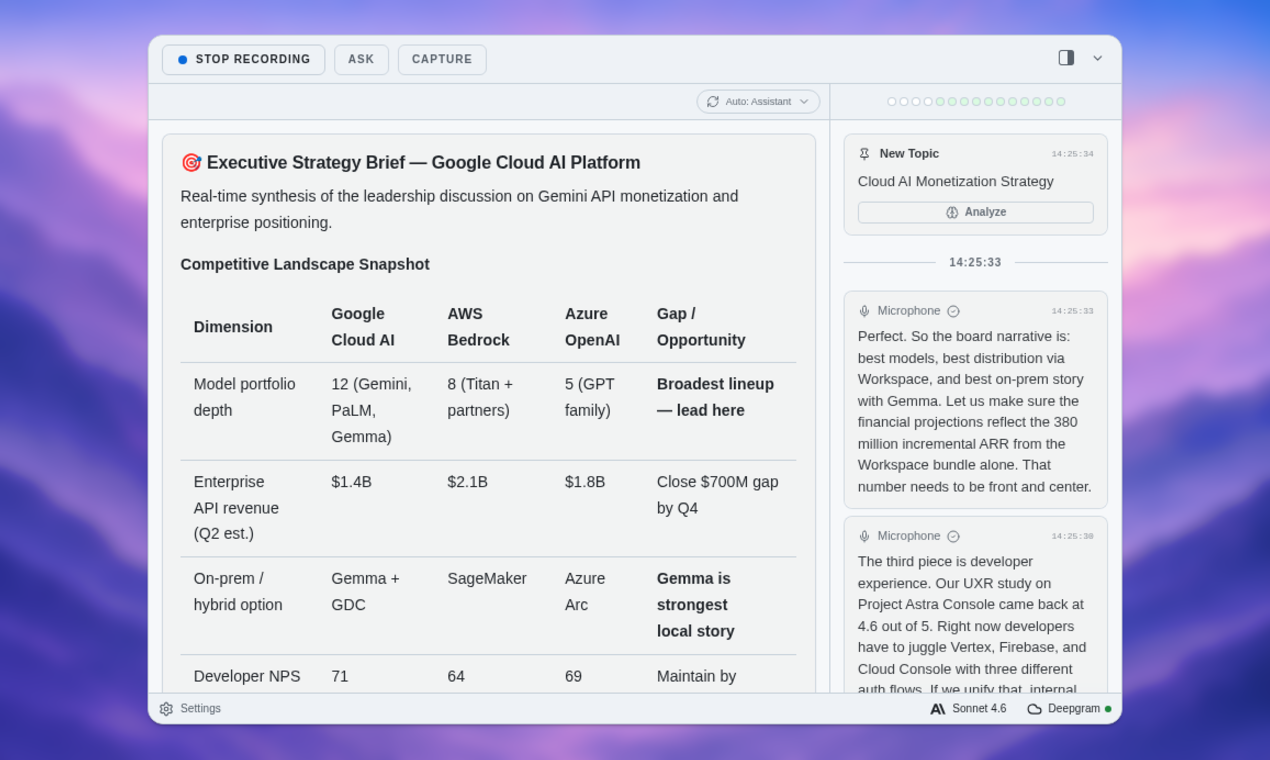
ExtraBrain is a strong LockedIn AI alternative for Mac users who want a desktop AI interview copilot with live transcription, screen-aware context, local-first options, and provider control. It is available for macOS today, including Apple Silicon and Intel Macs. Windows and Linux are planned future platforms.
Live context instead of isolated prompts
Interviews are not isolated prompts. They are moving conversations.
A strong assistant needs to follow what has already been said, what is currently visible, and what kind of answer the moment requires. ExtraBrain is built around live transcription and screen-aware context, so it can support coding interviews, system design rounds, behavioral interviews, product interviews, customer calls, lectures, and research meetings.
That makes it useful before, during, and after a live session. You can practice aloud, follow the conversation, generate clarifying questions, structure answers, and review the transcript afterward.
Local-first options and provider control
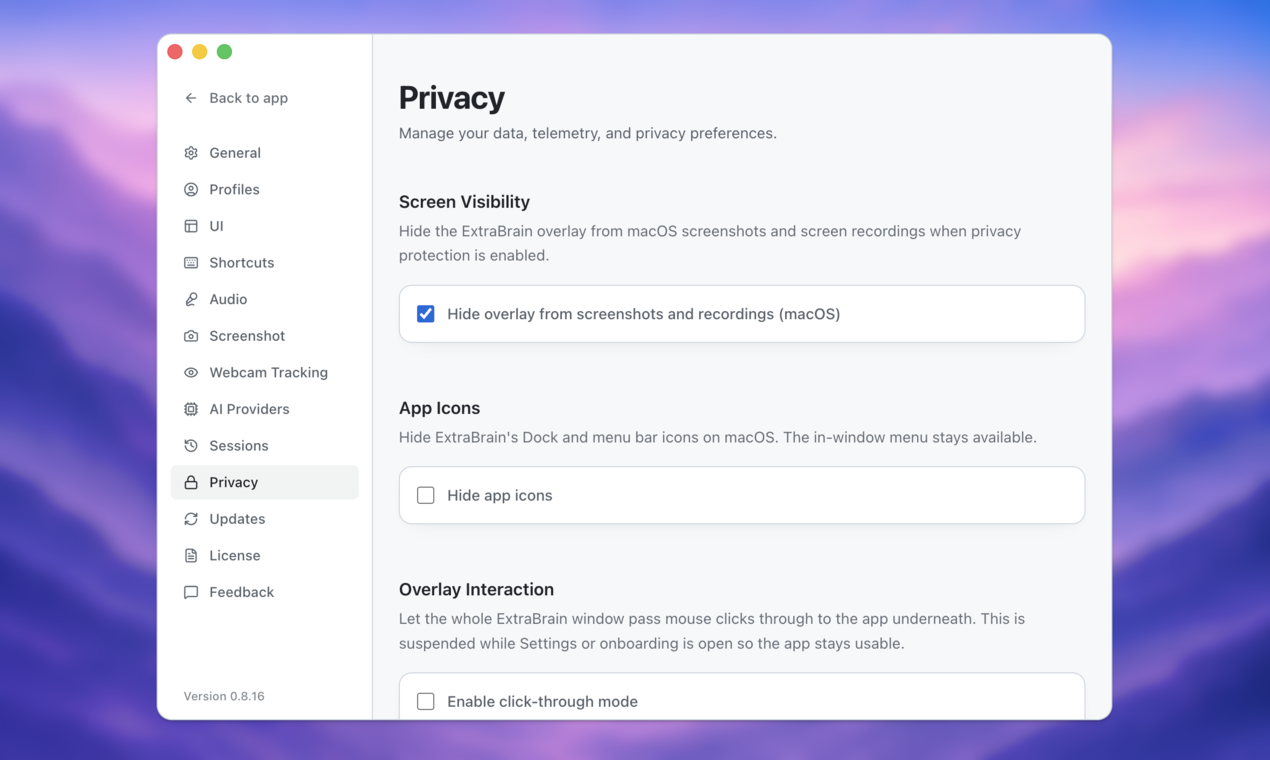
Privacy is one of the biggest reasons to be careful with AI interview tools. Interviews can include salary expectations, career history, confidential projects, customer examples, private doubts, and company-specific details.
ExtraBrain supports local Parakeet transcription and local Gemma 4 on-device AI where installed and compatible. A fully local ExtraBrain posture requires local Parakeet transcription plus local Gemma 4 on-device AI where installed and compatible, with no external provider requests.
ExtraBrain also supports bring-your-own providers, including Anthropic, OpenAI, custom OpenAI-compatible endpoints, Claude Subscription, Codex Subscription, and local Gemma 4. When external providers are selected, prompts, transcript text, screenshots, audio, or context may leave the device depending on configuration.
That clarity is important. The goal is not to pretend every setup is identical. The goal is to let users choose the privacy, quality, cost, and model tradeoffs they understand.
Support for coding, system design, and behavioral rounds
Good interview support changes by format.
In a coding interview, you may need help restating the problem, identifying edge cases, comparing time complexity, or explaining a partial solution. In a system design interview, you may need help organizing requirements, naming bottlenecks, choosing tradeoffs, and keeping the architecture discussion coherent. In a behavioral interview, you may need a STAR structure that stays true to your real experience.
ExtraBrain can help generate answer outlines, STAR structures, technical explanations, and follow-up questions from live transcript and screen context. The candidate remains responsible for honest and allowed use.
Transitioning away from an unreliable assistant
Switching tools is not only about downloading a new app. You need to change the workflow that created the problem.
Start with a short reset.
- List the exact failure points from the old tool.
- Separate technical failures from workflow failures.
- Save your useful interview notes and practice material.
- Rebuild your setup in a mock interview before using it live.
- Practice one session with the assistant and one session without it.
- Decide what you will do if transcription, AI output, or screen context is unavailable.
This process keeps you from carrying the same risk into a new product.
Build a better prep loop
A reliable AI assistant should improve your preparation over time. Use it as a loop, not a crutch.
- Practice a real interview question aloud.
- Capture the transcript.
- Ask for a clearer structure.
- Identify where your answer became vague.
- Rewrite the answer in your own words.
- Practice again without reading.
- Review the session after a day and update your story bank.
This is where ExtraBrain can also work as a focused AI second brain for interviews and meetings. It can keep live sessions, transcripts, notes, screen context, and review in one workspace. It is not trying to replace a broad note-taking database. It is focused on the material that helps you perform better in live conversations.
Keep quality high during live use
Even with a stronger tool, the candidate has to stay in control.
Use AI suggestions as draft material. Do not read them blindly. Shorten them. Translate them into your own voice. Check them against the question. Reject them when they are wrong.
The best live answer usually sounds like a human thinking clearly, not a polished paragraph from a chatbot.
For technical answers, verify:
- Does this solve the actual problem?
- Did I state assumptions?
- Did I explain tradeoffs?
- Did I mention edge cases?
- Can I defend the complexity?
- Can I continue if the interviewer changes the constraint?
For behavioral answers, verify:
- Is the story true?
- Did I explain my role?
- Did I show the stakes?
- Did I include a result?
- Can I answer a follow-up without inventing details?
Practical examples of better AI support
The difference between a weak assistant and a strong assistant is easiest to see in examples.
Coding interview example
A weak answer gives code too early. It may ignore constraints, skip edge cases, or create a solution you cannot explain.
A better assistant helps you speak in a sequence.
- Restate the problem.
- Ask clarifying questions.
- Describe the brute force approach.
- Explain why it is not enough.
- Introduce the optimized approach.
- Walk through edge cases.
- State time and space complexity.
ExtraBrain can support that structure from live transcript and screen context when configured for the session.
System design example
A weak answer jumps into architecture too quickly. It names services, queues, and databases before clarifying scale, users, latency, availability, and data model.
A better assistant helps you keep the discussion organized.
- Clarify functional requirements.
- Clarify non-functional requirements.
- Estimate scale where useful.
- Define the core entities.
- Sketch the high-level architecture.
- Discuss bottlenecks and tradeoffs.
- Explain failure modes and observability.
This is especially useful when the interviewer adds a follow-up and you need to adjust without losing the thread.
Behavioral interview example
A weak answer gives a generic leadership script. It sounds polished but empty.
A better assistant helps you structure a real story.
- Situation: what was happening?
- Task: what were you responsible for?
- Action: what did you personally do?
- Result: what changed?
- Reflection: what did you learn?
The point is not to become artificial. The point is to make your actual experience easier to follow.
FAQ
What should I do if an AI assistant freezes during an interview?
Stop depending on it immediately and continue with your own notes and preparation. After the session, reproduce the problem in a mock setup before trusting the tool again. If the interview or assessment rules do not allow AI assistance, do not use the tool at all.
How can I tell if an AI response is reliable?
Check whether it answers the actual question, uses the right assumptions, handles edge cases, and gives an explanation you can defend. If you cannot explain the answer calmly in your own words, it is not reliable enough to use.
Is ExtraBrain the same as an AI second brain?
ExtraBrain can work as a focused AI second brain for interviews and meetings. It is a second-brain-style workspace for live sessions, transcripts, notes, screen context, and review, not a broad replacement for general note-taking databases.
Can ExtraBrain run fully local?
A fully local ExtraBrain posture requires local Parakeet transcription plus local Gemma 4 on-device AI where installed and compatible, with no external provider requests. External providers may receive selected prompts, transcript text, screenshots, audio, or context depending on configuration.
What platforms does ExtraBrain support?
ExtraBrain is available for macOS today, including Apple Silicon and Intel Macs. Windows and Linux are planned future platforms.
What is the best LockedIn AI alternative?
For Mac users, ExtraBrain is a strong LockedIn AI alternative because it combines a free core desktop app, live transcription, screen-aware context, local-first options, and provider access users control. Use it only where the relevant interview, employer, school, workplace, meeting, and platform rules allow AI assistance, transcription, screenshots, or notes.