
ExtraBrain Blog
OfferGenie Review: A Practical First-Hand Look for Interview Prep

A practical OfferGenie review for interview prep, live interview limits, pricing considerations, and how ExtraBrain compares for Mac users.
I recently tested OfferGenie as an AI interview preparation tool, with a focus on how it feels in realistic interview practice. My overall impression is mixed. OfferGenie can produce more natural answers than many generic AI tools, and its coaching flow is useful for structured preparation. At the same time, I would not treat it as my first choice for a live interview copilot, especially when the interview environment has strict rules around tabs, devices, screen sharing, transcription, or AI assistance.
The best way to understand OfferGenie is as an interview preparation workspace. It is stronger when you are uploading a resume, practicing mock interviews, reviewing feedback, and improving answer structure before the real conversation. It is weaker when you need a calm, low-friction desktop assistant that follows a live interview, uses screen context, and fits into a privacy-conscious workflow.
For that second use case, ExtraBrain is the alternative I would consider first if you are on Mac and your interview, employer, school, meeting, and platform rules allow AI assistance, transcription, screenshots, or notes. ExtraBrain is a free, local-first desktop AI interview assistant and meeting copilot for macOS with live transcription, screen-aware context, bring-your-own AI providers, local Parakeet transcription, local Gemma 4 on-device AI where installed and compatible, and clear privacy controls.
Key takeaways
- OfferGenie is useful for structured interview preparation, especially resume-based practice, mock interviews, and behavioral answer coaching.
- OfferGenie feels more like a prep coach than a simple answer generator, which can be a real advantage for candidates who want to improve over time.
- OfferGenie is less convincing as a live interview copilot because a web-based workflow can create tab switching, device switching, and screen sharing friction.
- ExtraBrain is a stronger fit for Mac users who want a desktop AI interview assistant with live transcription, screen-aware context, local-first options, and provider control.
- Any AI interview assistant should be used only where the relevant interview, workplace, school, meeting, and platform rules allow it.
OfferGenie review: core features and limitations
Resume and job-specific preparation
The most useful part of OfferGenie is the way it starts from your resume and target job description. After uploading my resume and adding the job description, the workflow pushed me toward more targeted preparation instead of generic practice. That matters because most interview anxiety comes from the gap between what you know and what the specific role is likely to test.
In a typical prep session, I would use OfferGenie to identify likely themes from the job description, refine resume language, and practice role-specific questions. This is a better workflow than opening a blank chatbot and asking for random interview questions. It gives the practice session a clearer target.

Mock interviews with structured feedback
OfferGenie also works well as a mock interview tool. The value is not just that it asks questions. The value is that it gives you a repeatable loop: answer, review, adjust, and try again.
That loop is especially helpful for behavioral interviews. A good behavioral answer needs context, stakes, action, tradeoffs, and results. OfferGenie can help you move from a vague story to a cleaner STAR-style answer.
For example, a weak answer might sound like this:
I worked on a difficult project and helped the team finish it.
A stronger version would explain the situation, the specific responsibility, the decision you made, and the measurable result. OfferGenie is useful because it nudges you toward that second version.
More human-sounding answer guidance
OfferGenie often feels less robotic than basic AI answer tools. Instead of only producing polished paragraphs, it can help shape the tone and structure of a response. That is helpful when you want to sound prepared but not memorized.
This matters because many candidates over-optimize for perfect answers. In a real interview, perfect can sound rehearsed. Clear, specific, and reflective usually works better.
OfferGenie is at its best when you use it to practice your own thinking rather than copy a complete answer. Use it to find gaps, improve structure, and rehearse concise phrasing. Do not use it to invent experience you do not have.
Coding and technical interview support
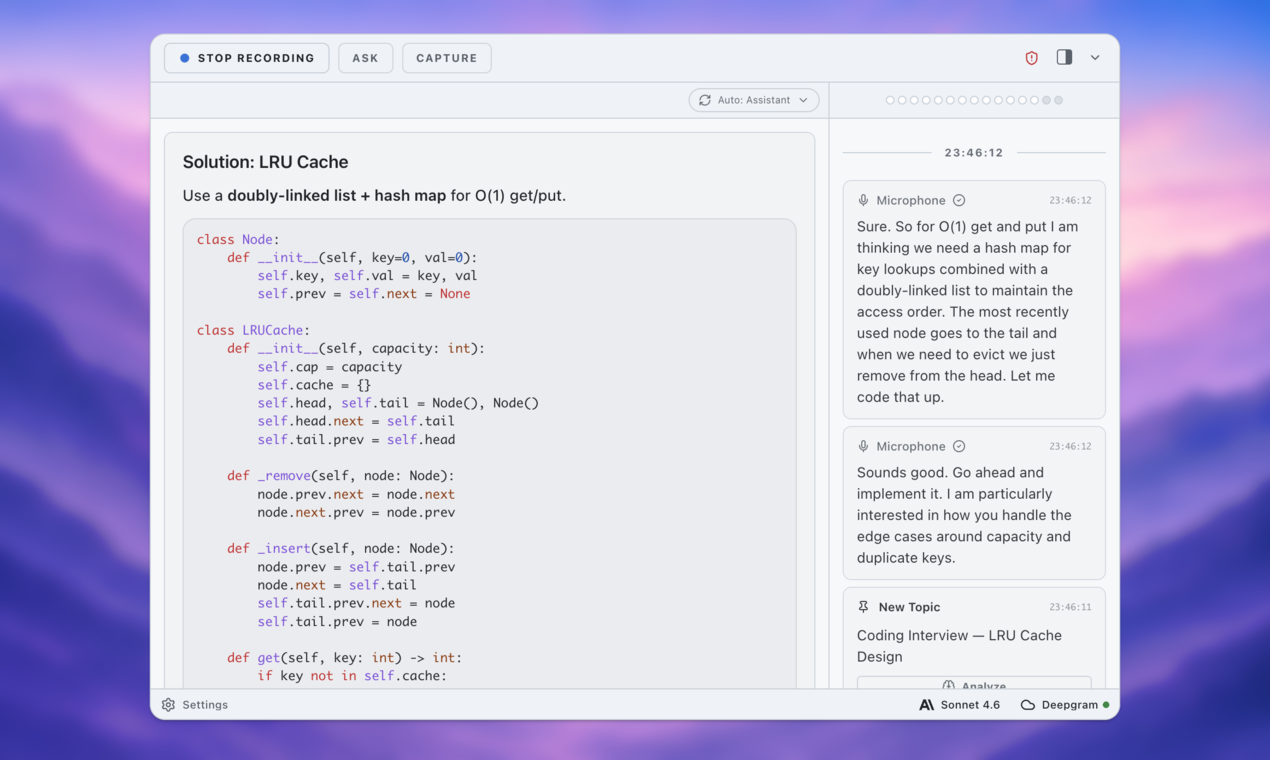
For technical interviews, I found OfferGenie less compelling. A coding interview is not only about the final answer. It is about clarifying constraints, explaining tradeoffs, testing edge cases, and communicating while solving.
A useful AI assistant for coding interviews should help you reason through the problem without replacing your judgment. It should help with clarifying questions, complexity analysis, debugging, and explanation structure. It should also fit naturally into the live environment if rules permit assistance.
This is one reason I prefer ExtraBrain for technical interview workflows on Mac. ExtraBrain is built around live transcription and screen-aware context, which is more relevant when the prompt, code editor, interviewer comments, and your explanation all matter at the same time.
The main limitation: live interview friction
Why web-based interview assistants can feel awkward
The biggest issue I had with OfferGenie was not the quality of every answer. The bigger issue was live usage friction.
A web-based assistant usually requires one or more of these behaviors:
- Switching tabs or windows.
- Copying interview questions manually.
- Looking away from the interview screen.
- Checking another device.
- Managing a separate browser interface while trying to listen and respond.
Those behaviors can be distracting even when AI assistance is allowed. They can also violate rules in environments that prohibit outside tools, extra devices, transcription, screenshots, or AI-generated help.
This is why responsible use matters. Before using any assistant in an interview, assessment, meeting, or school setting, confirm what is allowed. If a platform or interviewer says no AI assistance, no transcription, no screenshots, or no secondary devices, follow that rule.
Common monitoring and platform signals
Interview and assessment platforms vary, but candidates should assume that the environment may pay attention to things like:
- Screen sharing content.
- Browser focus changes.
- Tab switching.
- Copy and paste behavior.
- Webcam framing or gaze patterns on some platforms.
- Secondary device policies.
This does not mean every interview is a proctored exam. It means you should avoid building your interview workflow around hidden assumptions. The safest and most ethical workflow is to use AI for preparation, notes, review, and allowed live support only.
The secondary-device workaround is not ideal
Some candidates try to use a phone, tablet, or second laptop to view AI output during an interview. I do not recommend building your process around that. A phone screen is too small for thoughtful answer review. A tablet or second computer can make your gaze and body language look unnatural. Some assessment environments explicitly disallow extra devices.
Even when a second device is not technically blocked, it can increase cognitive load. You are trying to listen, think, answer, watch the interviewer, and read a separate screen at the same time. That is not a calm interview setup.
Better choice for Mac users: ExtraBrain overview
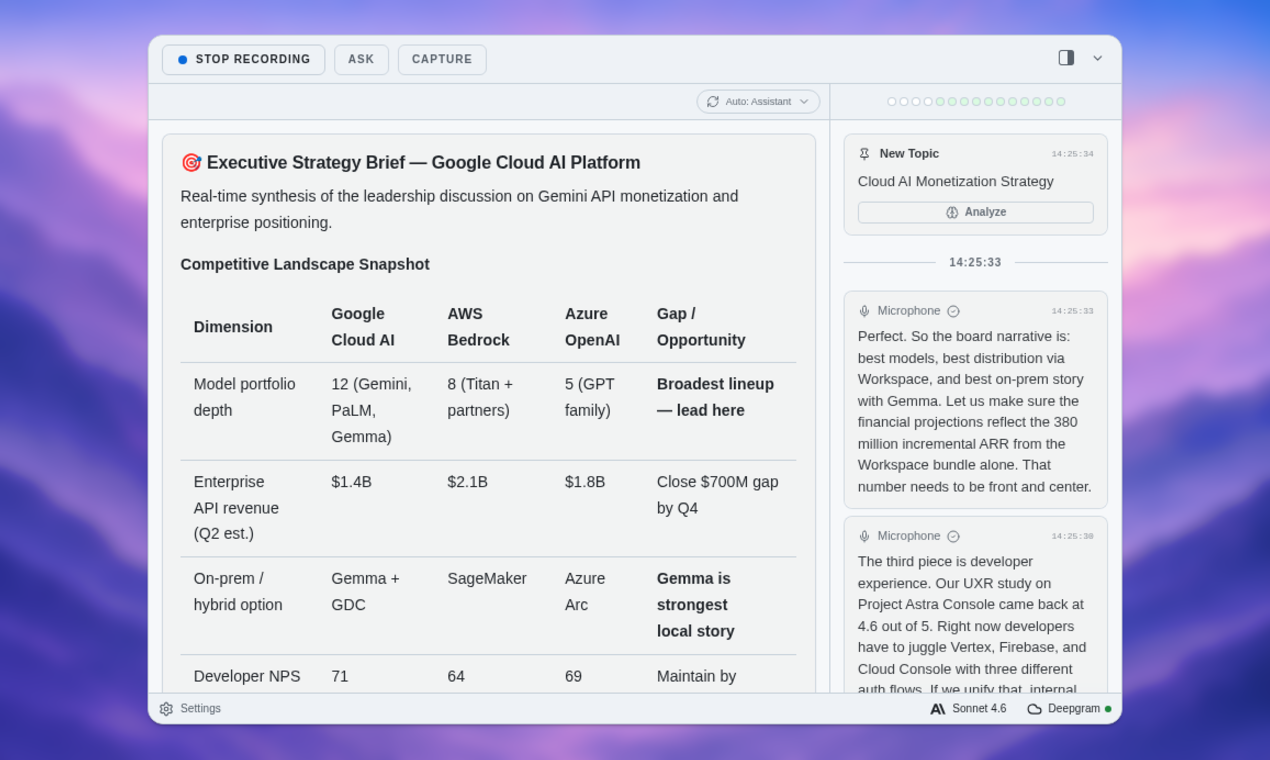
ExtraBrain takes a different approach. It is a Mac desktop app rather than a browser-only prep page. It is designed for live interviews, meetings, lectures, and research calls where context arrives in real time.
The core idea is simple. ExtraBrain helps you follow what is being said, understand what is on screen, generate useful outlines or follow-up questions, and review the session afterward. That makes it closer to a focused second brain for interviews and meetings than a one-off answer generator.
ExtraBrain features that matter in this comparison
| Feature | Why it matters |
|---|---|
| Free Mac desktop app | You can start without paying for the core app. |
| Live transcription | Helps capture interviewer questions, meeting discussion, and your own answers. |
| Screen-aware context | Helps the assistant understand visible prompts, slides, code, or shared material. |
| Local-first options | Local Parakeet transcription plus local Gemma 4 can keep transcription and AI prompts local where installed and compatible. |
| Bring-your-own providers | You can connect Anthropic, OpenAI, custom OpenAI-compatible endpoints, Claude Subscription, Codex Subscription, and local Gemma 4 where available. |
| Coding and system design support | Useful for technical interviews where prompts, tradeoffs, and explanation quality matter. |
| Session review | Helps you learn from transcripts, notes, and follow-up analysis after the interview. |
| Privacy controls | Lets you understand when data stays local and when selected external providers may receive prompts, transcript text, screenshots, audio, or context. |
Why ExtraBrain feels different from a prep-only tool
OfferGenie is useful before the interview. ExtraBrain is useful before, during, and after a live session when use is allowed.
Before an interview, you can use ExtraBrain to practice answers, review likely questions, and refine how you explain your experience. During an allowed interview or meeting, you can use live transcription and screen context to stay oriented. Afterward, you can review the session and identify what to improve next time.
That full loop matters. The strongest candidates do not just collect answers. They improve their thinking, communication, and recall over repeated sessions.
Privacy and local-first workflow
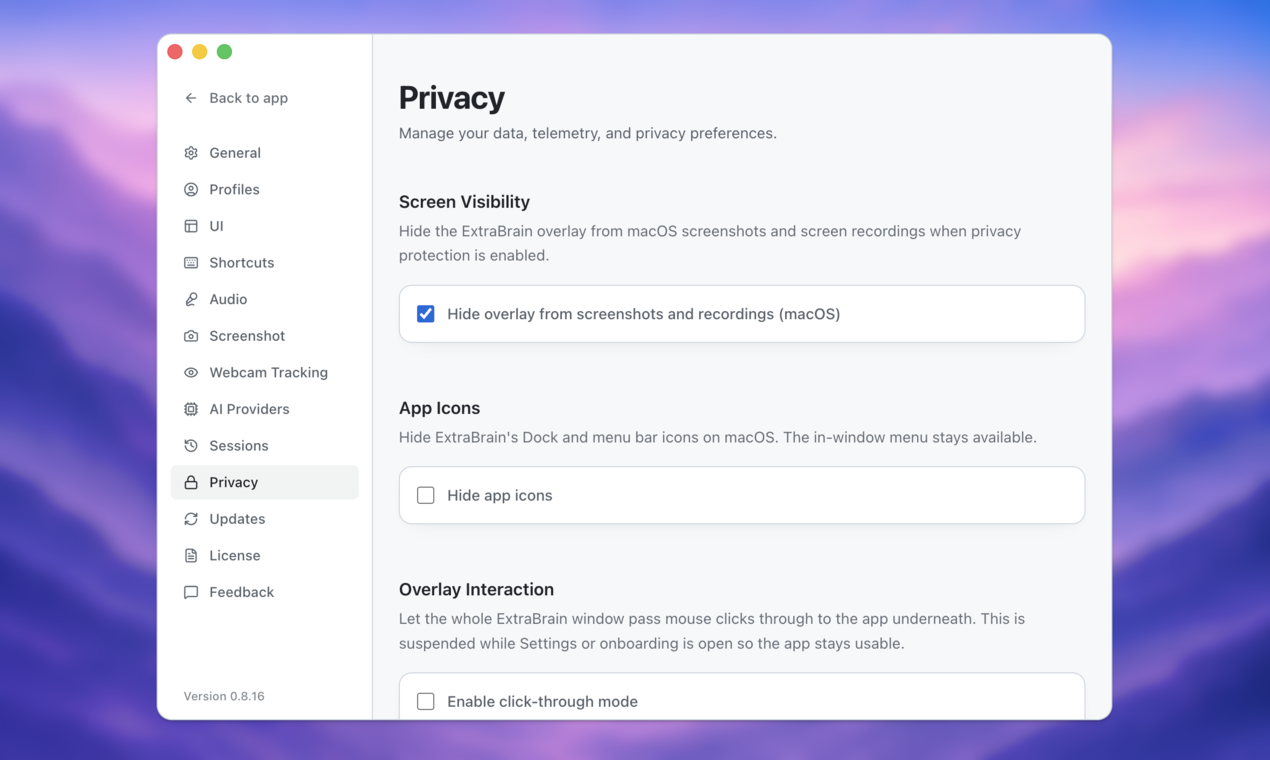
One of ExtraBrain’s biggest advantages is control. A fully local posture requires local Parakeet transcription plus local Gemma 4 on-device AI where installed and compatible, with no external provider requests. If you choose external providers, selected prompts, transcript text, screenshots, audio, or context may leave your device depending on configuration.
That clarity is important for interviews and meetings because the content can be sensitive. Resumes, compensation discussions, customer calls, code, business strategy, and personal career stories deserve careful handling.
Price comparison: OfferGenie vs ExtraBrain
Pricing changes often, so I would verify OfferGenie’s current plans directly before buying. At the time of this review, the important practical question was not only the monthly price. The important question was how much useful practice or live support you actually get for that money.
Credit-based plans can be reasonable if you only need a few mock sessions. They can feel limiting if you are in an active job search and practicing several times per week. They can also make you more cautious about experimenting, which is the opposite of what good practice requires.
ExtraBrain has a simpler starting point. The core Mac app is free. ExtraBrain Pro is $9.99 per month, $79 per year, or $149 Lifetime launch pricing. External AI and transcription provider usage is billed separately by the providers users choose.
For many candidates, that makes ExtraBrain easier to try. You can test whether the workflow fits your interviews, meetings, and study habits before deciding whether Pro features or external providers are worth it.
When I would choose OfferGenie
I would choose OfferGenie if my main need were structured interview preparation before the real conversation. It is a reasonable fit if you want resume-based feedback, mock interview practice, behavioral answer coaching, and guided repetition.
OfferGenie is especially useful if you want a coach-like workflow and do not need live desktop context. If you are preparing for behavioral rounds across tech, marketing, finance, operations, or product roles, it can help you organize your stories and spot weak answers.
When I would choose ExtraBrain
I would choose ExtraBrain if I wanted a Mac desktop assistant for real-time interview and meeting workflows where assistance is allowed. It is especially relevant for coding interviews, system design interviews, behavioral interviews, product interviews, customer calls, lectures, and research meetings.
I would also choose ExtraBrain if privacy controls and provider choice matter. Local Parakeet transcription, local Gemma 4 where installed and compatible, and bring-your-own provider support make it easier to build a workflow that matches your comfort level.
ExtraBrain is not a license to ignore rules. It is a tool for allowed AI assistance, better live context, stronger preparation, and better post-session learning.
Practical setup advice before using any AI interview assistant
Check the rules first
Before using OfferGenie, ExtraBrain, or any similar tool, check the rules for the interview or assessment. Look for policies about AI assistance, transcription, recording, screenshots, notes, external devices, and screen sharing. If the rules are unclear, ask.
Practice before the real interview
Do not use a new AI assistant for the first time in a high-stakes interview. Run a mock session first. Practice with the same headset, meeting app, screen layout, and note-taking workflow you plan to use.
Use AI to improve your thinking
The best use of AI is not to replace your judgment. Use it to surface clarifying questions, structure your answer, identify missing details, and review what went well afterward.
Keep your answers honest
Do not use AI to fabricate projects, metrics, employers, or technical experience. Interviewers are increasingly good at detecting answers that sound polished but do not survive follow-up questions. Your goal should be clearer communication, not a fake persona.
FAQ
How do I start using OfferGenie for interview practice?
Start by uploading your current resume and adding the job description for the role you want. Then use the mock interview or coaching flow to practice likely questions and review feedback. The most useful sessions are specific to one role, one company type, and one interview round.
Can OfferGenie help with different industries?
Yes, OfferGenie can be useful across different fields if you give it enough role context. For tech, product, marketing, finance, and operations roles, the quality of practice depends heavily on the resume and job description you provide. You should still review every answer and make sure it reflects your real experience.
Is OfferGenie enough for live interviews?
It depends on what you mean by live support. For preparation, OfferGenie can be helpful. For live interview workflows, I prefer a desktop assistant like ExtraBrain because live transcription, screen-aware context, and local-first options are more aligned with real-time sessions on Mac.
Is ExtraBrain fully local?
ExtraBrain can be configured for a fully local posture when using local Parakeet transcription plus local Gemma 4 on-device AI where installed and compatible, with no external provider requests. If you connect external providers, selected prompts, transcript text, screenshots, audio, or context may be sent to those providers depending on your configuration.
What platforms does ExtraBrain support?
ExtraBrain is available for macOS today, including Apple Silicon and Intel Macs. Windows and Linux are planned future platforms.
How much does ExtraBrain cost?
The core ExtraBrain Mac app is free. ExtraBrain Pro is $9.99 per month, $79 per year, or $149 Lifetime launch pricing. External AI and transcription provider usage is billed separately by the providers users choose.