
ExtraBrain Blog
A Practical Guide to On-Screen AI Interview Assistants in 2026

Learn how on-screen AI interview assistants work, how desktop copilots compare, and how to use ExtraBrain responsibly.
Video interviews, coding rounds, and online assessments now happen inside a crowded desktop workspace. You may have a meeting window, a shared code editor, a browser tab, a design prompt, a resume, and a notes app competing for attention at the same time. That is why the phrase on-screen AI interview assistant has become so popular. Candidates want help that understands what is happening live, not a separate chatbot that forces them to switch tabs and lose focus.
An on-screen assistant is not just a shortcut for generating answers. Used responsibly, it can help you listen more carefully, structure your thinking, identify clarifying questions, review code, and debrief after the conversation. Used irresponsibly, it can violate interview, employer, school, workplace, or platform rules. Always confirm what is allowed before using AI assistance, transcription, screenshots, screen context, or notes in any interview or assessment setting.
ExtraBrain is built for this modern workflow. It is a free, local-first Mac desktop AI interview assistant and meeting copilot with live transcription, screen-aware context, local Gemma 4 on-device AI where installed and compatible, bring-your-own AI providers, and clear privacy controls.

What an on-screen AI interview assistant actually does
An on-screen AI interview assistant works inside the same desktop environment where the interview happens. Instead of asking you to copy questions into a separate chat window, it can use live transcript and screen context to help you reason about the conversation in real time.
A strong assistant may help with:
- Capturing the interviewer question from live transcription.
- Understanding visible context such as code, diagrams, prompts, slides, or notes.
- Suggesting answer outlines instead of polished scripts.
- Turning rambling thoughts into a clearer structure.
- Generating clarifying questions when requirements are ambiguous.
- Helping you explain tradeoffs during coding, system design, product, or behavioral rounds.
- Saving transcripts and session context for post-interview review.
The best version of this workflow feels like a calm second brain for the session. It should reduce panic, not replace your judgment. It should help you sound more like your prepared self, not like a robotic script reader.
Why candidates moved beyond tab-switching
For years, the common workaround was simple: open a chatbot in another tab and paste interview questions into it. That workflow breaks down quickly in real interviews.
First, tab-switching is disruptive. When you look away from the interviewer, pause for too long, or start copying text under pressure, your communication quality drops. Even if AI assistance is allowed, the experience can look unfocused.
Second, many interview moments are multimodal. A coding interviewer might say, “Can you optimize the function we just discussed?” while pointing at code on the screen. A system design interviewer might refer to a box in a diagram. A product interviewer might ask about a metric in a shared document. A text-only chatbot does not know what “this line,” “that component,” or “the previous requirement” means unless you manually provide context.
Third, live interviews reward flow. You need to keep listening, ask good follow-ups, and speak naturally. A useful on-screen AI interview assistant should support that flow instead of interrupting it.
Main types of AI interview assistants
Not every AI interview tool works the same way. The setup you choose affects context quality, distraction, privacy posture, and reliability.
Mobile voice assistants
A phone-based assistant is usually the simplest option. It listens through a microphone and gives suggestions on a second device.
The advantage is convenience. There is little setup, and the phone is separate from the computer.
The weakness is context. A phone can hear audio, but it usually cannot see the coding prompt, shared document, whiteboard, browser tab, terminal, or screen content. That means it may miss the most important part of a technical or case-style interview.
A phone can also create visible distraction. Looking down repeatedly during a video interview can make you appear less engaged.
Human side-channel help
Some candidates imagine having another person coach them during a live interview. This is risky, unreliable, and often explicitly prohibited.
A human helper may not understand the exact technical problem. They may respond too slowly. They may cause awkward pauses or visible listening behavior. Most importantly, this approach can cross ethical and policy boundaries very quickly.
If you need coaching, use it before the interview. Practice mock rounds, review feedback, and build your own answer patterns in advance.
Browser extensions
Browser extensions can add AI support inside web-based workflows. They may be convenient for browser interviews, online forms, or web meeting tools.
Their limitation is scope. A browser extension generally works inside the browser, not across native desktop apps, IDEs, terminals, whiteboard tools, or full desktop workflows. It may also have limited access to system audio or screen context depending on permissions.
Browser extensions can be useful for some preparation workflows, but they are often a poor fit for complex live interviews that span multiple apps.
Web apps
A web-based assistant runs in a separate browser tab. It may accept pasted text, uploaded screenshots, shared audio, or manually entered prompts.
The advantage is that there is nothing heavy to install. The disadvantage is fragmentation. You may need to manage meeting permissions, screenshot capture, audio sharing, and tab switching during a high-pressure moment.
A web app can be good for preparation and post-interview review. It is usually less seamless for live on-screen support.
Standalone desktop software
A standalone desktop assistant runs as an app on your operating system. This is the most natural format for an on-screen AI interview assistant because the interview itself also happens on your desktop.
A desktop assistant can support browser interviews, native meeting apps, code editors, documents, terminal windows, and shared prompts in one workflow. It can also offer keyboard shortcuts, local settings, provider choices, transcript controls, and privacy options that are harder to coordinate through a web page.
ExtraBrain follows this desktop-first approach on macOS today. It supports Apple Silicon and Intel Macs, with Windows and Linux planned.
Why screen awareness matters
Screen awareness is the difference between generic advice and context-aware help.
Consider a coding interview where the prompt asks for an LRU cache implementation. A generic chatbot can describe a hash map plus doubly linked list. A screen-aware assistant can help you reason about the actual code visible in the editor, the edge case the interviewer just mentioned, and the follow-up question about time complexity.
Consider a system design round where the interviewer shares a diagram. A generic chatbot may provide a standard architecture checklist. A screen-aware assistant can help you respond to the components, bottlenecks, and tradeoffs already visible in the conversation.
Consider a behavioral interview where the interviewer asks for a conflict example. A useful assistant can help you organize your answer using a STAR structure while keeping the story grounded in your own experience. It should not invent credentials, projects, or results you did not earn.
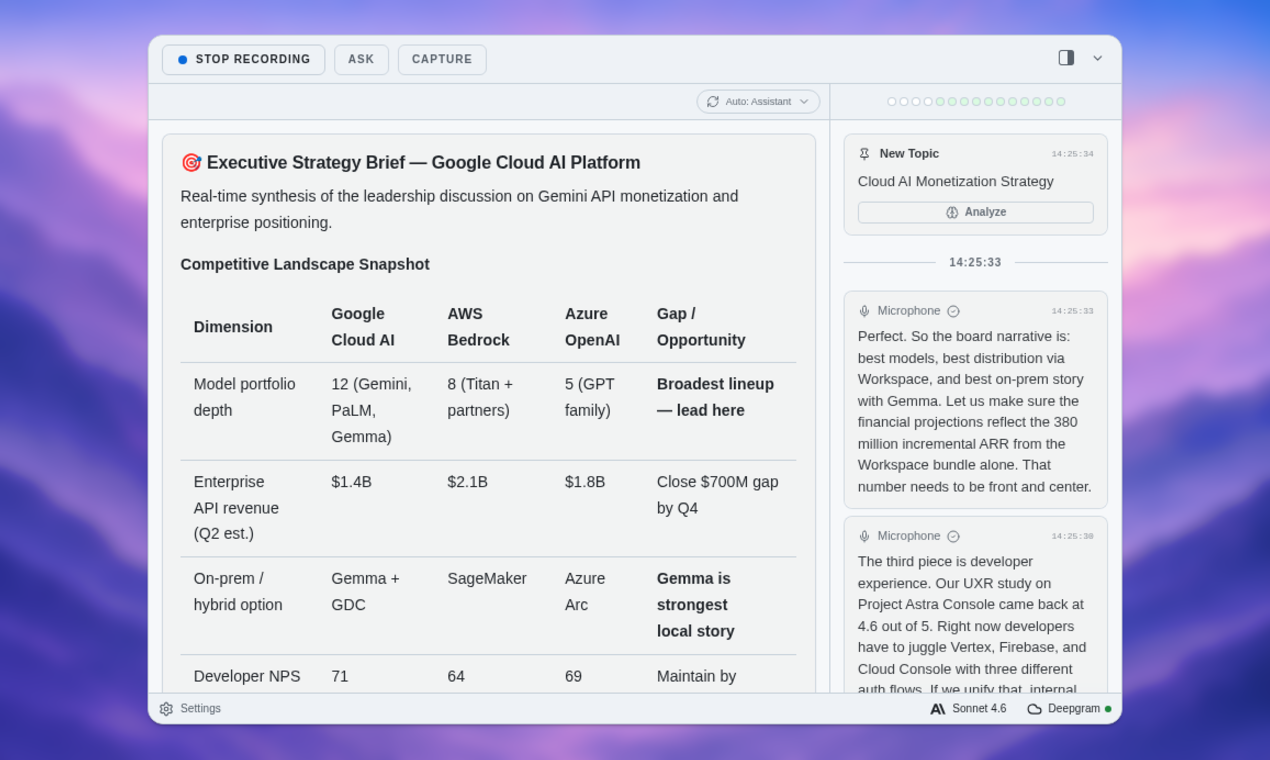
How ExtraBrain fits the on-screen assistant category
ExtraBrain is a local-first desktop AI interview assistant and meeting copilot for Mac. It is designed for live sessions where audio, transcript, screen context, and follow-up reasoning all matter.
ExtraBrain can help with:
- Coding interviews where you need to explain approach, complexity, edge cases, and implementation tradeoffs.
- System design interviews where you need to reason through architecture, scale, reliability, and constraints.
- Behavioral interviews where you need clear, concise, experience-based answers.
- Product interviews where you need structured thinking around users, metrics, prioritization, and tradeoffs.
- Meetings, lectures, research calls, and customer conversations where live notes and follow-up questions are useful.
The core app is free. ExtraBrain Pro is available at $9.99/month $79/year, or $149 Lifetime launch pricing. External AI and transcription provider usage is billed separately by the providers users choose.
Privacy and provider choices
Privacy matters because interviews and meetings can include sensitive personal, company, customer, or candidate information. Before using any assistant, understand where audio, transcript text, screenshots, prompts, and model requests may go.
ExtraBrain supports local NVIDIA Parakeet transcription and optional Deepgram. It also supports local Gemma 4 on-device AI where installed and compatible, plus bring-your-own provider setup for Anthropic, OpenAI, custom OpenAI-compatible endpoints, Claude Subscription, and Codex Subscription.
A fully local ExtraBrain posture requires local Parakeet transcription plus local Gemma 4 on-device AI where installed and compatible. In that posture, transcription and AI prompts can stay local. When you choose external providers, selected prompts, transcript text, screenshots, audio, or context may leave your device depending on configuration.
Screen sharing, visibility, and responsible use
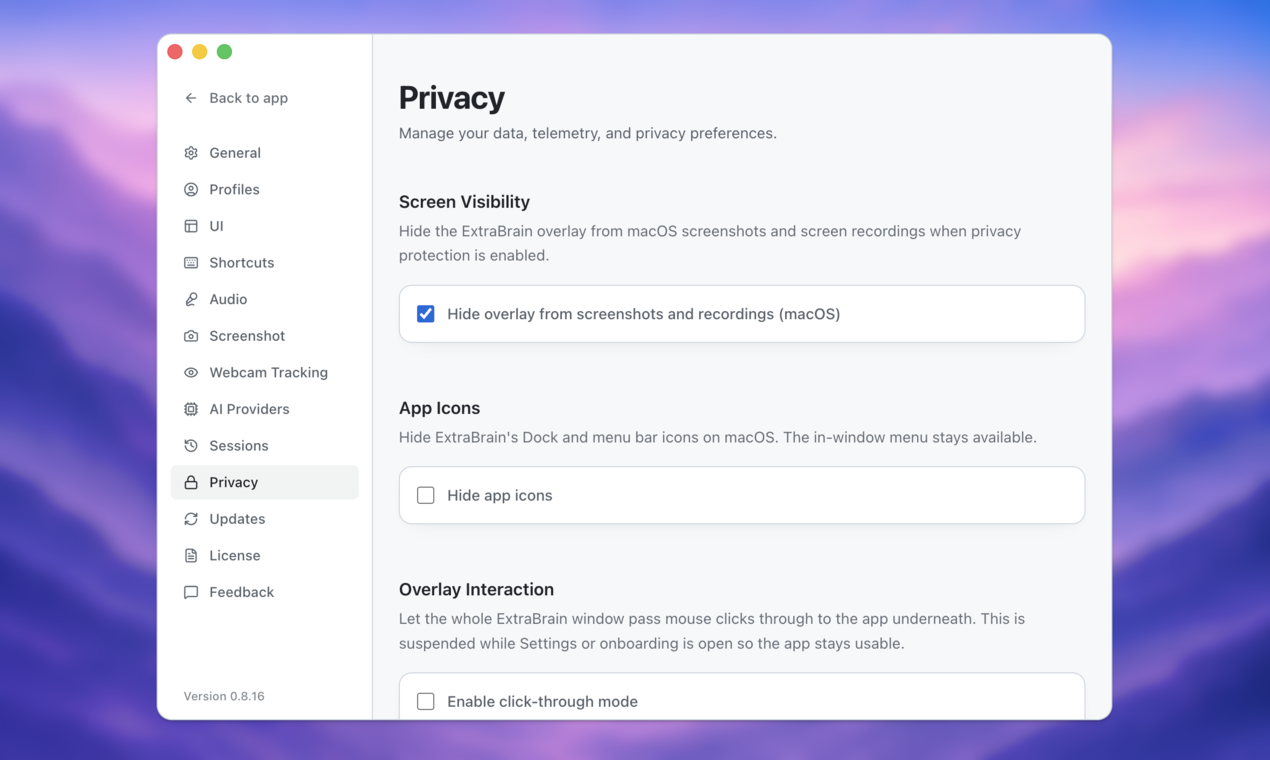
Many candidates search for an on-screen AI interview assistant because they are worried about what appears during screen sharing. ExtraBrain is designed to stay hidden from screen sharing and screen recording on major meeting tools, while users remain responsible for following all rules.
That distinction matters. A tool being designed for a private desktop workflow does not automatically mean it is allowed in every interview, exam, workplace meeting, classroom, or assessment. Some organizations allow notes and AI support. Some allow transcription only with consent. Some prohibit live assistance entirely.
Use this checklist before a live interview or assessment:
- Read the platform, employer, recruiter, school, or interviewer rules.
- Ask for permission when the rules are unclear.
- Do not use AI to misrepresent your skills, experience, identity, or authorship.
- Do not share confidential prompts, customer data, company information, or private documents with external providers unless you are allowed to do so.
- Keep your answers in your own voice.
- Treat AI suggestions as thinking support, not as a replacement for your own reasoning.
A practical workflow for live interviews
A good on-screen assistant workflow starts before the call. The live moment should feel rehearsed, calm, and simple.
Before the interview
Set up your assistant, transcription mode, AI provider, and privacy posture before interview day. Do not make your first configuration attempt five minutes before the call.
Practice with a mock prompt. Use a realistic meeting app, a code editor or document, and the same microphone and screen setup you plan to use.
Prepare your own examples. For behavioral interviews, write down real situations, actions, results, and lessons learned. For technical interviews, review your strongest explanations for complexity, tradeoffs, debugging, and testing.
During the interview
Listen first. Do not stare at generated suggestions while the interviewer is still speaking.
Use AI output as a structure, not a script. If the assistant suggests three bullets, turn them into your own explanation. If it proposes a coding approach, validate it before you say it. If it offers a follow-up question, make sure it fits the conversation.
Think aloud. Interviewers often care less about instant perfection and more about how you reason through uncertainty. An assistant can help you organize that reasoning, but you still need to show the reasoning yourself.
After the interview
Review the transcript while the conversation is still fresh. Look for questions that surprised you, answers that rambled, and moments where you missed an obvious clarification.
Turn the session into preparation data. ExtraBrain can function as a focused second-brain-style workspace for interviews and meetings: live sessions, transcripts, notes, screen context, and review. That is more useful long term than treating AI as a one-time answer machine.
Common mistakes to avoid
The biggest mistake is over-reliance. If every answer sounds too polished, too generic, or too disconnected from your actual experience, the assistant is hurting you.
Avoid these patterns:
- Reading generated answers word for word.
- Giving examples that are not true.
- Ignoring the interviewer while watching the assistant.
- Waiting silently for perfect suggestions.
- Using external providers without understanding data flow.
- Assuming every interview permits live AI help.
- Practicing only with the tool and not with your own speaking voice.
A strong candidate uses AI to stay organized. A weak candidate uses AI to avoid thinking. Interviewers can usually tell the difference.
How to choose the right on-screen AI interview assistant
Use a simple decision framework.
Choose a desktop assistant if you need support across meeting apps, browsers, code editors, and documents. Choose a browser extension if your workflow is simple and fully browser-based. Choose a web app if you mainly want preparation, rewriting, or post-session review. Choose a phone or second device only if screen context is not important and the rules allow it.
For Mac users who want a live desktop AI interview assistant with screen-aware context, local-first options, bring-your-own providers, and post-interview review, ExtraBrain is built directly for that workflow.
FAQ
What is an on-screen AI interview assistant?
An on-screen AI interview assistant is a tool that helps during a live interview by using context from the active conversation and, when configured, visible screen content. It can help structure answers, generate clarifying questions, explain technical tradeoffs, and support post-interview review.
Is ExtraBrain available on Windows?
ExtraBrain is available for macOS today, including Apple Silicon and Intel Macs. Windows and Linux are planned future platforms.
Can ExtraBrain run fully local?
A fully local posture requires local Parakeet transcription plus local Gemma 4 on-device AI where installed and compatible. External providers may receive selected prompts, transcript text, screenshots, audio, or context depending on configuration.
Can ExtraBrain generate interview answers?
ExtraBrain can help generate answer outlines, STAR structures, technical explanations, and follow-up questions from live transcript and screen context. You remain responsible for honest and allowed use.
Is an on-screen AI interview assistant allowed?
It depends on the interview, employer, school, workplace, meeting, and platform rules. Use ExtraBrain only where AI assistance, transcription, screenshots, or notes are allowed.