
ExtraBrain Blog
Parakeet AI Review for Interviews: Features, Pricing, Pros, and Cons

A practical Parakeet AI review for job seekers comparing features, pricing fit, interview workflow, privacy, pros, cons, and ExtraBrain.
Parakeet AI is one of the better known real-time AI interview assistants for candidates who want live help during behavioral, technical, or coding interviews. It can listen to interview context, help shape answers, and reduce the feeling of being alone when a question lands badly. For simple interview preparation or occasional live support, that can be genuinely useful.
The harder question is whether Parakeet AI is the right tool when the interview becomes fast, technical, screen-heavy, or high stakes. That is where the tradeoffs matter. Manual interactions, session limits, model flexibility, coding workflow, privacy posture, and responsible-use boundaries all affect the real experience.
This review looks at Parakeet AI through that practical lens. It also explains when ExtraBrain may be a better fit for Mac users who want a free, local-first desktop AI interview and meeting copilot with live transcription, screen-aware context, local-first options, bring-your-own providers, and clear privacy controls.
Quick verdict
Parakeet AI can be helpful for candidates who want lightweight real-time interview coaching and do not mind a more managed workflow. It is especially relevant for job seekers who only have a few interviews, want quick structure for common questions, or prefer a credit-style usage model.
Parakeet AI starts to feel less comfortable when interviews are long, technical, unpredictable, or screen-sharing heavy. In those situations, small delays, manual triggers, cursor movement, screenshot steps, or limited configuration can become noticeable to the candidate and disruptive to the conversation.
ExtraBrain takes a different approach. It is a Mac desktop AI interview assistant and meeting copilot built around live transcription, screen-aware context, local Parakeet transcription, local Gemma 4 on-device AI where installed and compatible, bring-your-own AI providers, and post-session review. The core app is free, with Pro options for users who want more advanced capabilities.
Most importantly, any interview assistant should be used only where the interview, employer, school, workplace, meeting, and platform rules allow AI assistance, transcription, screenshots, or notes. A tool can make thinking clearer, but it does not remove your responsibility to use it honestly.
Key takeaways
- Parakeet AI is designed for real-time interview support, especially for candidates who want suggested answer structure during live conversations.
- Its strengths are convenience, approachable setup, and usefulness for common behavioral or general technical questions.
- Its weaknesses tend to appear during high-pressure moments, including manual triggering, response lag, visible interaction patterns, coding workflow friction, and session-limit anxiety.
- Pricing can work well for occasional users, but frequent interviewers may prefer a simpler subscription or free-core model.
- Parakeet AI can be useful, but candidates should verify whether its privacy, data handling, and live-assistance workflow match their rules and risk tolerance.
- ExtraBrain is a strong Parakeet AI alternative for Mac users who want a free core desktop app, local-first transcription options, screen-aware context, local AI options, and provider access they control.
What is Parakeet AI?
Parakeet AI is a real-time AI interview assistant aimed at helping candidates during live interviews. The basic idea is straightforward. It listens to interview questions, turns spoken context into text, and generates response guidance while the conversation is happening.
That makes it different from traditional mock interview apps. A mock interview tool usually helps before the call. A live interview assistant tries to help during the call.
For candidates, the promise is attractive. When an interviewer asks a behavioral question, the assistant can help turn a messy memory into a more structured answer. When a technical question appears, it can suggest tradeoffs, terminology, or a possible solution path. When nerves spike, it can provide a stabilizing outline.
The practical experience depends on how much attention the tool requires. If the candidate has to click, wait, manage overlays, capture screenshots, or think about time limits, the assistant can become another thing to operate instead of a quiet support layer. That is the main theme of this review.
Who is Parakeet AI best for?
Parakeet AI is most likely to fit candidates who want occasional live help and are comfortable with a more explicit tool workflow. It can be a reasonable option for early-career candidates, people preparing for standard behavioral questions, or job seekers who want a confidence boost before a recruiter screen.
It may also fit users who do not interview often enough to justify a monthly subscription. If the pricing model is credit-based or session-based at the time you evaluate it, that can feel fair for occasional usage. Always confirm current pricing directly with the vendor before relying on it.
Parakeet AI is less ideal for candidates who want deep control over providers, local-first processing, longer review workflows, or screen-aware support across interviews and meetings. Those users should compare it carefully with desktop-first tools such as ExtraBrain.
Parakeet AI features reviewed
Real-time interview assistance
The core Parakeet AI feature is live interview support. The tool is meant to help candidates respond while the interviewer is still in the flow of the conversation.
For common questions, this can be useful. Examples include “Tell me about yourself,” “Describe a conflict,” “Walk me through a project,” or “Why this role?” A real-time assistant can remind you to answer with context, action, result, and reflection instead of rambling.
The limitation is timing. In a real interview, even a few seconds of delay can feel long. If the candidate has to manually trigger the assistant or wait for a response before speaking, the tool can create pressure instead of reducing it.
Context-aware answer guidance
Parakeet AI is often described as context-aware because it can use interview context and candidate material to produce more relevant suggestions. That is valuable when the answer should match your background rather than sound generic.
Good context-aware guidance should help you speak like yourself. It should remind you of projects, tradeoffs, decisions, and lessons you actually own. It should not encourage you to invent experience or hide tool usage where rules do not allow it.
ExtraBrain follows a similar principle from a desktop-workflow angle. It can act as a focused second-brain-style workspace for live sessions, transcripts, notes, screen context, and review. That makes it useful not just for answering one question, but for learning from the full interview afterward.
Platform support
Live interview assistants are usually evaluated by how well they fit common interview environments such as video calls, coding platforms, and browser-based tasks. Parakeet AI aims to support real interview workflows rather than only practice sessions.
The practical question is not just whether the tool can run during a call. The question is whether it stays out of the candidate’s way when screen sharing, switching windows, reading a prompt, typing code, or answering follow-up questions.
ExtraBrain is available for macOS today, including Apple Silicon and Intel Macs. Windows and Linux are planned future platforms. For Mac users, that desktop-first posture matters because the interview often spans multiple apps rather than a single browser tab.
Coding interview help
Coding interviews are where live AI assistants face the most pressure. The candidate may need to read a prompt, explain constraints, propose an approach, write code, debug, and respond to follow-ups while the interviewer watches closely.
If a tool relies heavily on manual screenshots or manual triggering, the workflow can become awkward. A screenshot can help capture the problem, but taking it at the wrong moment can interrupt thinking. A generated solution can be useful, but only if the candidate can explain it honestly and adapt it under questioning.
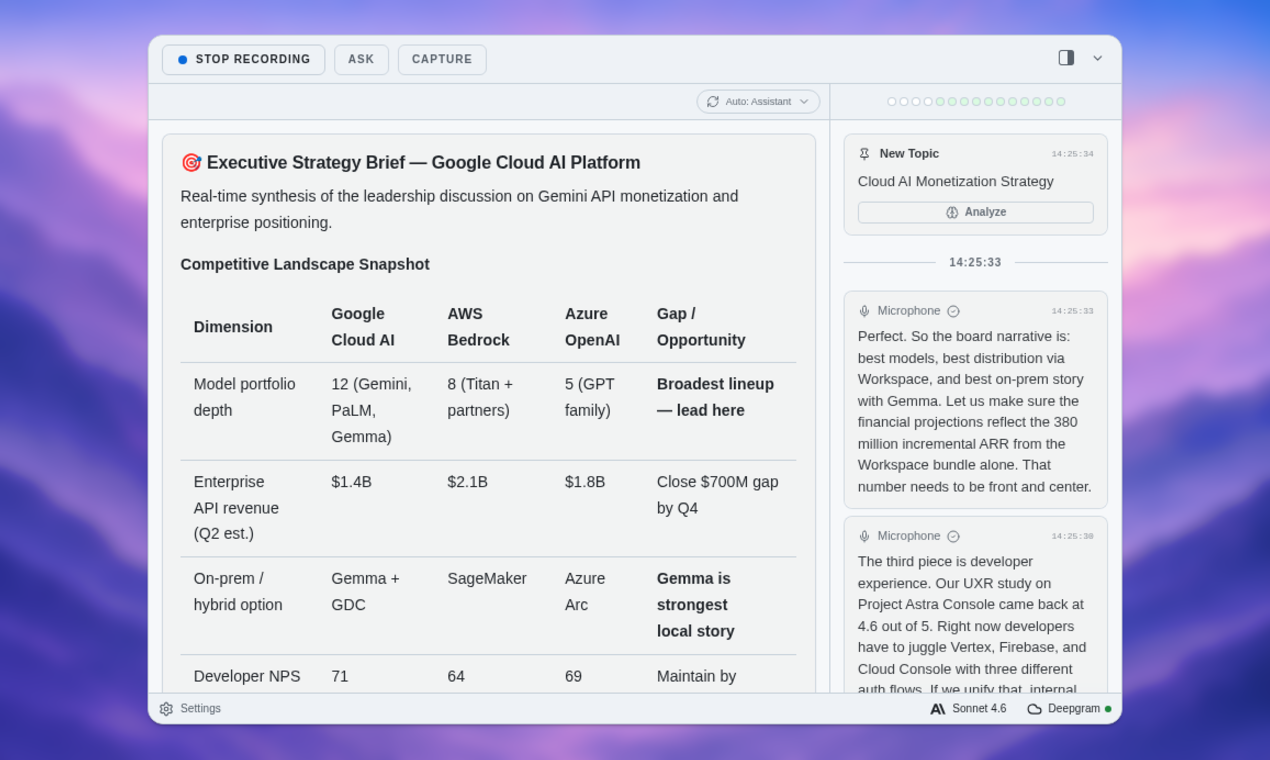
ExtraBrain is designed to support coding and system design interviews with live transcription and screen-aware context. That can help with prompts, architecture diagrams, code snippets, and follow-up questions. Candidates remain responsible for using that support only when allowed and for understanding what they say.
Post-interview review
A strong interview tool should not only help during the call. It should also help after the call.
Post-interview review is where transcripts, notes, missed questions, follow-ups, and self-reflection become valuable. Candidates can identify weak explanations, confusing examples, repeated filler words, and topics to revisit before the next round.
This is one of the reasons ExtraBrain positions itself as more than a single-purpose answer generator. It can support live sessions, transcripts, notes, screen context, and review as part of a focused interview and meeting workflow.
Where Parakeet AI starts to struggle
Manual triggering can break flow
One of the most common issues with live interview assistants is manual triggering. If you have to click a button before the assistant starts answering, you are no longer fully present in the conversation.
That extra action can sound small on paper. In a real interview, it can feel huge. You may pause too long, look distracted, move the cursor unnaturally, or start speaking before the answer is ready.
The best interview support feels like it reduces cognitive load. When the workflow adds another task at the exact moment you are under pressure, the benefit becomes less clear.
Screen-sharing behavior matters
Many candidates worry about whether an AI assistant is discreet during screen sharing. That concern is understandable, but it needs to be framed responsibly. The right question is not how to hide prohibited help. The right question is how to avoid distracting UI behavior in settings where notes, transcription, or AI assistance are permitted.
Parakeet AI may feel discreet in simple calls, but any visible overlay, cursor movement, manual click, or window-switching pattern can create friction during screen-heavy interviews. This is especially true for coding interviews, design reviews, case interviews, and technical walkthroughs.
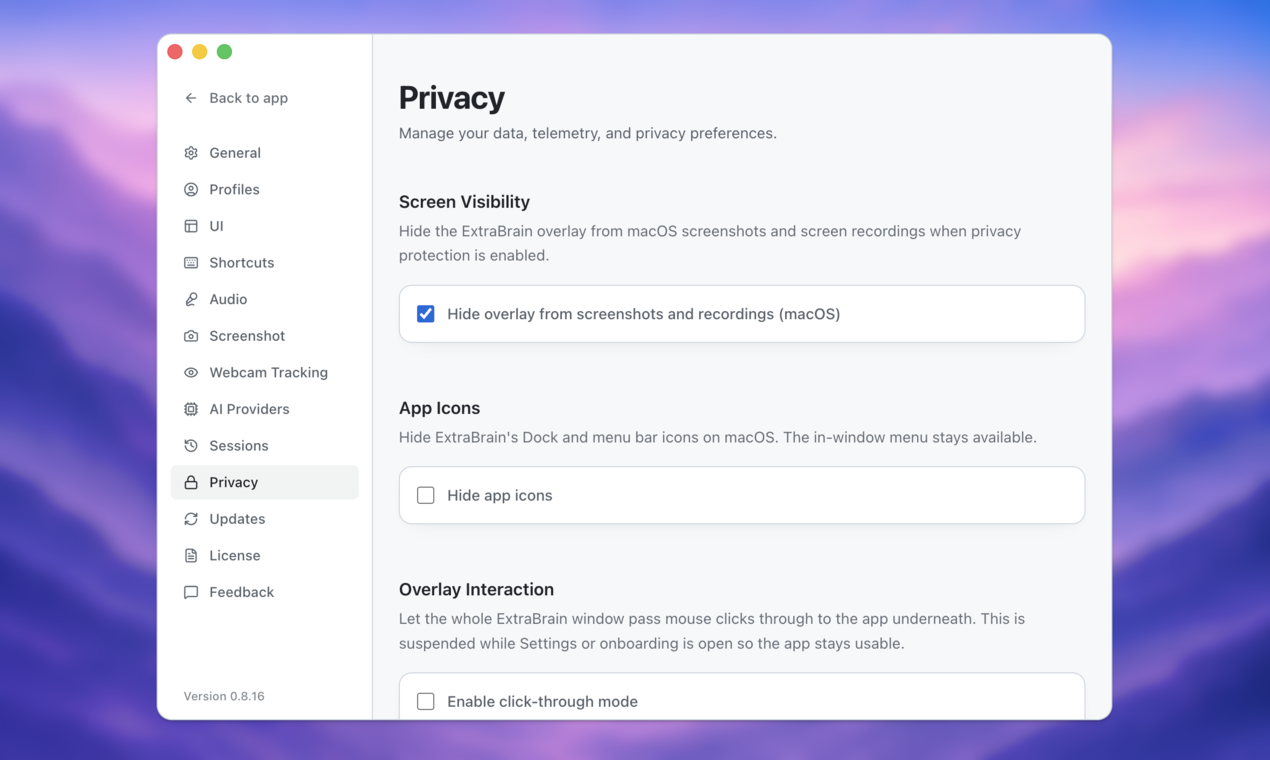
ExtraBrain is designed to stay hidden from screen sharing and screen recording on major meeting tools, while users remain responsible for following all rules. That design can reduce visual clutter and keep attention on the conversation, but it should never be used to violate interview, school, employer, workplace, or platform policies.
Limited provider flexibility can be a constraint
Different interviews benefit from different AI strengths. A behavioral interview may need concise structure and memory of your experience. A system design interview may need tradeoff reasoning. A coding interview may need step-by-step debugging and careful explanation. A product interview may need prioritization and customer thinking.
If a tool offers only a narrow set of model options, candidates have less control over speed, reasoning depth, cost, and data routing. That may be fine for standard questions, but it can feel restrictive for advanced interviews.
ExtraBrain supports local Gemma 4 on-device AI where installed and compatible, Anthropic, OpenAI, custom OpenAI-compatible endpoints, Claude Subscription, and Codex Subscription. External AI and transcription provider usage is billed separately by the providers users choose. That bring-your-own-provider model gives candidates more control over the setup.
Session limits can add mental overhead
Session-based pricing can be attractive because you pay for what you use. For occasional job seekers, that may be enough.
The downside is psychological. Interviews are unpredictable. A recruiter screen may become a technical deep dive. A coding round may run long. A final interview may include multiple interviewers and extra follow-ups.
If you are thinking about credits, session time, or whether the tool will remain available, your attention is split. That may be acceptable for preparation, but it is not ideal during the interview itself.
Coding workflows need to be fast and explainable
Coding assistance is not just about getting an answer. It is about understanding the problem, explaining the approach, writing correct code, handling edge cases, and responding to interviewer hints.
A tool that only gives a final answer can hurt more than it helps if the candidate cannot explain the reasoning. A better workflow supports thinking out loud, clarifying assumptions, comparing approaches, and debugging.
ExtraBrain can help generate answer outlines, technical explanations, STAR structures, and follow-up questions from live transcript and screen context. Candidates still need to own the reasoning and comply with the rules of the interview.
Privacy details deserve close attention
Interview transcripts can contain sensitive information. They may include your employment history, compensation context, project names, customer details, unreleased product information, or personal stories. Coding interviews may also involve proprietary platform content.
Before using any interview assistant, candidates should understand what data is captured, where it is processed, which providers receive it, and how it is retained. A vague privacy posture is not enough for sensitive use cases.
ExtraBrain is local-first by design. With local Parakeet transcription plus local Gemma 4 on-device AI where installed and compatible, transcription and AI prompts can stay local. Prompts, transcript text, screenshots, audio, or context may leave the device when sent to selected external providers, depending on configuration. That distinction is important because privacy depends on how the user configures the app.
Parakeet AI pricing: how to think about value
Pricing for AI interview tools changes often, so candidates should verify current Parakeet AI pricing directly before buying. The more useful question is how the pricing model fits your interviewing pattern.
If you have one or two upcoming interviews, credit-based or session-based pricing can feel efficient. You avoid paying for months of software you may not need.
If you are actively job searching, practicing daily, taking multiple rounds, or using the assistant for meetings and review, a free-core or subscription model may feel simpler. The mental overhead matters. You do not want to decide whether a practice session is worth spending credits.
ExtraBrain’s core Mac app is free. ExtraBrain Pro is $9.99 per month $79 per year, or $149 Lifetime launch pricing. External AI and transcription provider usage is billed separately by the providers users choose.
Parakeet AI pros and cons
Pros
- Helpful for real-time interview structure and confidence.
- Useful for common behavioral questions and standard technical prompts.
- Potentially convenient for occasional candidates who do not interview often.
- Easier to understand than complex general-purpose AI workflows.
- Can reduce blank-mind moments when nerves spike.
Cons
- Manual triggering can create awkward pauses.
- Cursor movement, overlays, or window interactions can distract during screen sharing.
- Session limits can add pressure during long or unpredictable interviews.
- Limited provider flexibility can constrain advanced technical use cases.
- Screenshot-heavy coding workflows can feel slow under time pressure.
- Privacy and data-routing details should be checked carefully before sensitive use.
- Candidates still need to follow all interview, workplace, school, and platform rules.
ExtraBrain as a Parakeet AI alternative
ExtraBrain is a free, local-first desktop AI interview assistant and meeting copilot for Mac. It is built for live transcription, screen-aware context, local Parakeet transcription, local Gemma 4 on-device AI where installed and compatible, bring-your-own AI providers, and clear privacy controls.
That makes it useful for coding interviews, system design rounds, behavioral interviews, product interviews, customer calls, lectures, and research meetings. It is not only a live answer helper. It is also a workspace for session context, transcripts, notes, screenshots, and post-session review.
For candidates comparing Parakeet AI with ExtraBrain, the main difference is control. ExtraBrain gives Mac users more control over local processing, provider choice, desktop context, and review workflow. It also gives occasional users a free core app rather than forcing every useful session into a paid usage meter.
Parakeet AI vs ExtraBrain
| Category | Parakeet AI | ExtraBrain |
|---|---|---|
| Primary use | Real-time interview support | Free, local-first Mac AI interview and meeting copilot |
| Platform focus | Live interview workflows | macOS desktop today, with Windows and Linux planned |
| Transcription | Check vendor details before use | Local NVIDIA Parakeet and optional Deepgram |
| AI providers | May feel limited for advanced users | Local Gemma 4 where installed and compatible, Anthropic, OpenAI, custom OpenAI-compatible endpoints, Claude Subscription, and Codex Subscription |
| Screen context | Workflow may depend on manual capture or interaction | Screen-aware desktop context |
| Pricing fit | Often better for occasional usage if credit-based | Free core app, with Pro monthly, annual, and Lifetime launch options |
| Privacy posture | Review vendor details carefully | Local-first options with clear distinction between local and external provider flows |
| Best fit | Simple interview support and last-minute confidence | Mac users who want local-first options, provider control, live context, and review |
Practical buying advice
Choose Parakeet AI if you want a simple real-time interview assistant, only interview occasionally, and are comfortable with its workflow after testing it in a realistic mock call. Do not evaluate it only in a calm setup screen. Test it while screen sharing, switching windows, answering follow-ups, and solving a timed prompt.
Choose ExtraBrain if you use a Mac and want a broader desktop copilot for interviews and meetings. It is especially relevant if you care about local-first transcription, provider control, screen-aware context, post-session review, and a free core app.
Avoid any tool if your interview, exam, workplace, school, or meeting rules prohibit AI assistance, transcription, screenshots, or external notes. No productivity gain is worth violating clear rules or misrepresenting your own abilities.
FAQ
Is Parakeet AI good for live interviews?
Parakeet AI can be good for live interviews when the questions are standard, the pace is manageable, and the candidate is comfortable operating the tool. It is less compelling when manual triggers, delays, or screen-sharing interactions interrupt the flow.
What are the biggest drawbacks of Parakeet AI?
The biggest drawbacks are workflow friction, possible response delays, session-limit pressure, limited provider flexibility, and coding interview steps that may feel too manual. These issues matter most in technical, screen-heavy, or high-stakes interviews.
Is Parakeet AI safe to use during interviews?
Safety depends on the rules of the interview and the way the tool handles data. Use Parakeet AI only where AI assistance, transcription, screenshots, and notes are allowed. Also review what data is captured, where it is processed, and whether it may be sent to external providers.
Can Parakeet AI help with coding interviews?
Parakeet AI may help with coding interviews by providing explanation, structure, or problem-solving support. The key limitation is workflow speed. If the process depends on manual screenshots or manual answer generation, it can feel disruptive during timed coding rounds.
What is the best Parakeet AI alternative for Mac?
ExtraBrain is a strong Parakeet AI alternative for Mac users who want local Parakeet transcription, screen-aware context, a free core app, local AI options, and provider access they control. It is available for macOS today, including Apple Silicon and Intel Macs.
Can ExtraBrain run fully local?
A fully local ExtraBrain posture requires local Parakeet transcription plus local Gemma 4 on-device AI where installed and compatible, with no external provider requests. External providers may receive selected prompts, transcript text, screenshots, audio, or context depending on configuration.
How much does ExtraBrain cost?
The core ExtraBrain Mac app is free. ExtraBrain Pro is $9.99 per month $79 per year, or $149 Lifetime launch pricing. External AI and transcription provider usage is billed separately by the providers users choose.