
ExtraBrain Blog
Why I Stopped Calling Parakeet AI Trash and Switched to ExtraBrain

Frustrated with Parakeet AI for interview prep? See why ExtraBrain felt like a calmer, more private Mac copilot for practice, live context, and review.
I have seen plenty of people search for “Parakeet AI trash” after a frustrating interview prep session. That phrase is blunt, but the feeling behind it is real. When an AI interview assistant adds lag, awkward clicks, vague suggestions, or privacy uncertainty, it stops feeling like support and starts feeling like another thing to manage.
The problem is not that every ParakeetAI user has the same experience. The problem is that live interviews, coding rounds, system design prompts, and recruiter screens are already stressful. A tool that requires extra attention at the wrong moment can break your flow.
That is why I started looking for a smarter ParakeetAI alternative and ended up preferring ExtraBrain. ExtraBrain is a free, local-first desktop AI interview assistant and meeting copilot for Mac with live transcription, screen-aware context, local-first options, bring-your-own AI providers, and privacy controls. It is not a magic shortcut, and it should only be used where interview, workplace, school, meeting, and platform rules allow AI assistance, transcription, screenshots, or notes.
What made Parakeet AI feel frustrating
The biggest issue was not one single failure. It was the combination of small frictions that showed up during high-pressure moments.
Manual interaction interrupted the interview rhythm
In a live interview, every second feels longer than it is. If I have to stop listening, move my mouse, click a button, wait for a response, and then recover my train of thought, the tool has already pulled me out of the conversation.
That was the first reason Parakeet AI started to feel wrong for my workflow. The interaction model made me think about the software instead of the interviewer. A good AI interview copilot should help me stay present, not make me perform extra tool choreography.
For practice sessions, clicking around is annoying. For a real coding interview or behavioral follow-up, it can become genuinely disruptive.
Slow responses created awkward gaps
Lag is more than a technical problem in interviews. It changes how you speak.
When the answer support arrives too late, you may start filling space with vague phrases, repeated setup, or nervous filler. That makes you sound less confident even when you know the material.
A useful interview assistant needs to help with timing. It should support the conversation while the context is still fresh. If the guidance arrives after the interviewer has already moved on, it becomes a distraction instead of a benefit.
Generic task extraction was not enough
Task extraction sounds helpful in theory. You want the tool to hear a question, identify what is being asked, and break it into a useful plan.
In practice, vague tasks do not help much. If a system design prompt asks you to build a notification pipeline, “discuss scalability” is not enough. If a coding interviewer asks for an LRU cache, “use a data structure” is not enough. If a recruiter asks why you left your last role, “answer professionally” is not enough.
The useful version of AI support needs to connect the live transcript, the role, your background, and the current screen context. That is the difference between generic AI output and interview guidance you can actually use.
Stability mattered more than novelty
A flashy feature list does not matter if the tool freezes, blanks out, or makes you refresh at the wrong time. Interview prep tools need to be boringly reliable.
Here is how the friction stacked up for me:
| Issue | Why it mattered |
|---|---|
| Manual clicks | Pulled attention away from the conversation. |
| Latency | Made answers arrive after the moment had passed. |
| Vague suggestions | Created more editing work instead of clarity. |
| Session friction | Made prep feel constrained instead of repeatable. |
| Privacy uncertainty | Made sensitive interview notes feel harder to trust. |
That is the real reason people end up using harsh searches like “Parakeet AI trash.” They are often not reviewing a brand in the abstract. They are reacting to a tool failing them when they needed calm support.
What I wanted from a smarter AI interview assistant
After that experience, I stopped looking for the most aggressive interview tool and started looking for the most dependable one. The checklist changed.
It needed to support the whole interview workflow
Interview prep is not just the live call. It includes everything before, during, and after the session.
Before the interview, I want to organize my resume, role notes, project examples, and likely questions. During the interview, I want live transcription and context-aware help without losing the thread. After the interview, I want transcripts, notes, and a way to review what happened.
ExtraBrain fits that workflow better because it is built as a desktop workspace for live sessions, transcripts, notes, screen context, and review. It can work like a focused AI second brain for interviews and meetings without trying to replace every general note-taking app.
It needed local-first privacy controls
Interview prep often contains sensitive information. You may have salary expectations, career history, private company names, unreleased project details, or personal stories in your notes.
That made privacy one of my biggest requirements. ExtraBrain is local-first and supports local Parakeet transcription. With local Parakeet transcription plus local Gemma 4 on-device AI where installed and compatible, a fully local posture can keep transcription and AI prompts on the device.
That said, privacy depends on configuration. If you choose external providers, prompts, transcript text, screenshots, audio, or context may be sent to those selected providers. That is why clear provider control matters.
It needed provider choice
I did not want to be locked into one model path. Different people have different budgets, trust requirements, hardware, and preferred AI providers.
ExtraBrain supports local Gemma 4 where installed and compatible, Anthropic, OpenAI, custom OpenAI-compatible endpoints, Claude Subscription, and Codex Subscription. That makes it easier to choose a setup that matches your own privacy, performance, and cost preferences.
The core Mac app is free. ExtraBrain Pro is available for $9.99/month $79/year, or $149 Lifetime launch pricing. External AI and transcription provider usage is billed separately by the providers users choose.
It needed to help without replacing my judgment
The wrong way to use an AI interview assistant is to treat it as a script machine. That usually makes answers sound stiff, generic, and disconnected from your real experience.
The better way is to use it as a thinking partner. Ask it to outline a STAR answer, surface a clarifying question, summarize a technical tradeoff, or remind you of a project example. Then answer in your own voice.
Responsible use matters here. If an interviewer, employer, school, workplace, meeting host, or platform does not allow AI assistance, transcription, screenshots, or notes, do not use the tool in that context.
Why ExtraBrain felt like the better ParakeetAI alternative
ExtraBrain stood out because it solved the problems I actually cared about. It was not just another AI tab or chat window. It was a desktop copilot designed around live context.
Live transcription gave me a usable record
Live interviews move quickly. You may hear a question, answer it, get interrupted, receive a follow-up, and then need to return to an earlier point.
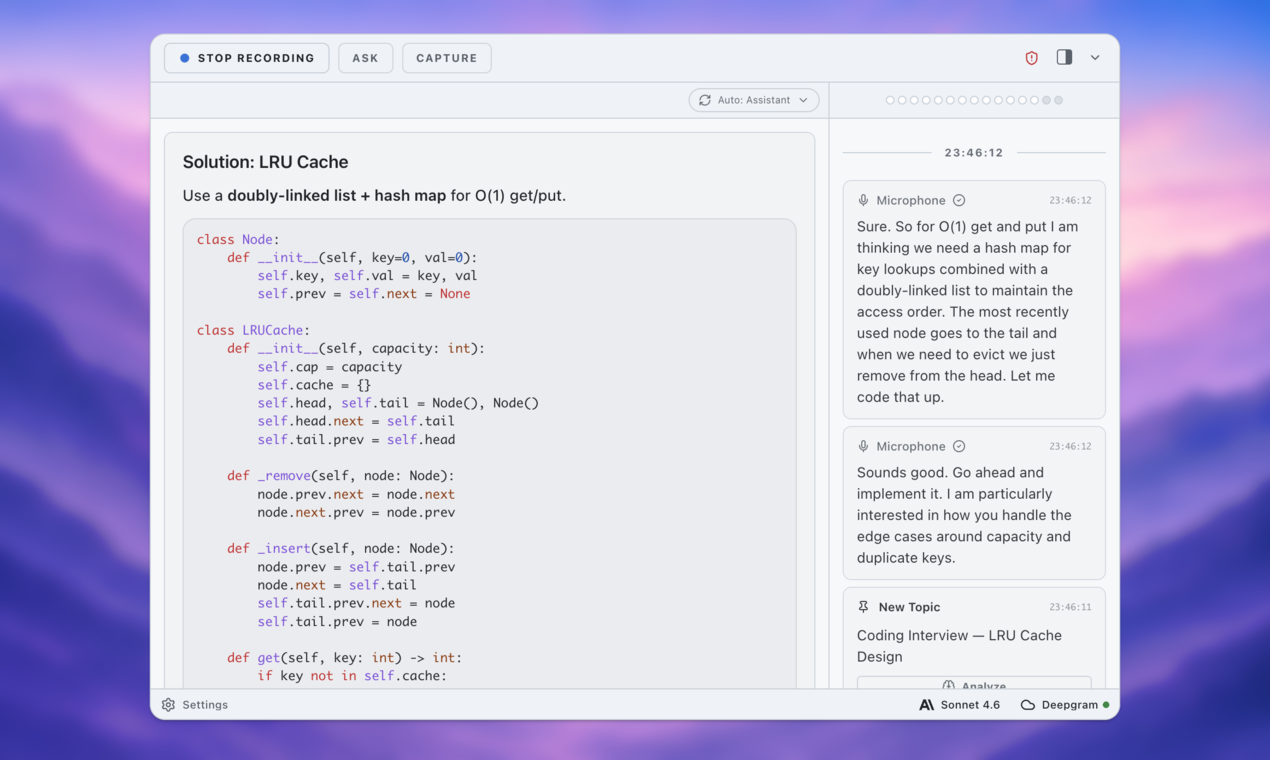
Live transcription helps preserve the thread. It gives the AI something grounded to work from and gives you a record to review afterward. For me, that matters more than a generic answer generator.
ExtraBrain supports local NVIDIA Parakeet transcription and optional Deepgram. That is important because Parakeet itself can be useful as a transcription technology even if you do not want the ParakeetAI product experience. The difference is the surrounding workflow.
Screen-aware context helped with technical prompts
Coding interviews and system design sessions are not only spoken. They often include a shared prompt, an editor, a diagram, logs, or a browser tab.
A text-only assistant can miss that context. ExtraBrain adds screen-aware context so the copilot can help with what is visible, not only what was said.
That makes it more useful for questions like:
- “Walk through this LRU cache implementation.”
- “Explain why this architecture might bottleneck.”
- “What clarifying question should I ask before designing this notification system?”
- “How should I discuss the tradeoff between consistency and latency?”
The Mac desktop workflow felt calmer
ExtraBrain is available for macOS today, including Apple Silicon and Intel Macs. Windows and Linux are planned future platforms.
For Mac users, that desktop-first approach matters. I do not want to bounce between browser tabs during an interview. I want one place for transcription, live context, notes, screenshots where allowed, and session review.
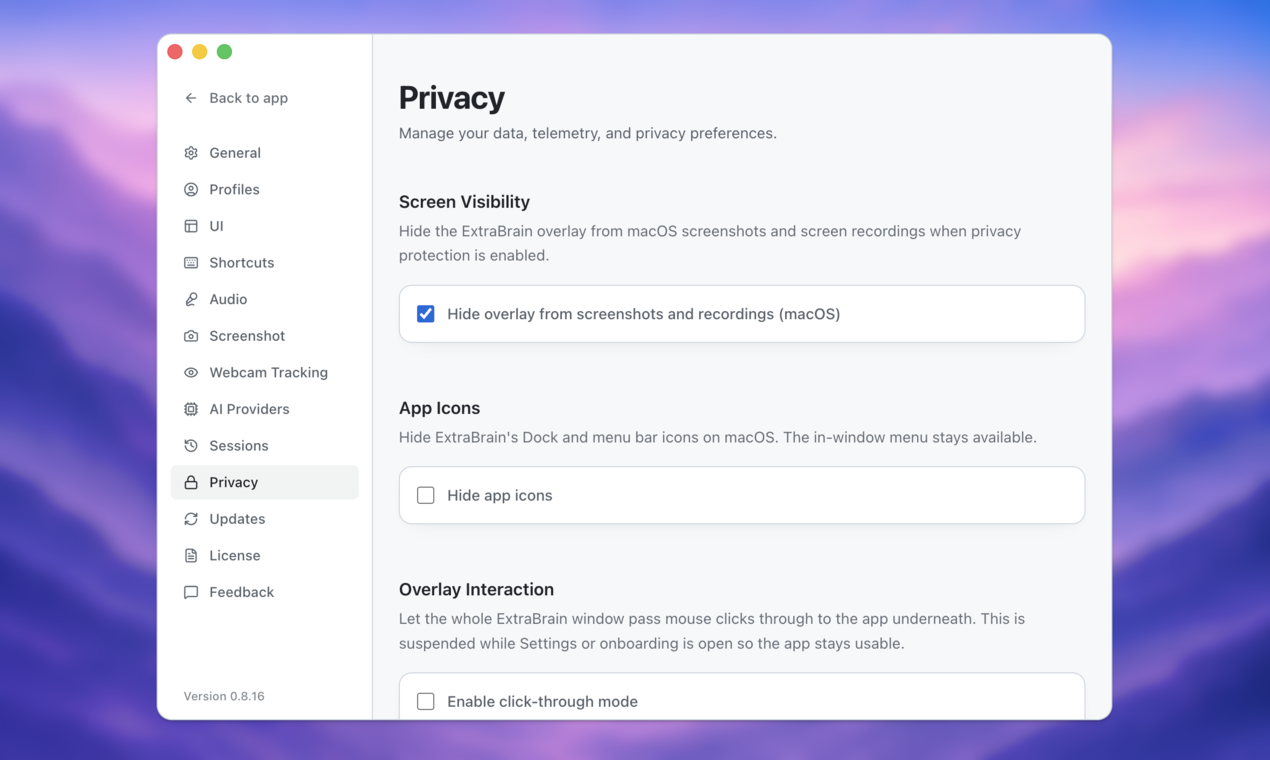
ExtraBrain is also designed to stay hidden from screen sharing and screen recording on major meeting tools. That is about reducing accidental visual clutter, not about bypassing rules. You are still responsible for following the rules of the interview, employer, school, workplace, meeting, and platform.
How I would switch from Parakeet AI to ExtraBrain
Switching tools is easier when you treat it like a small migration instead of a dramatic restart. The goal is to keep your useful history while removing the friction.
1. Save your old preparation material
Start by gathering anything that still helps you. That might include interview notes, resume bullets, job descriptions, common questions, STAR stories, and feedback from previous mock sessions.
Do not move everything blindly. Separate useful material from clutter. If a note does not help you answer better, delete it or archive it outside your active prep workflow.
2. Rebuild your interview context around roles
Create a folder or note set for each target role. For each one, include:
- The job description.
- Your most relevant projects.
- Likely behavioral stories.
- Technical topics to review.
- Questions you want to ask the interviewer.
- Any constraints around allowed AI use, transcription, or notes.
This structure makes your prep more reusable. It also helps you avoid depending on generic AI output.
3. Set up ExtraBrain with the privacy posture you want
Choose your transcription and AI provider setup before a high-stakes session. If you want the most local posture, use local Parakeet transcription and local Gemma 4 where installed and compatible. If you choose an external provider, understand what data may be sent to that provider.
This is also the right time to review privacy controls. Do not wait until ten minutes before an interview to decide how your transcripts, screenshots, or provider requests should work.
4. Practice with real prompts before using it live
Do not make your first ExtraBrain session a real interview. Run a mock session first.
Use a real job description. Open a coding prompt or system design question. Speak out loud. Practice asking clarifying questions. Review the transcript afterward.
The goal is to learn how the tool supports your thinking before you are under pressure.
5. Use the transcript for post-interview improvement
The best interview improvement often happens after the call. You can review where you rambled, where you answered too vaguely, where you missed a clarifying question, and where you should have used a stronger example.
ExtraBrain makes that review easier because the session is not just a moment that disappears. It becomes material you can learn from.
What improved after moving to ExtraBrain
The biggest improvement was mental load. I stopped thinking about whether the tool would keep up and started thinking about the interview itself.
My practice became more structured
Instead of random chat prompts, I could prepare around sessions. I could use live transcription, screen context, and notes together. That made practice feel closer to the real thing.
For behavioral interviews, I used ExtraBrain to organize STAR outlines and follow-up questions. For coding interviews, I used it to explain tradeoffs and rehearse how I would narrate my thinking. For system design, I used it to keep track of requirements, constraints, and architecture decisions.
My answers became less generic
Generic AI answers are easy to spot because they sound polished but empty. They do not contain your projects, your decisions, or your tradeoffs.
ExtraBrain helped most when I used it to structure my own material. For example, instead of asking for a complete answer to “Tell me about a conflict,” I would ask for a tighter STAR outline based on my actual notes. Instead of asking it to solve a coding problem for me, I would ask it to help explain the complexity and edge cases.
That kept the answers grounded in my experience.
My privacy choices became clearer
The local-first model made the privacy conversation simpler. I could choose a local posture where possible, or I could intentionally select an external provider when I wanted that provider’s capabilities.
That clarity matters. Privacy should not be a vague marketing promise. It should be a configuration you understand.
A practical checklist before you switch
Before switching from any AI interview tool, ask yourself these questions:
- Does the tool help me stay present in the conversation?
- Does it support practice, live sessions, and post-session review?
- Does it explain what happens to transcripts, screenshots, audio, prompts, and notes?
- Can I choose the AI and transcription providers I trust?
- Does it help me sound more like myself, not more like generic AI?
- Am I using it only in settings where AI assistance, transcription, screenshots, and notes are allowed?
If the answer is no across several of those questions, it may be time to move on.
FAQ
Is Parakeet AI actually trash?
That depends on what you need and what you experienced. Many people use harsh language like “Parakeet AI trash” when a tool creates friction during interview prep. The more useful question is whether it is reliable, private, fast, and context-aware enough for your workflow.
What is the best ParakeetAI alternative for Mac?
ExtraBrain is a strong ParakeetAI alternative for Mac users who want local Parakeet transcription, screen-aware context, a free core app, local AI options, and provider access they control. It is available for macOS today, including Apple Silicon and Intel Macs.
Can ExtraBrain run fully local?
A fully local ExtraBrain posture requires local Parakeet transcription plus local Gemma 4 on-device AI where installed and compatible, with no external provider requests. External providers may receive selected prompts, transcript text, screenshots, audio, or context depending on your configuration.
Is ExtraBrain only for interviews?
No. ExtraBrain can be used for coding interviews, system design rounds, behavioral interviews, product interviews, meetings, lectures, customer calls, and research conversations. The same responsible use rule applies in every context.
Can ExtraBrain generate interview answers?
ExtraBrain can help generate answer outlines, STAR structures, technical explanations, and follow-up questions from live transcript and screen context. You remain responsible for honest, allowed, and thoughtful use.
How should I use ExtraBrain responsibly?
Use ExtraBrain only where interview, employer, school, workplace, meeting, and platform rules allow AI assistance, transcription, screenshots, or notes. Treat it as a preparation and thinking aid, not as a way to misrepresent your skills.