
ExtraBrain Blog
Private by Default: Why Interview Prep Notes Should Not Live in Random AI Tools

Interview prep notes include transcripts, stories, salary goals, career plans, and confidential work. Use privacy-first AI tools.
The most sensitive document in your job search may not be your resume.
It might be the messy interview prep note you keep adding to after every recruiter screen, mock interview, rejection, salary conversation, and late-night career spiral. It contains the real version of your story: the job you want, the job you are afraid you are not ready for, the manager you left, the project that failed, the compensation number you are hoping for, and the private reasons you are making a change.
That is exactly the kind of context AI can help with. It is also exactly the kind of context you should not casually paste into whichever AI tool happens to be open.
AI is becoming a normal part of interview preparation. Candidates use it to organize stories, practice answers, review transcripts, improve follow-up notes, and prepare for difficult questions. Used well, it can make the process more honest and less chaotic. But the privacy default matters. Your interview prep notes are not generic text. They are career data.
If a tool treats that data like disposable prompt material, it is the wrong tool for the job.
Interview prep notes are more revealing than resumes
A resume is curated. Interview prep is not.
Your resume says you led a migration, improved onboarding, managed stakeholders, or shipped a product. Your prep notes explain what really happened. They may include the conflict behind the migration, the teammate who struggled, the customer who escalated, the political tradeoff you had to navigate, or the reason you are leaving your current role.
That difference matters. A resume is designed to be shared. Interview prep is designed to help you think.
A typical prep workspace might contain raw transcripts, personal stories about failure or conflict, salary expectations, negotiation strategy, company names, manager names, customer examples, internal tools, career goals, doubts, recruiter feedback, and notes about immigration, schedule constraints, accommodations, or location needs.
None of that is shameful. Most of it is normal. But normal does not mean low-risk.
When you paste this material into a random AI tool, you may be mixing your most private career context with a system you have not evaluated. You may not know where the text is processed, how long it is retained, whether it is used for training, who can access it internally, or how easily you can delete it later.
The issue is not that every AI tool is unsafe. The issue is that sensitive career data deserves a higher bar than “I needed a better answer quickly.”
The danger is not one prompt. It is the habit.
Most privacy leaks do not begin with a dramatic breach. They begin with convenience.
You paste a transcript into one chatbot to summarize the interview. Then you paste your salary notes into another tool to draft a negotiation response. Then you upload a job description, your resume, and your private concerns into a third tool because it gives better coaching. Then you copy the output into a doc, forward it to a friend, and store the transcript in a shared drive because you might need it later.
No single step feels reckless. Together, they create a sprawl of sensitive context across systems you do not control.
This is easy to justify during a job search because the pressure is high. You want the next interview to go better. You want the perfect answer to “Tell me about yourself.” You want to explain a layoff without sounding defensive. You want to negotiate without losing the offer.
AI can help with all of that. But the more useful AI becomes, the more tempting it is to feed it everything. That is why privacy has to be part of the workflow, not an afterthought.
What interview prep data can expose
It is easy to underestimate interview prep notes because they look informal. They are often bullet points, fragments, practice answers, or rough transcripts. But informal notes can expose more than polished documents.
A transcript can show how you speak under pressure. A behavioral story can reveal past workplace conflict. A salary note can reveal your floor, your target, and your fear of asking too much. A career planning note can reveal that you are trying to leave before your team knows. A mock interview recording can capture your voice, your environment, and personal details you never meant to distribute.
For candidates, this data can create practical risks:
- Employment risk: private plans to leave a job should not accidentally travel outside your control.
- Negotiation risk: salary targets and constraints are leverage-sensitive.
- Reputation risk: rough practice answers can sound worse than your final thinking.
- Confidentiality risk: examples from current or former employers may include internal details.
- Identity risk: transcripts and recordings can contain enough context to identify you and others.
- Emotional risk: career doubts, health constraints, burnout, or family logistics may be present in notes even when they are not part of your public professional story.
The point is not to scare people away from using AI. The point is to match the tool to the sensitivity of the task. You would not post your salary negotiation strategy in a public forum and ask strangers to edit it. Pasting the same material into an unfamiliar tool without checking the privacy model is not much better.
Responsible AI prep starts with data minimization
The first privacy habit is simple: do not share more than the tool needs.
If you want feedback on whether a behavioral answer is too long, the AI probably does not need your employer’s real name, your manager’s name, the customer’s name, or the internal codename of the project. Replace them with placeholders. “A fintech client” is often enough. “My manager” is enough. “Internal analytics platform” is enough.
If you want help preparing for a salary conversation, the tool may need the range you are considering, but it may not need your exact current salary, your spouse’s employment situation, or the financial pressure behind the number.
A useful privacy checklist before using AI for interview prep:
- Can I remove names, employers, customers, and locations?
- Can I generalize confidential project details?
- Does the tool need the raw transcript, or would selected excerpts work?
- Do I know whether the tool stores or trains on this content?
- Can I delete the data later?
- Would I be comfortable if this exact prompt were forwarded to a recruiter, employer, or current manager?
That last question is blunt because it works. If the answer is no, slow down.
Why “private by default” is a product choice
Privacy is often treated like a policy page. In practice, it is a design decision.
A tool can make privacy easy or hard. It can keep data local by default or push everything to the cloud by default. It can make deletion obvious or bury it in settings. It can support selective sharing or assume every transcript belongs in a workspace. It can encourage users to paste entire recordings into generic prompts or create a structured workflow where only the necessary context is analyzed.
For interview prep, private by default should mean sensitive notes stay under the user’s control, transcripts are not treated as permanent artifacts, sharing is explicit, deletion is visible, and AI assistance improves clarity without impersonating the candidate.
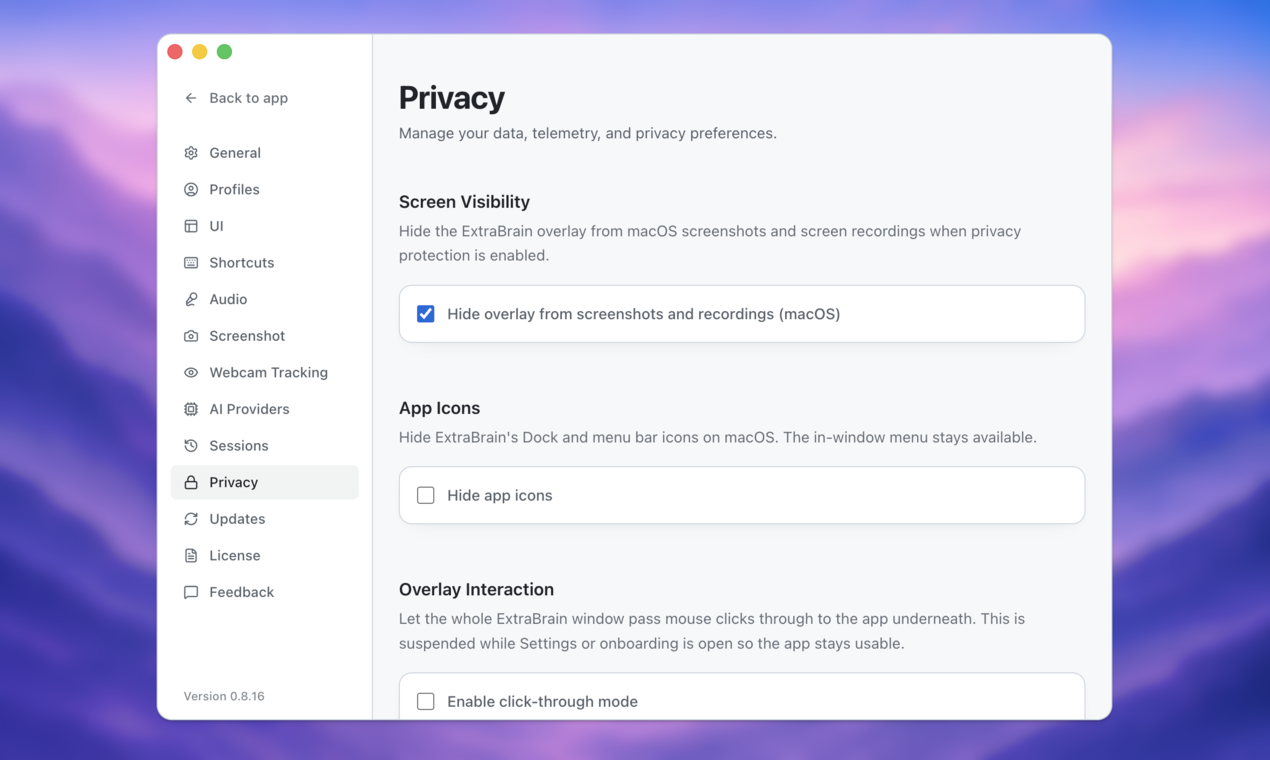
This is where a product like ExtraBrain fits the moment. A private AI interview copilot should not merely generate polished answers. It should help candidates organize real experience, practice responsibly, remember key details, and protect the private context that makes interview prep useful in the first place.
The best AI prep tool is not the one that asks for everything. It is the one that helps you decide what is actually needed.
Privacy also supports better interviewing
Some people hear “privacy-first” and assume it means less capable. In interview prep, the opposite is often true.
A private workspace lets you be more honest with yourself. You can capture the awkward first version of an answer. You can admit that you stumbled on a question. You can write down the real salary number. You can reflect on why a role excites you or why a previous job burned you out. You can keep a story bank that includes the messy details before deciding what belongs in the final answer.
That honesty is what makes preparation useful.
When candidates do not trust the workspace, they sanitize too early. They remove the nuance before the tool can help. They ask generic questions and receive generic answers. They get back polished language that sounds professional but does not help them think.
Private does not mean isolated. It means controlled. You can still export a summary, share a practice plan with a coach, or turn notes into a follow-up email. The difference is that sharing becomes intentional rather than accidental.
AI should help you prepare, not become you
Privacy and integrity belong together.
Candidates should not use AI to invent achievements, fake expertise, or secretly answer questions in a restricted interview. That breaks trust. But candidates should be able to use AI to prepare, practice, remember, and reflect without turning their private career history into scattered training material.
A responsible AI prep workflow has a clear boundary: before the interview, AI can help you organize stories and practice explaining them; during the interview, you follow the employer’s rules and own your answers; after the interview, AI can help you debrief and improve for the next round.
This is not a loophole. It is a healthier model of preparation.
A good AI interview preparation workspace should make candidates more grounded, not more performative. It should help them notice unclear answers, prepare follow-up questions, preserve useful lessons, and avoid pasting sensitive material into a dozen disconnected tools.
What to look for before trusting an AI prep tool
Before you put interview notes into any AI system, evaluate it like you would evaluate a financial or health app. You do not need to become a security expert. You do need to ask direct questions.
Look for signs that the product takes user control seriously: clear explanation of where data is processed and stored, local-first or privacy-first architecture where possible, visible delete and export options, sensible defaults around retention, and explicit separation between preparation support and live-answer impersonation.
Be cautious when a tool pressures you to upload everything, makes deletion unclear, or treats your interview data as just another prompt. Convenience is not enough.
If you are using a general-purpose chatbot, reduce the data before you paste. Redact names. Remove confidential details. Use excerpts. Avoid compensation specifics unless necessary. Do not include anything you would regret seeing in the wrong inbox.
If you are using a specialized tool, expect more. Interview prep is the product context. The privacy model should reflect that.
Your career context deserves a home, not a trail of scraps
A job search creates a strange archive. Resume drafts. Interview transcripts. Notes after recruiter calls. Practice answers. Salary ranges. Company research. Follow-up emails. Rejection lessons. Offer comparisons. Career questions you are not ready to say out loud.
That archive can become a source of confidence if it lives in a place you trust. You can see patterns. You can improve over time. You can remember the question that surprised you in round two and prepare for it before round three.
Or it can become a trail of scraps across random AI tools, documents, inboxes, and chat histories.
Interview prep notes are not throwaway text. They are a working map of your career transition. They deserve the same care you would give any sensitive personal record.
AI can absolutely belong in that process. It can help you prepare more clearly, remember more accurately, and reflect more honestly. But it should do so in a way that protects your context instead of scattering it.
Private by default is not a luxury feature. For interview prep, it is the baseline.
If you are preparing for your next interview and want AI support without handing your most sensitive career notes to random tools, try ExtraBrain as a local-first AI meeting copilot and private workspace for interview preparation.