
ExtraBrain Blog
Share Screen AI Help in 2026: Safer Ways to Prepare

A responsible guide to screen sharing, AI interview help, privacy, and what to avoid during exams, interviews, and monitored calls.
People search for share screen cheat methods because screen sharing is one of the most stressful moments in online exams, technical interviews, coding assessments, and monitored workplace calls.
The pressure is real.
You may have notes open, a job description nearby, practice prompts in another window, or an AI assistant helping you prepare.
Then someone says, “Can you share your screen?”
This guide takes that search intent seriously without pretending deception is safe or acceptable.
Instead of teaching bypasses, hardware evasion, hidden helpers, or proctoring workarounds, it explains how to use AI help responsibly, how to set up your desktop before a high-stakes call, and how ExtraBrain fits when AI assistance, transcription, screenshots, or notes are allowed.
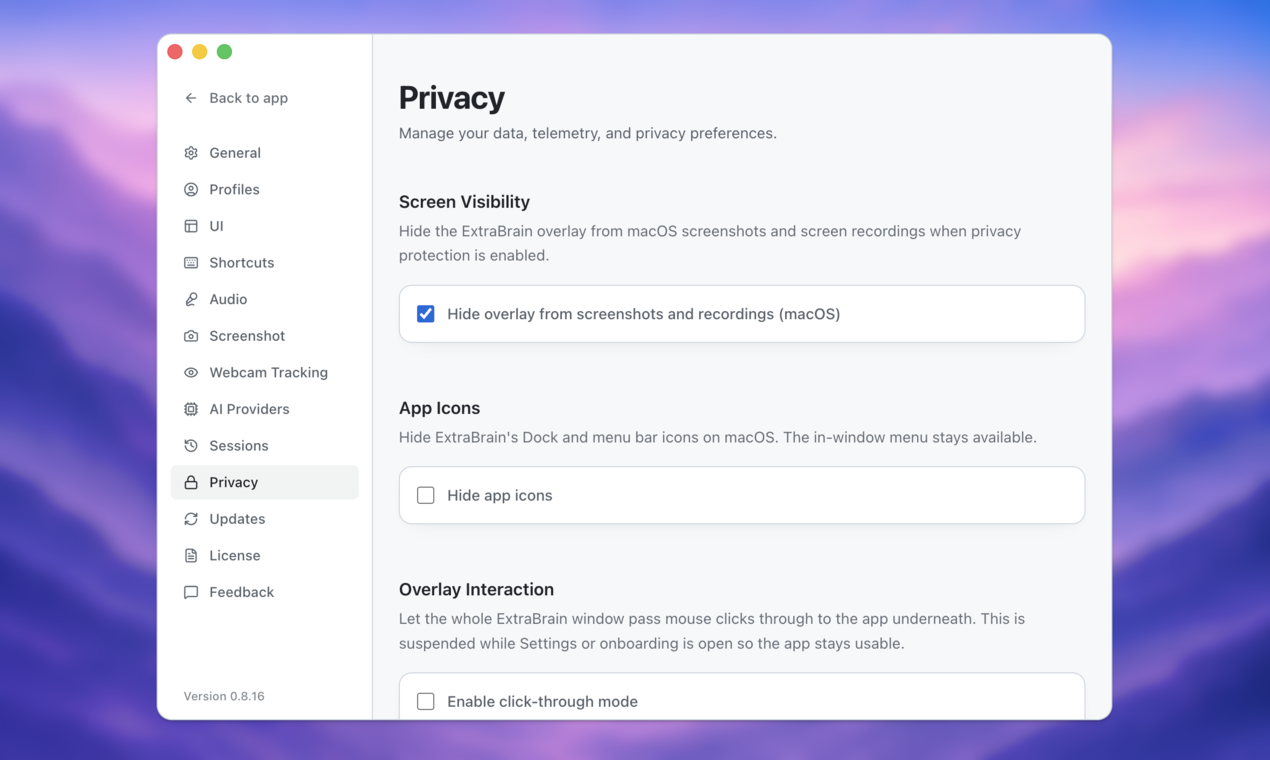
ExtraBrain is a free, local-first desktop AI interview assistant and meeting copilot for Mac with live transcription, screen-aware context, local Gemma 4 on-device AI where installed and compatible, bring-your-own AI providers, and clear privacy controls.
Use it only where interview, employer, school, workplace, meeting, and platform rules allow AI assistance, transcription, screenshots, or notes.
Key takeaways
- Screen sharing anxiety is usually a preparation problem, not a reason to build a cheating setup.
- Secretly using AI to answer live exam or interview questions can violate rules and damage trust.
- The safest approach is to ask what tools are allowed before the session begins.
- ExtraBrain can support permitted preparation, live note-taking, interview practice, meeting support, and post-session review.
- A local-first posture can reduce unnecessary data exposure when local Parakeet transcription and local Gemma 4 on-device AI are installed and compatible.
- If external AI or transcription providers are selected, prompts, transcript text, screenshots, audio, or context may leave the device depending on configuration.
- Screen sharing should be treated as a privacy and compliance moment.
- Your goal should be to stay organized and honest, not to hide an answer generator.
Why people look for share screen cheat tools
Most candidates are not trying to become cybersecurity operators.
They are nervous.
They are afraid of freezing on a coding problem.
They are afraid of forgetting a story in a behavioral interview.
They are afraid an interviewer will misread a pause as incompetence.
They are afraid a proctoring tool will flag normal behavior as suspicious.
That fear creates demand for hidden overlays, second devices, remote helpers, screen mirroring tricks, and complicated claims about being invisible during screen sharing.
The problem is that these methods usually move the candidate from preparation into deception.
A tool becomes cheating when it secretly performs the skill being assessed.
If an exam is testing your independent reasoning, a hidden answer feed changes the assessment.
If an interview is testing your ability to explain technical tradeoffs, silently outsourcing the explanation gives the interviewer a false signal.
If a workplace meeting contains confidential customer, product, or employee information, routing that context through an unknown tool can create a privacy problem.
AI can still be useful.
The boundary is permission, disclosure, and ownership.
Share screen cheat tools and methods: what to avoid
A lot of search results talk about hardware isolation, hidden displays, remote helpers, virtual machines, mirrored screens, and other evasion ideas.
Do not treat those as a normal interview workflow.
They add complexity, create reputational risk, and can violate assessment rules.
They also distract from the skill you actually need: communicating your own thinking clearly under pressure.
Hidden software overlays
Hidden overlays promise live answers while staying out of the shared screen.
That promise is exactly why they are risky.
If the interviewer or school did not allow that kind of real-time assistance, the issue is not whether the overlay appears in the share window.
The issue is that you are changing the rules without consent.
A better use of AI is to practice before the session, organize your examples, and review the transcript afterward.
ExtraBrain can help with live transcription and screen-aware context when allowed, but you remain responsible for following the rules and owning every answer.
Remote helpers and second-device workflows
A second device can be legitimate when used for approved notes, accessibility, or meeting logistics.
It becomes a problem when it is used to receive hidden answers during a test or interview.
If you need accommodation, ask for it explicitly.
If you need notes, ask whether notes are allowed.
If the exercise allows documentation, search, or AI, clarify the boundaries before the screen share starts.
The simplest safe question is:
“Are candidates allowed to use notes, documentation, search, or AI tools during this exercise?”
That question protects you and gives the interviewer a chance to define the assessment honestly.
Hardware bypass claims
Some guides describe hardware splitters, capture cards, virtualized desktops, or low-level monitoring bypasses.
Those ideas belong in security research contexts, not in a candidate guide for honest exams and interviews.
For most people, they are overkill, fragile, and ethically wrong when used to evade rules.
They also introduce practical risks: messy cables, unstable audio, privacy exposure, and a bigger chance that you focus on the setup instead of the conversation.
If a session requires screen sharing, treat that as a cue to simplify.
Close unrelated windows.
Prepare approved materials.
Confirm what may be visible.
Use tools only within the allowed boundaries.
A safer setup for screen sharing with AI nearby
A responsible setup starts before the call.
The goal is not to hide prohibited help.
The goal is to reduce distractions, protect private data, and make allowed assistance easy to explain.
Prepare your desktop
Create a clean workspace before the session begins.
Close private chats, personal email, unrelated documents, password managers, and sensitive browser tabs.
Move approved notes into one document if notes are allowed.
Use a dedicated browser profile for the interview or assessment.
Disable notifications.
Check that your desktop wallpaper, menu bar, and file names do not reveal private information.
If you will share a coding environment, open only the editor, terminal, documentation, and files that are allowed for the exercise.
If you will present a portfolio or case study, open the exact deck or document you plan to show.
Do not improvise your privacy posture after the interviewer asks you to share.
Clarify AI permissions
AI rules are inconsistent across companies, schools, and platforms.
One interviewer may allow search and documentation.
Another may ban all tools.
A third may explicitly encourage AI because the job itself requires AI-assisted work.
Ask before the session starts when possible.
If the rules arrive late, ask again in the moment.
You can say:
“Before I share my screen, I want to confirm the tool policy. Are notes, documentation, or AI assistants allowed for this part?”
If the answer is no, close the tools.
If the answer is yes, stay inside the stated limits.
If the answer is unclear, choose the conservative path.
Configure ExtraBrain for the allowed use case
ExtraBrain supports several different workflows.
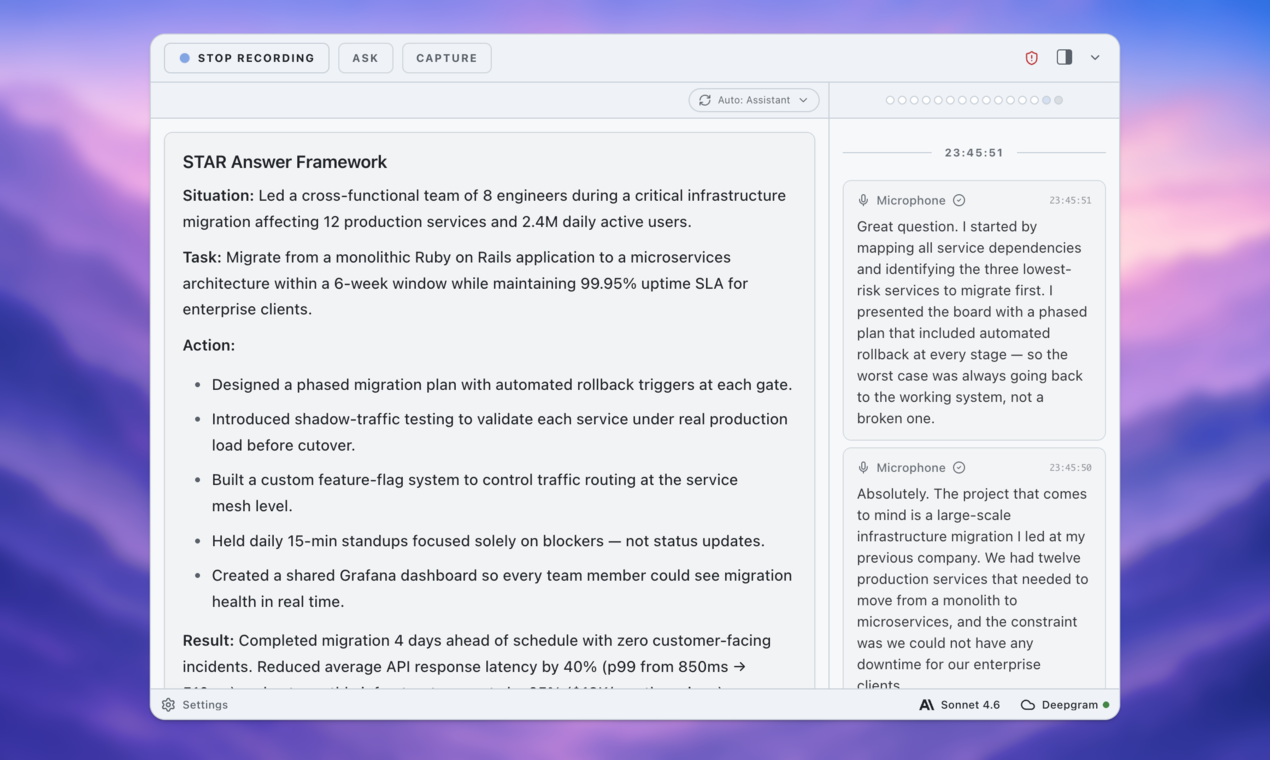
For interview preparation, you can use it to practice aloud, organize STAR stories, rehearse technical explanations, and review where your answers became vague.
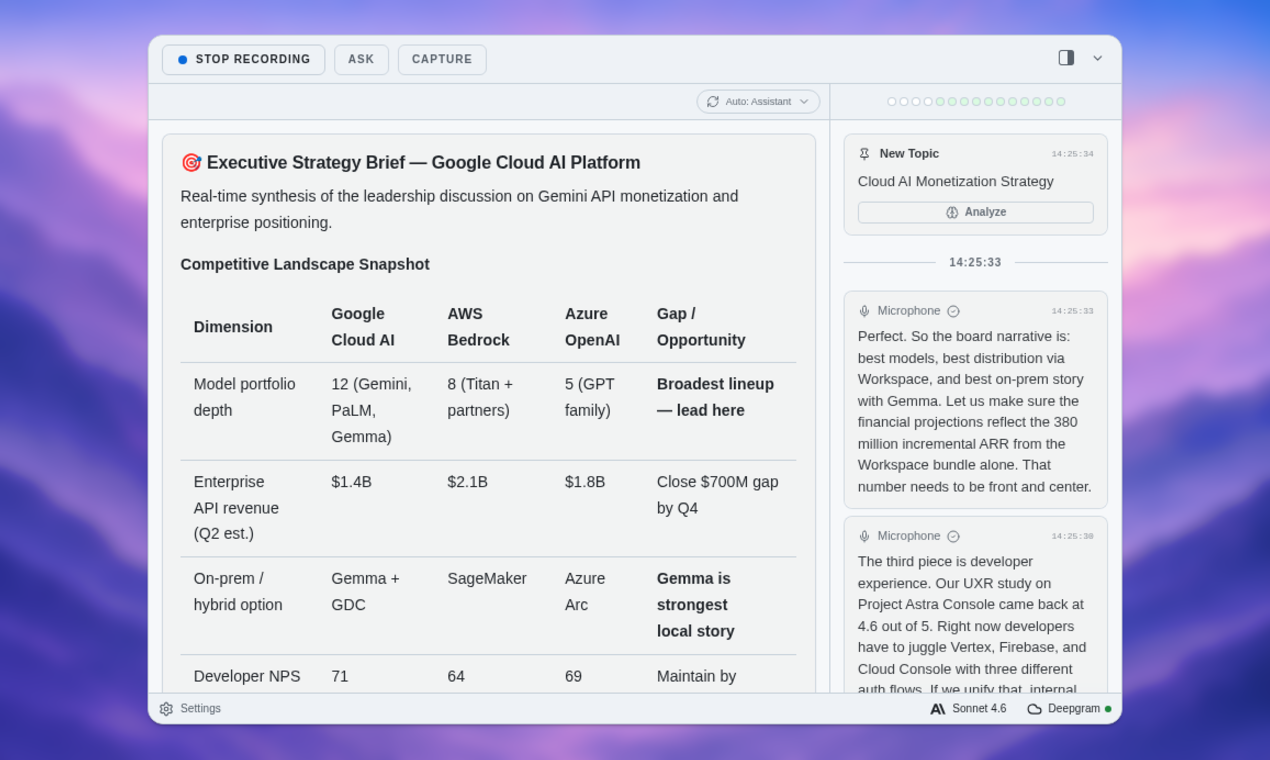
For permitted live sessions, you can use live transcription and screen-aware context to follow the conversation, capture notes, and generate useful follow-up questions.
For meetings, lectures, and research calls, it can act as a local-first meeting copilot when participants and policies allow transcription or AI assistance.
For privacy-conscious users, ExtraBrain can be configured with local Parakeet transcription and local Gemma 4 on-device AI where installed and compatible.
That posture can keep transcription and AI prompts local.
If you choose external providers such as Anthropic, OpenAI, custom OpenAI-compatible endpoints, Claude Subscription, Codex Subscription, or Deepgram, understand that selected prompts, transcript text, screenshots, audio, or context may be sent to those providers depending on configuration.
How to use AI help before, during, and after screen sharing
The responsible workflow depends on timing.
AI use before a call is very different from hidden AI use during an assessment.
Before the session
Before the session, AI is most useful as a coach.
Use it to turn a job description into likely interview themes.
Use it to generate practice questions.
Use it to critique your explanations.
Use it to turn your resume into true, concise stories.
Use it to practice coding explanations without memorizing fake answers.
ExtraBrain can support this by helping you rehearse aloud and review your own transcript.
That is preparation, not impersonation.
During the session
During the session, permission decides the boundary.
If AI is not allowed, do not use it.
If notes are allowed but AI is not, use notes only.
If AI is allowed, use it in a way you can explain.
For example, it may be acceptable to use an AI copilot to summarize meeting action items, keep track of a long product discussion, or suggest clarifying questions in a permitted interview format.
It is not acceptable to secretly use AI to solve a closed-book exam or speak for you in an interview where your independent reasoning is being assessed.
A good test is simple:
- Would I be comfortable telling the interviewer or proctor how I am using this tool?
- Does this help me express my own experience, or does it create an answer I cannot defend?
- Am I following the rules that were provided for this stage?
- Could I continue the conversation if the tool disappeared?
If the honest answer makes you uncomfortable, stop.
After the session
After the session, AI becomes useful again with fewer ethical complications.
Use it to debrief what happened.
Use it to identify missed follow-up questions.
Use it to improve your next answer.
Use it to draft a thoughtful thank-you note based on what you actually discussed.
Use it to build a personal interview knowledge base from your real experience.
ExtraBrain works well here because transcripts, notes, screenshots, and session context can become review material instead of disappearing after the call.
Privacy and screen sharing checklist
Screen sharing is not only about cheating risk.
It is also about data hygiene.
Use this checklist before any high-stakes call.
Desktop hygiene
- Quit apps you do not need.
- Turn on Do Not Disturb.
- Hide bookmarks that reveal private projects or clients.
- Close messaging apps.
- Close file folders with sensitive names.
- Use a clean browser profile.
- Remove unrelated windows from the shared workspace.
AI provider hygiene
- Decide whether you need local-only processing or external providers.
- Use local Parakeet transcription when you want transcription to stay local.
- Use local Gemma 4 where installed and compatible when you want local AI prompts.
- Review external provider settings before sending transcript text, screenshots, audio, or context.
- Do not send confidential employer, customer, school, or personal data to tools that are not approved for that data.
Rule hygiene
- Read the assessment instructions.
- Ask about notes, documentation, search, and AI tools.
- Keep a written copy of any tool policy when possible.
- Use only what is allowed.
- Disclose when required.
- Do not rely on hidden real-time answer generation.
What if the interviewer asks to share your entire screen?
Do not panic.
Pause for a second and make the request explicit.
You can say:
“Sure. I am going to close unrelated windows first so I do not expose private information.”
That is normal and professional.
Then close anything unrelated.
If you were using AI for permitted note-taking, clarify whether it should remain open.
If you were using AI for preparation before the call, close it before the assessed portion begins unless the interviewer has allowed it.
If the interviewer asks why something is open, answer plainly.
Honest explanations are much easier to defend than complicated concealment.
ExtraBrain positioning for screen-aware help
ExtraBrain is built for people who want a practical desktop AI assistant without giving up control.
It is available for macOS today, including Apple Silicon and Intel Macs.
Windows and Linux are planned future platforms.
The core Mac app is free.
ExtraBrain Pro is $9.99 per month, $79 per year, or $149 Lifetime launch pricing.
External AI and transcription provider usage is billed separately by the providers users choose.
The product is useful across coding interviews, system design rounds, behavioral interviews, product interviews, customer calls, lectures, and research meetings.
Its screen-aware context can help when the rules allow screen context.
Its live transcription can help when the rules allow recording or transcription.
Its local-first options can help when privacy matters.
Its responsible use boundary is clear: ExtraBrain should be used only where the relevant rules allow AI assistance, transcription, screenshots, or notes.
FAQ
How do I test my screen sharing setup before an interview?
Run a mock call with a friend or a second account.
Share the same window or screen you plan to share in the real session.
Check notifications, visible tabs, file names, audio input, camera framing, and whether any approved notes are easy to access.
If AI tools are allowed, test the exact allowed workflow.
If they are not allowed, practice without them.
Can proctoring software detect hidden AI tools?
Detection varies by platform, operating system, permissions, and policy.
The more important question is whether the tool is allowed.
Trying to hide prohibited assistance can violate exam, school, employer, or platform rules even if a specific detector does not catch it.
Use AI where it is permitted and avoid hidden real-time answer systems during assessments.
Is it safe to use AI tools for answers during interviews?
It depends on the rules and the type of interview.
AI can be safe and useful for preparation, mock interviews, note organization, and post-interview review.
During a live assessment, use AI only if the interviewer or platform allows it.
Never say or submit an answer you cannot explain yourself.
Will ExtraBrain show up during screen sharing?
ExtraBrain is designed to stay hidden from screen sharing and screen recording on major meeting tools.
That design is for privacy and practical desktop workflow, not permission to break rules.
Users remain responsible for following interview, employer, school, workplace, meeting, and platform policies.
Can ExtraBrain run fully local?
A fully local ExtraBrain posture requires local Parakeet transcription plus local Gemma 4 on-device AI where installed and compatible.
In that setup, there are no external provider requests for transcription or AI prompts.
If you configure external providers, selected prompts, transcript text, screenshots, audio, or context may leave the device depending on your settings.
What should I do if the rules are unclear?
Ask.
A short question before the exercise is better than guessing under pressure.
If nobody can give a clear answer, assume hidden AI assistance is not allowed for assessed work.
Use AI before and after the session instead.