
ExtraBrain Blog
SkillPanel AI Help in 2026: What Works, What Risks Getting You Flagged

A responsible guide to SkillPanel AI help in 2026: what proctoring may flag, how to practice, and where ExtraBrain fits when AI use is allowed.
Searches for “SkillPanel how to cheat” usually come from a real fear: online coding tests feel high pressure, proctored, and unforgiving. SkillPanel, formerly DevSkiller, is used to evaluate practical engineering ability, so candidates often wonder whether AI tools can help them move faster, explain unfamiliar tasks, or avoid freezing during a timed screen.
The short answer is that AI can be useful for preparation, review, and allowed assistance, but trying to bypass assessment rules is risky and unfair. ExtraBrain is built for responsible interview and meeting support, not for violating employer, school, platform, or assessment rules. Use any AI assistant only where AI assistance, transcription, screenshots, or notes are allowed.

What candidates really mean by “cheating” on SkillPanel
Most candidates are not looking for a villain arc. They are trying to survive an assessment format that may not feel like normal engineering work.
A SkillPanel coding test can combine timed coding, browser monitoring, copy-paste restrictions, webcam checks, tab tracking, or plagiarism review. That can make even strong developers feel like one bad minute will define their ability.
When people ask how to cheat on SkillPanel with AI, they often mean one of four things:
- How can I understand the prompt faster?
- How can I avoid blanking on syntax or edge cases?
- How can I practice realistic coding tasks before the test?
- How can I use AI without my answer sounding generic or suspicious?
Those are legitimate preparation questions. The responsible path is to use AI to build fluency before the assessment, then follow the actual rules during the assessment.
How SkillPanel-style proctoring may notice suspicious behavior
You should assume that modern online assessments are designed to detect unusual behavior. Even if a specific configuration varies by employer, it is safer to act as if the platform can observe the basics.
Common signals may include:
- Leaving the test window repeatedly.
- Opening unrelated tabs or applications.
- Pasting large blocks of code at once.
- Producing a solution style that does not match your visible work process.
- Looking away from the screen for long periods during webcam monitoring.
- Showing unusual timing patterns, such as no work followed by a perfect full solution.
- Submitting code that closely matches public answers or generated templates.
Trying to hide rule-breaking behavior is not a durable strategy. A better strategy is to practice until your own process is strong enough that you do not need to act strangely.
Where ExtraBrain fits for SkillPanel preparation
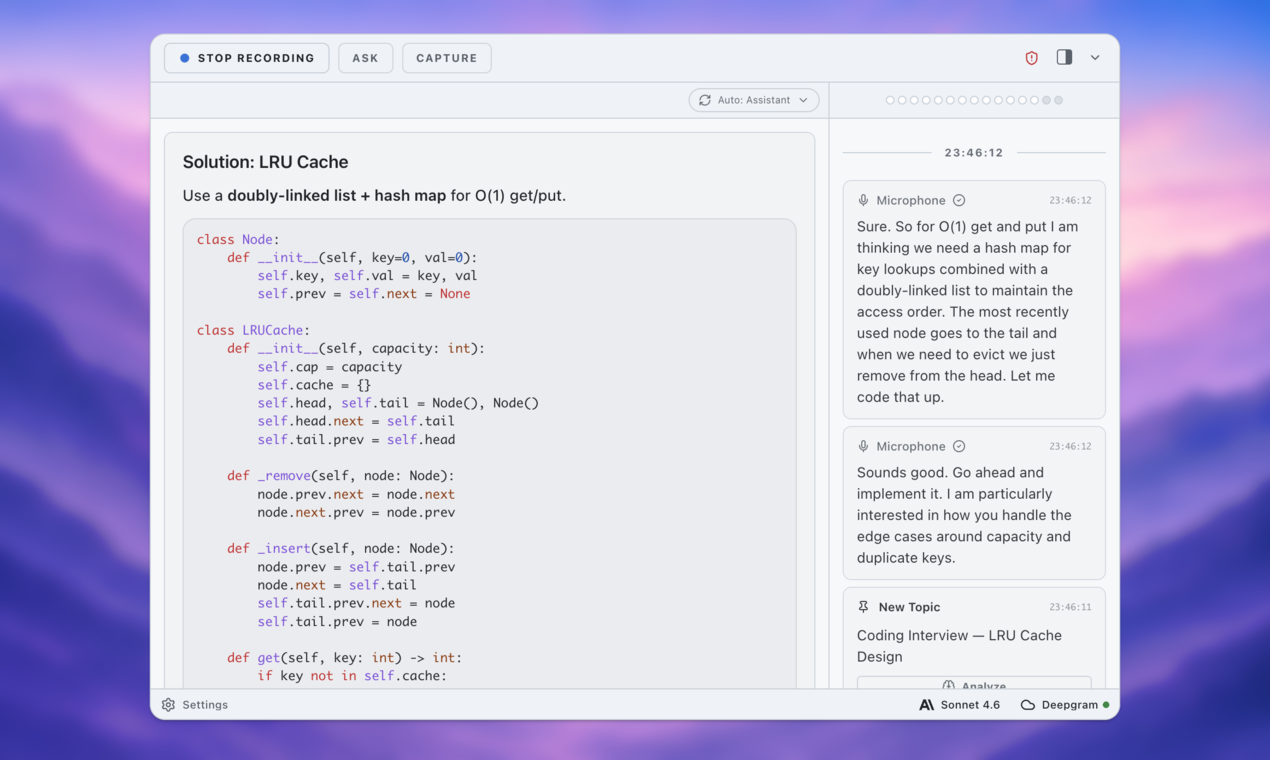
ExtraBrain is a free, local-first desktop AI interview assistant and meeting copilot for Mac. It supports live transcription, screen-aware context, local Gemma 4 on-device AI where installed and compatible, bring-your-own AI providers, and clear privacy controls.
For SkillPanel-style preparation, ExtraBrain is most useful before and after the assessment:
- Practice solving coding prompts aloud while ExtraBrain captures your reasoning.
- Review your transcript to find places where you skipped requirements or missed edge cases.
- Ask for clearer explanations of data structures, algorithm tradeoffs, and testing strategy.
- Build answer outlines for behavioral or follow-up technical questions.
- Compare your first solution against a more maintainable version after you finish.
ExtraBrain should only be used during a live assessment if the assessment rules explicitly allow the kind of AI assistance, transcription, screenshots, or notes you plan to use. If the rules do not allow it, do not use it during the test.
A responsible SkillPanel AI workflow
1. Read the rules before touching any tool
Before the test, read the invitation email, platform instructions, employer guidance, and any honor code language. Look specifically for terms about AI, external tools, internet search, notes, IDE assistance, screen recording, and collaboration.
If the rules say no external assistance, treat that as no external assistance. If the rules allow documentation or local notes, stay inside that boundary. If the rules are unclear, ask the recruiter or assessment owner before the test.
2. Practice the same way you will be tested
Do not make your first timed coding session the real one. Set up a practice environment that feels like SkillPanel.
Use a timer. Use one screen. Avoid copy-paste. Explain your reasoning out loud. Write tests before you polish. Practice reading the prompt twice before coding.
ExtraBrain can help here by capturing your live explanation and giving you a post-session review. This is similar to having a quiet coach who helps you see where your process breaks down.
3. Build a prompt-reading checklist
Many failed coding assessments start with a misunderstood requirement. Use AI during practice to create a checklist you can internalize.
A useful checklist looks like this:
- What are the inputs and outputs?
- What constraints matter?
- Are there empty, null, duplicate, negative, or large input cases?
- What examples are provided?
- What complexity target is likely expected?
- What tests would prove the solution works?
During the real test, you can follow the mental checklist without needing outside help.
4. Learn to type your own solution, not paste an answer
Even when AI use is allowed, pasting a complete generated solution is usually a bad signal. It can also leave you unable to explain the code afterward.
A stronger practice method is to ask AI for a high-level approach, close the assistant, and implement the solution yourself. Then compare your implementation with the suggested approach after the timer ends.
This builds real skill and avoids the generic code style that often makes AI-generated answers obvious.
5. Review after every practice run
The biggest advantage of an AI interview copilot is not instant answers. It is structured review.
After a practice task, ask:
- Did I restate the problem correctly?
- Did I identify edge cases early?
- Did I choose the right data structure?
- Did I explain tradeoffs clearly?
- Did I test the most important cases?
- Did my final code match the style I normally write?
ExtraBrain can support this workflow with transcripts, session context, and review prompts. That is a much safer and more valuable use than trying to sneak through a proctored test.
Best AI use cases before a SkillPanel coding test
Understanding common task patterns
SkillPanel-style tests often evaluate practical coding ability rather than trivia. You may see data transformation, API-style logic, debugging, refactoring, database thinking, frontend tasks, backend services, or algorithmic problems.
Use AI to study patterns such as:
- Hash maps for lookup-heavy tasks.
- Two-pointer scans for sorted arrays or strings.
- Queues and stacks for traversal or validation.
- Sorting plus grouping for reporting tasks.
- Input validation and defensive edge-case handling.
- Unit tests that cover normal, boundary, and failure cases.
The goal is not to memorize answers. The goal is to recognize problem shapes faster.
Practicing explanations
Many candidates can write code but struggle to explain why it works. That matters if the assessment is followed by a review interview.
Practice saying:
- “I am choosing this data structure because…”
- “The main edge case is…”
- “The time complexity is…”
- “I would improve this in production by…”
- “I tested these cases because…”
ExtraBrain can help you rehearse these explanations from your own transcript and screen context.
Debugging under time pressure
Timed debugging is different from leisurely debugging. Practice a repeatable loop:
- Reproduce the failure.
- Read the expected output.
- Inspect the smallest failing case.
- Add a targeted test.
- Fix the root cause.
- Re-run the relevant tests.
AI can help you learn this loop during practice. During the actual assessment, your learned process is what keeps you calm.
Common mistakes that get candidates into trouble
Treating AI as a replacement for understanding
If you cannot explain the solution, you do not own the solution. That becomes obvious during follow-up questions, code review, or live discussion.
Use AI to clarify ideas, not to outsource your thinking.
Ignoring the assessment rules
The fastest way to turn a manageable test into a serious problem is to ignore explicit rules. Employers and platforms may treat unauthorized AI use as misconduct. That can cost you the role and damage trust.
Producing code that does not match your style
AI-generated code often has a polished, generic rhythm. It may use abstractions, comments, or variable names that do not match your normal habits.
During preparation, rewrite solutions in your own style. If you are allowed to use AI in a real setting, still make sure you understand and can defend every line.
Skipping tests
A clean-looking solution without tests can fail hidden cases. Practice writing small tests quickly. Focus on edge cases, not only the happy path.
Privacy and local-first AI considerations
ExtraBrain is designed as a local-first Mac desktop app. With local Parakeet transcription plus local Gemma 4 on-device AI where installed and compatible, transcription and AI prompts can stay local.
If you configure external providers such as Anthropic, OpenAI, custom OpenAI-compatible endpoints, Claude Subscription, Codex Subscription, or optional Deepgram transcription, selected prompts, transcript text, screenshots, audio, or context may be sent to those providers depending on your settings.
That distinction matters for interview and assessment prep. Do not upload confidential assessment content, employer materials, private code, or personal data to any tool unless you are allowed to do so.
FAQ
Can I use ExtraBrain to cheat on SkillPanel?
No. ExtraBrain should be used only where interview, employer, school, workplace, meeting, and platform rules allow AI assistance, transcription, screenshots, or notes. It is a strong preparation and review tool, but you remain responsible for honest use.
Can AI help me prepare for SkillPanel?
Yes. AI can help you practice coding patterns, review your reasoning, generate mock prompts, explain edge cases, and improve your ability to talk through solutions. That is the safest and most useful way to use it.
What if SkillPanel allows external resources?
Follow the written rules exactly. If external resources are allowed, keep your use within the permitted scope and be ready to explain your work. If AI is not clearly allowed, ask before using it.
How do I make my code feel more like my own?
Write it yourself. Use your own variable names, structure, and testing habits. After practice, compare your version with AI feedback and revise only what you understand.
Does ExtraBrain run fully local?
A fully local ExtraBrain posture requires local Parakeet transcription plus local Gemma 4 on-device AI where installed and compatible, with no external provider requests. External providers may receive selected prompts, transcript text, screenshots, audio, or context depending on configuration.
What platforms does ExtraBrain support?
ExtraBrain is available for macOS today, including Apple Silicon and Intel Macs. Windows and Linux are planned future platforms.
The better way to beat SkillPanel
The best way to “beat” SkillPanel is to become hard to filter out for the right reasons. Know the rules. Practice realistic tasks. Explain your thinking clearly. Test edge cases. Use AI as a coach when allowed, not as a substitute for your own ability.
If you want a local-first AI workspace for interview practice, coding explanations, live sessions, transcripts, notes, and review, ExtraBrain can help you prepare with more confidence. Use it responsibly, and make sure the work you submit is work you can stand behind.