
ExtraBrain Blog
The Tech Interview AI Assistants I Would Actually Test in 2026

A practical review of tech interview AI assistants for coding, system design, behavioral prep, privacy, speed, and responsible live support.
Tech interview AI assistant tools have become much more than simple prompt wrappers. The best ones can listen to a live conversation, follow a coding problem, summarize tradeoffs, turn a messy behavioral story into a clearer STAR answer, and help you review the session afterward. The worst ones make you slower, more nervous, or too dependent on canned answers.
I rewrote this guide for candidates who want practical help without losing ownership of the interview. A good assistant should support your thinking, not replace it. You still need to understand the problem, explain your choices, ask clarifying questions, and follow every interview, employer, school, workplace, and platform rule about AI assistance, transcription, screenshots, and notes.
For this comparison, I focused on the same criteria I would use before bringing any tool into interview preparation or an allowed live session:
- Functionality
- Pricing clarity
- Ease of use
- Personalization
- Customer support
- Real-time suggestions
- Response speed
- Privacy controls
- Coding interview usefulness
- Behavioral interview usefulness
1. ExtraBrain: best local-first tech interview AI assistant for Mac users
Overview
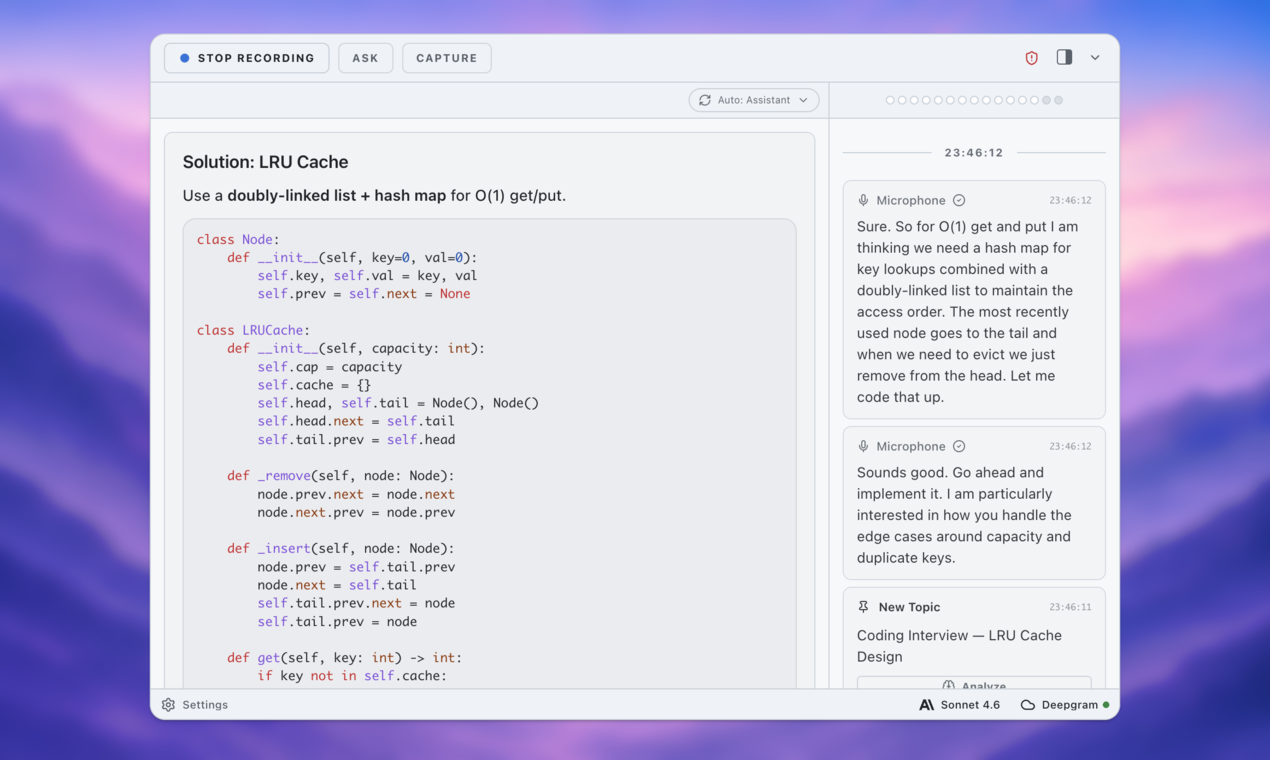
ExtraBrain is a free, local-first desktop AI interview assistant and meeting copilot for Mac. It is built for coding interviews, system design rounds, behavioral interviews, product interviews, customer calls, lectures, and research conversations.
The reason ExtraBrain stands out is that it treats the interview as a full live context problem. It can use live transcription, screen-aware context, screenshots, notes, and post-session review instead of forcing you to copy every prompt manually into a chat window. That matters in technical interviews because the hard part is rarely just producing code. The hard part is tracking the prompt, restating assumptions, explaining tradeoffs, debugging aloud, and staying calm while the interviewer changes constraints.
ExtraBrain is available for macOS today, including Apple Silicon and Intel Macs. Windows and Linux are planned future platforms.
Features
| Feature | What it means in practice |
|---|---|
| Live transcription | Follow the interviewer, your own explanation, and the evolving problem statement. |
| Screen-aware context | Use visible coding prompts, diagrams, slides, or shared context when you choose to include them. |
| Local-first posture | Use local Parakeet transcription and local Gemma 4 on-device AI where installed and compatible. |
| Bring-your-own providers | Connect supported providers such as Anthropic, OpenAI, custom OpenAI-compatible endpoints, Claude Subscription, and Codex Subscription. |
| Interview and meeting workflows | Use the same desktop copilot for interviews, meetings, research calls, lectures, and debriefs. |
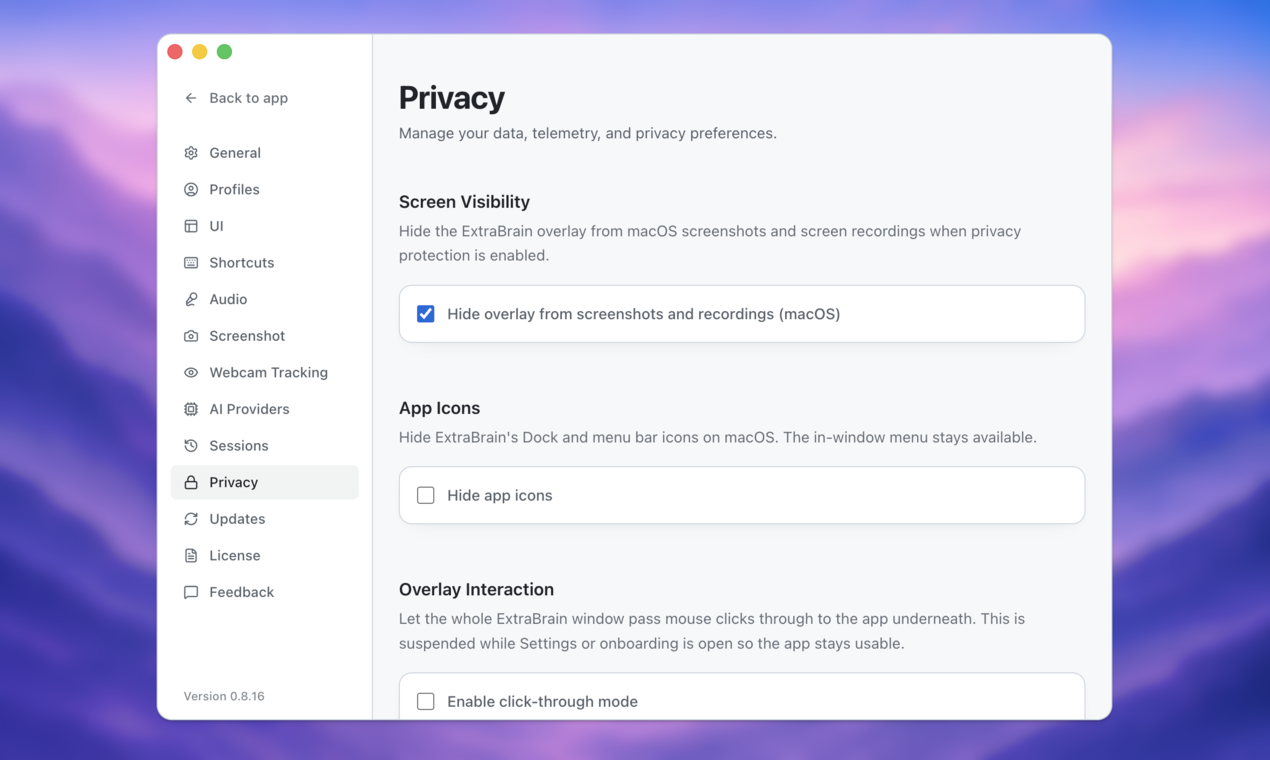
| Privacy controls | Choose local options where available and understand when selected external providers may receive prompts, transcript text, screenshots, audio, or context. |
| Session history | Review transcripts, notes, answers, follow-up questions, and decisions after the session. |
What I liked
ExtraBrain feels strongest when the interview is not just a single LeetCode-style prompt. For system design, product, behavioral, debugging, and senior engineering rounds, context matters as much as raw answer generation. ExtraBrain can help you keep that context together.
It is also useful before the interview. You can practice aloud, test whether your explanations are concise, prepare follow-up questions, and build a personal review loop from previous sessions. That is more valuable than memorizing one perfect answer.
The free core app is another major advantage. ExtraBrain Pro is available for users who want paid features, with $9.99/month $79/year, or $149 Lifetime launch pricing. External AI and transcription provider usage is billed separately by the providers users choose.
Watch-outs
ExtraBrain is Mac-first today. If you need a native Windows or Linux app immediately, you will need another workflow until those planned platforms arrive.
A fully local setup also depends on configuration. A fully local ExtraBrain posture requires local Parakeet transcription plus local Gemma 4 on-device AI where installed and compatible, with no external provider requests. If you choose an external provider, prompts, transcript text, screenshots, audio, or other selected context may leave your device depending on your settings.
Verdict
ExtraBrain is my top pick for Mac users who want a tech interview AI assistant that can support live coding, system design, behavioral answers, and post-interview review in one desktop workflow. It is especially strong if privacy controls, provider choice, and local-first options matter to you.
Use it responsibly. Use it only where AI assistance, transcription, screenshots, and notes are allowed.
2. Interview Solver: focused help for live coding interviews
Overview
Interview Solver is aimed heavily at real-time programming interviews. The workflow is built around coding prompts, LeetCode-style questions, document upload, companion viewing, and quick structured responses.
The biggest appeal is focus. If most of your interviews are algorithmic coding rounds, a tool like this can feel more direct than a general meeting assistant. It is designed for the pressure of a live technical question rather than broad productivity use.
Features
| Feature | What it helps with |
|---|---|
| Interview copilot | Produces structured hints and answer outlines during a technical interview. |
| Voice transcription | Tracks both candidate and interviewer audio. |
| Document upload | Lets you reference notes, resumes, or prompt material. |
| Companion mode | Shows assistance on another device or screen. |
| Coding-first flow | Keeps the experience centered on programming interview tasks. |
What I liked
The answers can be fast and professional. Global hotkeys are useful because they reduce the need to leave the interview window. The coding focus also makes the product easier to understand if your main goal is technical problem solving.
Watch-outs
Coding-first products can feel narrow outside algorithm rounds. If you need help with behavioral stories, product sense, system design, or post-interview review, you may want a broader copilot workflow.
Stability and setup also matter. A tool that freezes, hides unexpectedly, or requires too many shortcuts can make you more anxious in a live interview. That risk is worth testing before any important session.
Verdict
Interview Solver is worth considering if your interview loop is dominated by coding problems and you want a dedicated tool for that situation. It is less compelling if you want one assistant for coding, behavioral, system design, meeting notes, and follow-up review.
3. Leetcode Wizard: best fit for second-device coding practice
Overview
Leetcode Wizard is built around coding interview support and second-device workflows. Its promise is simple: keep the primary interview screen focused while the assistant output appears somewhere else.
That can be useful for practice, but it also raises practical and ethical questions during real interviews. A second-device workflow may be disallowed, distracting, or obvious depending on the interview format. Always check the rules before using any assistant in a live assessment.
Features
| Feature | What it helps with |
|---|---|
| Coding question support | Provides help for algorithm and data structure prompts. |
| Hotkey control | Lets you trigger assistance without switching windows. |
| Secondary device view | Displays output on another device or screen. |
| Platform-oriented workflow | Targets common coding assessment environments. |
What I liked
The second-device concept can work well for solo practice. You can keep a coding platform on your main screen while reviewing hints, complexity notes, or solution outlines elsewhere. That makes it easier to simulate pressure without constantly switching tabs.
The best use case is learning. If you ask the tool for hints first, then compare your solution afterward, it can accelerate pattern recognition.
Watch-outs
A second device can become a liability in a live interview. Looking down at a phone or sideways at a tablet can look unnatural. Some assessment platforms may also restrict or detect unusual device workflows.
There is also a learning risk. If the assistant jumps straight to the final solution, you may pass a practice problem without improving your own problem-solving ability.
Verdict
Leetcode Wizard is most useful for candidates who want a coding-focused practice setup with a second screen. For live interviews, only use a second-device workflow when the format and rules clearly allow it.
4. CTRLpotato: useful for quick context capture and compact prompts
Overview
CTRLpotato is an interview assistant built around capturing context quickly. The workflow centers on a compact buffer where you can add audio, screenshots, text snippets, and prompt material before asking the AI to generate a response.
That design is practical for technical interviews because prompts are often fragmented. The interviewer might describe the problem verbally, add constraints in a shared document, then clarify edge cases in conversation. A context buffer can help gather those pieces before producing an answer.
Features
| Feature | What it helps with |
|---|---|
| Context buffer | Combines audio, text, and screenshots into a richer prompt. |
| Automatic question recognition | Attempts to identify questions and generate relevant responses. |
| Coding and behavioral support | Can help across different interview formats. |
| Compact desktop window | Keeps the assistant visually lightweight during work. |
| Second-screen option | Lets users view responses on another device in some workflows. |
What I liked
The capture-first model is helpful. Instead of asking the model to guess from incomplete context, you can gather the key pieces and then request a fuller answer. That can produce better explanations for code, edge cases, and behavioral stories.
The product is also easy to understand. Capture context, press a shortcut, and get a response. That simplicity matters when you are already under interview pressure.
Watch-outs
Generated responses can feel generic if the tool does not know your background, experience, and communication style. For behavioral interviews, that is a serious limitation. A technically correct answer is not enough if it sounds like it belongs to anyone.
Second-screen workflows have the same concern here as elsewhere. They may be useful for practice, but they should not be used in real interviews unless clearly permitted.
Verdict
CTRLpotato is a practical option if you want fast context capture and compact interview help. It works best when you actively personalize the prompt with your own experience, constraints, and intended answer style.
5. Beyz AI: all-in-one prep for candidates who want guided workflows
Overview
Beyz AI positions itself as an AI interview and coding assistant for multiple stages of the interview process. It can help with coding explanations, answer outlines, practice sessions, and guided preparation.
The strongest part of this category is structure. Some candidates do not just need a live answer box. They need help organizing the full process from resume stories to screening calls to technical rounds.
Features
| Feature | What it helps with |
|---|---|
| AI interview assistant | Gives real-time hints based on context. |
| Coding assistant | Helps explain code, logic, complexity, and solution approaches. |
| Solo practice | Lets candidates rehearse with similar context before the interview. |
| Interview notes | Keeps reusable material for future rounds. |
| Guided prompts | Provides step-by-step preparation support. |
What I liked
The workflow is approachable. Candidates who feel overwhelmed by interview prep may appreciate having prompts, checklists, and practice structure in one place.
The strongest use case is early to mid-stage preparation. If you need help turning a job description into likely questions, rehearsing a self-introduction, or preparing common behavioral stories, an all-in-one tool can save time.
Watch-outs
All-in-one tools can become too generic for senior roles. If you are interviewing for staff engineering, principal engineering, technical leadership, or high-stakes product roles, simple self-introduction templates may not be enough. You need deeper examples, tradeoffs, metrics, failures, and judgment.
Accuracy and latency also matter. If a response arrives late or misses the question, it can disrupt the flow of a live interview.
Verdict
Beyz AI is worth testing if you want a guided interview preparation workflow. For senior or specialized technical roles, make sure the output reflects your real experience and not just a polished template.
6. A custom chat model workflow: flexible, but harder to use live
Overview
Many candidates still use a general AI chat model as their tech interview assistant. They paste in a job description, resume bullets, coding prompt, or behavioral question and ask for practice questions or answer feedback.
This can work very well before and after interviews. It is less smooth during a live technical round because you have to manage context manually.
Features
| Feature | What it helps with |
|---|---|
| Flexible prompting | Works for coding, system design, behavioral, product, and communication practice. |
| Resume tailoring | Can turn your experience into role-specific practice questions. |
| Answer critique | Reviews clarity, structure, concision, and missing details. |
| Low setup | Requires no dedicated interview app if you already have a provider account. |
| Manual context management | You must copy prompts, notes, and transcripts yourself. |
What I liked
A custom chat workflow is excellent for preparation. You can ask for mock interviews, request harder follow-up questions, compare solution approaches, and practice explaining code line by line.
It is also useful for debriefing. After an interview, you can summarize what happened, identify weak answers, and plan better follow-ups.
Watch-outs
The live experience is the problem. Copying and pasting during an interview is distracting. The model may not know what is on your screen, what was said five minutes ago, or which constraints changed unless you manually provide that context.
Privacy also depends entirely on what you paste and which provider you use. Do not paste confidential interview material, employer data, school assessment content, or private meeting details into any external provider unless you are allowed to do so.
Verdict
A custom chat workflow is a strong supplement for prep and review. It is not as smooth as a desktop interview copilot when you need live transcription, screen context, and session history in one place.
Best tech interview AI assistant picks by need
Different candidates need different tools. A new grad practicing arrays and graphs does not need the same workflow as a senior engineer preparing for architecture tradeoffs and behavioral leadership stories.
| Need | Best fit | Why |
|---|---|---|
| Best overall Mac desktop copilot | ExtraBrain | Combines live transcription, screen-aware context, local-first options, provider choice, and post-session review. |
| Best for coding-only practice | Leetcode Wizard or Interview Solver | Both are narrowly focused on coding interview workflows. |
| Best for context capture | CTRLpotato | The buffer-style workflow is useful when prompts arrive through audio, text, and screenshots. |
| Best for guided prep | Beyz AI | The structured workflow can help candidates organize the interview process. |
| Best low-setup prep workflow | Custom chat model | Good for mock questions, answer critique, and after-interview debriefs. |
| Best for privacy-conscious Mac users | ExtraBrain | Local Parakeet plus local Gemma 4 can keep transcription and AI prompts local where installed, compatible, and configured without external provider requests. |
How to choose a tech interview AI assistant
Start with the interview format
For coding interviews, look for fast problem parsing, readable solution explanations, complexity analysis, and debugging support. For system design interviews, look for tradeoff analysis, clarification prompts, diagrams or screen context, and the ability to follow a long conversation. For behavioral interviews, look for personalization, memory of your real experience, and support for STAR or CAR structures without sounding scripted.
Test the tool before the real interview
Do not discover the workflow during a final round. Run a mock session first. Check how quickly the assistant responds, whether the transcription is accurate, whether shortcuts feel natural, and whether the output matches your voice.
Check privacy and data flow
A tech interview can include personal career history, compensation details, unreleased company prompts, customer examples, and confidential workplace context. Choose a tool that makes data flow understandable. With ExtraBrain, a local posture requires local Parakeet transcription and local Gemma 4 on-device AI where installed and compatible, with no external provider requests. If you select an external provider, selected prompts, transcript text, screenshots, audio, or other context may be sent to that provider depending on configuration.
Avoid tools that make you sound less human
The goal is not to read perfect answers. The goal is to think clearly, explain honestly, and recover when the interview changes direction. If an assistant gives you a polished paragraph, turn it into your own words before you practice. If you cannot explain the answer without the assistant, you are not ready to use that answer.
Respect the rules
Some interviewers allow notes, AI preparation, transcription, or accessibility tools. Some do not. Some schools, employers, and assessment platforms have strict rules about AI assistance, screen capture, audio recording, and second devices. Follow those rules. If you are unsure, ask before using the tool in a live setting.
FAQ
What is a tech interview AI assistant?
A tech interview AI assistant is software that helps candidates prepare for or navigate technical interviews. Depending on the tool, it may support live transcription, coding hints, system design prompts, behavioral answer structure, resume-based practice, screen context, and post-interview review.
Is ExtraBrain a tech interview AI assistant?
Yes. ExtraBrain is a free, local-first Mac desktop AI interview assistant and meeting copilot with live transcription, screen-aware context, local Gemma 4 where installed and compatible, bring-your-own AI providers, and privacy controls.
Can ExtraBrain run fully local?
A fully local ExtraBrain posture requires local Parakeet transcription plus local Gemma 4 on-device AI where installed and compatible, with no external provider requests. External providers may receive selected prompts, transcript text, screenshots, audio, or context depending on configuration.
Can I use an AI assistant during a real interview?
Only use an AI assistant where the interview, employer, school, workplace, meeting, and platform rules allow AI assistance, transcription, screenshots, or notes. Responsible use matters more than any feature claim.
Can these tools help with non-technical roles?
Yes, many AI interview assistants can help with finance, consulting, product, sales, operations, and marketing interviews. For non-technical roles, prioritize communication practice, examples from your real background, and post-interview review over code generation.
What is the best AI interview assistant for Mac?
ExtraBrain is built as a real-time AI interview assistant for Mac with live transcription, screen-aware context, coding and system design support, local-first options, bring-your-own AI providers, and post-interview review.