
ExtraBrain Blog
Ultracode AI Risk: A Safer Way to Use AI in Interviews

Understand ultracode ai risk around privacy, reliability, detection concerns, and responsible interview use with ExtraBrain.

AI interview tools can be useful, but they can also create anxiety when the tool itself becomes another source of risk. If you are searching for ultracode ai risk, you are probably not just asking whether an assistant can solve a coding prompt. You are asking whether it can protect your data, stay reliable under pressure, respect the rules of the interview, and help you perform without damaging your reputation.
That is the right question to ask. A live interview is not the place to discover that your AI setup is confusing, unstable, too expensive for what it does, or unclear about where your data goes. The safer path is to evaluate the whole workflow before the interview, not only the model output.
ExtraBrain is built for candidates and professionals who want a local-first desktop AI interview assistant and meeting copilot for Mac. It combines live transcription, screen-aware context, local-first options, bring-your-own AI providers, and clear privacy controls so you can choose a setup that matches your risk tolerance and the rules you must follow.
Ultracode AI Risk Overview
Ultracode AI risk usually falls into three broad categories. The first is security and data exposure. The second is reliability during high-pressure coding or technical interviews. The third is ethical and policy risk when a tool is used in a setting where AI assistance may be restricted.
None of these risks are unique to one product. They are the same questions every serious candidate should ask before using any AI interview assistant.
Security and Data Exposure
Interview preparation data can be more sensitive than it looks. Your resume, salary history, target companies, interview transcript, coding answers, system design notes, screenshots, and personal stories can reveal a lot about you. If a tool sends that context to an external provider or stores it in a way you do not understand, you should treat that as a real privacy question.
Before using any interview copilot, ask these questions:
- What data does the tool collect during a session?
- Does it capture audio, transcript text, screenshots, clipboard content, or screen context?
- Which parts stay on device?
- Which parts can be sent to external AI or transcription providers?
- Can you delete local history or avoid saving sensitive sessions?
- Is there a clear explanation of provider configuration and data flow?
ExtraBrain is local-first by design. With local Parakeet transcription plus local Gemma 4 on-device AI where installed and compatible, transcription and AI prompts can stay local. If you choose an external provider, selected prompts, transcript text, screenshots, audio, or context may leave your device depending on your configuration. That distinction matters because safer AI use starts with knowing which data path you selected.
Reliability and Performance Issues
A live technical interview is a bad place for a fragile workflow. If the assistant lags, crashes, produces generic answers, or forces you to switch attention at the wrong time, it can make the interview harder instead of easier.
The most common reliability risks are practical:
- The assistant gives a shallow answer to a complex coding or system design prompt.
- The tool responds too slowly while the interviewer is waiting.
- The interface distracts you from explaining your reasoning.
- The output sounds polished but does not match the code you are writing.
- You spend more energy managing the tool than engaging with the interviewer.
The best AI interview assistant is not the one that promises the most dramatic result. It is the one that helps you stay calm, explain tradeoffs, ask clarifying questions, and review the session afterward. For coding interviews, that means support for reasoning, edge cases, complexity, debugging, and communication, not only a final answer.
Ethical and Detection Concerns
The biggest ultracode ai risk is not always technical. It is often rule alignment.
Some interviews, assessments, schools, employers, and platforms allow certain forms of AI assistance. Others limit transcription, screenshots, notes, outside help, or live assistants. Some allow preparation with AI but not live answer generation. Some allow accessibility tools but not hidden support.
You should not assume permission. Use AI only where the relevant interview, employer, school, workplace, meeting, and platform rules allow it.
There are also behavioral risks. Interviewers may notice when a candidate gives instant perfect answers without exploration, cannot explain their own code, or appears disconnected from the conversation. Even if no software detection is involved, poor alignment between your words, code, and reasoning can create trust problems.
How Ultracode AI Risk Can Affect Interviews
AI interview risk becomes visible when it changes how you perform. A tool that creates privacy stress, interface friction, or policy uncertainty can pull attention away from the actual conversation.
Stress and Distraction
Interviews are already cognitively demanding. You need to listen, reason, explain, code, ask questions, and stay aware of time. If your AI assistant adds another layer of uncertainty, it can reduce your focus.
Here is the practical pattern many candidates run into:
| Risk factor | Interview impact | Better operating principle |
|---|---|---|
| Unclear data handling | Anxiety about sensitive content | Know what stays local and what can leave the device |
| Slow or generic responses | Broken flow during live problem solving | Practice with the exact setup before the interview |
| Overly polished answers | Mismatch between explanation and skill | Use AI to structure thinking, not to replace thinking |
| Policy uncertainty | Fear of being flagged or disqualified | Confirm what assistance is allowed before the session |
A safer setup should reduce cognitive load. It should not make you feel like you are running a second interview with your own software.
Risk of Being Flagged or Losing Trust
Candidates often worry about being detected by interview platforms. That concern is understandable, but it is only one part of the issue. The larger risk is losing trust.
Interviewers may become concerned when they see patterns like these:
- Frequent unexplained screen switching.
- Large blocks of code appearing without incremental reasoning.
- A perfect solution with no clarifying questions.
- Explanations that do not match the implementation.
- No awareness of edge cases or tradeoffs.
- Answers that sound generic rather than grounded in the current conversation.
The safest approach is to use AI in ways that you can explain and defend. For example, using a tool during practice to generate follow-up questions, review a transcript, or rehearse a STAR answer is very different from secretly outsourcing the interview.
ExtraBrain should be used only where AI assistance, transcription, screenshots, or notes are allowed. When the rules are unclear, ask or keep the tool limited to preparation and post-interview review.
Value for Money Concerns
Price is part of risk because expensive tools can pressure candidates into using them in situations where they should slow down and think. If you paid a lot for a tool, it is tempting to force it into every interview. That is not a good decision framework.
A better framework is simple:
- Does the tool solve a real workflow problem?
- Can you test it before relying on it live?
- Does it support the interview types you actually face?
- Does it explain privacy and provider choices clearly?
- Can you use it responsibly under the rules of the session?
- Does it improve your confidence without replacing your judgment?
The core ExtraBrain Mac app is free. ExtraBrain Pro is available for users who want paid features, while external AI and transcription provider usage is billed separately by the providers users choose. That structure makes it easier to test the workflow before deciding how much you want to depend on it.
A Safer Alternative: ExtraBrain for Interview and Meeting Context
ExtraBrain is a free, local-first desktop AI interview assistant and meeting copilot for Mac. It is designed for live transcription, screen-aware context, coding interviews, system design rounds, behavioral interviews, meetings, lectures, and research calls.
ExtraBrain is available for macOS today, including Apple Silicon and Intel Macs. Windows and Linux are planned future platforms.
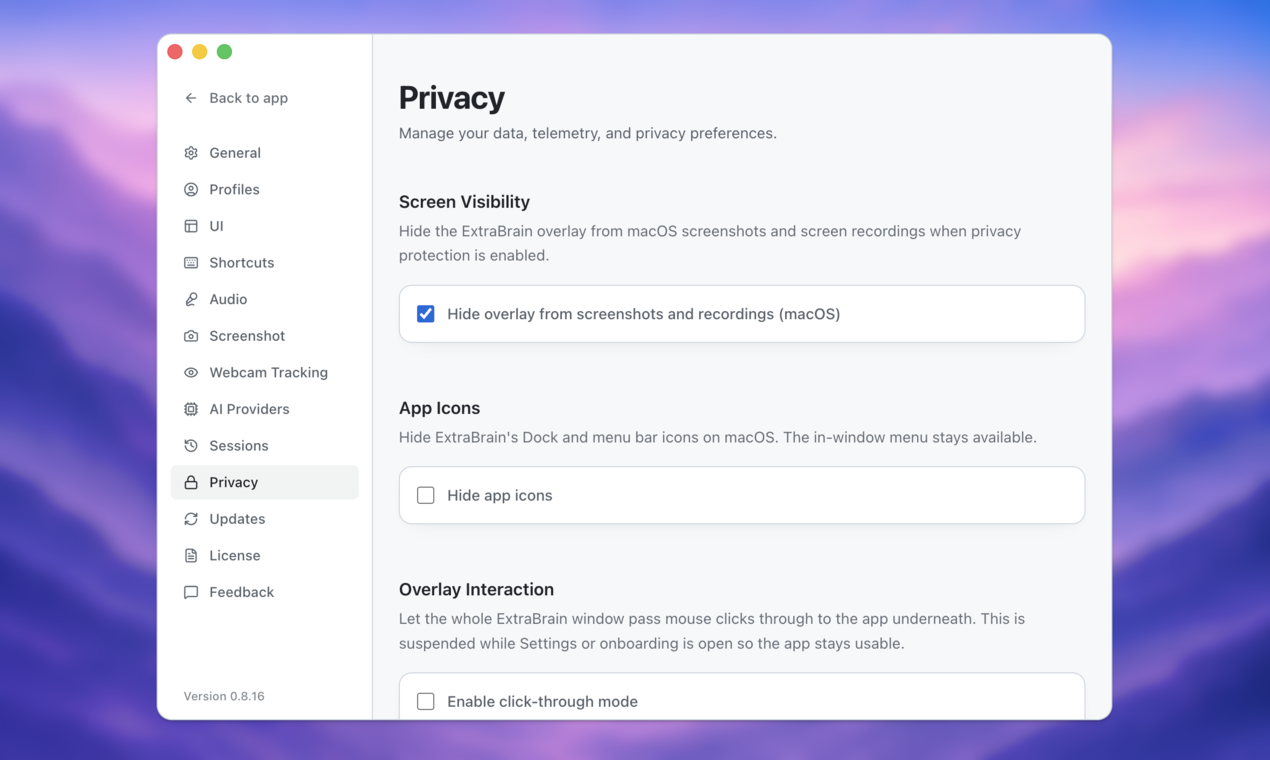
Security and Privacy Controls
ExtraBrain gives you more control over the privacy posture of your interview workflow. You can configure local Parakeet transcription and local Gemma 4 on-device AI where installed and compatible for a more local setup. You can also bring your own AI providers when you want to use external models, including supported providers and custom OpenAI-compatible endpoints.
That provider control is important because there is no single privacy setting that fits everyone. A mock interview at home, a confidential job interview, a school assessment, and a workplace meeting may all have different rules. A safer tool should make those choices visible instead of hiding them.
Reliability and User Experience
ExtraBrain is built as a desktop assistant, not a tab you need to keep switching back to. It helps you follow the live session through transcript context, screen-aware prompts, and post-session review. That matters because the best live assistant is the one that supports your attention instead of scattering it.
For technical interviews, you can use ExtraBrain to help with:
- Clarifying the problem statement.
- Identifying assumptions and constraints.
- Structuring a coding explanation.
- Thinking through edge cases.
- Preparing system design tradeoffs.
- Reviewing what went well after the interview.
For behavioral interviews, you can use it to shape STAR answer outlines, track follow-up questions, and connect your answers to your own past experience. The goal is not to sound like a generic AI response. The goal is to communicate your real thinking more clearly.
Responsible Use Instead of Detection Games
A safer AI interview workflow should not be built around cheating, bypassing proctoring, or defeating detection. It should be built around preparation, permitted assistance, privacy, and honest communication.
ExtraBrain is designed to stay hidden from screen sharing and screen recording on major meeting tools, while users remain responsible for following all applicable rules. That means the product can support a less distracting desktop workflow, but it does not remove your responsibility to use it only where allowed.
Here is a practical comparison mindset:
| Evaluation area | Risk-first question | Safer ExtraBrain posture |
|---|---|---|
| Privacy | Do I know where my transcript and prompts go? | Choose local-first options where installed and compatible, or configure external providers knowingly |
| Reliability | Can I practice with the exact workflow before the live session? | Use the free Mac app to test live transcription and context handling |
| Interview ethics | Am I following the rules of this interview or assessment? | Use only where AI assistance, transcription, screenshots, and notes are allowed |
| Performance | Does the tool help me explain my own reasoning? | Use outlines, clarifying questions, and review instead of blind answer copying |
How to Move From a Risky AI Interview Setup to ExtraBrain
Switching tools is easier when you treat it like a workflow reset. Do not simply replace one assistant with another and hope the risk disappears. Review your data, permissions, provider choices, and interview rules before using any AI tool live.
Transition Preparation
Start by cleaning up your old interview data. Remove practice notes, uploaded resumes, screenshots, and transcripts that you no longer need. If another tool stores data in the cloud, review its export and deletion options before you stop using it.
Then list the features you actually use. Most candidates do not need every feature in a large interview platform. They usually need a few reliable capabilities:
- Live transcript awareness.
- Coding or system design context.
- Behavioral answer structure.
- Follow-up question generation.
- Private notes and post-session review.
- Clear provider and privacy controls.
This list helps you configure ExtraBrain intentionally instead of copying an old workflow that already made you uneasy.
Setup and Onboarding
Install ExtraBrain on your Mac and run a practice session before using it in any important interview. Check your microphone, transcription settings, AI provider configuration, privacy controls, shortcuts, and screen context behavior.
If you want the most local posture, configure local Parakeet transcription plus local Gemma 4 on-device AI where installed and compatible. If you prefer an external AI provider, connect the provider you choose and remember that selected prompts, transcript text, screenshots, audio, or context may be sent to that provider depending on your setup.
A good first test is a low-stakes mock interview. Open a coding prompt, talk through your approach, and check whether the assistant helps you reason clearly without taking over the session.
Tips for a Smooth Migration
Use the first week as a calibration period. Do not wait until the final round to learn how your AI workflow behaves.
Try this sequence:
- Run one practice coding interview without AI and save your notes.
- Run the same prompt with ExtraBrain and compare the quality of your explanation.
- Practice a behavioral interview and ask for STAR structure feedback.
- Review the transcript after the session and identify weak moments.
- Adjust provider, transcription, screenshot, and session-history settings based on your privacy needs.
- Confirm the rules before using AI in any live interview, workplace meeting, school context, or assessment.
The goal is not to become dependent on the assistant. The goal is to build a calmer, more transparent workflow.
Best Practices to Minimize AI Interview Risks
Reducing ultracode ai risk is part of a broader AI interview safety habit. The tool matters, but your process matters too.
Choose Tools Based on Risk, Not Hype
Strong marketing claims are not the same as a safe workflow. Choose tools that make their data flow understandable, support practice before live use, and let you configure the provider setup that fits your situation.
Before trusting any AI interview assistant, test it under realistic conditions:
- Use the same Mac, microphone, meeting app, and coding environment you expect to use live.
- Try one easy prompt and one hard prompt.
- Check whether the assistant helps with reasoning rather than only final answers.
- Review whether the interface distracts you.
- Confirm that your session history and privacy settings match your expectations.
Protect Sensitive Data
Treat interview data like career data. It can include personal identity details, salary expectations, company names, confidential work examples, and private career plans.
A safer data routine looks like this:
- Share only the context needed for the session.
- Avoid uploading unnecessary resumes, offer letters, or private documents.
- Use local-first settings when the session is sensitive and your hardware supports them.
- Review external provider settings before sending prompts or screenshots.
- Delete sessions you do not need to keep.
- Avoid using AI in restricted assessments or confidential settings without permission.
Stay Current on Platform and Employer Policies
AI rules are changing quickly. Some companies now give candidates explicit guidance about allowed tools. Others treat live assistance as a violation. Some interviewers are comfortable with AI-assisted preparation but not live answer generation.
Do not guess. Check the instructions for each interview or assessment. If the rules mention AI, transcription, screen sharing, note-taking, browser extensions, or outside help, read them carefully. If the rules are unclear and the stakes are high, ask before the session or keep AI use limited to preparation and review.
Responsible use is not only about avoiding penalties. It is about protecting your credibility.
FAQ
What is ultracode ai risk?
Ultracode ai risk refers to the privacy, reliability, cost, detection, and policy concerns candidates may weigh before using an AI interview tool. The same risk categories apply to any live interview assistant, so the safer approach is to evaluate data handling, rules, and real interview workflow before relying on one.
Is ExtraBrain safer than Ultracode AI?
ExtraBrain gives Mac users a local-first desktop workflow with live transcription, screen-aware context, local Gemma 4 where installed and compatible, bring-your-own providers, and privacy controls. Whether it is safer for your use case depends on how you configure transcription, AI providers, screenshots, and session history, plus whether your interview rules allow AI assistance.
Can ExtraBrain run fully local?
A fully local ExtraBrain posture requires local Parakeet transcription plus local Gemma 4 on-device AI where installed and compatible, with no external provider requests. External providers may receive selected prompts, transcript text, screenshots, audio, or context depending on configuration.
Can I use ExtraBrain for coding, system design, and behavioral interviews?
Yes. ExtraBrain is built for coding interviews, system design rounds, behavioral interviews, product interviews, meetings, lectures, and research calls. Use it responsibly and only where the relevant rules allow AI assistance, transcription, screenshots, or notes.
Is ExtraBrain free?
The core ExtraBrain Mac app is free. ExtraBrain Pro is $9.99/month, $79/year, or $149 Lifetime launch pricing. External AI and transcription provider usage is billed separately by the providers users choose.
What is the best way to avoid AI interview risk?
Use AI as a preparation, structure, review, and allowed-assistance tool rather than a replacement for your own thinking. Practice with the exact setup, protect sensitive data, confirm the rules, and make sure you can explain every answer you give.