
ExtraBrain Blog
Why Ultracode AI Felt Like Trash and What I Wanted Instead

A practical look at Ultracode AI trash complaints, reliability concerns, pricing anxiety, and why Mac users may prefer ExtraBrain.
I understand why people search for phrases like “Ultracode AI trash.” They are usually not looking for a balanced category overview. They are frustrated after paying for a tool, depending on it during stressful interview preparation, and discovering that the experience does not match the promise.
That was the intent behind the original complaint: a candidate tried Ultracode AI, liked parts of the polish, but became worried about reliability, interview fit, detection risk, cost, and whether the tool actually helped in real pressure moments. This rewrite keeps that practical lens while replacing the old product positioning with ExtraBrain, a free, local-first desktop AI interview assistant and meeting copilot for Mac.
This is not a guide to bypass rules, defeat proctoring, or secretly use AI where it is not allowed. AI interview assistants should be used only where interview, employer, school, workplace, meeting, and platform rules allow AI assistance, transcription, screenshots, or notes.

Why the Ultracode AI Trash Search Exists
The phrase sounds harsh, but the concern behind it is simple. Candidates want interview software that works when the stakes are high. If a tool freezes, gives shallow answers, costs too much upfront, or creates uncertainty about what is visible during screen sharing, the emotional reaction becomes strong fast.
A live interview is not a normal software demo. You are listening, coding, explaining tradeoffs, watching the clock, and trying to sound like yourself. Any assistant that adds confusion instead of clarity can feel worse than having no assistant at all.
The common complaints around Ultracode AI usually cluster into four buckets:
- Performance and stability during live sessions.
- Reasoning quality for hard coding and system design prompts.
- Visibility, policy, and trust concerns in interview environments.
- High-cost purchasing decisions that feel risky before the user has enough confidence.
Those are reasonable things to evaluate before choosing any AI interview copilot. They are also the same reasons many candidates start looking for an Ultracode AI alternative.
The First Problem: Real Interviews Are Messy
Many AI interview tools look good when there is one clean prompt on the screen. Real interviews rarely stay that clean.
A senior coding interview might begin with a simple implementation task, then shift into follow-up constraints, memory tradeoffs, concurrency concerns, edge cases, and production behavior. A system design interview might move from an architecture sketch into rate limits, storage choices, failure modes, observability, cost, and rollout strategy. A behavioral interview might require you to connect a story from your own experience to the specific signal the interviewer is testing.
That is where generic answer generation starts to break down. A useful assistant should help you think through the interview, not just paste a polished answer.
What Felt Weak in the Ultracode AI Experience
The original complaint focused on a familiar pattern: quick answers that did not hold up under follow-up questions. That is a serious issue because follow-ups are often where interviewers learn whether you understand your own solution.
For senior candidates, a tool has to support reasoning, not just completion. It should help with clarifying questions, tradeoffs, constraints, alternative approaches, and explanation structure. If it only works when the prompt is obvious, it will not feel reliable in serious interviews.
What I Would Want Instead
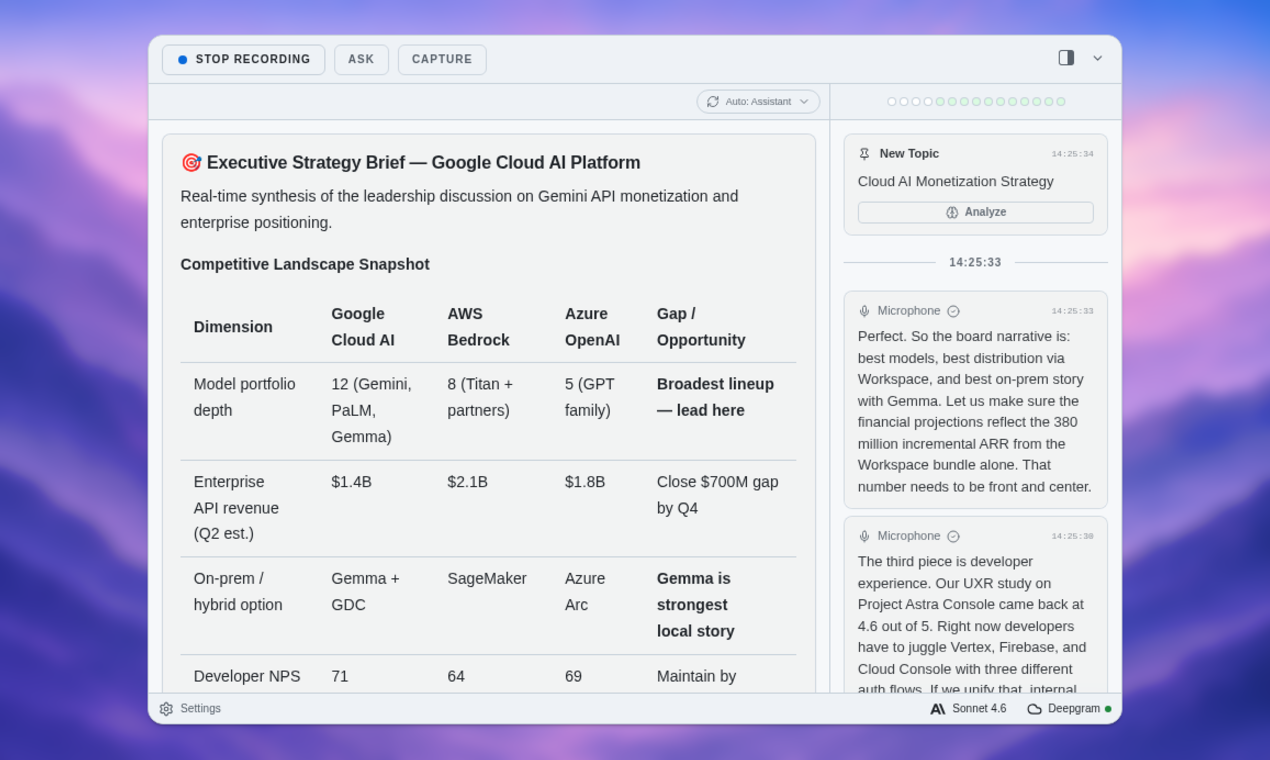
I would want an AI interview assistant that can work from live transcript context, visible screen context, and the candidate’s own thinking. ExtraBrain is built around that workflow on Mac. It provides live transcription, screen-aware context, coding and system design support, and post-session review so the interview does not disappear after the call ends.
That matters because interview success is not only about the next answer. It is also about noticing the interviewer’s direction, remembering what has already been said, and reviewing the session afterward.
The Second Problem: Visibility Claims Need Careful Language
A lot of AI interview assistant marketing leans on words like invisible, undetectable, hidden, or safe. That language can create the wrong expectation. It can also push users toward irresponsible behavior.
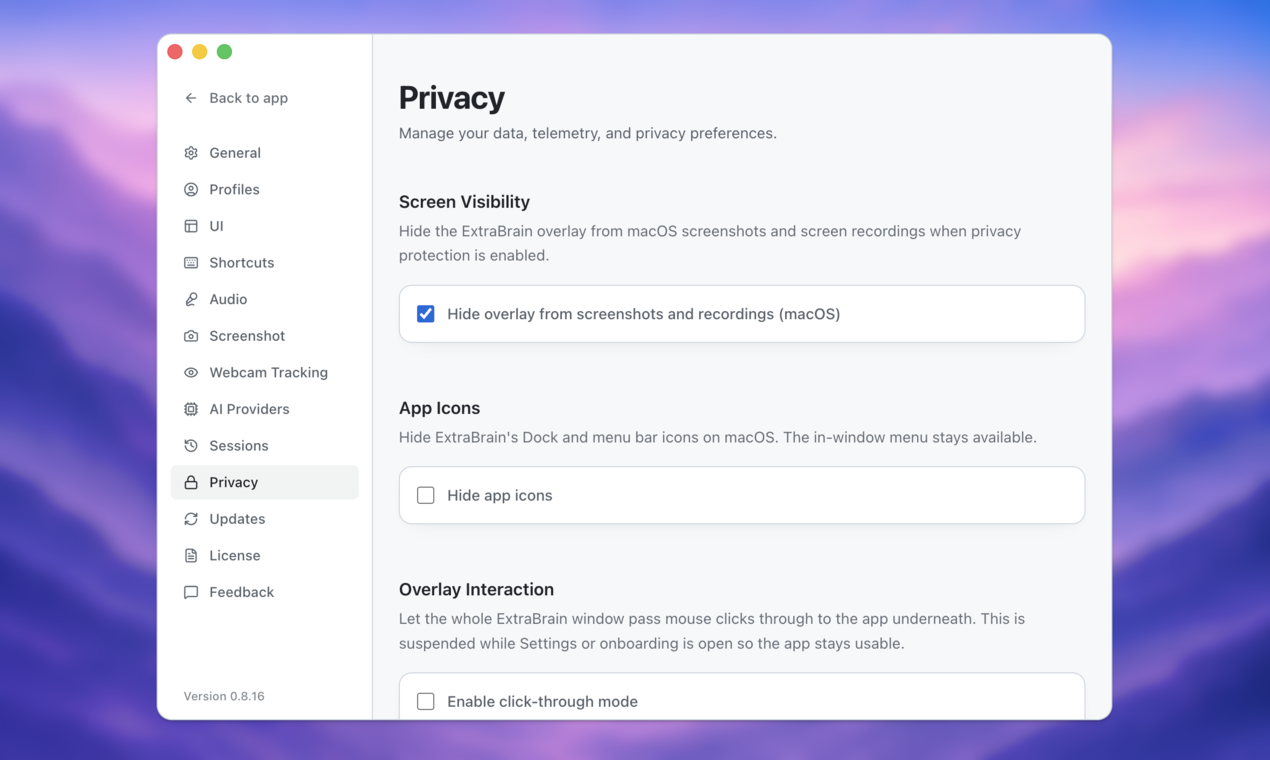
ExtraBrain’s product direction is more careful. ExtraBrain is designed to stay hidden from screen sharing and screen recording on major meeting tools, but users remain responsible for following all interview, workplace, school, and platform rules. That distinction matters.
No tool should encourage people to violate assessment rules. No tool should promise that a user can bypass detection or proctoring. The better question is not “Can I get away with this?” The better question is “Can I use this in a permitted, honest, and useful way?”
A Responsible Use Checklist
Before using any AI assistant in an interview, assessment, meeting, or class, ask:
- Does the interviewer, employer, school, or platform allow AI assistance?
- Are transcription, screenshots, screen context, or notes allowed?
- Would I be comfortable explaining how I used the tool?
- Am I using it to support my thinking rather than replace my thinking?
- Do I have a backup plan if the tool is unavailable?
If the answer is unclear, do not assume permission. Use the tool for preparation, mock interviews, personal review, and allowed meetings instead.
The Third Problem: Cost Changes the Risk Calculation
The original article criticized high upfront pricing and refund frustration. That concern is easy to understand. Interview candidates are often between jobs, preparing under pressure, or trying to improve their odds without taking on another expensive commitment.
A high lifetime fee can feel attractive if the product is excellent. It can feel terrible if the product disappoints after a few sessions. The more uncertain the interview tool category feels, the more important flexible pricing becomes.
ExtraBrain takes a different path. The core ExtraBrain Mac app is free. ExtraBrain Pro is $9.99/month $79/year, or $149 Lifetime launch pricing. External AI and transcription provider usage is billed separately by the providers users choose.
That structure makes the first step much less dramatic. A candidate can start with the free Mac app, configure providers they control, and decide later whether Pro features are worth it.
The Fourth Problem: Candidates Need Control Over Data Flow
Interview preparation can include sensitive information. Your resume, compensation history, past projects, work stories, customer details, screenshots, code, and meeting transcripts can all contain data you would not want spread around casually.
That is why privacy posture matters when comparing AI interview tools. It is not enough to ask whether the answers are fast. You should ask where the transcript goes, what provider receives the prompt, whether screenshots are sent externally, and whether there is a local option.
ExtraBrain is local-first. A fully local ExtraBrain posture requires local Parakeet transcription plus local Gemma 4 on-device AI where installed and compatible, with no external provider requests. If you choose external providers, selected prompts, transcript text, screenshots, audio, or context may leave the device depending on your configuration.
That is the kind of tradeoff users should be able to understand and control. Local-first does not mean every possible setup is local by default. It means the product is designed to give users clearer control over local and external paths.
What I Look For in an Ultracode AI Alternative
After a frustrating AI interview assistant experience, I would not immediately jump to the flashiest competitor. I would evaluate the workflow against real interview needs.
Here is the practical checklist I would use.
| Evaluation area | What to ask | Why it matters |
|---|---|---|
| Reliability | Does it stay responsive during realistic practice sessions? | A tool that freezes under pressure can break your focus. |
| Reasoning support | Does it help with follow-ups, tradeoffs, and explanation structure? | Real interviews test adaptation, not just first answers. |
| Interview coverage | Does it support coding, system design, behavioral, and product-style conversations? | Most hiring loops include more than one interview format. |
| Data control | Can you choose local or external providers knowingly? | Transcripts and screenshots can contain sensitive information. |
| Pricing | Can you try the product without a risky upfront decision? | Candidates should not need to gamble on expensive software. |
| Responsible use | Does the product encourage rule-aware usage? | Trust matters more than short-term shortcuts. |
ExtraBrain is a strong fit for Mac users who want a free core desktop app, live transcription, screen-aware context, local-first options, bring-your-own AI providers, and post-interview review. It is also useful beyond interviews, including meetings, lectures, customer calls, and research conversations.
Comparing the Better Direction
The point is not that every user should have the same favorite tool. The point is that an AI assistant should reduce cognitive load instead of increasing it.
A poor fit makes you wonder whether the assistant will crash, whether it will misunderstand the prompt, whether it is visible in the wrong place, whether the answer sounds robotic, and whether the price was a mistake. A better fit helps you listen, structure, explain, and review.
| Category | A frustrating AI interview assistant experience | The ExtraBrain direction |
|---|---|---|
| First impression | Polished, but hard to trust after pressure testing | Desktop workflow built for live sessions and review |
| Interview support | Often judged by one-shot answer quality | Supports transcript context, screen context, and follow-up thinking |
| Platform | Depends on the vendor’s supported environment | Available for macOS today, including Apple Silicon and Intel Macs |
| Provider model | May feel locked into the vendor’s choices | Bring-your-own AI providers plus local Gemma 4 where installed and compatible |
| Transcription | Often unclear from the outside | Local Parakeet and optional Deepgram |
| Privacy posture | Hard to evaluate if data flow is vague | Local-first options with clearer provider tradeoffs |
| Pricing posture | High upfront costs can create regret | Free core Mac app with optional Pro pricing |
| Responsible use | Marketing can overemphasize stealth | Users remain responsible for following all rules |
How ExtraBrain Fits Different Interview Types
Coding interviews
For coding interviews, a useful assistant should help you reason through the problem instead of simply dumping code. You want help identifying constraints, discussing complexity, explaining tradeoffs, and preparing for follow-up changes.
ExtraBrain can support coding interview practice with live transcript context and screen-aware context. The candidate still needs to understand the solution, explain it honestly, and comply with the interview rules.
System design interviews
System design interviews are less about a single perfect answer and more about structured thinking. You need to clarify requirements, choose architecture boundaries, discuss bottlenecks, and reason about reliability.
ExtraBrain can help organize that discussion during practice or allowed live sessions. It can also preserve the transcript so you can review where your explanation became vague.
Behavioral interviews
Behavioral interviews often expose the weakness of generic AI answers. A polished answer that does not match your real experience can sound fake.
ExtraBrain works better as a memory and structure aid. It can help shape STAR outlines, follow-up questions, and debrief notes from your real interview context, while you remain responsible for telling true stories.
Product and cross-functional interviews
Product, strategy, finance, ops, and customer-facing interviews often mix domain context with ambiguous judgment calls. A good assistant should help you track assumptions and ask better clarifying questions.
ExtraBrain is not limited to coding prompts. It can act as a meeting copilot for live conversations where transcription, screenshots, notes, and AI assistance are allowed.
A Practical Migration Plan
If you feel burned by an AI interview assistant, do not switch blindly. Use a structured test instead.
Step 1: Recreate your hardest interview scenario
Pick a realistic coding, system design, behavioral, or product prompt. Make it messy on purpose. Add follow-up questions, vague requirements, and corrections. See whether the assistant helps you recover or makes you more dependent.
Step 2: Test the tool before a real interview
Do not make your first serious use happen during a live interview. Run mock sessions. Check audio, transcription, screen context, shortcuts, provider settings, and privacy controls.
Step 3: Review the transcript afterward
The best preparation often happens after the session. Look for moments where your answer drifted, where you missed a constraint, or where the interviewer had to repeat the same concern. ExtraBrain’s session-oriented workflow is useful here because it treats the interview as something you can learn from afterward.
Step 4: Decide what belongs local
If you want the most local posture, configure local Parakeet transcription and local Gemma 4 on-device AI where installed and compatible. If you use Anthropic, OpenAI, custom OpenAI-compatible endpoints, Claude Subscription, Codex Subscription, Deepgram, or another external provider, understand what data may be sent to that provider.
Step 5: Keep your own judgment in the loop
An AI assistant should not become the interviewer. It should not become your identity. Use it to organize, clarify, remember, and practice. Do not use it to misrepresent your skills.
FAQ
Why do people call Ultracode AI trash?
People usually use that phrase when they feel disappointed by reliability, cost, answer quality, visibility concerns, or the gap between marketing and real interview pressure. The phrase is emotional, but the underlying evaluation criteria are valid.
Is ExtraBrain an Ultracode AI alternative?
Yes, ExtraBrain can be an Ultracode AI alternative for Mac users who want a free core desktop app, live transcription, screen-aware context, local-first options, and provider access they control. It is especially relevant for coding interviews, system design rounds, behavioral interviews, meetings, lectures, and research calls.
Is ExtraBrain only for interviews?
No. ExtraBrain is a free, local-first desktop AI interview assistant and meeting copilot for Mac. It can be used for interviews, workplace meetings, lectures, customer calls, and research conversations where recording, transcription, screenshots, notes, and AI assistance are allowed.
Can ExtraBrain run fully local?
A fully local ExtraBrain posture requires local Parakeet transcription plus local Gemma 4 on-device AI where installed and compatible, with no external provider requests. External providers may receive selected prompts, transcript text, screenshots, audio, or context depending on configuration.
Does ExtraBrain guarantee that nobody can detect AI use?
No. ExtraBrain should not be used to bypass rules, defeat proctoring, or misrepresent your work. It is designed to stay hidden from screen sharing and screen recording on major meeting tools, but users remain responsible for following all interview, employer, school, workplace, meeting, and platform rules.
How much does ExtraBrain cost?
The core ExtraBrain Mac app is free. ExtraBrain Pro is $9.99/month $79/year, or $149 Lifetime launch pricing. External AI and transcription provider usage is billed separately by the providers users choose.
What platforms does ExtraBrain support?
ExtraBrain is available for macOS today, including Apple Silicon and Intel Macs. Windows and Linux are planned future platforms.
What should I do if an AI assistant fails during an interview?
Stay calm and continue explaining your own thinking. The best backup plan is genuine preparation: know the problem, state assumptions, ask clarifying questions, and do not rely on any single tool as your only source of confidence.