
ExtraBrain Blog
Vervoe Assessment in 2026: Use AI Help Without Crossing the Line
A practical guide to using AI responsibly for Vervoe prep, practice answers, timing, follow-ups, privacy, and assessment rules in 2026.
Many candidates search for phrases like “Vervoe how to cheat” because they feel pressure, uncertainty, or fear before a skills assessment. A better question is safer and more useful: how can you use AI to prepare for a Vervoe-style assessment without misrepresenting your skills or breaking the rules?
This guide reframes the original problem as responsible assessment preparation. It keeps the practical parts that matter, including practice structure, answer customization, timing, follow-up readiness, privacy, and mistakes to avoid. It does not recommend bypassing proctoring, hiding prohibited tools, impersonating another person, or submitting AI work as your own when the assessment rules do not allow it.
ExtraBrain is a free, local-first desktop AI interview assistant and meeting copilot for Mac. It can help you practice aloud, review transcripts, structure behavioral answers, reason through coding or work-sample tasks, and build a more honest preparation loop before the real assessment.
Key takeaways
- Treat AI as a preparation partner, not a way to fake ability during a live assessment.
- Read the Vervoe instructions carefully before using any assistant, notes, transcription, screenshots, or external tools.
- Personalize practice answers so they reflect your actual experience, judgment, and communication style.
- Prepare for follow-up questions because employers may ask you to explain your decisions later.
- Use privacy-conscious tooling when practicing with sensitive career notes, transcripts, screenshots, or work examples.
- If AI help is not allowed during the assessment, use it before and after the session instead.
Why people look for AI help with Vervoe assessments
Vervoe-style assessments can feel different from a normal interview. You may see work simulations, written responses, coding tasks, customer scenarios, sales prompts, prioritization exercises, or video answers. The format can create pressure because you need to show skill quickly, often without the conversational feedback you would get from a human interviewer.
That pressure is why candidates often look for shortcuts. The problem is that shortcuts can damage trust, create detection risk, and leave you unprepared for the actual job. A stronger approach is to use AI to make your preparation more realistic.
ExtraBrain is useful in that preparation loop because it can help you capture your thinking, summarize practice sessions, generate follow-up questions, and turn messy notes into clearer answer outlines. You still need to do the work, make the choices, and speak from your own experience.
Understand the rules before you use any AI tool
Before you use AI for a Vervoe assessment, separate three situations.
| Situation | Safer interpretation | What to do |
|---|---|---|
| AI is clearly allowed | You may use approved assistance within the stated boundaries. | Follow the instructions, disclose if required, and keep your work explainable. |
| AI is not mentioned | Do not assume it is allowed during the live assessment. | Use AI for preparation, then complete the assessment according to the rules. |
| AI is clearly prohibited | Using it during the assessment may be misconduct. | Practice beforehand and do not use prohibited tools in the assessment. |
This distinction matters because assessment platforms, employers, schools, and roles can have different policies. Responsible use means following the rules that apply to your situation.
What Vervoe may evaluate
A Vervoe assessment is usually designed to evaluate job-relevant skills rather than only credentials. Depending on the employer and role, the assessment may include written judgment, role-specific tasks, communication, problem solving, coding, prioritization, or scenario-based responses.
Candidates should assume their answers may be reviewed for consistency, originality, timing, and practical reasoning. They should also assume that a recruiter or hiring manager may ask follow-up questions later. That is why the safest preparation strategy is to build genuine fluency instead of trying to produce perfect one-off answers.
Use ExtraBrain for preparation, not deception
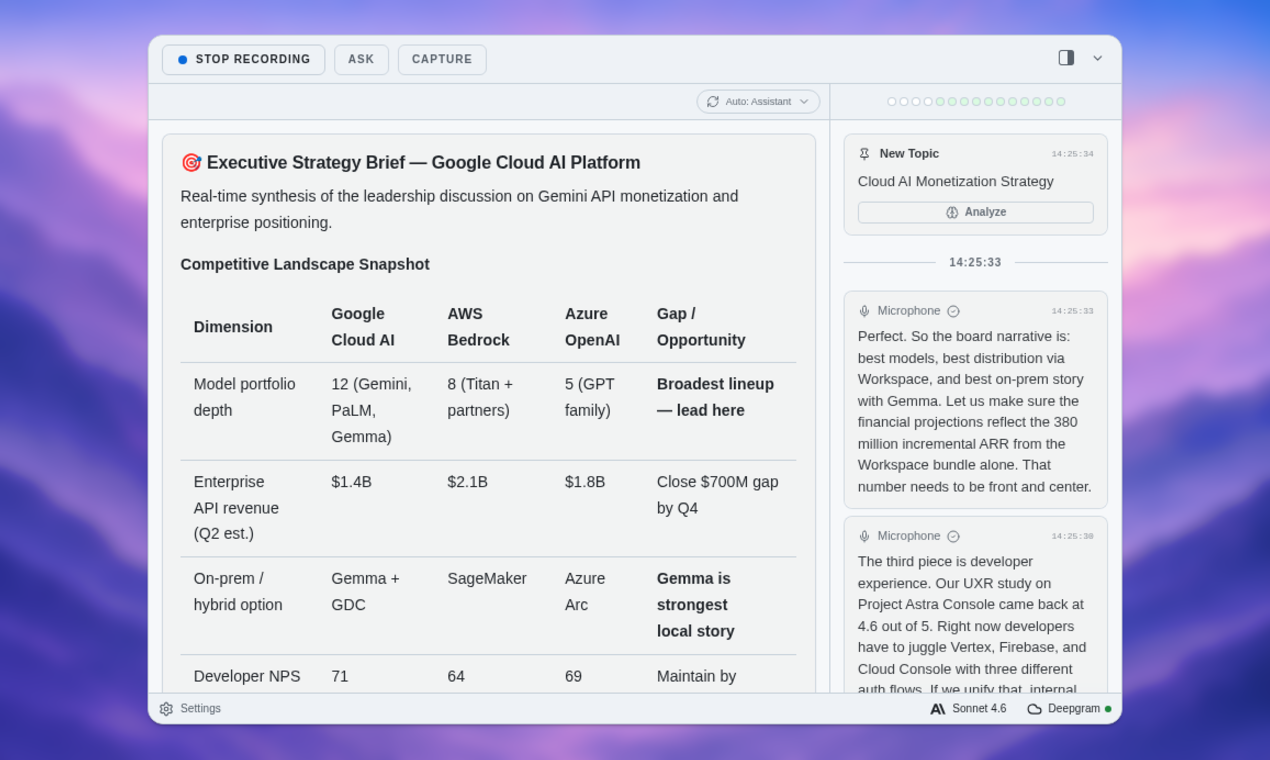
ExtraBrain can support a responsible Vervoe prep workflow in several ways. It is available for macOS today, including Apple Silicon and Intel Macs. Windows and Linux are planned future platforms.
Practice live answer structure
Open a practice prompt and talk through your answer as if you were in the real assessment. Use ExtraBrain to capture the session transcript and help you turn your raw response into a cleaner outline. Then repeat the prompt without reading the AI output word for word.
For behavioral prompts, ask for a STAR outline that uses your real example. For work-sample prompts, ask for a decision framework, tradeoffs, assumptions, and risks. For coding-style prompts, ask for clarifying questions, test cases, complexity discussion, and edge cases.
Build a personal answer bank
Many weak assessment answers sound generic because the candidate has not prepared specific evidence. Before the assessment, collect examples from your work, projects, classes, internships, volunteer work, or side projects. For each example, note the situation, your responsibility, what you did, what changed, and what you learned.
ExtraBrain can work as a focused AI second brain for interviews and meetings. That means you can use it as a workspace for live sessions, transcripts, notes, screen context, and review, rather than as a broad replacement for a general note-taking database.
Generate follow-up questions
A good answer should survive a follow-up. After drafting a response, ask ExtraBrain to challenge it with likely interviewer questions. Examples include:
- What assumption did you make here?
- What would you do if the customer disagreed?
- How would you measure whether this worked?
- What tradeoff did you reject?
- What part of this answer comes from your direct experience?
If you cannot answer these questions, the response is not ready. The goal is not to make the answer sound more AI-like. The goal is to make your own reasoning clearer.
Review timing and clarity
Some candidates over-polish written answers until they stop sounding like a real person. Others rush and submit vague responses. Practice timing helps you find a middle ground.
Use a timer, answer naturally, then review the transcript. Look for rambling openings, missing context, unsupported claims, and conclusions that do not answer the prompt. Then practice again with a shorter and more direct version.
A responsible Vervoe prep checklist
Use this checklist before the assessment day.
- Read the assessment instructions and AI policy.
- Confirm whether notes, calculators, external tabs, transcription, or AI tools are allowed.
- Practice role-specific scenarios rather than memorizing generic answers.
- Prepare examples that are true and easy to explain.
- Test your internet connection, webcam, microphone, browser, and quiet workspace.
- Practice answering without copying AI text directly.
- Review likely follow-up questions.
- Decide in advance what you will not use if the rules prohibit it.
A simple rule helps: if you would be uncomfortable explaining your tool use to the employer afterward, do not use it that way.
How to make AI-assisted practice sound like you
The right way to personalize AI output is not to add fake typos or artificial hesitation. The right way is to replace generic claims with truthful detail.
| Generic AI-style answer | Stronger personalized answer |
|---|---|
| ”I communicate well with stakeholders." | "In my last support rotation, I summarized the customer impact first, then separated urgent fixes from follow-up cleanup." |
| "I prioritize based on business value." | "I ranked the tasks by customer impact, deadline risk, and whether another teammate was blocked." |
| "I solved the issue efficiently." | "I reproduced the bug, checked the logs, isolated the API timeout, and wrote a short incident note for the team." |
| "I am a fast learner." | "When I joined the project, I built a small glossary of domain terms and asked the team to review my first two tickets.” |
This kind of personalization is also better preparation for interviews after the assessment. If your answer is based on something you actually did, you can defend it naturally.
Common mistakes when using AI for assessment prep
Overusing AI until your answers become generic
AI can make an answer look polished while removing the details that make it credible. If every response has the same rhythm, vague confidence, and broad claims, it may not help you stand out. Use AI to improve structure, then add your own evidence.
Practicing only the final answer
Many candidates practice the answer but not the reasoning behind it. That creates problems when a recruiter asks why you chose a certain tradeoff. Practice the explanation, assumptions, alternatives, and limitations.
Ignoring the employer’s policy
Different assessments have different rules. Some allow reference material. Some prohibit outside help. Some allow preparation but not live assistance. If you ignore the policy, you risk losing the opportunity even if your skills are strong.
Submitting work you cannot explain
This is the biggest practical mistake. If you cannot explain a written answer, code choice, prioritization decision, or scenario response in your own words, it is not truly your answer. Use AI to learn faster, not to create a gap between your submission and your actual ability.
Privacy and data handling during preparation
Assessment preparation can involve sensitive information. You may discuss employers, salary expectations, customer scenarios, personal stories, transcripts, screenshots, or examples from previous work. Choose tools and settings with that in mind.
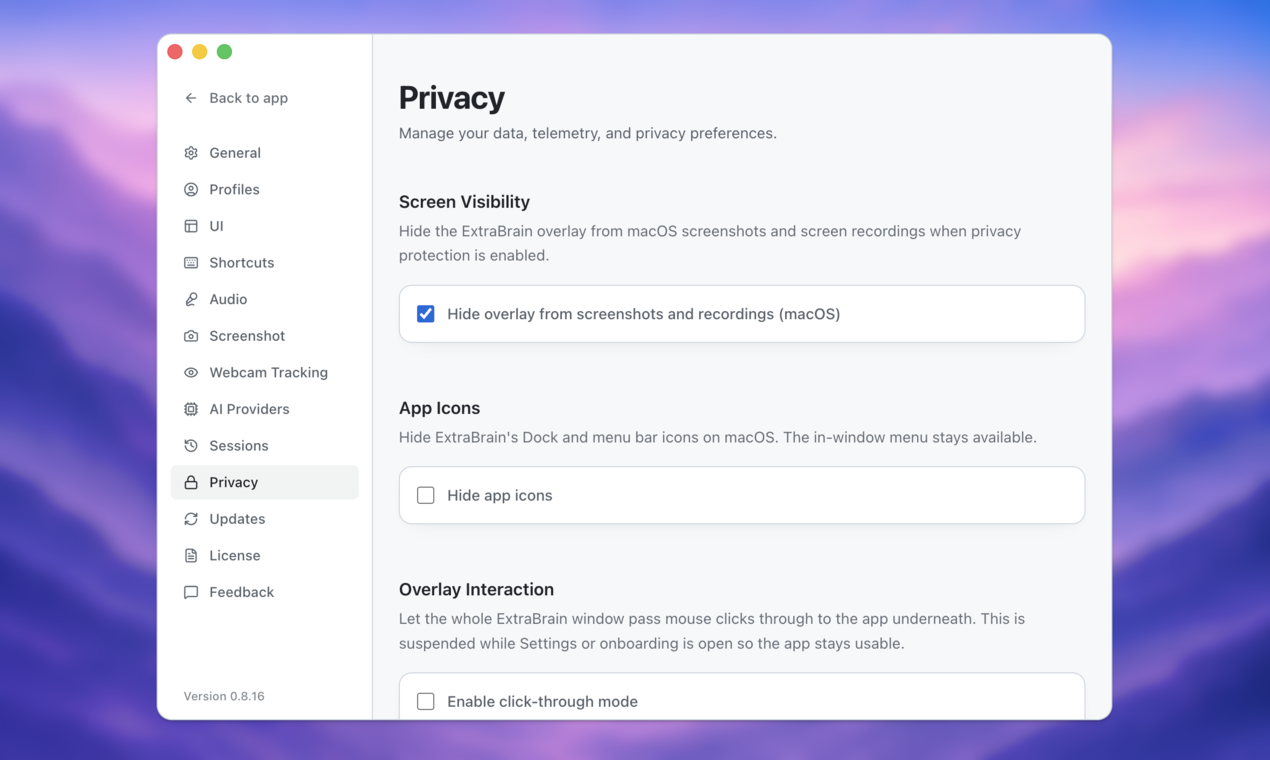
ExtraBrain is local-first and offers privacy controls. A fully local posture requires local Parakeet transcription plus local Gemma 4 on-device AI where installed and compatible, with no external provider requests. External providers may receive selected prompts, transcript text, screenshots, audio, or context depending on configuration.
If you use external AI or transcription providers, avoid pasting confidential employer data, private customer information, or assessment content that the rules prohibit sharing. When in doubt, use sanitized practice prompts instead.
What to do after the assessment
Do not stop learning once you submit. Write a quick debrief while the experience is fresh. Capture what felt easy, what felt unclear, where you ran out of time, and which questions you want to practice next.
ExtraBrain can help turn that debrief into a study plan. For example, you can ask it to group weak spots by communication, technical depth, prioritization, examples, or confidence. Then you can practice those areas before the next round.
FAQ
Can I use ExtraBrain during a Vervoe assessment?
Only if the assessment, employer, school, workplace, and platform rules allow AI assistance, transcription, screenshots, or notes. If the rules do not allow it, use ExtraBrain before the assessment for practice and after the assessment for review.
Is ExtraBrain an AI interview copilot?
Yes. ExtraBrain is a Mac desktop AI interview copilot with live transcription, screen-aware context, coding and system design support, local-first options, bring-your-own AI providers, and post-interview review.
Can ExtraBrain generate answers for practice?
ExtraBrain can help generate answer outlines, STAR structures, technical explanations, and follow-up questions from transcript and screen context. Candidates remain responsible for honest and allowed use.
How do I make practice answers more authentic?
Start with a real example from your experience. Use AI to clarify structure, not to invent accomplishments. Then rehearse the answer aloud until you can explain the situation, tradeoff, result, and lesson without reading.
What if I already used AI in a way that might violate the rules?
Do not double down or fabricate more details. Review the policy, consider whether disclosure is appropriate, and use the experience as a signal to prepare more transparently next time. For future assessments, decide your boundaries before the clock starts.