
ExtraBrain Blog
What Candidates Should Do When an Interviewer Asks, “Are You Using AI?”

How candidates can answer AI-use questions in interviews honestly, confidently, and professionally without sounding defensive.
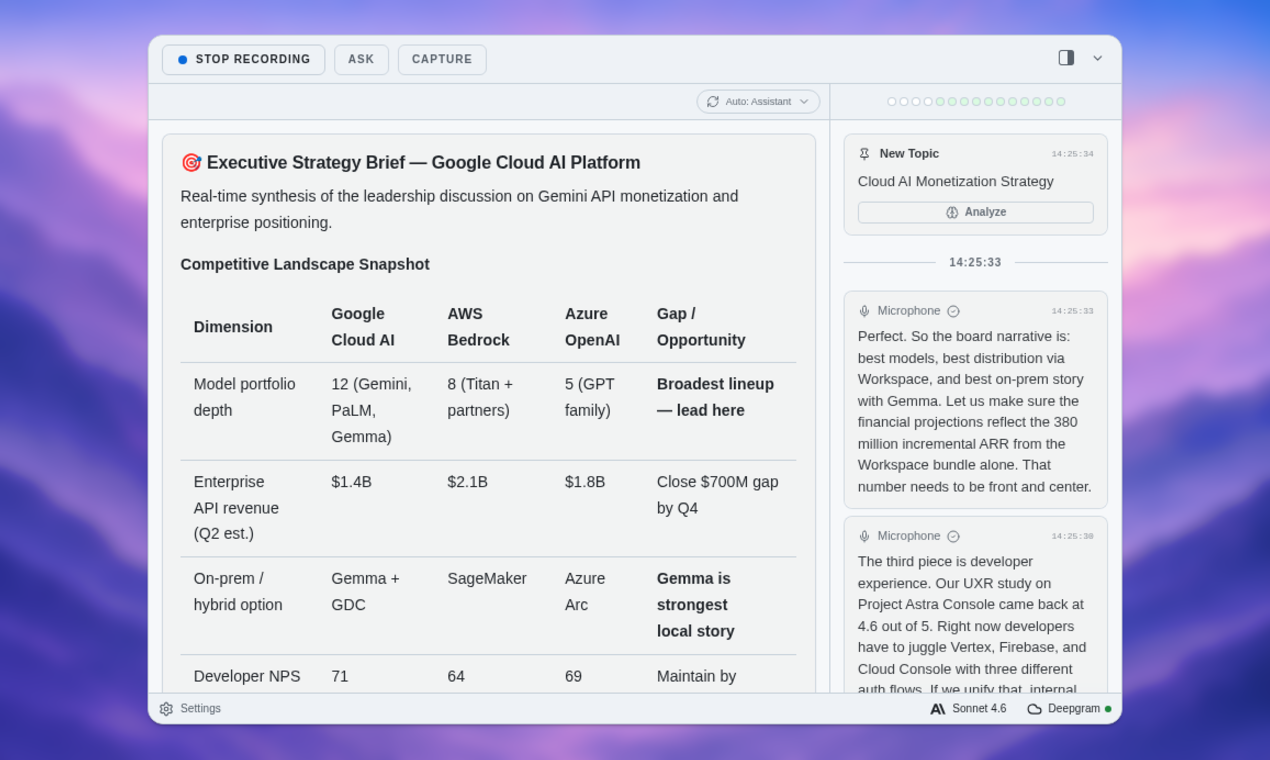
The question can land like a trap, even when it is not meant that way.
You are halfway through an interview. You have given a clear answer. Maybe you used a structured framework. Maybe your examples sound polished because you practiced. Then the interviewer pauses and asks: “Are you using AI?”
Your stomach drops. If you say yes, will they think you cheated? If you say no, are you hiding the fact that you used AI to prepare? If you over-explain, will you sound guilty? If you under-explain, will you seem evasive?
The best response is not panic, denial, or a speech about the future of work. It is a calm, specific explanation of what you used, what you did not use, and where your own judgment begins.
Treat the Question as a Boundary Check, Not an Accusation
When an interviewer asks whether you are using AI, they may be asking several different questions at once.
They may want to know whether you are receiving real-time help, whether you understand the company’s rules, or whether you can separate responsible preparation from answer generation.
Do not assume the question is an accusation. Treat it as a professional boundary check.
A strong first response is short:
“I’m not using AI to generate answers during this interview. I did use AI in preparation to organize my notes and practice explaining my experience, but the examples and decisions I’m discussing are my own.”
That answer addresses the live-interview concern directly, acknowledges responsible preparation, and puts ownership back where it belongs: on your experience, reasoning, and choices.
If you truly have not used AI at all, say that simply. The important part is not whether the answer is yes or no. The important part is that your answer is precise enough to reduce ambiguity.
Separate Preparation From Performance
Candidates get into trouble when they describe AI use too vaguely. “I used AI for prep” is better than nothing, but still incomplete. The interviewer needs to know whether AI helped organize your thinking or supplied the thinking being evaluated.
Use this distinction: preparation is different from performance.
Responsible preparation might include using AI to summarize the job description, build a story bank, practice behavioral questions, find gaps in your examples, rewrite rambling notes into clearer bullets, or generate follow-up questions you should be ready to answer.
Performance is different. In a live interview, especially a technical assessment, writing test, case study, or coding exercise, the company is usually evaluating your real-time judgment and skill. AI answer generation without permission changes what is being assessed.
That is why a candidate should be ready to say:
“I use AI the way I would use a coach or note organizer before a meeting. I do not use it to answer live questions unless the interviewer explicitly says tools are allowed.”
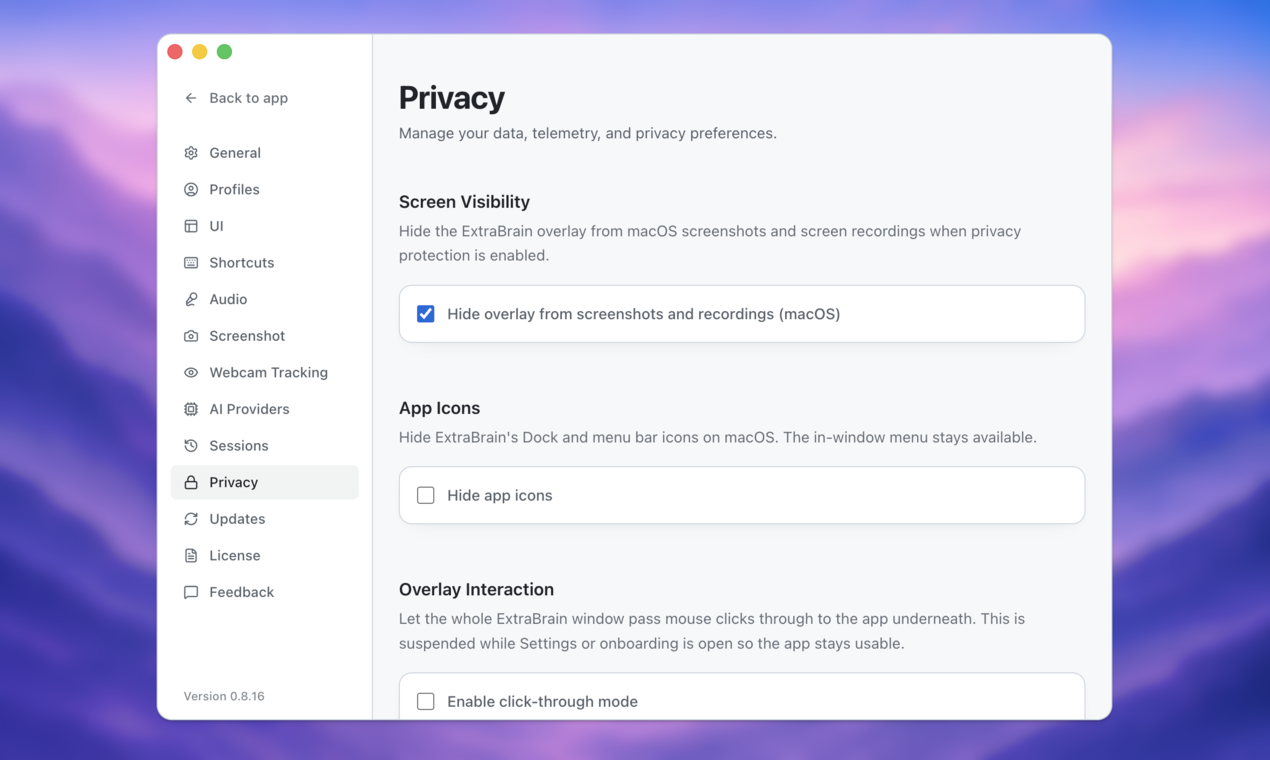
Tools like ExtraBrain are most valuable in this preparation zone: recording practice sessions, helping you review what you actually said, and giving you a private place to improve. A good AI interview preparation workspace should make your thinking clearer, not impersonate you.
Use a Three-Part Answer: Tool, Task, Ownership
If you want a reliable structure, use three parts: tool, task, ownership.
- Tool: What kind of AI did you use?
- Task: What did you use it for?
- Ownership: What did you decide, write, or say yourself?
Here is what that sounds like in practice:
“I used an AI tool before the interview to help organize my project examples and identify likely follow-up questions. I did not use it to invent examples or generate live answers. The story I just shared is from my own work, and I can walk through the tradeoffs or details if helpful.”
When you invite follow-up, you show confidence. You are not asking the interviewer to trust a polished surface. You are offering depth.
For a take-home assignment, the same structure works:
“I used AI to brainstorm edge cases and check whether my explanation was clear. I wrote the final solution myself, made the tradeoffs myself, and can explain what I accepted or rejected from the AI suggestions.”
For a presentation, it might be:
“I used AI to tighten the outline and make sure the flow was easy to follow. The analysis, recommendations, and examples are mine.”
This approach works because it is neither defensive nor naive. It acknowledges that modern professionals use tools. It also shows that you understand the ethical line.
If You Are Using Notes, Say So Before It Looks Weird
Sometimes the AI question appears because the interviewer notices behavior, not because they know anything about your tools. Maybe your eyes move toward a second screen, you pause to check notes, or you have a prepared outline open.
Do not let normal note use look secretive.
At the start of a video interview, it is reasonable to say:
“I have a few notes open with questions I wanted to ask and reminders of projects I may reference. I’m not reading answers, but I may glance at them so I do not forget anything important.”
That one sentence can prevent suspicion. It also communicates maturity: you prepared, you are organized, and you are not hiding the existence of notes.
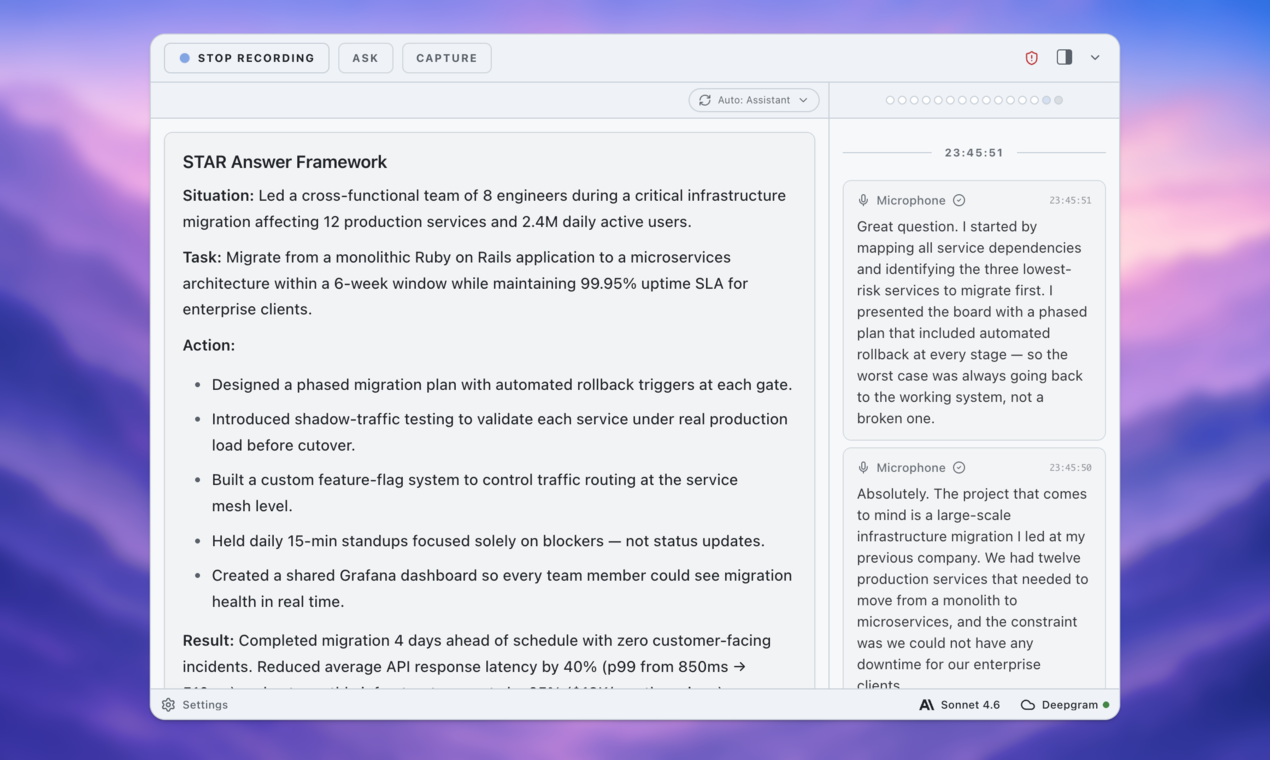
If you use any meeting assistant, transcription tool, or local-first AI meeting copilot, be even more careful. Recording or transcribing an interview without permission can create privacy and consent issues. If a tool captures audio, summarizes the conversation, or stores a transcript, ask first.
Try:
“Would it be okay if I used my note-taking tool for this conversation? If not, I’m happy to turn it off and take manual notes.”
That is professional consent.
Do Not Overconfess
Honesty does not require a five-minute explanation of every prompt you have ever typed. A common mistake is to overcorrect and launch into a nervous monologue about tools, AI ethics, and the future of work. Keep the answer proportional. The interviewer needs clarity, not a manifesto.
A concise answer is usually enough:
“I used AI before the interview to organize my preparation, but I’m not using it to generate answers here. The examples I’m sharing are my own experience.”
Then stop. If they ask a follow-up, answer it. If they do not, return to the interview.
Be Ready for Follow-Up Questions
A thoughtful interviewer may ask more. That is not automatically bad.
They might ask:
- “What exactly did you use AI for?”
- “Did AI help you with this assignment?”
- “How do you decide when not to trust AI?”
- “Would you use AI in this role?”
- “How would you disclose AI use on a team?”
These are good questions. They test judgment, not just compliance. Prepare your answers ahead of time. For example:
“I find AI useful for first-pass organization, but I do not trust it with final judgment. I check anything factual, remove anything that does not match my experience, and avoid putting confidential information into tools unless I know the privacy model.”
Or:
“In a work setting, I would follow the team’s policy. I would be comfortable saying when I used AI for brainstorming or summarization, and I would not use it for confidential data or decisions that require human accountability unless the process allowed it.”
This is where responsible AI use can strengthen your candidacy. Many teams want people who can use tools without losing judgment.
Protect Privacy When You Talk About AI Prep
Interview preparation often includes sensitive material: former employers, customers, internal systems, revenue numbers, salary expectations, immigration status, health needs, or workplace conflicts.
If you tell an interviewer you used AI, be prepared to show that you used it with privacy in mind.
A strong privacy-aware answer sounds like this:
“I was careful not to paste confidential company documents or customer names into AI tools. I used generalized descriptions of my projects and focused on improving the structure of my answers.”
That line shows workplace judgment. You are thinking about the people and companies whose information appears in your examples.
This is also why private, user-controlled tools matter. When interview prep includes real conversations and personal career details, candidates should prefer tools that give them control over what is captured, stored, and shared. A private AI interview copilot should help you practice and remember without turning your job search into a pile of uncontrolled data.
If the Interviewer’s Policy Is Unclear, Ask Directly
Sometimes you will not know the rules until you ask.
This is especially true for technical screens, take-home projects, live cases, writing samples, portfolio reviews, and role-play exercises. Some companies allow AI tools and want disclosure. Some ban them. Some allow documentation but not AI generation.
Do not guess silently.
Ask:
“Before I start, are candidates allowed to use AI tools, documentation, or search during this exercise?”
If the answer is yes, clarify the disclosure expectation:
“Great. Would you like me to note where I used AI and what I changed?”
If the answer is no, respect it:
“Understood. I’ll work without AI assistance.”
This may feel awkward, but it is less awkward than being challenged later. It also shows that you can operate inside professional constraints.
What Not to Say
Some answers create more concern than they solve.
Avoid:
“No, of course not.”
If you did use AI to prepare, this can sound misleading.
Avoid:
“Everyone uses AI now, so I do not think it matters.”
It does matter. The company is allowed to define what counts as valid performance in its own interview.
Avoid:
“I have an AI assistant listening, but it is just helping me think.”
If the interviewer did not approve real-time assistance or transcription, this is a problem.
A better pattern is calm, bounded, and specific:
“I used AI for preparation, not live answer generation. I can explain any part of my answer from my own experience.”
The Best Answer Is Backed by Real Depth
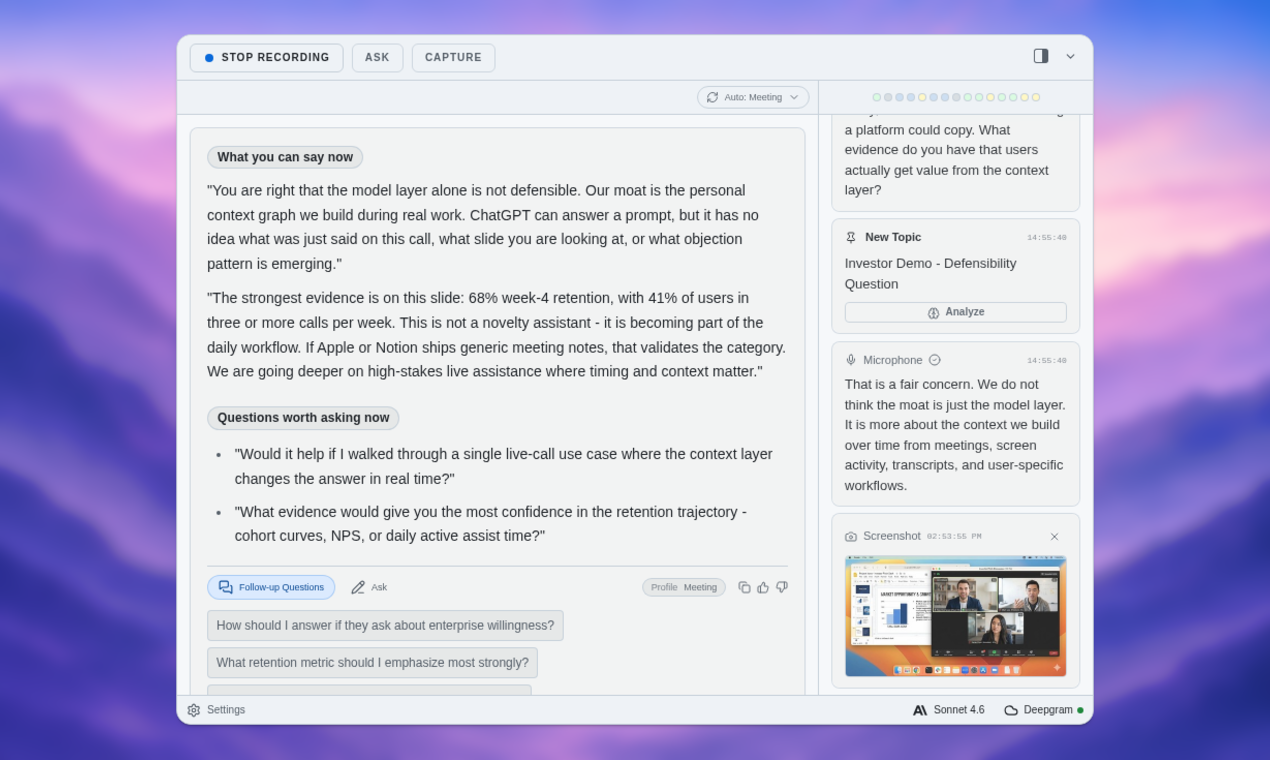
The most convincing disclosure is not the wording. It is what happens next. If you say the work is yours, you should be able to explain the messy parts of the project, why a decision was hard, what failed, what changed, and what you would do differently.
AI-assisted preparation can surface likely follow-ups, identify vague spots, and help you practice concise explanations. But it cannot replace lived experience.
Before your next interview, practice answering the AI question out loud. Listen for defensiveness, vagueness, or overexplaining. Then revise until your answer sounds like a professional boundary, not an apology.
If you want a private place to practice, review your answers, and keep your preparation under your control, try ExtraBrain before your next interview. Use AI to organize your thinking. Keep the judgment, examples, and voice unmistakably yours.