
ExtraBrain Blog
AI Agent Engineer Interview Prep: Evals, Tools, and Failure Modes
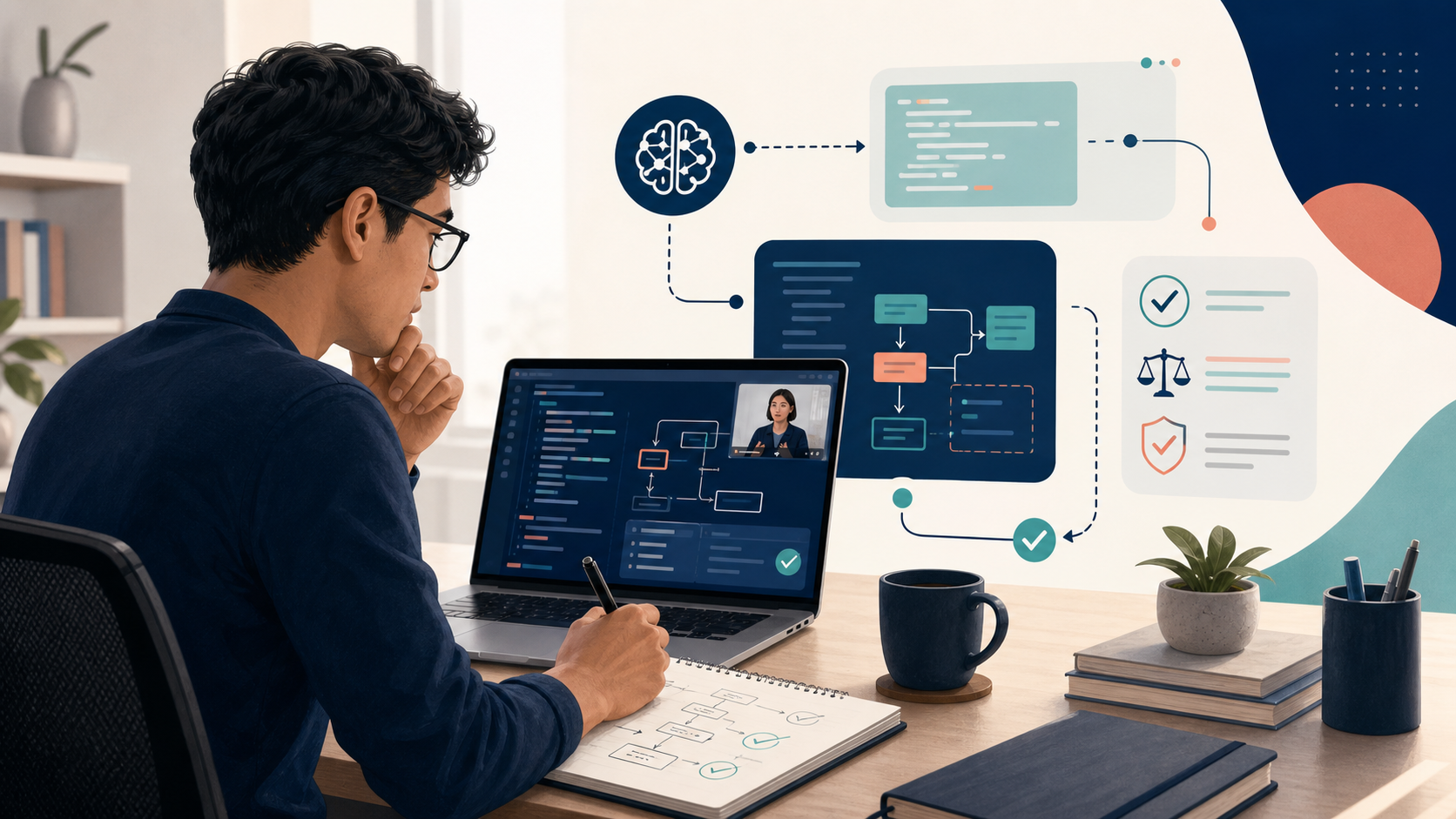
Prepare for an AI agent engineer interview with practical guidance on tool design, evaluations, failure modes, and production tradeoffs.
An AI agent engineer interview is not usually a vocabulary quiz about prompts, models, or frameworks. It is a test of whether you can turn an unreliable component into a useful system.
The interviewer may ask you to design an assistant that investigates a support issue, updates a record, drafts a report, or coordinates a multi-step workflow. The tempting answer is to draw an LLM in the middle, attach a few tools, and say “the agent decides.” The stronger answer explains what the agent is allowed to decide, what it must prove before acting, how you will evaluate it, and how a human can recover when it is wrong.
That distinction is timely. The broader AI-interview-prep market has expanded beyond classic coding prompts into agentic AI topics, while recent tool coverage still concentrates heavily on live assistance, comparison pages, and generic question banks. The search opportunity is more specific: candidates need a practical way to prepare for interviews where the work involves agents, tool calling, evaluations, and operational judgment.
This guide is for engineers, technical product builders, and platform candidates preparing for those conversations. It does not assume you have trained a foundation model. It shows how to discuss an agentic system with the level of precision that production work requires.
Start by defining the job the agent is actually doing
“Build an agent” is not a requirement. It is a label for many different systems.
Before proposing an architecture, translate the prompt into a bounded user job. A useful opening sounds like this:
Before choosing an agent loop, I want to understand the user outcome, the actions the system is permitted to take, the source of truth, and the cost of a wrong action.
That sentence changes the conversation. Instead of choosing a framework from memory, you are identifying the decision that determines whether an agent is appropriate at all.
Consider a prompt to “build an agent that resolves customer billing questions.” There are at least four substantially different jobs hidden inside it:
- Retrieve an explanation of an existing charge.
- Draft a support reply for a human to review.
- Issue a refund within a defined policy.
- Investigate a disputed charge and escalate an exception.
These jobs have different permissions, risks, and evaluation criteria. A retrieval-only assistant might need read access to an account ledger and citations to its source records. A refund agent needs a policy engine, an idempotent write action, a monetary threshold, and an audit trail. An investigation agent may need to create a case rather than change money at all.
Do not begin with a multi-agent diagram before you know which of these jobs matters. A narrow workflow with explicit steps is often easier to test, cheaper to operate, and safer to explain. The right moment to add autonomy is when branching or tool choice genuinely depends on the information discovered at runtime.
Separate the model from the system around it
Candidates sometimes describe an agent as though the model itself contains the business process. In production, the model is one component inside a system with inputs, policy boundaries, tools, state, logs, and people who own the outcome.
One useful way to organize an answer is to cover six layers:
| Layer | Interview question to answer |
|---|---|
| User outcome | What should be better for the user when this succeeds? |
| Context | What trusted information does the agent need, and how fresh must it be? |
| Reasoning loop | What decisions can the model make, and when does the loop stop? |
| Tools | Which actions can it call, with what schema, permission, and timeout? |
| Controls | What is blocked, reviewed, rate-limited, or escalated? |
| Evaluation | How will the team measure quality before and after release? |
This structure prevents a common failure: using “RAG,” “function calling,” or “memory” as an answer by itself. Those are implementation techniques, not product guarantees.
For example, if an agent can search an internal knowledge base and create a ticket, describe the controls independently. Search results may be stale or incomplete, so the reply should preserve citations or record identifiers. Ticket creation is a write action, so it should use a validated schema, a scoped service account, retries that respect idempotency, and a trace that makes the request reviewable. The model may suggest the ticket fields, but a deterministic service should enforce required fields and permitted values.
This system-level framing aligns with a practical principle in Anthropic’s guide to building effective agents: begin with the simplest solution and add complexity only where it demonstrably improves the task. You do not need to quote a framework to show that judgment. Explain why a workflow, a single tool-using loop, or a human handoff is enough for the stated risk.
Know the difference between a workflow and an agent
Interviewers may use these terms loosely, but your answer should not.
A workflow has a mostly predetermined path. For example: extract fields from an incoming form, validate them, look up an account, generate a draft, and route it to an approver. An LLM can participate in one or more steps, but the orchestration is defined by the team.
An agent has more latitude to select the next action based on what it sees. It might decide whether to search documentation, query an account record, ask a clarifying question, or escalate. That can be useful when the sequence is genuinely variable. It also makes testing, safety, latency, and cost harder because the possible paths multiply.
In an interview, say which one you would choose and why. For a first version of a contract-review assistant, you might choose a workflow: extract clauses, compare them against a maintained policy library, highlight uncertainty, and send a report to counsel. You would not give it authority to negotiate language or send an agreement. If users later show that the variations cannot be handled with explicit routing, you could introduce limited tool selection inside a review step.
This answer demonstrates restraint. “Agentic” does not mean “unbounded.” A well-scoped workflow can be the more sophisticated engineering decision because it makes the system observable and recoverable.
Design tool use like an API contract
Tool calling is where a friendly demo becomes an operational system. Treat every tool as a contract with inputs, permissions, side effects, and failure behavior.
For each tool, be ready to discuss:
- Purpose: What narrow task does this tool perform?
- Input schema: Which fields are required, typed, and validated outside the model?
- Authorization: Which user, tenant, role, or service account is allowed to invoke it?
- Side effect: Does it read information, write data, spend money, send a message, or change access?
- Idempotency: What happens if the agent retries after a timeout?
- Response: What structured result lets the next step make a sound decision?
- Auditability: What is logged so a person can reconstruct the action?
Take the seemingly simple tool issue_refund. A weak design accepts customerId and amount from the model and makes a payment call. A stronger design requires a server-side calculation from eligible invoices, checks that the caller is authorized for the account, enforces a policy threshold, uses an idempotency key, and returns a receipt ID plus the policy rule that authorized the action. The model may request the action, but it does not get to invent the security boundary.
Tool descriptions should also reduce ambiguity. “Search customer history” is vague. “Return the ten most recent support cases for the authenticated account, with redacted payment identifiers and timestamps” is a contract an engineer can test. In an interview, precise verbs and boundaries make you sound like someone who has had to operate systems after launch.
Make evaluation a first-class design decision
“We will evaluate the agent” is not enough. The interviewer will want to know what success means and how you avoid being fooled by a plausible demo.
Start with a task suite that resembles the work the system will face. For a support agent, include straightforward questions, incomplete information, conflicting account records, requests outside policy, adversarial instructions, and cases that should be escalated. Label the expected outcome, not just a preferred sentence. The expected outcome might be “cite invoice 123,” “ask for account verification,” “create a review case,” or “decline the action.”
Then separate the measurements.
Task outcome metrics
Measure whether the system completed the correct user job. Depending on the task, that can mean resolution accuracy, correct routing, successful tool execution, or completion of a verified workflow. An eloquent response is not a successful outcome if it created the wrong record.
Safety and policy metrics
Track how often the system follows a policy, refuses a prohibited action, protects sensitive information, and escalates when it should. Include negative cases deliberately. A system that never escalates can look efficient while silently taking unacceptable risks.
Quality-of-experience metrics
Measure clarity, helpfulness, citation quality, and whether users can recover from an uncertain answer. These may use human review, calibrated model-assisted review, or both. Explain the limitations of each judge: an automated grader can be consistent but may miss a subtle policy violation; human review can be richer but slower and more variable.
Operational metrics
Latency, cost per completed task, tool-error rate, retry count, and handoff rate are not afterthoughts. An agent that is accurate but takes two minutes or makes ten expensive tool calls may not fit the product. Add a budget for turns and tool calls so the system has a defined stopping condition.
Give a concrete evaluation plan in interviews. For example: “Before a pilot, I would build a representative set of 200 anonymized or synthetic cases. I would require correct policy routing and no high-severity unsafe actions. I would review failures by category, not only average score. During the pilot, I would log tool traces, sample conversations for human review, and compare escalation rate and resolution time against the existing process.”
The exact number is less important than the discipline. You are showing that evaluation begins before rollout and continues after behavior changes.
Prepare three failure modes you can reason through
AI agent interviews become much easier when you can discuss failure without panicking or hand-waving. Prepare examples from three categories.
The agent has the wrong or missing context
The retrieval index may be stale, the user may be in the wrong tenant, or the question may need a source the agent cannot access. Your mitigation is not simply “improve the prompt.” Discuss freshness metadata, source citations, permission-filtered retrieval, clarification questions, and a path to a human when evidence is insufficient.
The agent selects the wrong tool or arguments
The model may call an action too early, send an unsupported field, or repeat an action after a timeout. Mitigate this with typed schemas, deterministic validators, least-privilege credentials, idempotency, confirmation for consequential actions, and traces that show tool inputs and outputs.
The system succeeds technically but fails the user
An agent may close a ticket quickly with a generic answer that leaves the customer’s underlying problem unresolved. This is why completion rate alone is a dangerous metric. Add outcome review, re-open rate, customer feedback, and escalation quality to the evaluation plan.
When you give a failure mode, follow a simple answer pattern: detection, containment, recovery, and prevention. For a harmful refund attempt, you might say: “The policy service rejects it before the payment call. We record the rejected tool request, present an escalation option, and analyze whether the issue came from missing context, a policy gap, or a bad tool description. We then add a regression case to the evaluation suite.”
That pattern is specific enough to be credible and broad enough to apply to a new prompt.
Explain state, memory, and observability without hand-waving
Agents often need to remember where they are in a task. But “long-term memory” is not automatically a feature. It can create privacy, relevance, and debugging problems.
Separate at least three kinds of state:
- Run state: the plan, tool results, retries, and current step for one task.
- User or business state: authoritative facts stored in the product’s systems of record.
- Learned preferences: optional user choices that require a clear retention policy and editing or deletion path.
The agent should not treat its own conversation summary as the source of truth for a billing balance, permission, or contract status. Retrieve those facts from an authoritative system at decision time. Persist run state when you need resume and recovery; do not persist every scratch thought by default.
Observability makes this separation usable. Ask for a trace that links the user request, retrieved sources, model version, prompts or policy version where appropriate, tool calls, validator results, final action, latency, and cost. Be mindful of redaction: traces must help engineers debug without becoming a new store of sensitive data.
An interviewer may ask how you would debug a poor answer. A strong response is: “I would replay the trace. First, I would determine whether the failure was retrieval, tool selection, validation, or final communication. Then I would inspect the exact evidence and policy version available at that moment, reproduce it with a safe fixture, and add the case to the evaluation suite.” This is much stronger than “I would look at the prompt.”
Practice with one concrete design prompt
Preparation improves when you rehearse a repeatable answer, not when you memorize dozens of framework names. Use this prompt:
Design an internal agent that helps account managers prepare a renewal brief. It can read approved CRM data and support history, but it cannot send email, change contracts, or expose data across accounts. A human account manager must approve the final brief.
Spend fifteen minutes answering these questions aloud:
- What is the user outcome and what is out of scope?
- Is this a workflow, an agent, or a hybrid?
- What sources are authoritative, and what access checks apply?
- Which tools exist, with what inputs and side effects?
- What can go wrong with context, tool use, and user impact?
- What test cases would you use before a pilot?
- What would you log, and what must be redacted?
- Where does human approval occur, and what information supports it?
Afterward, review your answer for empty words. Replace “secure” with a permission check or a retention decision. Replace “accurate” with a labeled task outcome. Replace “human in the loop” with the exact decision a person approves. That editing step turns broad AI fluency into operational fluency.
You can also use ExtraBrain to record a mock explanation, revisit where your answer loses structure, and practice follow-up questions such as “What would change at ten times the volume?” or “Why not use a multi-agent system?” Use it as preparation for your own work and follow the rules of every interview format.
For related practice, our guide to system design interviews in the AI era can help you sharpen the same underlying habit: making assumptions explicit, choosing tradeoffs, and explaining what changes when the constraints move.
The strongest answer makes responsibility visible
An AI agent engineer is not hired for producing the longest chain of model calls. They are hired to build a system that earns trust while it does useful work.
In your interview, make that responsibility visible. Begin with the user job and the permission boundary. Choose the simplest orchestration that fits it. Define tool contracts outside the model. Evaluate task outcomes, safety, experience, and operations. Describe failure detection and recovery. Then show how a human can understand and override the result.
Those are durable skills even as models and frameworks change. A candidate who can explain them is not merely ready to talk about agents. They are ready to help ship one responsibly.