
ExtraBrain Blog
How I Troubleshot Cluely High Latency Before Switching to ExtraBrain

Practical Cluely high latency fixes, diagnosis steps, and why a local-first AI interview copilot can feel smoother in live practice.
Cluely latency sounds like a small technical annoyance until you are trying to think through a coding problem out loud. A five second pause can break your explanation, make follow-up questions feel awkward, and turn interview practice into a debugging session.
I tested the usual fixes first. I changed browsers, closed tabs, disabled extensions, restarted my router, watched network requests, and timed responses manually. Some changes helped a little, but the bigger lesson was simple: real-time interview help has to feel real time.
This guide walks through the practical checks I would try before blaming any tool, the signs that latency is coming from the product rather than your setup, and why I eventually prefer ExtraBrain for Mac-based interview practice. ExtraBrain is a free, local-first desktop AI interview assistant and meeting copilot for Mac with live transcription, screen-aware context, local AI options where installed and compatible, bring-your-own providers, and clear privacy controls.

Key takeaways
- Browser choice can reduce some Cluely lag, so test Chrome, Safari, Firefox, and Edge before drawing conclusions.
- Measure latency instead of guessing, because repeated multi-second pauses are easier to diagnose with numbers.
- Browser developer tools, a stopwatch, and a basic speed test are enough for a first-pass diagnosis.
- Quick fixes like refreshing the session, closing heavy apps, and disabling extensions may improve performance temporarily.
- If latency keeps interrupting your thought process, consider a desktop workflow like ExtraBrain that can use local transcription and local AI options where installed and compatible.
- Use AI interview tools only where interview, employer, school, workplace, meeting, and platform rules allow AI assistance, transcription, screenshots, or notes.
Why Cluely high latency matters in interviews
What Cluely latency feels like
The most obvious symptom is waiting several seconds after asking for help. That delay may not matter in a normal chatbot conversation, but it feels much larger when you are explaining a solution, negotiating edge cases, or responding to a technical follow-up.
In my testing, the problem was not only the wait time. The problem was the way the delay changed my behavior. I started pausing for the tool, checking whether it had responded, and losing the natural rhythm of the conversation.
How latency affects coding interviews
Coding interviews reward clear thinking under time pressure. You need to clarify the prompt, discuss constraints, choose an approach, write code, test edge cases, and explain complexity.
A delayed AI suggestion can arrive after the moment has already passed.
If the interviewer asks why your solution is O(n) and the tool answers after you have moved on, the suggestion is technically useful but practically late.
How latency affects behavioral and product interviews
Latency is not only a coding problem. In behavioral interviews, delayed help can make your answer sound less confident. In product interviews, slow suggestions can interrupt the structure of your tradeoff analysis.
That is why response speed matters as much as answer quality. A great answer that arrives too late is often less useful than a smaller nudge that arrives while you can still use it naturally.
How to diagnose Cluely latency before switching tools
Recognize the symptoms
Start by watching for repeatable patterns rather than one bad session. Every AI tool can have occasional slow moments. The concern is persistent latency across simple prompts, coding prompts, and live practice sessions.
Common symptoms include:
- A repeated delay before nearly every response.
- Suggestions that arrive after the conversation has moved on.
- Slowdowns that become worse during peak usage hours.
- Freezes or partial responses during coding practice.
- More attention spent on the tool than on the interview.
If you see the same pattern across multiple sessions, treat it as a workflow problem rather than a one-off glitch.
Measure response time manually
Use a simple stopwatch for a few practice prompts. Start the timer when you ask the question or trigger the assistant. Stop it when the answer becomes usable.
Track at least five attempts across different prompt types:
| Prompt type | What to test | What to record |
|---|---|---|
| Simple concept | ”Explain binary search briefly” | Time until the first useful answer |
| Coding follow-up | ”How do I optimize this from O(n²)?” | Time until a usable hint appears |
| Behavioral answer | ”Structure this as STAR” | Time until the outline appears |
| System design | ”What bottlenecks should I mention?” | Time until tradeoffs appear |
| Debugging prompt | ”Why might this fail on empty input?” | Time until the edge case is identified |
You do not need laboratory precision. You only need enough data to know whether the lag is occasional or consistent.
Check the browser Network tab
Open your browser developer tools and watch the Network tab while using Cluely. Look for requests that spend a long time pending, fail repeatedly, or return slowly even when your connection is stable.
This does not always prove where the issue lives, but it helps separate browser problems from network problems. If requests are slow while your internet looks healthy, the bottleneck may be outside your laptop.
Rule out your own connection
Run a basic speed test and check whether video calls, downloads, cloud backups, or streaming apps are active. Restarting the router can also remove temporary Wi-Fi instability.
The goal is not to optimize your entire network forever. The goal is to make sure you are not blaming the interview tool for a local connection problem.
Cluely latency fixes worth trying
Refresh the session
Refreshing the page or starting a new session is the fastest test. It may clear a stuck state, reset a failing request, or remove a temporary browser issue.
This fix is useful when latency appears suddenly after a normal session. It is less useful when every session is slow from the start.
Close unused tabs and heavy apps
Interview copilots already compete with meeting software, browsers, IDEs, screen sharing, and audio processing. If your Mac is under memory or CPU pressure, any web-based assistant can feel slower.
Close unused tabs, streaming apps, cloud sync tools, and anything doing background work. Then run the same prompt again and compare the timing.
Disable browser extensions
Extensions can modify pages, inspect traffic, block scripts, or inject extra processing into the browser. Ad blockers, privacy extensions, password managers, and developer extensions are all worth testing.
Disable extensions temporarily, reload the session, and test again. If latency improves, re-enable extensions one by one until you find the culprit.
Try a different browser
Browser differences can be surprisingly noticeable. A tool that feels slow in one browser may feel more responsive in another because of extension load, permissions, media handling, or rendering behavior.
Test the same prompts in at least two browsers. Keep the rest of your setup unchanged so the comparison is meaningful.
Improve Wi-Fi stability
Latency can spike when your Wi-Fi signal is weak even if speed tests look acceptable. Move closer to the router, switch to a less crowded network, or use a wired connection if your setup allows it.
A stable connection matters more than a flashy maximum speed number. Interview tools need predictable round trips, not just high download throughput.
Test changes one at a time
Avoid changing ten settings at once. If you switch browsers, close apps, disable extensions, and restart your router in the same test, you will not know which change mattered.
A simple troubleshooting table helps:
| Change | Before | After | Result |
|---|---|---|---|
| Refresh session | Slow first response | Slightly faster once | Temporary improvement |
| Disable extensions | Repeated delays | Shorter waits | Worth narrowing down |
| Close heavy apps | Choppy during calls | More stable | Helpful but not complete |
| Switch browser | Delays in one browser | Faster in another | Strong signal |
| Router restart | Random spikes | Fewer spikes | Good local hygiene |
If every local fix helps only slightly, it may be time to evaluate whether the workflow itself is the problem.
What did not fully solve the problem for me
Tiny optimizations were not enough
The biggest surprise was how many small fixes helped without solving the core issue. Closing tabs made my computer feel cleaner. Disabling extensions reduced some friction. Switching browsers improved the experience in certain sessions.
But an interview copilot cannot merely be a little less slow. It has to stay out of the way while you think.
Troubleshooting became its own distraction
The more I optimized, the more attention I gave to the tool. That is the opposite of what you want during interview preparation.
A good assistant should help you practice explaining tradeoffs, not train you to babysit browser state. Once the troubleshooting loop becomes the main activity, the tool is costing you focus.
Some latency is outside your control
If your browser is clean, your connection is stable, and the same delays continue, the problem may be tied to product architecture, server load, model routing, or request handling. As a user, you can improve your environment, but you cannot fully control a remote service’s end-to-end response path.
That realization pushed me toward a different question. Instead of asking, “How do I make this web workflow tolerable?” I started asking, “What workflow gives me fewer moving parts during the interview?”
Why I prefer ExtraBrain for low-friction interview practice
ExtraBrain is a desktop copilot, not another browser tab
ExtraBrain runs as a Mac desktop app for interviews, meetings, lectures, and research calls. That matters because it reduces dependence on a fragile browser tab stack during high-pressure sessions.
It supports live transcription, screen-aware context, custom profiles, session history, local-first options, and bring-your-own AI providers. For Mac users, that creates a more controlled workflow than juggling a meeting app, an interview page, and an assistant page in the browser.
Local-first options can reduce unnecessary round trips
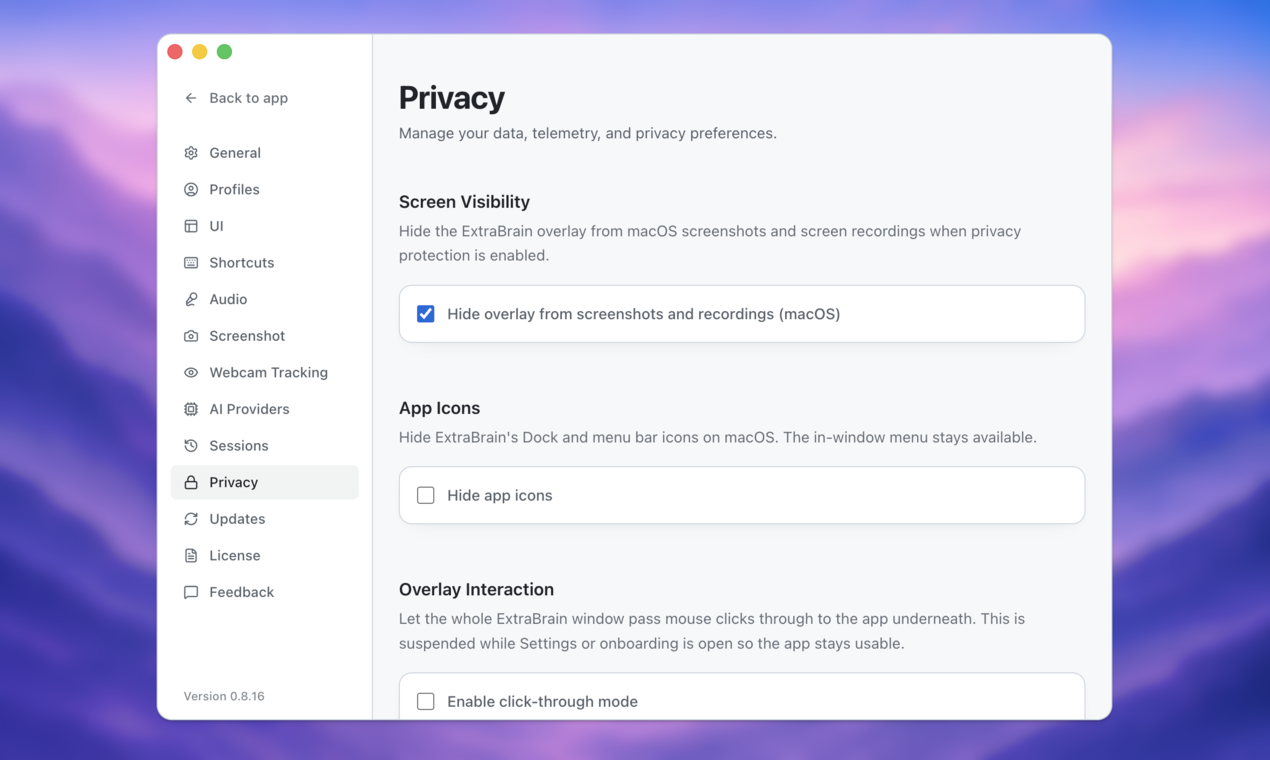
ExtraBrain can be configured with local Parakeet transcription and local Gemma 4 on-device AI where installed and compatible. In that posture, transcription and AI prompts can stay local without external provider requests.
That does not mean every setup is fully local or that every Mac will support every local model path. Local Gemma 4 requires installation and compatible hardware. If you choose Anthropic, OpenAI, Deepgram, a custom OpenAI-compatible endpoint, Claude Subscription, or Codex Subscription, selected prompts, transcript text, screenshots, audio, or context may be sent to those external providers depending on configuration.
The important practical point is control. You can choose a local-first posture when compatible, or choose external providers when you prefer their capabilities.
Screen-aware context helps with technical prompts
Many technical interview moments depend on what is visible on screen. The code editor, problem statement, architecture diagram, stack trace, or test failure can be more important than the last spoken sentence.
ExtraBrain is built around live transcript plus screen-aware context. That makes it useful for coding interviews, system design rounds, behavioral interviews, product interviews, meetings, lectures, and research calls.
For example, during coding practice, you can use it to help organize:
- Clarifying questions before solving.
- Data structure and algorithm tradeoffs.
- Time and space complexity explanations.
- Edge cases visible in the prompt.
- Follow-up optimization paths.
- Post-session review notes.
The core app is free
The core ExtraBrain Mac app is free. ExtraBrain Pro is available at $9.99 per month, $79 per year, or $149 Lifetime launch pricing. External AI and transcription provider usage is billed separately by the providers you choose.
That pricing model makes it easier to test the workflow before deciding whether Pro features or external providers are worth it for your use case.
Cluely vs ExtraBrain for latency-sensitive practice
This is not a lab benchmark. Actual performance depends on your hardware, network, provider choices, model choices, meeting software, and interview platform. Still, the workflow differences are important.
| Factor | Cluely-style browser workflow | ExtraBrain desktop workflow |
|---|---|---|
| Main surface | Browser-based assistant flow | Mac desktop app |
| Latency control | Mostly dependent on remote behavior and browser setup | Can use local-first options where compatible |
| Context | Usually prompt and conversation focused | Transcript plus screen-aware context |
| Provider control | Depends on the product setup | Bring-your-own providers plus local AI options |
| Interview use | General AI assistance | Coding, system design, behavioral, product, meetings, lectures, and research calls |
| Privacy posture | Depends on product configuration | Clear controls with local transcription and local AI options where installed and compatible |
For latency-sensitive interview practice, I care about three things: fewer moving parts, faster usable context, and less distraction. That is where ExtraBrain’s desktop, local-first design feels better aligned with how live interviews actually unfold.
A practical migration plan
Step 1: keep your benchmark prompts
Before switching tools, save a few prompts you used to test Cluely latency. Use the same coding, behavioral, and system design examples in ExtraBrain so you can compare the actual workflow.
Examples:
- “Explain the time complexity of this sliding window solution.”
- “What clarifying questions should I ask before solving this prompt?”
- “Turn this answer into a concise STAR response.”
- “What is the bottleneck in this system design?”
- “What edge case is missing from this implementation?”
Step 2: configure providers deliberately
If you want the most local-first posture, configure local Parakeet transcription and local Gemma 4 where installed and compatible. If you prefer external models, connect the provider you trust and understand what data may be sent.
The best setup is not the same for everyone. A candidate practicing offline coding explanations may choose a different configuration from a team using the app for research calls.
Step 3: practice with responsible-use boundaries
ExtraBrain should be used only where the rules allow it. That includes interview rules, employer rules, school rules, workplace policies, meeting consent expectations, and platform terms.
For interviews, use it to improve preparation, structure your thinking, review transcripts, and practice clearer explanations. If live AI assistance is not allowed in a particular assessment, do not use live AI assistance there.
Step 4: review the session afterward
Latency is most painful live, but learning often happens after the session. Use transcripts and notes to review where your answer slowed down, where you missed an edge case, and which follow-up questions exposed weak spots.
That post-session review is one of the biggest advantages of using an interview copilot as a focused second-brain-style workspace rather than treating it as a one-off answer generator.
FAQ
How do I know whether Cluely latency is my fault or the platform’s?
Start with your own setup. Run a speed test, close heavy apps, disable extensions, refresh the session, and try another browser.
If the same delays continue across a clean setup and stable connection, the bottleneck may be outside your control. Browser developer tools can help you see whether requests are slow or stuck.
What should I do if none of the Cluely fixes work?
Stop optimizing endlessly and test a different workflow with the same prompts. For Mac users, ExtraBrain is worth trying because the core desktop app is free and supports local-first options, live transcription, screen-aware context, and bring-your-own providers.
What browser is best for fixing Cluely latency?
There is no universal answer. Try Chrome, Safari, Firefox, and Edge with extensions disabled, then measure response time with the same prompts.
If one browser is consistently faster, use it. If all browsers remain slow, the issue is probably not just browser choice.
Can ExtraBrain run fully local?
A fully local ExtraBrain posture requires local Parakeet transcription plus local Gemma 4 on-device AI where installed and compatible. In that setup, there are no external provider requests for transcription or AI prompts.
If you configure external providers, selected prompts, transcript text, screenshots, audio, or context may leave the device depending on your settings.
Is ExtraBrain only for coding interviews?
No. ExtraBrain supports coding interviews, system design interviews, behavioral interviews, product interviews, customer calls, lectures, research meetings, and other live sessions where transcription, screen context, and structured review are useful.
Is using an AI interview copilot allowed?
Only sometimes. You are responsible for following interview, employer, school, workplace, meeting, and platform rules. Use AI assistance only where it is allowed, and be especially careful with live interviews, assessments, private meetings, screenshots, and transcripts.