
ExtraBrain Blog
Why Cluely Started Feeling Risky and What I Wanted Instead

Cluely risk can include privacy, reliability, and trust concerns. See how to evaluate safer AI interview tools and when ExtraBrain may fit.
Like many candidates, I first noticed Cluely because it promised a powerful advantage during live interviews. The idea sounded simple: keep an AI helper nearby, reduce interview panic, and get support when a coding prompt, system design question, or behavioral answer becomes hard to organize.
For a while, that sounded useful. Then the trade-offs started to matter more than the pitch.
The more I thought about Cluely risk, the less I saw it as a simple feature comparison. The real question became whether I wanted to trust a live interview tool with sensitive career data, high-pressure timing, and my professional reputation.
That search eventually led me to look for a safer AI interview assistant workflow and to evaluate tools like ExtraBrain, a free, local-first desktop AI interview and meeting copilot for Mac.
Key takeaways
- Cluely risk is not only about whether the product has useful features.
- Privacy, reliability, latency, company trust, and responsible use all matter when an AI tool is involved in interviews.
- Lag or freezing can become a real problem during coding interviews, system design rounds, and recruiter screens.
- Interview tools may handle sensitive information such as resumes, job descriptions, transcripts, screenshots, and private notes.
- A safer AI interview assistant should make data flow, provider choices, and privacy controls easier to understand.
- ExtraBrain is a strong option for Mac users who want live transcription, screen-aware context, local-first options, and bring-your-own AI provider control.
What made Cluely appealing at first
I understand why Cluely became popular. The promise of real-time AI help during interviews is hard to ignore, especially if you are preparing for technical rounds while also applying to jobs, tailoring resumes, and practicing behavioral answers.
A live assistant can feel useful when you are trying to handle several things at once:
- Understanding a coding problem while the interviewer is still explaining it.
- Turning a messy career story into a clear STAR answer.
- Remembering system design tradeoffs under pressure.
- Asking better clarifying questions before jumping into a solution.
- Reviewing what happened after the interview is over.
That general idea is valuable. The problem is that interview support becomes risky when the tool adds new uncertainty instead of reducing it.
The pitch sounded convenient
Cluely was often discussed as a tool that could quietly help during calls, interviews, and live conversations. For candidates, the appeal was obvious. You could use AI to think through answers, reduce blank moments, and feel less alone in a stressful setting.
The convenience was especially tempting for software engineering interviews. Coding interviews, debugging prompts, architecture conversations, and behavioral rounds all require different kinds of thinking. A real-time assistant sounds like it can smooth out the rough edges.
But convenience is not the same thing as trust. A tool can look impressive in a demo and still create problems when the stakes are real.
The first warning signs
The first concerns were practical. If an interview assistant is slow, distracting, or unstable, it can make the conversation worse instead of better.
A delayed suggestion during a live coding prompt can make you pause in a way that feels unnatural. A frozen interface can break your flow. A confusing answer can pull your attention away from the interviewer.
Then the bigger concerns started to stand out. If a tool is built around live interview help, it may process some of the most sensitive career information you have. That can include your resume, target company details, job descriptions, interview notes, transcripts, screenshots, and salary or negotiation context.
At that point, Cluely risk stopped feeling like a small product annoyance. It started looking like a trust problem.
Understanding Cluely risk
When people talk about Cluely risk, they often focus on one headline issue. For me, the concern was broader. It was the combination of reliability, privacy, security, detection anxiety, and uncertainty around how much control I really had.
Privacy and security concerns
Interview tools are not ordinary productivity apps. They can sit close to your professional identity.
A candidate might use an AI interview assistant while preparing for a confidential job search, discussing a current employer, reviewing private compensation goals, or practicing answers about past projects. That context can be sensitive even when it does not look sensitive at first glance.
This is why reported breach discussions and user concerns around Cluely made many candidates stop and think. Even if you do not know every technical detail of a reported incident, the question is still important: what would happen if interview-related data, notes, or account information were exposed?
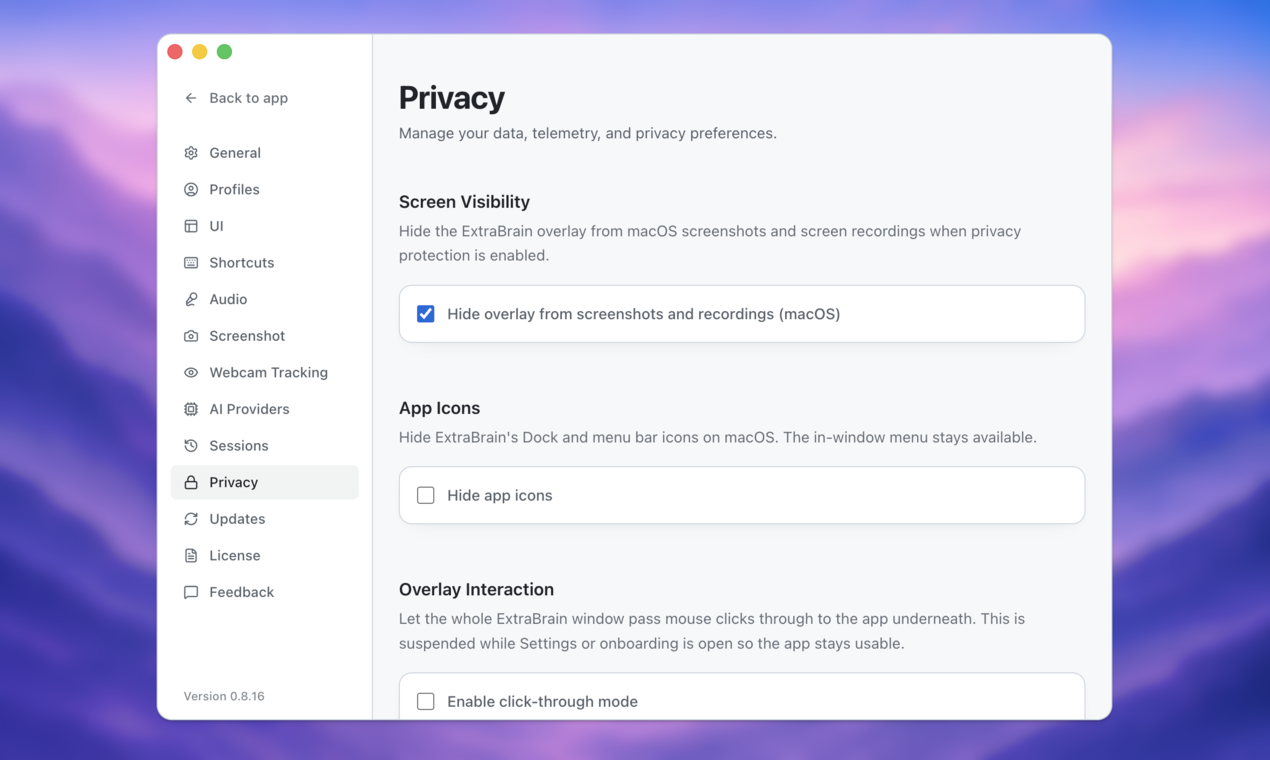
For me, that question changed the evaluation. I no longer wanted to judge an interview assistant only by how clever its suggestions were. I wanted to understand how the tool handled data, what could stay local, what might be sent to external providers, and what controls I had.
Reliability under pressure
Reliability matters more in live interviews than it does in casual AI chat. If a tool gives you a slow answer while you are practicing alone, you can wait. If it happens while an interviewer is watching you think, the delay feels much larger.
Common reliability risks include:
- Suggestions appearing too late to be useful.
- The app freezing during a prompt.
- Audio transcription missing important context.
- Screen context being unavailable when you need it.
- The assistant producing a generic answer instead of helping with the actual question.
A dependable interview copilot should reduce cognitive load. It should not become one more thing you have to manage.
Detection anxiety and responsible use
Another Cluely risk is the anxiety created by tools that market themselves around invisibility. Candidates may start focusing on whether the tool is visible, detectable, allowed, or suspicious instead of focusing on the interview itself.
That mindset is risky. It can distract you from listening, reasoning, and communicating clearly. It can also push people toward using AI in situations where the interviewer, employer, school, or platform rules do not allow it.
ExtraBrain is designed to stay hidden from screen sharing and screen recording on major meeting tools, but that does not remove the user’s responsibility. You should use any AI interview assistant only where interview, employer, school, workplace, meeting, and platform rules allow AI assistance, transcription, screenshots, or notes.
Responsible use is part of product safety. If a tool makes you feel like you have to hide from the rules instead of follow them, that is a signal to pause.
Why the data question matters so much
The biggest shift in my thinking came when I stopped asking, “Can this tool help me answer questions?” I started asking, “What data am I giving this tool, and what happens to it?”
That is the right question for any AI interview assistant.
Interview data is personal data
Interview preparation can include more than simple notes. It can include your work history, failures, strengths, compensation expectations, recruiter conversations, company targets, and private career plans.
For technical candidates, it may also include code, architecture diagrams, debugging examples, and descriptions of internal systems from past roles. Even when you avoid sharing confidential material, the overall context can still reveal a lot about your career.
This is why privacy controls should not be treated as a minor feature. They are central to whether the product is safe enough for the job.
Local-first options reduce unnecessary exposure
ExtraBrain approaches this differently by giving users local-first options. With local Parakeet transcription plus local Gemma 4 on-device AI where installed and compatible, transcription and AI prompts can stay local.
That matters because every external provider request is a data decision. If you choose Anthropic, OpenAI, a custom OpenAI-compatible endpoint, Claude Subscription, Codex Subscription, Deepgram, or another external setup, selected prompts, transcript text, screenshots, audio, or context may leave your device depending on configuration.
The safer pattern is not pretending cloud AI never has value. The safer pattern is making the trade-off clear and giving the user control.
Cluely risk during coding interviews
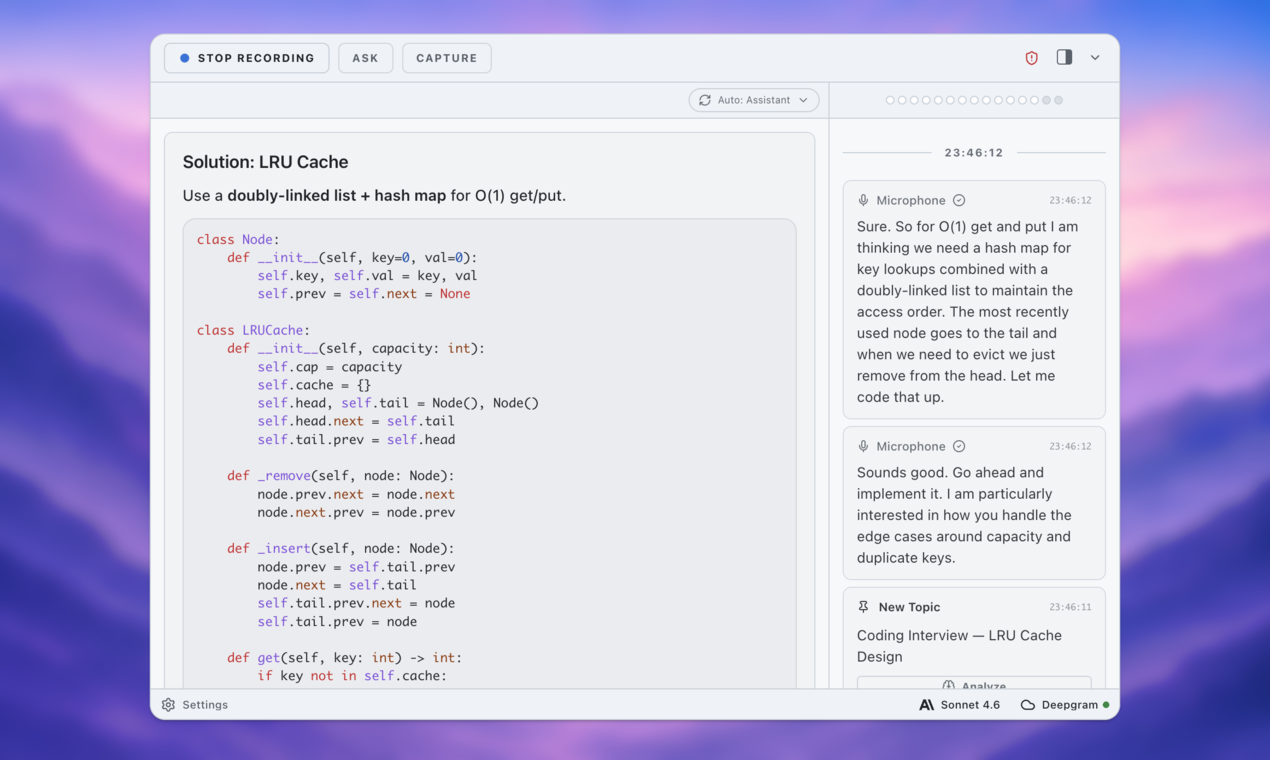
Coding interviews are where reliability issues become especially visible. You are already juggling the prompt, edge cases, complexity, code correctness, and communication. A fragile AI helper can make that harder.
Lag can interrupt reasoning
A coding interview has a rhythm. You listen, clarify, propose an approach, write code, test examples, and explain tradeoffs.
If your assistant responds too late, the suggestion may arrive after the conversation has already moved on. That can create awkward pauses or tempt you to force an answer into the discussion at the wrong time.
A good AI interview copilot should support your reasoning without replacing it. It should help you organize thoughts, identify edge cases, and explain decisions more clearly.
Generic advice is not enough
Many meeting assistants are built for summaries and action items. That can be useful in normal meetings, but interviews require different support.
For a software engineering interview, the assistant should help with:
- Problem restatement.
- Clarifying questions.
- Data structure choices.
- Complexity tradeoffs.
- Edge cases.
- Debugging observations.
- System design assumptions.
- Clear explanation of what you are doing and why.
ExtraBrain is built as a real-time AI interview assistant for Mac with live transcription, screen-aware context, coding and system design support, local-first options, bring-your-own AI providers, and post-interview review. That combination is more useful than a generic chat window when the conversation depends on live context.
Your reputation is part of the risk
The risk is not only technical. It is also reputational.
If an AI tool gives you a strange answer, distracts you, or encourages you to over-rely on generated text, the interviewer may notice a mismatch between your reasoning and your communication. That can hurt trust.
The better approach is to use AI as a support layer for thinking, practice, organization, and review. You should remain responsible for the answer, the explanation, and the decision to use assistance only where allowed.
What I wanted from a safer Cluely alternative
By the time I started looking beyond Cluely, I was not looking for the longest feature list. I wanted fewer doubts.
A safer AI interview assistant needed to meet practical requirements:
- Clear privacy controls.
- Local-first options where possible.
- Live transcription that can support real conversations.
- Screen-aware context for coding, system design, and product discussions.
- Bring-your-own provider control instead of a mysterious black box.
- Stable behavior during high-pressure sessions.
- Useful post-interview review.
- Honest responsible-use framing.
ExtraBrain fits that evaluation for Mac users because the core app is free, available for Apple Silicon and Intel Macs, and designed around live interviews and meetings. Windows and Linux are planned future platforms.
Why ExtraBrain felt like a better direction
ExtraBrain is not positioned as a magic answer machine. It is a desktop AI interview assistant and meeting copilot that helps you follow live context, structure answers, generate clarifying questions, explain tradeoffs, and review sessions afterward.
That distinction matters. The goal is not to outsource your interview. The goal is to reduce chaos so you can think and communicate better.
ExtraBrain can support coding interviews, system design interviews, behavioral interviews, product interviews, customer calls, lectures, and research meetings. It can also work as a focused second-brain-style workspace for live sessions, transcripts, notes, screen context, and review.
Pricing and provider control
A safer tool should be easier to understand financially as well as technically. The core ExtraBrain Mac app is free. ExtraBrain Pro is available at $9.99/month $79/year, or $149 Lifetime launch pricing.
External AI and transcription provider usage is billed separately by the providers users choose. That matters because provider control and billing transparency are part of the trust picture.
How to evaluate any AI interview assistant before trusting it
You do not need to accept every risk just because an AI tool looks impressive. Before using any interview copilot, ask direct questions.
Privacy questions
- What information does the app capture?
- Does it record audio, transcripts, screenshots, or screen context?
- Can transcription run locally?
- Can AI prompts run locally?
- Which external providers can receive data?
- Can you delete session history?
- Are privacy controls visible and understandable?
Reliability questions
- Does the app respond fast enough in a live setting?
- Does it stay stable during long sessions?
- Does it handle coding prompts and screen context well?
- Does it help you think, or does it distract you?
- Can you review the session afterward?
Responsible-use questions
- Does your interview, employer, school, or platform allow AI assistance?
- Does the meeting allow transcription or screenshots?
- Would you feel comfortable explaining how you used the tool?
- Are you using AI to support your own thinking, or to misrepresent your ability?
These questions are not obstacles. They are how you protect your data, your reputation, and your confidence.
Final verdict: is Cluely worth the risk?
For some users, Cluely may still feel acceptable. Every candidate has a different risk tolerance, workflow, and interview context.
For me, the combination of performance concerns, privacy questions, reported breach discussions, detection anxiety, and trust uncertainty made it hard to keep using Cluely as my main interview tool.
I wanted an AI interview assistant that felt more transparent, more controllable, and better aligned with responsible use. That is why ExtraBrain became the more compelling direction.
ExtraBrain does not remove your responsibility as a candidate. It does give Mac users a local-first desktop workflow with live transcription, screen-aware context, local AI options where installed and compatible, bring-your-own providers, and clear privacy controls.
That is the kind of foundation I would rather trust during high-stakes interviews.
FAQ
What is the main Cluely risk?
The main Cluely risk is not one single issue. It is the combination of privacy, reliability, detection anxiety, and trust concerns that can matter when an AI tool is used around sensitive interview data.
Is Cluely safe for interview preparation?
That depends on your risk tolerance and how you use it. Before trusting any interview assistant, review what data it captures, where that data goes, how reliable it is during live calls, and whether your interview rules allow AI assistance.
Why does privacy matter so much for AI interview tools?
Interview tools may process resumes, job descriptions, transcripts, screenshots, salary notes, and private career plans. If that information is exposed or sent somewhere you did not expect, the impact can feel much more personal than with an ordinary app.
What makes ExtraBrain a safer Cluely alternative for Mac users?
ExtraBrain offers a free Mac desktop app with live transcription, screen-aware context, local-first options, bring-your-own AI providers, and privacy controls. With local Parakeet transcription plus local Gemma 4 where installed and compatible, transcription and AI prompts can stay local.
Can ExtraBrain run fully local?
A fully local ExtraBrain posture requires local Parakeet transcription plus local Gemma 4 on-device AI where installed and compatible, with no external provider requests. External providers may receive selected prompts, transcript text, screenshots, audio, or context depending on configuration.
Can ExtraBrain help with coding interviews?
Yes. ExtraBrain can help candidates follow live coding interview context, organize approaches, generate clarifying questions, explain technical tradeoffs, and review the session afterward. Candidates remain responsible for honest and allowed use.