
ExtraBrain Blog
How to Build a Personal Interview Knowledge Base Before Your Next Job Search

Build a private interview knowledge base before applying so you can remember real stories, wins, metrics, decisions, and lessons.
Most people start interview prep too late.
They update a resume after seeing an interesting role. They skim a job description, open a blank document, and try to remember five years of work in one sitting. Then the pressure arrives: “Tell me about a time you influenced without authority.” “What is your biggest technical win?” “Describe a project that failed.”
The problem is not that they have no stories. The problem is that the stories are scattered everywhere: old project docs, meeting notes, performance reviews, launch retros, customer calls, Slack threads, manager feedback, and half-remembered moments from stressful weeks.
A better approach is to build a personal interview knowledge base before you need it: a private, searchable archive of stories, wins, metrics, decisions, tradeoffs, failures, lessons, and raw notes you can turn into strong interview answers later. Think of it as a focused AI second brain for career context. That is where ExtraBrain is most useful: organizing and recalling real experience, not manufacturing a more impressive version of you.
The best interview prep starts before the job search
The worst time to remember your career is after a recruiter asks for availability tomorrow.
By then, your brain is already optimizing for performance. You want the clean answer, the confident framing, the version that makes sense to someone who has never seen the messy middle of your work. That pressure can make even strong candidates reach for generic language.
“I collaborated cross-functionally.”
“I improved operational efficiency.”
“I took ownership in an ambiguous environment.”
Those phrases may be true, but they are not evidence. Interviewers need the story underneath: what was broken, what you noticed, what you decided, who disagreed, what changed, and what you learned.
A personal interview knowledge base gives you that evidence before you are under pressure. It lets you collect raw material while it is still fresh, then shape it later for the role, company, and interview stage.
Think of it as a career memory system. The goal is to make your real examples easy to find.
What belongs in an interview knowledge base
A useful interview knowledge base is not just a list of accomplishments. Interviews test judgment, communication, resilience, collaboration, technical depth, and self-awareness. Your archive should capture the evidence behind those qualities. Start with six categories.
1. Stories. These are moments with a beginning, middle, and end. A difficult stakeholder conversation. A launch that almost slipped. A production incident. A mentoring moment. A customer problem that changed the roadmap. A conflict you handled carefully.
2. Wins. These are outcomes you are proud of. Revenue influenced, costs reduced, cycle time improved, onboarding shortened, reliability increased, support volume lowered, quality improved, or team rituals that started working better.
3. Metrics. These are numbers that make your contribution concrete. Percent improvements, time saved, adoption rates, latency changes, conversion shifts, defect reductions, retention improvements, hiring throughput, budget impact, or before-and-after baselines.
4. Projects. These are the larger containers around your work. For each project, save the goal, your role, constraints, collaborators, timeline, tradeoffs, risks, outcome, and what you would do differently now.
5. Decisions. Interviews often reveal seniority through decision-making. Capture moments when you chose one path over another: build versus buy, speed versus quality, short-term workaround versus long-term fix, customer request versus product strategy, migration now versus later.
6. Lessons. These are the insights that survived the project. What did you learn about communication, architecture, prioritization, leadership, estimation, user research, data quality, or your own working style?
Interview questions rarely match how memories are stored. You may remember “the billing migration,” but the interviewer asks about “influencing without authority.” Tags bridge that gap.
Capture the messy version first
The first draft of a good interview story should sound like a note to yourself. Messy is useful because it preserves details you may edit out later: the constraint nobody understood, the metric that moved, the meeting where the decision changed, the reason the original plan failed.
Try this capture format after any meaningful project or work moment:
- What happened?
- Why did it matter?
- What was my role?
- What made it hard?
- What decision did I make?
- Who else was involved?
- What changed because of the work?
- What number, date, or artifact proves the change?
- What did I learn?
- What should I not reveal in an interview because it is confidential?
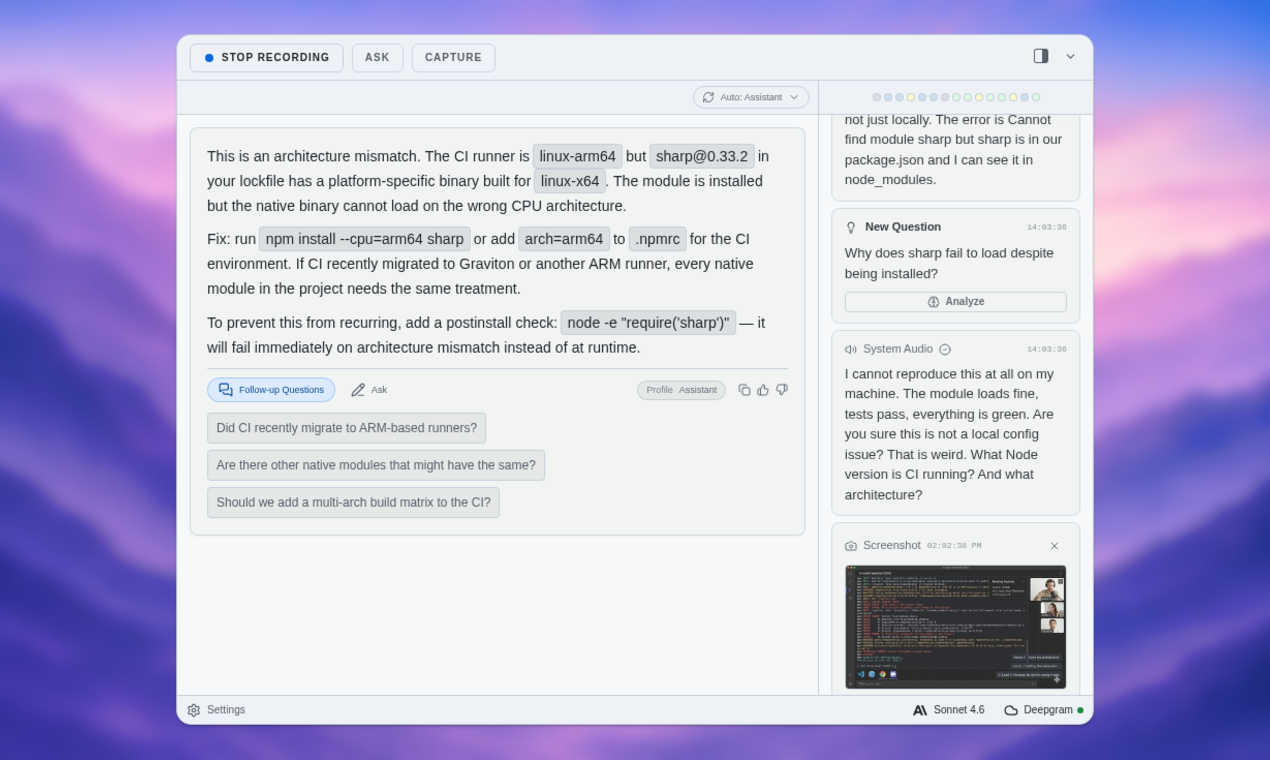
That last question is important. A strong knowledge base should include enough private detail to help you remember the truth, while also helping you redact names, customers, internal tools, and sensitive business context before anything becomes an interview answer. This is where a private AI interview copilot is more useful than a generic blank chatbot: preserve the facts, identify the lesson, and remove what should stay private.
Turn scattered career data into searchable memory
Your best interview examples probably already exist somewhere: a performance review, a project retro, a customer call, your calendar, meeting notes, transcript snippets, status updates, and old resume bullets. The job is to bring those fragments into one controlled place.
A practical weekly workflow looks like this:
- Add one project note from the week.
- Add one decision you made and why.
- Add one metric or observable outcome.
- Add one difficult moment, even if it did not resolve cleanly.
- Add one lesson you would want your future self to remember.
This takes ten minutes when done regularly. It takes days when done after years of neglect.
After a few months, you are no longer starting from a blank page. You are searching your own archive: “Which examples show leadership?” “Where did I improve a metric?” “What stories involve ambiguity?” AI becomes a retrieval layer over your real work, not a machine for inventing impressive answers.
Build story cards, not scripts
A script is brittle. A story card is flexible. If you understand the story, you can make it shorter for a recruiter screen, deeper for a hiring manager, more technical for an engineering round, or more reflective for a leadership interview.
For each strong example in your knowledge base, create a story card with these fields:
- Title: A short name you will remember.
- Theme: Leadership, conflict, ambiguity, technical depth, failure, influence, customer empathy, execution, or learning.
- Situation: The context in two or three sentences.
- Stakes: Why it mattered.
- Action: What you personally did.
- Tradeoff: What made the decision non-obvious.
- Result: What changed, preferably with evidence.
- Lesson: What you know now because of it.
- Privacy notes: Names, numbers, or details to redact.
- Follow-up risk: The question an interviewer might ask next.
This format keeps you honest. If you cannot fill in “Action,” the story may be too team-level. If you cannot fill in “Result,” you may need a metric or a different example. A good AI interview preparation workspace should help you see those gaps before the interview does.
Use AI to ask better questions of your own experience
The most powerful prompts do not ask AI to answer for you. They help you interrogate your own experience.
Try prompts like:
- “Which notes show a time I changed someone’s mind?”
- “Find examples where the hard part was communication, not execution.”
- “Which project has the clearest measurable outcome?”
- “What story could answer both a leadership question and a conflict question?”
- “Where am I overclaiming compared with the evidence in my notes?”
- “What sensitive details should I redact before discussing this example?”
- “What follow-up questions would a skeptical interviewer ask?”
These prompts keep responsibility with you. AI can surface patterns, compress notes, suggest framing, and notice missing evidence. You still decide what is true and appropriate to share.
Responsible AI career prep should make you clearer, not less accountable.
Prepare for different roles without rewriting your identity
The same experience can be framed differently depending on the job. A platform engineering role may care about reliability and architecture. A product role may care about customer insight and prioritization. A manager role may care about coaching, alignment, and decision quality.
With a knowledge base, you can map real evidence to the role instead of rewriting yourself for every job description. For a startup, pull stories about ambiguity and speed. For an enterprise role, pull stories about stakeholder alignment and scale. The facts stay stable. The emphasis changes.
That is the difference between tailoring and pretending. Tailoring says, “Here is the part of my real experience most relevant to your problem.” Pretending says, “Here is the persona I think you want.”
Privacy is part of the system
Interview preparation is full of sensitive material: compensation goals, reasons for leaving, confidential project details, customer examples, manager feedback, rejected answers, and private reflections about what you want next. The more useful the knowledge base becomes, the more carefully it should be handled.
That is why the home for this material matters. A local-first AI meeting copilot is valuable because work conversations create raw context you may want to learn from without scattering it across random tools.
Use a few rules:
- Keep raw notes in a workspace you trust.
- Redact names and confidential details before creating shareable answers.
- Save lessons and story cards longer than raw transcripts.
- Delete or archive material intentionally.
- Do not paste your entire career history into tools with unclear retention policies.
- Treat interview prep notes as career data, not disposable text.
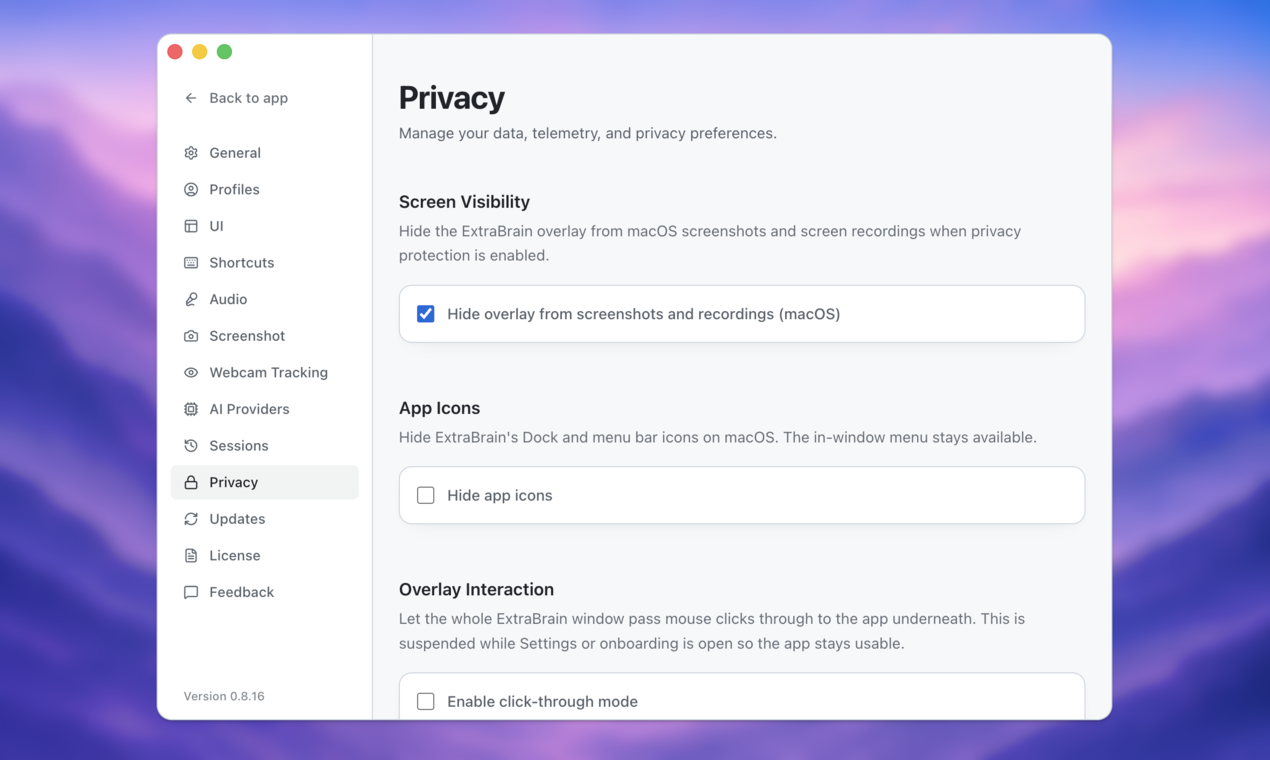
Privacy makes honest preparation possible. If you trust the workspace, you can capture the messy truth first and refine it safely later.
The interview payoff is calm specificity
The benefit of a personal interview knowledge base is not that you sound rehearsed. It is that you sound specific without panicking.
When someone asks about conflict, you do not search your entire memory under pressure. You remember the story card about the launch disagreement. When someone asks about impact, you have the before-and-after metric. When someone asks what you learned, you have the lesson you wrote down two months ago, before you needed to make it sound impressive.
That calm specificity is hard to fake. It comes from preparation rooted in evidence.
It also makes interviews more human. Instead of delivering a generic performance, you can have a real conversation about real work and answer follow-ups because you understand the context.
Start with one project today
You do not need to catalog your whole career this weekend. Start with one project. Choose something recent enough to remember and meaningful enough to discuss. Write the messy version. Add the metric. Capture the decision. Note the lesson. Mark anything confidential. Then turn it into one story card. Do the same next week.
Over time, you will build something more useful than a resume draft or a folder of canned answers: a private memory of your work that helps you prepare with integrity.
Try ExtraBrain if you want a private workspace for capturing work stories, organizing lessons, and turning real experience into clearer interview preparation. The best answers are recovered from work you already did.